青岛银行

Search documents
可转债发行预案激增,供需矛盾缓解!
Zheng Quan Shi Bao· 2025-10-20 04:20
Core Viewpoint - The issuance of convertible bonds in the A-share market has significantly increased since August, with 32 companies announcing or updating their issuance plans, indicating a potential easing of supply-demand imbalances in the market [1][2]. Group 1: Issuance Trends - Since August, 32 listed companies have announced or updated their convertible bond issuance plans, with a total planned issuance of 377.36 billion yuan [2][3]. - Notable issuances include TBEA Co., Ltd. planning to raise up to 8 billion yuan and Qingdao Bank planning to raise up to 4.8 billion yuan [2]. - The majority of the recent issuances are from companies listed on the Sci-Tech Innovation Board and the Growth Enterprise Market, which now account for 62.5% of the total [3]. Group 2: Market Structure Issues - Despite the increase in issuance, structural issues remain, particularly the scarcity of large-cap convertible bonds as bank convertible bonds have exited the market [4][5]. - The total market size of convertible bonds has decreased from 733.73 billion yuan at the end of 2024 to 593.15 billion yuan as of October 16, 2023, a reduction of over 140 billion yuan [4]. Group 3: Market Resilience - The convertible bond market has shown strong resilience amid recent fluctuations in the A-share market, with a significant reduction in supply leading to a demand for fund reallocation [6]. - The current median price of convertible bonds is around 130 yuan, indicating a historically high valuation level [7].

可转债发行预案激增,供需矛盾缓解!
证券时报· 2025-10-20 04:15
在A股市场整体攀升走强的背景下,今年8月以来的可转债发行预案明显增多。 Wind数据显示,以预案公告日为统计口径,今年8月以来,已有32家上市公司公布或更新了可转债发行预案,其中,8月份有20家公司,9月份有10家,10月 份以来也有2家。值得一提的是,自8月以来,已有22家上市公司可转债发行预案获得股东大会通过,较今年上半年明显增多。 业内人士指出,随着8月以来发行预案密集落地,市场"僧多粥少"的供需矛盾有望缓解,但银行转债缺位、大盘品种稀缺等问题仍待破解。 发行预案激增 市场分析人士指出,随着科技创新型企业的快速发展,其对灵活融资工具的需求不断增加。可转债作为一种兼具股性和债性的融资工具,能够满足这些企业 的融资需求。 在上述32家上市公司中,已有22家上市公司可转债发行预案获得股东大会通过,特变电工等上市公司的发行预案迅速获得了交易所受理。 从流程看,可转债发行需经历董事会预案、股东大会批准、交易所受理、上市委通过、同意注册等环节。2025年监管审核节奏明显加快,新券从预案到股东 大会的平均周期明显缩短。规模高达80亿元的特变电工可转债预案,从9月4日获股东大会审议通过,到9月26日获交易所受理,用时不 ...


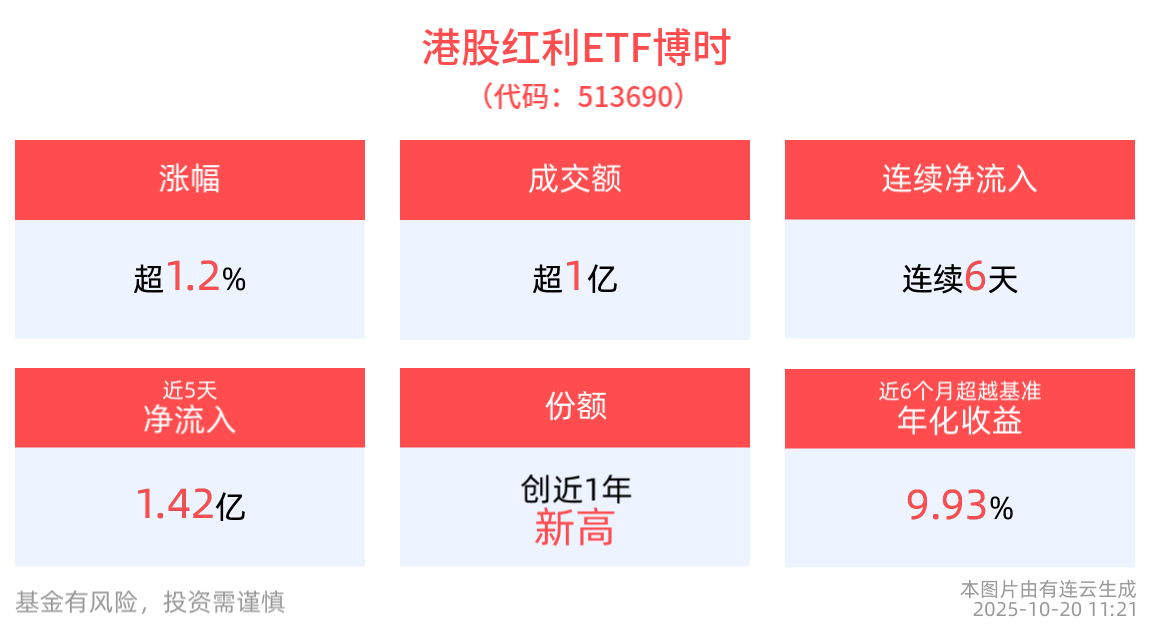
性价比与确定性凸显,红利资产获资金青睐,港股红利ETF博时(513690)涨超1%,连续6日获资金净流入
Xin Lang Cai Jing· 2025-10-20 03:41
Core Insights - The Hang Seng High Dividend Yield Index has increased by 0.97% as of October 20, 2025, with notable gains in stocks such as China Petroleum (up 3.96%) and Xinyi Glass (up 2.86%) [3] - The BoShi Hang Seng High Dividend ETF has seen a price increase of 1.29%, reaching 1.1 yuan, and has accumulated a 0.65% rise over the past week [3] - The A-share market has shown significant structural differentiation, with low valuation high dividend sectors gaining traction amid a volatile environment [3] Market Trends - High dividend blue-chip stocks, particularly in the banking sector, have performed well, with the banking index rising for seven consecutive days [4] - Agricultural Bank has notably achieved 11 consecutive days of positive daily closes, reaching a historical high [4] - Analysts suggest that after a tech growth phase, dividend assets may become more attractive as they have returned to relatively low levels [4] Investment Strategies - The banking sector's dividend yield has improved post-correction, making it a compelling option for medium to long-term investment [4] - The "dumbbell strategy" combining high dividend assets with high valuation tech growth stocks is expected to remain effective in the fourth quarter [4] - The BoShi Hang Seng High Dividend ETF has seen a significant inflow of funds, totaling 163 million yuan over six days, with a peak single-day inflow of 49.21 million yuan [4][5] Fund Performance - The BoShi Hang Seng High Dividend ETF closely tracks the Hang Seng High Dividend Yield Index, which reflects the performance of high dividend securities available through the Hong Kong Stock Connect [5] - As of October 8, 2025, the top ten weighted stocks in the index accounted for 28.98% of the total index weight [5] - The latest fund size of the BoShi Hang Seng High Dividend ETF is 5.536 billion yuan, with a record high of 5.119 billion shares [4][5]
中信证券:银行基本面稳定 绝对收益有望延续
智通财经网· 2025-10-20 00:19
Core Viewpoint - The macro-prudential management expansion and the enhancement of financial stability tools are expected to lead banks into a new phase of risk management, which will strengthen their balance sheets and accelerate the realization of net asset revaluation expectations [1][2]. Summary by Sections Macro-Prudential Management - The interview with the head of the Financial Stability Bureau of the People's Bank of China emphasizes the need to balance growth and risk prevention, expanding the macro-prudential management framework and enhancing the financial stability toolbox [2]. - Future regulations will likely deepen oversight of non-traditional banking activities, including wealth management and asset management subsidiaries [2]. Banking Sector Performance - The banking sector is expected to maintain a stable performance in Q3, with positive trends in interest margins and stable non-performing loan generation, although investment income may see a quarter-on-quarter decline [1][4]. - The KBW bank index experienced a significant drop due to concerns over credit risks in U.S. regional banks, leading to a market capitalization loss of over $100 billion for 74 major banks in a single day [3]. Stock Market Trends - Last week, both A-shares and H-shares in the banking sector outperformed the broader market, with notable gains in individual bank stocks, particularly Chongqing Bank and Agricultural Bank [4]. - The increase in mid-term dividends from banks, now reaching 17 institutions, contributes to the relative and absolute returns of bank stocks amid rising market uncertainties [4]. Investment Strategy - The banking sector is seen as offering significant value, with a shift towards alpha strategies in stock selection, focusing on companies with high and stable ROE and optimistic valuation space [1][4].

新主线确立?农业银行逆市新高!百亿银行ETF(512800)顽强7连阳,近7日大举吸金逾48亿元
Xin Lang Ji Jin· 2025-10-19 12:06
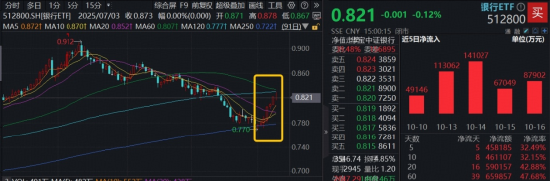
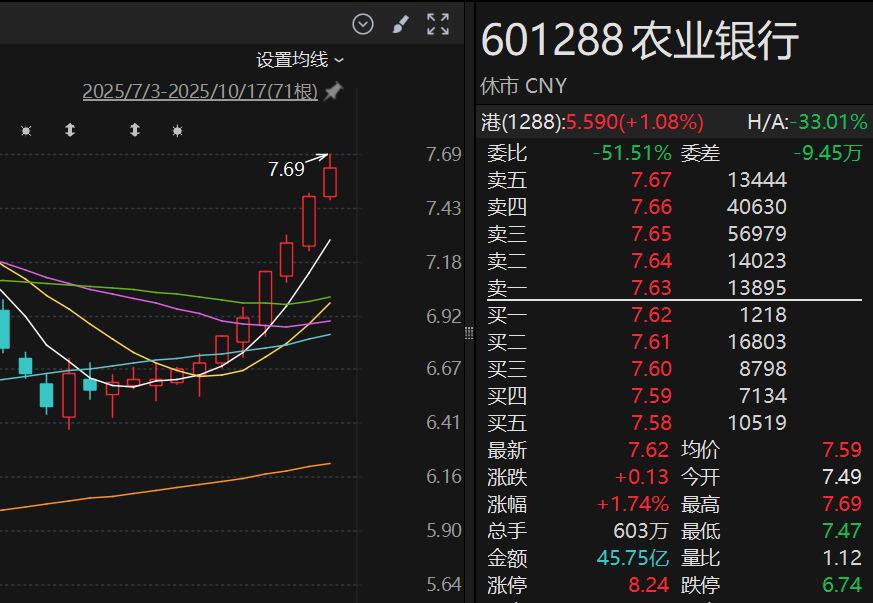
Core Viewpoint - The banking sector demonstrates resilience amid a declining market, with several banks, including Agricultural Bank of China, reaching historical highs, indicating strong investor interest in bank stocks as a safe haven [1][7]. Group 1: Market Performance - Agricultural Bank of China saw an intraday increase of over 2%, closing up 1.74%, while other banks like Xiamen Bank and Qingdao Bank also rose by more than 2% [1]. - The Bank ETF (512800) experienced a brief intraday surge of nearly 1% before closing down 0.12%, maintaining a seven-day upward trend with a total trading volume of 2.922 billion yuan [1][3]. - The Bank ETF has attracted significant capital inflow, with a net inflow of 4.854 billion yuan over the past seven days, bringing its total size close to 20 billion yuan, setting a new historical high [5]. Group 2: Investment Drivers - The banking sector is benefiting from multiple catalysts, including heightened market risk aversion, leading investors to seek stable, high-dividend bank stocks [7]. - Continued government policies aimed at economic stability are fostering expectations of recovery, which directly benefits the banking sector due to its close ties to economic cycles [7]. - Historical trends suggest that the fourth quarter is typically a favorable period for undervalued, high-dividend large-cap stocks, potentially enhancing the appeal of bank stocks [8]. Group 3: Future Outlook - Analysts believe that the banking sector will become a key focus in the current market phase, with defensive asset allocation driving demand for bank stocks [8]. - The stability of bank dividends and the recent price corrections have improved the attractiveness of bank stocks, likely drawing in risk-averse capital [8]. - The Bank ETF (512800) and its associated funds are effective tools for tracking the overall performance of the banking sector, comprising 42 listed banks in A-shares [8].

A股市场震荡调整,银行股成资金避风港
Huan Qiu Wang· 2025-10-18 03:48
Market Overview - The A-share market is experiencing a volatile adjustment, with major indices retreating due to external market fluctuations. The Shanghai Composite Index failed to break through 3900 points, while the Shenzhen Component Index fell below 13000 points, and the ChiNext Index dropped below 3000 points, marking a new low for the past month [1] - Market trading activity has decreased, with total market turnover ending a streak of 40 consecutive trading days above 2 trillion yuan [1] Sector Performance - In the context of overall market pressure, the banking sector has emerged as a "safe haven" for funds, attracting a net inflow of 12.3 billion yuan, leading all industries [1] - Other sectors such as transportation, steel, and pharmaceuticals also received capital inflows, while sectors like electronics, telecommunications, and computers saw significant capital outflows, each exceeding 7.5 billion yuan [1] Banking Sector Insights - The banking sector has shown resilience, with the sector index rising for seven consecutive days, approaching historical highs. Agricultural Bank of China has recorded an unprecedented "eleven consecutive days of gains," setting a new historical price record [2] - The median dividend yield for the banking sector reached 4.01%, with some banks like Zhangjiagang Bank and Changsha Bank exceeding 6%. Even with rising stock prices, Agricultural Bank maintains a dividend yield of 3.27%, significantly higher than typical wealth management product returns [3] - Valuation metrics indicate that the banking sector's dynamic price-to-earnings ratio is generally below 10 times, with a median price-to-book ratio of only 0.61, reflecting a high margin of safety [3] Market Outlook - Analysts suggest that the current market is in a structural adjustment phase, with funds shifting from high-valuation sectors to undervalued, high-dividend assets. If market volume does not recover effectively, indices may continue to exhibit a range-bound oscillation pattern [3] - The "14th Five-Year Plan" is expected to serve as a significant guiding principle for future market trends, with areas such as digital technology, space economy, and healthcare being highlighted for long-term investment opportunities [3]
资金情绪持续谨慎 市场出现风格切换迹象
Zhong Guo Zheng Quan Bao· 2025-10-17 22:27
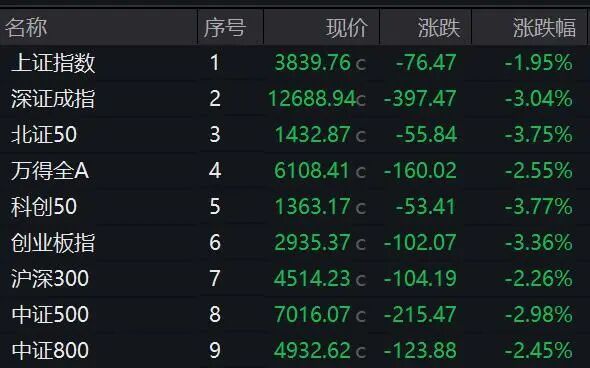
Market Overview - On October 17, the A-share market experienced a broad decline, with major indices such as the Shanghai Composite Index, Shenzhen Component Index, and ChiNext Index falling by 1.95%, 3.04%, and 3.36% respectively [2] - The total market capitalization of A-shares decreased by 2.56 trillion yuan, bringing the total market value to 113.02 trillion yuan [8] - The trading volume was 1.95 trillion yuan, marking the second consecutive day below 2 trillion yuan [2] Sector Performance - The majority of sectors declined, with the power equipment, electronics, and machinery sectors leading the losses, down by 4.99%, 4.17%, and 3.69% respectively [3] - Defensive sectors such as banking, coal, and public utilities showed resilience, with only minor declines [3] - Notably, the banking sector saw gains, with Xiamen Bank and Qingdao Bank rising over 2% [3] Fund Flow and Investor Sentiment - Main funds experienced a net outflow for five consecutive trading days, with a total outflow of over 790 billion yuan on October 17 alone [6] - The cautious sentiment among investors is reflected in the low trading volumes and the shift of funds towards lower valuation and higher dividend yield defensive sectors [4][6] - The number of stocks with net inflows was 1,495, while 3,658 stocks saw net outflows on October 17 [6] Market Drivers and Outlook - Analysts attribute the market adjustment to a combination of external shocks, internal concerns, and technical factors [4] - Despite the short-term volatility, the core drivers of the market remain unchanged, with expectations of continued favorable liquidity [8] - The upcoming disclosure of Q3 earnings reports is anticipated to influence market sentiment, particularly regarding the performance of high-valuation technology growth stocks [4][9]
资金情绪持续谨慎市场出现风格切换迹象
Zhong Guo Zheng Quan Bao· 2025-10-17 20:19
Market Overview - On October 17, the A-share market experienced a broad decline, with major indices such as the Shanghai Composite Index, Shenzhen Component Index, and ChiNext Index falling by 1.95%, 3.04%, and 3.36% respectively [2][4] - The total market turnover was 1.95 trillion yuan, marking a slight increase of 57 billion yuan from the previous trading day, but it has been below 2 trillion yuan for two consecutive days [2][4] - A total of 602 stocks rose, while 4,783 stocks fell, indicating a significant market downturn [2] Sector Performance - The sectors leading the decline included power equipment, electronics, and machinery, with respective drops of 4.99%, 4.17%, and 3.69% [3][5] - Defensive sectors such as banking, coal, and public utilities showed relative strength, with the banking sector seeing stocks like Xiamen Bank and Qingdao Bank rising over 2% [3][5] - The technology growth sector faced significant selling pressure, with notable declines in electronic, media, and automotive industries, which fell by 7.14%, 6.27%, and 5.99% respectively [5] Capital Flow - The market has shown signs of style rotation, with dividend-paying sectors gaining strength while technology growth stocks have been under pressure [5][8] - Main capital outflows were observed, with over 790 billion yuan leaving the market on October 17 alone, and a total of 5 consecutive days of net outflows [5][7] - The A-share market's total market capitalization decreased by 2.56 trillion yuan to 113.02 trillion yuan as of October 17 [7] Market Sentiment and Future Outlook - Analysts attribute the market's adjustment to a combination of external shocks, internal concerns, and technical factors, with global market conditions, particularly in the U.S., impacting investor sentiment [4][8] - Despite short-term volatility, the core drivers of the market remain unchanged, with expectations of continued favorable liquidity trends [8] - The upcoming disclosure of Q3 earnings reports is anticipated to create opportunities for valuation adjustments and structural rebalancing in the market [8]



阶段新主线?银行接连走强,百亿银行ETF(512800)逆市7连阳,逾48亿元资金密集涌入
Xin Lang Ji Jin· 2025-10-17 12:00
Core Viewpoint - The banking sector demonstrates resilience amid a declining market, with several banks, including Agricultural Bank, Xiamen Bank, and Qingdao Bank, showing significant gains, indicating a potential investment opportunity in this sector [1][7]. Group 1: Market Performance - Agricultural Bank's stock rose over 2% during trading, reaching a historical high, and closed up 1.74% [1]. - The Bank ETF (512800) experienced a brief price surge of nearly 1% before closing slightly down by 0.12%, marking a seven-day consecutive increase in daily performance [1][3]. - The Bank ETF attracted a net inflow of 4.854 billion yuan over the past seven days, nearing a total size of 20 billion yuan, setting a new historical high [5]. Group 2: Investment Drivers - The banking sector is benefiting from multiple catalysts, including increased market risk aversion, leading investors to seek stable, high-dividend bank stocks [7]. - Ongoing policies aimed at economic stability are fostering expectations for recovery, which directly benefits the banking sector due to its close ties to economic cycles [7]. - Historical trends suggest that the fourth quarter is typically a favorable period for undervalued, high-dividend large-cap stocks, which may explain the current upward movement in bank stocks [7]. Group 3: Future Outlook - Analysts believe that the banking sector will become a key focus in the upcoming market phase, with defensive asset allocation driving demand for bank stocks [8]. - The stability of bank dividends and the recent price corrections have improved the attractiveness of bank stocks for risk-averse investors [8]. - The Bank ETF (512800) and its associated funds are efficient investment tools for tracking the overall banking sector, comprising 42 listed banks in A-shares [8].



A股这一板块,逆势加仓
Zheng Quan Shi Bao· 2025-10-17 08:58
Market Overview - The financing net purchase in A-shares exceeded 14.4 billion yuan for the week, with the financing balance reaching a historical high of 2.44 trillion yuan [1][3] - The A-share market experienced adjustments due to external market volatility, with the Shanghai Composite Index failing to break through 3,900 points and the Shenzhen Component Index falling below 13,000 points [1][3] Index Performance - The Shanghai Composite Index closed at 3,839.76, down 76.47 points or 1.95% [2] - The Shenzhen Component Index closed at 12,688.94, down 397.47 points or 3.04% [2] - The ChiNext Index fell to 2,935.37, down 102.07 points or 3.36% [2] - The Hong Kong Hang Seng Index dropped 2.48% for the week, with a cumulative decline of 3.97% [2] Sector Analysis - The non-ferrous metals sector saw a net purchase of over 7.6 billion yuan, while the power equipment sector received over 2.7 billion yuan in net purchases [3] - The banking sector experienced a net outflow of over 1.3 billion yuan, while the food and beverage, home appliances, electronics, and automotive sectors also faced net outflows exceeding 1 billion yuan [3] - The banking sector was the only one to see a net inflow exceeding 12.3 billion yuan, with transportation and steel sectors also receiving significant inflows [3] Investment Trends - The banking sector's dividend yield median is 4.01%, with several banks exceeding 6% [6] - All bank stocks have a dynamic price-to-earnings ratio below 10, indicating a favorable long-term investment opportunity [6] - The coal sector has shown strength due to the onset of the heating season, with coal stocks experiencing significant price increases [4][8] Future Outlook - The "14th Five-Year Plan" is expected to drive sector rotation in the A-share market, with a focus on digital technology, space economy, and healthcare [3] - The coal industry is projected to maintain a balanced supply and demand, with potential price improvements expected due to seasonal demand [8]