
电投能源

Search documents
电投VS神火深度对比之电解铝行业投资机会
2025-09-26 02:29
Summary of Key Points from the Conference Call on the Electrolytic Aluminum Industry Industry Overview - The electrolytic aluminum industry is significantly influenced by supply-side reforms that have capped production capacity, stabilizing market supply and demand relationships [1][3] - China holds approximately 60% of the global electrolytic aluminum production capacity, establishing its strategic importance in the industry [2] Core Insights and Arguments - **Supply-Side Reforms**: Initiated in 2017, these reforms have effectively regulated production capacity, ensuring alignment with actual demand and eliminating excessive production [3] - **Energy Cost Advantage**: China's low coal and electricity costs provide a competitive edge, making it the largest producer of electrolytic aluminum globally [4] - **Short-Term Demand**: Anticipated demand increase during traditional peak seasons (September and October) is expected to drive inventory reduction and price increases [5] - **Long-Term Supply-Demand Dynamics**: A slowdown in domestic supply growth, coupled with increasing demand, is projected to exacerbate supply-demand imbalances, supporting price increases [5] - **Recycling and Overseas Expansion**: Both are critical for addressing future supply issues, but require higher prices to ensure profitability [6] Additional Important Content - **Domestic Capacity Growth**: Current electrolytic aluminum capacity is 44 million tons, with limited room for growth due to regulatory caps. Future increments are expected to be modest, around 1% to 1.5% annually [8] - **Global Supply Challenges**: New overseas production faces high initial investment costs and slow construction progress, limiting its impact on global supply-demand dynamics [10][11] - **Profitability Outlook**: Current profitability levels for companies are sustainable, supported by stable cost structures and a tightening supply-demand balance [12][14] - **Demand Performance**: Recent demand has exceeded expectations across various sectors, including photovoltaics and automotive, indicating a positive trend for the industry [15] - **Investment Sentiment**: The investment perspective has shifted towards a focus on sustained high profitability and dividend yields, with companies like China Hongqiao emphasizing dividend distribution [17][18] This summary encapsulates the critical aspects of the electrolytic aluminum industry as discussed in the conference call, highlighting both current conditions and future outlooks.
朝闻国盛:以史为鉴:末位“黑金”或觉醒
GOLDEN SUN SECURITIES· 2025-09-23 23:59
Core Insights - The report emphasizes the potential awakening of the coal sector, suggesting that after a challenging period, coal prices are expected to rise towards the end of the year, providing upward momentum for the sector [2]. Industry Performance - As of September 19, 2025, the coal industry has seen a decline of 2.3% year-to-date, ranking last among 30 industries. However, in the week of September 19, it experienced a weekly increase of 3.6%, ranking second among the industries, indicating a significant contrast in performance [2]. - The report predicts that the coal price will stabilize and potentially reach a peak by the end of the year, which could drive further positive performance in the coal sector [2]. Company Focus - The report highlights several companies to watch within the coal sector: - **Keda Control**: Noted for its focus on smart mining [2]. - **China Coal Energy (H+A)** and **China Shenhua (H+A)**: Major state-owned enterprises in the coal industry [2]. - **China Qinfa**: Recommended for its turnaround potential [2]. - **Shanxi Coal and Electricity, Huainan Mining, and Xinji Energy**: Identified as strong performers [2]. - **Yankuang Energy, Jinkong Coal, and Pingmei Shenma**: Noted for their elasticity and potential for growth [2]. - **Huayang Co. and Gansu Energy**: Suggested as companies with future growth potential [2]. - **Anyuan Coal Industry**: Highlighted for its recent changes in control and ongoing asset restructuring [2].


电投能源涨2.06%,成交额2090.51万元,主力资金净流入68.57万元
Xin Lang Cai Jing· 2025-09-23 01:58
Core Viewpoint - The stock of Electric Power Investment Energy has shown a year-to-date increase of 21.14%, with recent fluctuations indicating a slight decline in the short term, while the company continues to maintain a significant market presence in the coal and energy sectors [2]. Company Overview - Electric Power Investment Energy, established on December 18, 2001, and listed on April 18, 2007, is located in Tongliao City, Inner Mongolia. The company primarily engages in the production, processing, and sale of coal products, thermal power, and electrolytic aluminum [2]. - The revenue composition of Electric Power Investment Energy includes: 55.11% from electrolytic aluminum, 30.29% from coal products, 6.44% from wind power products, 5.53% from coal-electric products, 1.59% from other sources, and 1.04% from solar power products [2]. Financial Performance - For the first half of 2025, Electric Power Investment Energy reported a revenue of 14.464 billion yuan, reflecting a year-on-year growth of 2.38%. However, the net profit attributable to shareholders decreased by 5.36% to 2.787 billion yuan [2]. - The company has distributed a total of 11.815 billion yuan in dividends since its A-share listing, with 4.550 billion yuan distributed over the past three years [3]. Shareholder Information - As of June 30, 2025, the number of shareholders for Electric Power Investment Energy was 30,500, a decrease of 2.75% from the previous period. The average circulating shares per person increased by 2.82% to 73,482 shares [2]. - Among the top ten circulating shareholders, Hong Kong Central Clearing Limited holds 28.7392 million shares, an increase of 5.3277 million shares compared to the previous period [3]. Market Activity - On September 23, the stock price of Electric Power Investment Energy rose by 2.06%, reaching 22.75 yuan per share, with a trading volume of 20.9051 million yuan and a turnover rate of 0.04%. The total market capitalization stands at 50.996 billion yuan [1]. - The net inflow of main funds was 685,700 yuan, with large orders accounting for 20.44% of purchases and 17.16% of sales [1].

电力现货市场建设迈入关键阶段,央企现代能源ETF(561790)回调蓄势
Xin Lang Cai Jing· 2025-09-22 05:34
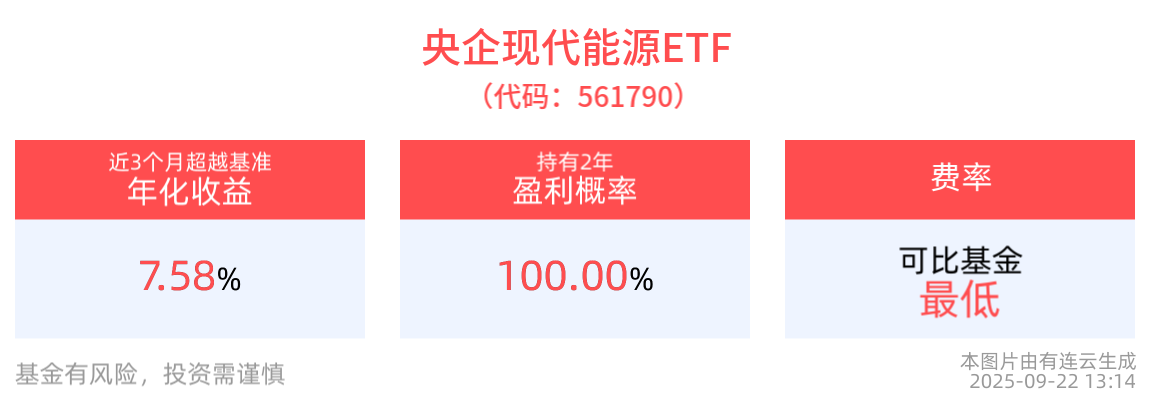
Core Insights - The China Securities National New State-Owned Enterprises Modern Energy Index has decreased by 0.56% as of September 22, 2025, with mixed performance among constituent stocks [3] - The Central State-Owned Enterprises Modern Energy ETF (561790) has seen a decline of 0.79%, with a latest price of 1.14 yuan, while it has increased by 0.97% over the past month [3][4] - The electricity spot market in China has begun to show its guiding role in the consumption of renewable energy, with inter-provincial spot market transactions of renewable energy reaching 7.75 billion kilowatt-hours, accounting for 36.5% of total transactions in the first eight months of the year [3] Market Development - The construction of the electricity spot market in China has entered a critical phase, with seven provincial-level spot markets officially operational as of August this year [4] - A multi-layered system is proposed for the future, including an energy market, capacity market, and ancillary services market to ensure long-term supply capabilities and reasonable returns for flexible resources [4] Index Composition - As of August 29, 2025, the top ten weighted stocks in the China Securities National New State-Owned Enterprises Modern Energy Index account for 48.28% of the index, including companies like Yangtze Power and China Nuclear Power [5]

关注反内卷下核增产能退出风险
Changjiang Securities· 2025-09-22 02:14
Investment Rating - The report maintains a "Positive" investment rating for the coal industry [10]. Core Insights - The report highlights the risks of capacity exit under the "anti-involution" policy, suggesting that the marginal supply contraction could catalyze an upward trend in coal prices and the sector [2][7]. Summary by Sections Market Performance - The coal index (Yangtze) increased by 3.50%, outperforming the CSI 300 index by 3.95 percentage points, ranking 1st among 32 industries [6][23]. - As of September 19, the market price for Qinhuangdao thermal coal was 704 RMB/ton, up 24 RMB/ton week-on-week [6][24]. Supply and Demand Analysis - The report notes that despite the end of high-temperature weather, daily coal consumption may decline, but the non-electric demand during the "golden September and silver October" period is expected to support thermal coal demand [6][24]. - The report indicates that the supply from coal-producing regions remains constrained due to overproduction controls, which may lead to stable or rising coal prices in the short term [6][24]. Policy and Regulatory Environment - The "anti-involution" policy is being actively implemented, with a focus on capacity verification in major production areas, which is expected to enhance market confidence in the policy's enforcement [7]. - The report discusses the potential exit risks of previously approved capacity that has not yet completed the necessary replacement procedures, emphasizing the importance of monitoring these developments [7]. Investment Recommendations - The report recommends focusing on coal companies with strong defensive and offensive characteristics, such as Yanzhou Coal Mining Company and China Shenhua Energy, due to their favorable valuation and growth prospects [8]. - It suggests that the coal sector presents a compelling investment opportunity given the expected policy effects and market dynamics [8].
电投能源:投资者建议公司慎重定增,勿稀释股东权益
Xin Lang Cai Jing· 2025-09-22 01:09
Core Viewpoint - The investor raises concerns about the potential risks associated with the company's past private placements, suggesting that the introduction of certain investors may not be beneficial for long-term shareholders [1] Group 1: Investor Concerns - The investor highlights vulnerabilities in previous private placements, indicating that they may have diluted the interests of long-term shareholders [1] - The introduction of Huaneng and Yuneng is compared to "close relatives marrying," implying a lack of diversity in investor backgrounds [1] - The involvement of three investment companies from Shandong is viewed as potentially harmful, as Shandong hosts two of the largest electrolytic aluminum producers in the country [1] Group 2: Company Response - The company acknowledges the investor's concerns and expresses gratitude for the feedback [1]
8月煤炭行业数据解读
2025-09-22 01:00
Summary of Coal Industry Conference Call Industry Overview - The conference call primarily discusses the coal industry, focusing on market dynamics, pricing, and production trends in China and abroad [1][2][3]. Key Points and Arguments Market Dynamics - In September, there was a notable improvement in non-electric demand, leading to a significant increase in pit coal prices, with Shanxi high-calorie coal rising by 8% [1][2]. - The price of 5,500 kcal coal from the Jinshan-Mongolia region is now between 700-780 RMB, with a widening price gap compared to port prices, making imported coal less competitive [1][3][4]. Inventory and Supply - Qinhuangdao's coal inventory has significantly decreased, and the inventory at nine northern ports is lower than the same period last year, indicating a recovery from previously high levels [1][4]. - European A2A3 port inventories are at extremely low levels, continuing a depletion trend [1][4]. Price Trends - Coking coal prices have increased, with Shanxi's main coking coal rising by 60 RMB and imported Mongolian coking coal by 70 RMB [1][5]. - The black industry chain's profit distribution favors high-capacity utilization segments, supporting coking coal demand due to increased steel production and coking expansion [1][5]. Production Trends - August coal production was 390 million tons, a slight month-on-month increase of 2.5%, but a clear downward trend year-on-year [1][7]. - The production growth rate is expected to continue declining in the second half of the year due to policy constraints in major coal-producing regions like Shanxi and Inner Mongolia [1][8][10]. Policy Impact - The government is enforcing stricter production regulations, particularly in Inner Mongolia, where safety checks are ongoing, indicating a commitment to maintaining industry stability [1][12][18]. - There is an expectation of approximately 100 million tons of excess production across the country, with the government not fully recognizing capacity increases from 2021 [1][17]. Future Expectations - The market is anticipated to maintain a balanced supply-demand state in the coming months, with slight increases in domestic coal supply but reduced imports, leading to an overall near-zero growth in coal supply [1][14][15]. - The focus on coking coal is expected to grow, with companies like Yanzhou Coal Mining Company being highlighted as strong investment opportunities due to their defensive and offensive characteristics [1][6][20]. Investment Recommendations - The coal sector is experiencing a general upward trend, with Yanzhou Energy's Hong Kong stock showing a 14% increase [1][6]. - Recommendations include focusing on coking coal companies, particularly Lu'an Huanneng, which may see performance improvements in the fourth quarter [1][20][21]. Other Industry Insights - The steel and cement industries are showing mixed demand trends, with steel production increasing slightly while cement production is declining [1][13]. - The overall coal supply is tightening, and prices are expected to rise further if the supply constraints continue [1][18]. Additional Important Information - The call emphasizes the importance of monitoring policy changes and market conditions, as they significantly impact coal pricing and production dynamics [1][12][19].
行业周报:煤价再度反弹至700元之上,煤炭布局稳扎稳打-20250921
KAIYUAN SECURITIES· 2025-09-21 12:45
Investment Rating - The investment rating for the coal industry is "Positive" (maintained) [1] Core Viewpoints - Coal prices have rebounded above 700 RMB, with a current price of 704 RMB/ton, reflecting a week-on-week increase of 24 RMB/ton (3.53%) [3][4] - The demand for non-electric coal is expected to be a highlight in the upcoming months, particularly during the "golden September and silver October" period [4] - The report predicts that the current rebound in coal prices is at a turning point, with potential further increases expected as the market stabilizes [4][5] Summary by Sections Investment Logic - The prices of thermal coal and coking coal are at a turning point, with thermal coal prices expected to recover to long-term contract prices, currently above the second target price of around 700 RMB [4][13] - Future expectations indicate that thermal coal prices could reach a third target price of approximately 750 RMB, with a potential peak at around 860 RMB [4][13] Market Performance - The coal index increased by 3.51% this week, outperforming the CSI 300 index by 3.96 percentage points [8][25] - The average PE ratio for the coal sector is 13.59, and the PB ratio is 1.28, ranking low among all A-share industries [25][31] Coal Price Indicators - As of September 19, the Qinhuangdao Q5500 thermal coal price is 704 RMB/ton, with a week-on-week increase of 24 RMB [20] - The price of coking coal at the Jingtang port has risen to 1670 RMB/ton, reflecting a significant increase from earlier months [21][23] Investment Recommendations - The report suggests a dual logic for investment in coal stocks, focusing on both cyclical recovery and stable dividends, with specific stocks recommended for investment [5][14] - Key stocks identified for investment include: - Cyclical logic: Jinko Coal Industry, Yanzhou Coal Mining - Dividend logic: China Shenhua, Zhongmei Energy - Diversified aluminum elasticity: Shenhua Holdings, Electric Power Investment Energy - Growth logic: Xinjie Energy, Guanghui Energy [5][14][15]




煤炭开采行业跟踪周报:受节前补库影响,港口煤价有所上涨-20250921
Soochow Securities· 2025-09-21 08:44
Investment Rating - The report maintains an "Overweight" rating for the coal mining industry [1] Core Viewpoints - The port coal price has increased due to pre-holiday stockpiling, with the current price at 704 RMB/ton, up by 24 RMB/ton week-on-week [1] - Supply from the four ports in the Bohai Rim has decreased, with an average daily inflow of 1.4861 million tons, down by 127,400 tons or 7.90% from the previous week [1] - Demand has also weakened, with a daily outflow of 1.5383 million tons, down by 45,100 tons or 2.85% week-on-week [1] - The total inventory in the Bohai Rim ports has decreased to 20.61 million tons, down by 207,700 tons or 9.16% from the previous week [1] - The report anticipates that coal prices will maintain a volatile trend in the short term due to seasonal demand fluctuations and decreasing temperatures [1] Summary by Sections Weekly Market Review - The Shanghai Composite Index closed at 3,820.09 points, down 1.05% week-on-week, while the coal sector index rose by 2.16% to 2,735.68 points [10] - The total transaction amount for the coal sector reached 73.185 billion RMB, an increase of 91.54% from the previous week [10] Production and Pricing - Domestic coal prices have shown stability with slight increases; for instance, the price of 5500 kcal coal in Datong rose by 37 RMB/ton to 597 RMB/ton [18] - The international coal price index has shown a slight decline, with the Newcastle coal price down by 6.67 USD/ton to 101.11 USD/ton [20] Inventory and Shipping - The average daily shipping volume in the Bohai Rim has decreased, with a total inventory reduction indicating a tightening supply situation [28][31] - Domestic shipping costs have increased by 19.91%, now averaging 35.53 RMB/ton [33] Recommendations - The report suggests focusing on resource stocks, particularly recommending companies like Haohua Energy and Guanghui Energy as potential investment opportunities due to their low valuations and market elasticity [35]
再度提示煤炭供需改善与潜在政策催化下的配置机遇
Xinda Securities· 2025-09-21 02:05
Investment Rating - The investment rating for the coal mining industry is "Positive" [2] Core Viewpoints - The report indicates that the coal economy is at the beginning of a new upward cycle, with a resonance between fundamentals and policies, making it an opportune time to invest in the coal sector [3][13] - The report highlights that coal prices have shown signs of stabilization, and there is an expectation for price increases due to seasonal demand and supply constraints [5][13] - The report emphasizes the continued investment logic of coal capacity shortages, with a short-term balance and a long-term gap in supply [13][14] Summary by Sections Coal Price Tracking - As of September 19, the market price for Qinhuangdao port thermal coal (Q5500) is 699 CNY/ton, an increase of 21 CNY/ton week-on-week [4][31] - The price for coking coal at Jingtang port is 1610 CNY/ton, up 60 CNY/ton week-on-week [4][33] - International thermal coal prices have also seen fluctuations, with Newcastle thermal coal at 69.6 USD/ton, a week-on-week increase of 0.4 USD/ton [4][31] Supply and Demand Tracking - The capacity utilization rate for sample thermal coal mines is 91.7%, an increase of 2.4 percentage points week-on-week [4][48] - Daily coal consumption in inland provinces has increased by 4.10 thousand tons/day (+1.22%) [5][13] - The report notes that the supply side is still constrained by policies, and the demand is expected to rise as winter heating needs begin [5][13] Industry Performance - The coal sector has shown a weekly increase of 3.59%, outperforming the broader market [16] - The report identifies key companies to focus on, including China Shenhua, Shaanxi Coal, and others, highlighting their stable operations and strong performance [14][16]


