宝洁公司

Search documents
美团闪购推全套增长解决方案,称将为电商品牌"流量内卷"提供针对性解法
Ge Long Hui· 2025-10-30 12:22
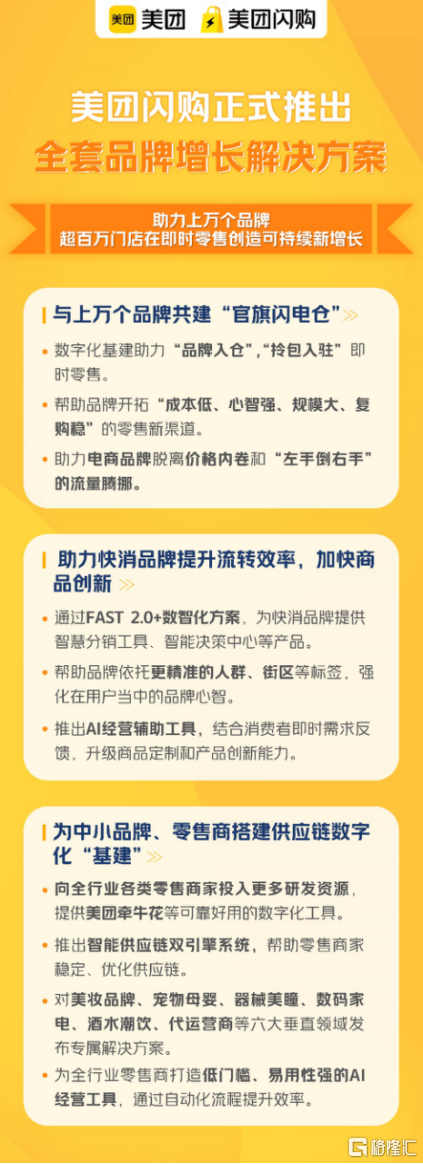
Core Insights - Meituan has launched a comprehensive growth solution for domestic and international brands through its "Brand Official Flag Lightning Warehouse" initiative, aimed at e-commerce brands lacking offline channels and mature fast-moving consumer goods (FMCG) brands [1][4] Group 1: Meituan's Initiatives - Meituan's "Brand Official Flag Lightning Warehouse" provides targeted solutions by building infrastructure such as warehousing, distribution, and digital systems for brands, enabling them to achieve lower costs, stronger brand recognition, larger scale, and more stable repurchase rates [4] - Over a hundred brands, including Sony PlayStation, Proya, Logitech, Kingston, and L'Oreal, have already joined the "Brand Official Flag Lightning Warehouse," allowing consumers in major cities like Beijing, Shanghai, and Guangzhou to shop at these brands' official flagship stores on Meituan [4] Group 2: Industry Trends - The competition in the instant retail sector has garnered significant attention this year, with Deloitte reporting that traditional offline retail in China is expected to underperform by 2025, while instant retail and new business models are rapidly growing [5] - The focus of leading instant retail platforms, such as Meituan, is on helping brands find incremental growth, indicating a trend where e-commerce brands reliant on traditional channels are accelerating their expansion into instant retail and new channels [5]


大厂裁员14000人背后真相:AI干不了你的活,却先砸了你的饭碗
3 6 Ke· 2025-10-30 12:13
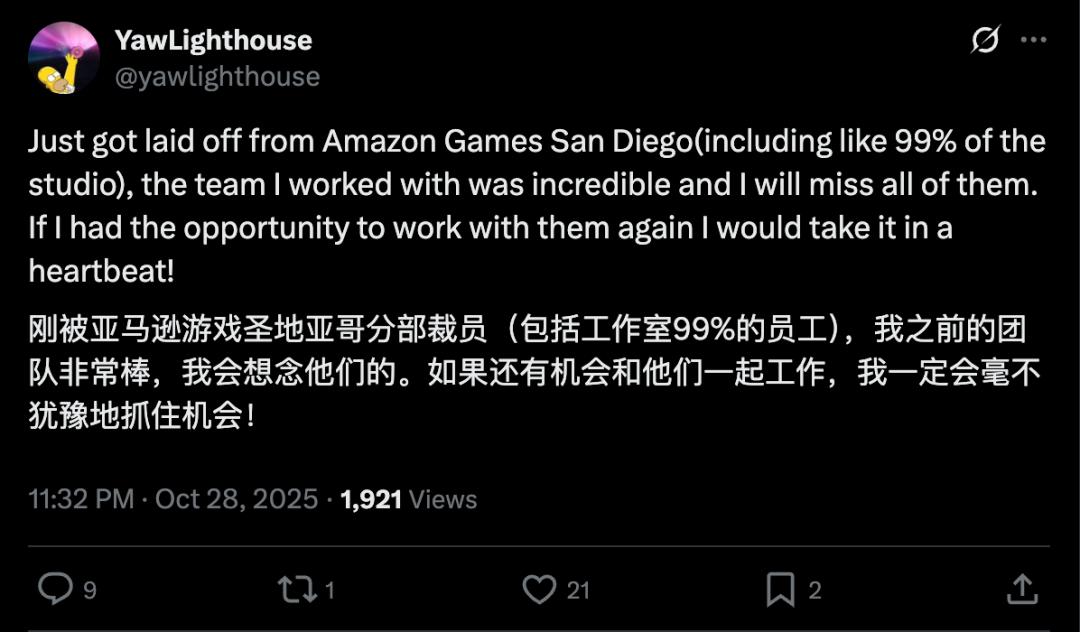
Core Insights - Amazon is undergoing significant layoffs, with 14,000 employees already affected and potential total layoffs reaching 30,000, which is nearly 10% of its workforce [1][3] - The layoffs are occurring despite Amazon's strong operational performance in recent quarters, raising questions about the rationale behind such drastic measures [3] Group 1: Layoff Details - The majority of layoffs are targeting middle management, specifically L5 to L7 level employees, with over 78% of affected workers falling within this range [9][11] - Departments impacted include HR, device and service teams, and parts of AWS support teams [9] - The layoffs are part of a broader trend seen in other companies like Microsoft and Intel, which cite AI as a driving factor for workforce reductions [5] Group 2: AI's Role - Amazon's HR head, Beth Galetti, stated that AI is the most transformative technology since the internet, necessitating a leaner organizational structure [5] - The narrative suggests that AI can replace many tasks traditionally performed by middle management, which has led to the perception that these roles are redundant [11] - However, internal sources indicate that AI is not the primary reason for the layoffs, suggesting a trend of "AI-washing" where companies frame layoffs as a response to AI advancements [13][16] Group 3: Financial Implications - Amazon is facing pressure to release cash for expensive AI investments, with spending on servers and data centers projected to exceed $120 billion by 2025 [24][25] - Analysts note that reducing white-collar salaries can free up funds for purchasing high-cost AI infrastructure, such as GPUs [25][38] - The layoffs are also seen as a correction to over-hiring during the pandemic, as Amazon's workforce nearly tripled from 2017 to 2024 [31][28] Group 4: Broader Industry Context - The tech industry is in a fierce AI arms race, with companies needing to invest heavily in AI capabilities to remain competitive [38][43] - Other companies, such as Meta and UPS, are also laying off employees, but their reasons differ, focusing on the current utility of AI rather than future potential [40][43] - The overall trend indicates a shift in wealth towards computational power rather than labor, with companies like NVIDIA benefiting significantly from this transition [44]

美团闪购推全套增长解决方案,称将为电商品牌“流量内卷”提供针对性解法
Xin Lang Ke Ji· 2025-10-30 12:09
Core Insights - Meituan has launched a comprehensive growth solution called "Brand Official Flag Lightning Warehouse" aimed at e-commerce brands lacking offline channels and mature fast-moving consumer goods (FMCG) brands, as well as retailers across various industries [1] - The solution addresses the issue of e-commerce brands being trapped in traditional platform traffic competition and lacking channel expansion opportunities, allowing brands to achieve lower costs, stronger brand recognition, larger scale, and more stable repurchase rates [1] - Over a hundred brands, including Sony PlayStation, Proya, Logitech, Kingston, and L'Oreal, have already joined the "Brand Official Flag Lightning Warehouse," enabling consumers in major cities to shop at these brands' official flagship stores on Meituan [1] Industry Developments - Meituan plans to introduce multiple digital tools aimed at enhancing circulation efficiency and accelerating product innovation for mature FMCG brands [1] - The company will invest more research and development resources to provide digital infrastructure and AI-assisted instant retail management tools to various retail businesses [1] - Notable domestic and international brands such as Yili, Qingdao Beer, Pepsi, Sofy, and Procter & Gamble have engaged in deep cooperation with Meituan's related business segments [1]
16000人,一家超级巨头宣布裁员
36氪· 2025-10-30 00:11
Core Viewpoint - Nestlé plans to lay off approximately 16,000 employees globally over the next two years, primarily targeting white-collar professionals, as part of a strategy to reduce costs and adapt to changing market conditions [5][6][7]. Group 1: Layoff Strategy - The layoffs will save the company 1 billion Swiss francs annually, doubling the previous target of 500 million Swiss francs, with a one-time restructuring cost expected to be twice the annual savings [6]. - The CEO emphasized the need for faster adaptation to market changes, indicating that the company must take difficult but necessary steps to reduce workforce [6][7]. - The majority of the layoffs (75%) will affect cross-functional and cross-regional white-collar workers rather than frontline employees [6]. Group 2: Digital Transformation - Nestlé is implementing a "digital twin" strategy to centralize demand forecasting, promotional scheduling, and SKU profitability calculations into a unified cloud-based data model, allowing AI to provide replenishment and pricing suggestions [6][8]. - This digital transformation aims to streamline operations, reducing the time required for promotional planning from two weeks to 30 minutes, with a low error rate [6][8]. Group 3: Industry Challenges - The traditional food industry faces significant challenges, including SKU proliferation, regulatory compliance delays, and competition from agile new brands leveraging social media [7][16]. - The impact of GLP-1 drugs and extreme weather events is expected to shrink the global candy market by 15% over the next five years, adding to the uncertainty in the food sector [7][16]. Group 4: Historical Context - Nestlé's peak performance was around 2005, with revenues of approximately $74 billion, but has since faced declining growth rates and increased competition [10][14]. - The company's historical success was built on technological advancements, aggressive acquisitions, and a strong global presence, but it has struggled to adapt to the fragmented consumer landscape [15][17]. Group 5: Future Outlook - The company must transition from a traditional food model to a nutrition technology model, leveraging synthetic biology and real-time data to create personalized nutrition solutions [19][21]. - The ability to innovate and retain a connection to consumer preferences will be crucial for Nestlé to regain its competitive edge in a rapidly evolving market [8][21].
Quad/Graphics(QUAD) - 2025 Q3 - Earnings Call Transcript
2025-10-29 13:30
Financial Data and Key Metrics Changes - Net sales for Q3 2025 were $588 million, a decrease of 7% compared to Q3 2024, excluding a 6% impact from the divestiture of European operations [20] - Adjusted EBITDA was $53 million in Q3 2025, down from $59 million in Q3 2024, with an adjusted EBITDA margin improving from 8.7% to 8.9% year-to-date [21] - Adjusted diluted earnings per share increased by 19% to $0.31 in Q3 2025 from $0.26 in Q3 2024, and year-to-date adjusted diluted earnings per share rose by 33% to $0.65 in 2025 from $0.49 in 2024 [22] Business Line Data and Key Metrics Changes - Revenue mix as a percentage of total net sales increased by 2% in targeted print offerings, driven by growth in direct marketing, packaging, and in-store solutions [20] - Direct mail revenue increased by over 6% year-to-date, packaging grew by over 9%, and in-store solutions rose by 11% year-to-date [36] Market Data and Key Metrics Changes - The USPS announced it would not issue a January price increase for market-dominant mail, which is expected to positively impact marketers as they finalize their 2026 media plans [6][39] - High postage rates continue to significantly impact the industry, but the lack of a January increase is seen as favorable for clients [39] Company Strategy and Development Direction - The company is making targeted investments in AI-powered tools, data intelligence services, and retail media networks to diversify revenue and return to net sales growth by 2028 [4] - The strategic focus includes maximizing savings for clients while increasing marketing effectiveness through innovative solutions like co-mailing and audience intelligence [8][9] Management's Comments on Operating Environment and Future Outlook - Management expressed optimism about the future growth of In-Store Connect, citing strong sales lift results from campaigns with major clients [16] - The company is closely monitoring macroeconomic pressures, including inflation and tariffs, which could affect client marketing spend [31] Other Important Information - The company returned $19 million of capital to shareholders year-to-date through dividends and share repurchases, with a 50% increase in the quarterly dividend [25] - The company expects free cash flow in Q4 2025 to be between $137 million and $147 million, following a seasonal pattern of negative cash flow in the first nine months of the year [23] Q&A Session Summary Question: Trends in targeted print categories - Management noted that catalog sales are muted due to postal increases, while direct mail, packaging, and in-store solutions are seeing growth [36][37] Question: Impact of USPS postponing price increase - Management indicated that the postponement is favorable and could positively influence client spending for 2026 [39][40] Question: Updated guidance for net sales - Management discussed variability in direct mail as a transactional area that could impact sales outlook for Q4 [42][44] Question: Adjusted EBITDA and CapEx guidance - The midpoint for adjusted EBITDA was slightly decreased, while capital expenditures are expected to shift towards technology and automation [46][48] Question: Updates on In-Store Connect deployment - Management reported increased interest from clients and a strong pipeline for In-Store Connect, with positive feedback on new digital signage solutions [49][50]

Market Digest: CB, CHKP, NEE, GLW, PG, SYY, TMO, UL, XYL, KMI, PYPL, W, CARR
Yahoo Finance· 2025-10-29 10:55
Sign in to access your portfolio Sign in ...
宽类窄品,低效零售自残的利器
3 6 Ke· 2025-10-29 04:27
Core Viewpoint - The retail industry is witnessing a significant shift towards the "wide category, narrow product" strategy, exemplified by the success of retailers like Aldi, which has achieved remarkable sales figures and efficiency through this approach [1][10]. Group 1: Concept of Wide Category, Narrow Product - The concept of "wide category, narrow product" signifies a strategic shift in retail management, focusing on a limited number of high-performing products within broad categories to enhance operational efficiency [3][4]. - This strategy is not merely a voluntary action by retailers but a necessary response to competitive pressures and the need for improved retail efficiency [3][4]. - Effective implementation requires a thorough understanding of customer needs and a well-structured product organization, rather than arbitrary reductions in product offerings [4][5]. Group 2: Importance of Category Management - Category management, introduced by leading fast-moving consumer goods brands, has evolved into a critical component of retail strategy, emphasizing the need for effective product organization and consumer preference analysis [4][5]. - Retailers must adapt their product structures to align with customer demographics and preferences, ensuring that the right products are available in the right categories [4][6]. - The success of the "wide category, narrow product" approach hinges on the ability to identify and eliminate underperforming products while enhancing the visibility of high-demand items [7][8]. Group 3: Self-Branding Strategy - Many retailers are leveraging self-branded products as a means to establish price positioning, achieve higher margins, and differentiate themselves in a crowded market [8][9]. - The "wide category, narrow product" strategy can facilitate the development of self-branded products by consolidating consumer demand into fewer, more impactful offerings [8][9]. - Retailers are encouraged to focus on high-selling categories and create self-brands that resonate with customer expectations, thereby reducing risks associated with inventory and enhancing profitability [9]. Group 4: Operational Efficiency and Market Trends - The retail sector is experiencing intense competition, necessitating a focus on operational efficiency as a fundamental survival strategy [10]. - The "wide category, narrow product" approach is not just about product assortment but is also a reflection of deeper insights into customer behavior and operational effectiveness [10]. - Early adoption of this strategy can provide a competitive edge, allowing retailers to differentiate themselves in a rapidly evolving market landscape [10].
五年首次双增!中国美妆代工一哥靠“减法”赢了
Xin Lang Cai Jing· 2025-10-29 03:07
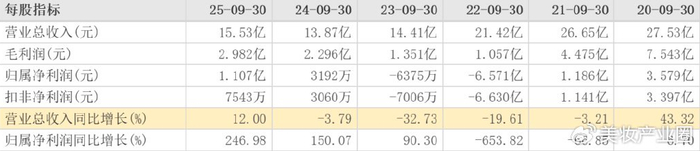
Core Viewpoint - Qingsong Co. reported a significant turnaround in its financial performance for the first three quarters of 2025, achieving a revenue of 1.553 billion yuan, a year-on-year increase of 12%, and a net profit of 111 million yuan, reflecting a substantial growth of 246.98% [1][2][4]. Financial Performance - The revenue for Qingsong Co. in the first three quarters of 2025 was 1.553 billion yuan, compared to 1.387 billion yuan in the same period of 2024, marking a 12% increase [3][5]. - The net profit reached 111 million yuan, a significant increase from 31.92 million yuan in the previous year, indicating a growth rate of 246.98% [3][4]. - This is the first time in five years that Qingsong Co. has achieved a "double increase" in both revenue and net profit for the first three quarters [5][6]. Operational Efficiency - The company has shown improved operational efficiency, as evidenced by the significant increase in net profit compared to revenue growth, indicating enhanced profitability [1][5]. - Qingsong Co. reported a net cash flow from operating activities of 139 million yuan, a year-on-year increase of 50.11%, demonstrating improved cash recovery capabilities [5][10]. Asset Management - Qingsong Co. successfully disposed of a 148-acre industrial park project, generating a cash inflow of 163 million yuan, which contributed approximately 31.25 million yuan to the net profit for the first three quarters [6][10]. - The disposal of this asset has improved the company's cash flow and reduced future capital expenditure pressures, allowing it to focus more on its core cosmetics business [10][11]. Strategic Focus - The company’s subsidiary, Norsbel, has maintained a strong market position, achieving double-digit revenue growth despite a challenging macroeconomic environment [5][12]. - Norsbel's strategy emphasizes focusing on core customers and high-value products, which has led to a 16.04% increase in R&D expenses, outpacing revenue growth [12][14]. - Qingsong Co. aims to enhance its core competitiveness in the cosmetics sector through continuous improvements in product development, market expansion, cost control, and structural optimization [12][16].

JPMorgan Raises Procter & Gamble (PG) Price Target to $165, Keeps Neutral Rating
Yahoo Finance· 2025-10-29 01:47
Core Viewpoint - The Procter & Gamble Company (NYSE:PG) is recognized for its financial stability and commitment to shareholders, making it a strong candidate for income-focused investors and retirement portfolios [2][5]. Financial Performance - For the fiscal first quarter of 2026, Procter & Gamble reported net earnings of $4.8 billion and operating cash flow of $5.4 billion, indicating robust financial health [4]. - The company's adjusted free cash flow productivity was 102%, reflecting strong financial discipline [4]. - Procter & Gamble returned $3.8 billion to shareholders in the quarter, which included $2.55 billion in dividends and $1.25 billion in share buybacks [4]. Investment Outlook - JPMorgan raised its price target for Procter & Gamble to $165 from $163 while maintaining a Neutral rating, suggesting a conservative outlook for the company [3]. - The stock has a dividend yield of 2.79% as of October 27, and the company has increased its dividend payouts for 69 consecutive years, reinforcing its reliability for income-focused investors [5].

陈春花:战略思维就是选择不做什么
Sou Hu Cai Jing· 2025-10-29 00:46
Core Insights - The essence of a company's success lies in its strategic thinking and the ability to implement strategies, which cannot be replaced by management concepts [2][4] - Strategic thinking focuses on making choices about what to do and what not to do, rather than merely solving immediate problems [3][7] - Management efforts often address current issues, while strategic efforts are about future positioning and value creation [5][6] Strategic Thinking vs. Management - Strategic thinking is fundamentally about making choices that determine a company's fate, while management deals with unavoidable issues that arise in business operations [6][10] - Companies must prioritize strategic choices over problem-solving to ensure long-term survival and growth [5][11] - A clear distinction exists between strategic thinking (what to pursue) and management (how to address problems) [7][12] Importance of Sustainable Development - Strategic choices should be based on sustainable development rather than immediate profitability, as profit is a result of strategic decisions [8][9] - Companies focusing solely on problem-solving risk missing future opportunities and may become stagnant [8][11] - Historical data suggests that even long-established companies may not survive if they fail to adapt strategically [8][9] Environmental Interaction - Companies must align their strategies with environmental changes to maintain competitiveness and seize growth opportunities [13][14] - Understanding and responding to shifts in consumer behavior and industry dynamics is crucial for sustained success [13][14] - Companies that engage with their environment and adapt to changes are more likely to thrive [14]