五粮液

Search documents
酒价内参1月27日价格发布 精品茅台上涨4元/瓶
Xin Lang Cai Jing· 2026-01-27 01:16
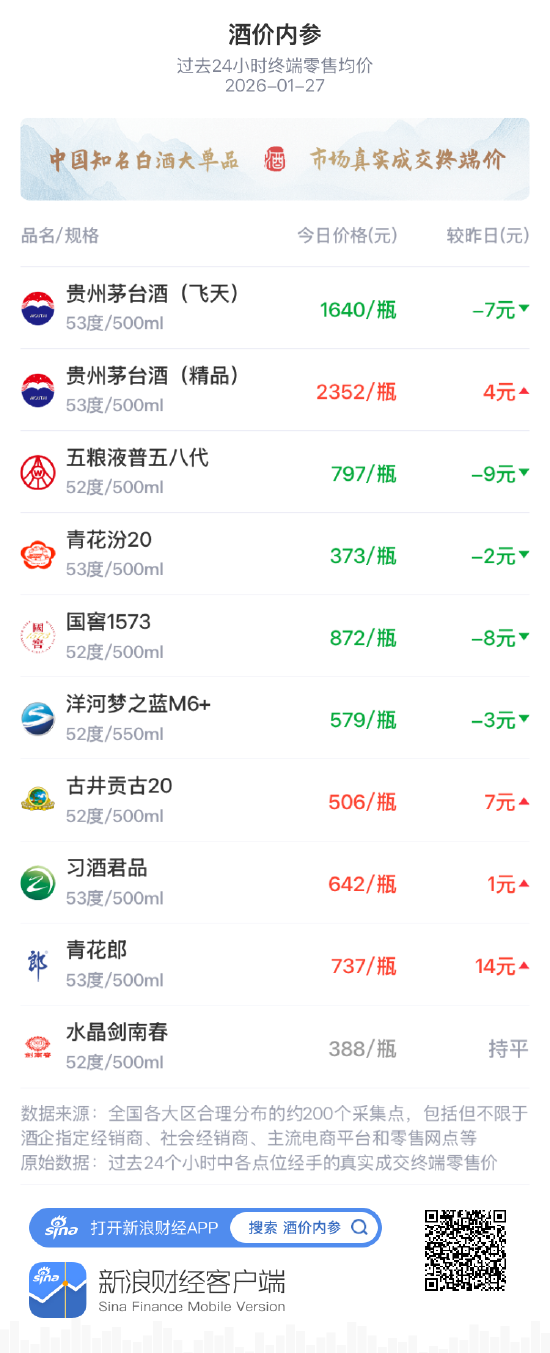
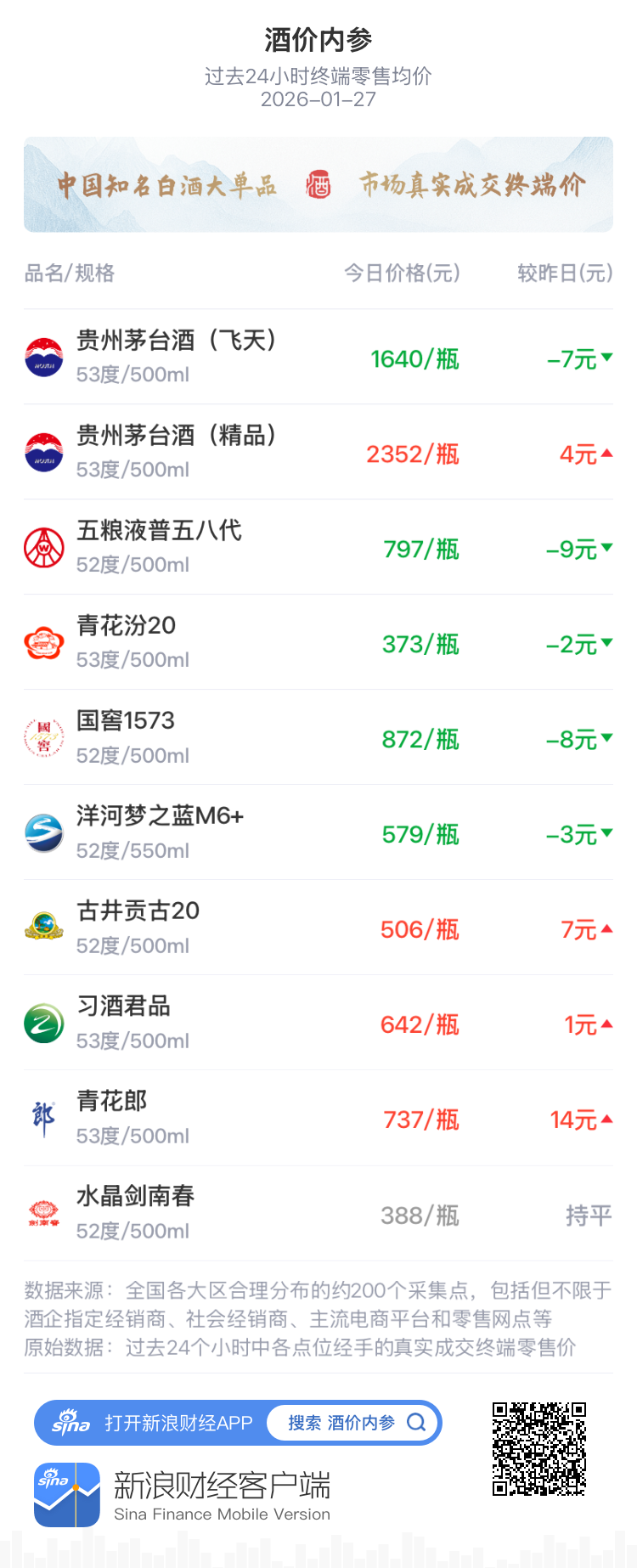
新浪财经"酒价内参"重磅上线 知名白酒真实市场价尽在掌握 新浪财经"酒价内参"过去24小时收集的数据显示,中国白酒市场十大单品的终端零售均价在1月27日继 续呈现分化走势。如果十大单品各取一瓶整体打包售卖,今日总售价为8886元,较昨日下跌3元。市场 整体趋稳,核心单品涨跌互现。 今日市场四涨五跌一平。上涨端,青花郎领涨14元/瓶,且已连续五天攀升;古井贡古20与精品茅台分 别上涨7元/瓶、4元/瓶;习酒君品微涨1元/瓶。下跌端,五粮液下跌9元/瓶;国窖1573下跌8元/瓶;飞天 茅台受i茅台平台常态化供应影响,终端零售均价环比下跌7元/瓶;梦之蓝M6+和青花汾20分别下跌3元/ 瓶、2元/瓶;水晶剑南春价格与昨日持平。 | 酒价内参 | | | | --- | --- | --- | | 过去24小时终端零售均价 2026-01-27 | | | | 中国知名白酒大单品 NEW | 币场真实成交终端价 | | | 品名/规格 | 今日价格(元) | 较昨日(元) | | 贵州茅台酒(飞天) 53度/500ml | 1640/瓶 | -7元▼ | | 贵州茅台酒(精品) 53度/500ml | 2352/瓶 ...




酒价内参1月27日价格发布 习酒君品微涨1元/瓶
Xin Lang Cai Jing· 2026-01-27 01:16
新浪财经"酒价内参"重磅上线 知名白酒真实市场价尽在掌握 "酒价内参"的每日数据源自全国各大区均有合理分布的约200个采集点,包括但不限于酒企的指定经销 商、社会经销商、电商平台和零售网点等,原始取样数据为过去24个小时中各点位经手的真实成交终端 零售价格,力求为社会各界提供一份关于知名白酒市场价格的客观、真实、科学、全程可追溯的数据。 随着元旦官方i茅台平台开始出售1499元/瓶的飞天茅台,以及1月9日开始出售2299元/瓶的精品茅台,这 一新产生的渠道对两款产品市场终端零售均价的磁吸式影响力已逐步显现。"酒价内参"每日发布的酒价 遵循对真实成交量加权的计算规则,我们已逐渐将可确量的价格引入飞天茅台和精品茅台终端零售价的 计算中。 【点击进入酒价内参,查看真实酒价】 白酒业的重要新闻方面,财经媒体华见刊文称,目前白酒板块正经历典型的"至暗时刻"与"曙光初现"博 弈:一方面,机构持仓已降至2015年的历史底部,洋河等头部酒企业绩承压;但另一方面,茅台批价企 稳、五粮液现金充沛、洋河承诺全额分红。公募基金白酒股持仓已回落至2015年底部,当市场极度悲观 时,板块的"黄金坑"或许已经出现。最新数据显示,公募基金对 ...
酒价内参1月27日价格发布 总价微跌青花郎逆势连涨
Xin Lang Cai Jing· 2026-01-27 01:06
Core Viewpoint - The Chinese liquor market shows a mixed trend in retail prices for the top ten products, with an overall slight decline in total price, indicating market stabilization with fluctuations among core products [1]. Price Trends - The total retail price for a package of the top ten liquor products is 8,886 yuan, down by 3 yuan from the previous day [1]. - Among the ten products, four increased in price, five decreased, and one remained stable [1]. Price Increases - Qinghua Lang leads the price increase with a rise of 14 yuan per bottle, marking five consecutive days of price growth [1]. - Gujing Gonggu 20 and Jingpin Moutai saw increases of 7 yuan and 4 yuan per bottle, respectively [1]. - Xijiu Junpin experienced a slight increase of 1 yuan per bottle [1]. Price Decreases - Wuliangye dropped by 9 yuan per bottle [1]. - Guojiao 1573 decreased by 8 yuan per bottle [1]. - Feitian Moutai's average retail price fell by 7 yuan per bottle due to the normalized supply from the iMoutai platform [1]. - Mengzhilun M6+ and Qinghua Fen 20 saw decreases of 3 yuan and 2 yuan per bottle, respectively [1]. - Shuijing Jianan Chun's price remained unchanged from the previous day [1]. Specific Product Prices - Feitian Moutai (53 degrees, 500ml) is priced at 1,640 yuan, down by 7 yuan [3]. - Jingpin Moutai (53 degrees, 500ml) is priced at 2,352 yuan, up by 4 yuan [3]. - Wuliangye (52 degrees, 500ml) is priced at 797 yuan, down by 9 yuan [3]. - Gujing Gonggu 20 (52 degrees, 550ml) is priced at 506 yuan, up by 7 yuan [4]. - Xijiu Junpin (53 degrees, 500ml) is priced at 642 yuan, up by 1 yuan [4]. - Qinghua Lang (53 degrees, 500ml) is priced at 737 yuan, up by 14 yuan [4]. - Shuijing Jianan Chun (52 degrees, 500ml) is priced at 388 yuan, unchanged [4].
从渠道变革到价值重塑,酒企如何在即时零售消费场景重构白酒消费生态?
Sou Hu Cai Jing· 2026-01-26 15:35
Core Insights - The Chinese liquor industry is facing significant challenges in 2025, with major companies implementing strategies to reduce alcohol content and product tiers, while regional firms are pressured by price cuts and slowing growth [1] - The industry's deep adjustment is attributed to multiple factors, including structural changes, economic fluctuations, policy regulations, and shifts in consumer demand [1] Group 1: Industry Pain Points - Economic pressures are leading to a rational return of consumer spending capacity, with GDP growth at 5.2% in the first three quarters of 2025, while disposable income growth is only 4.9%, impacting high-end liquor consumption [2] - Policy regulations have led to a structural change in consumption scenarios, with government restrictions on alcohol at official events and many companies adopting internal alcohol bans [3] - The share of liquor consumption in government and business banquets has significantly decreased, while family gatherings and casual drinking scenarios have increased to 58%, highlighting the resilience of non-banquet consumption [5] Group 2: Changing Consumer Preferences - The younger generation's preference shift is reshaping the liquor industry, with only 31.8% of Gen Z consuming liquor compared to over 40% for beer and fruit wine, indicating a decline in traditional liquor growth [6] - Instant retail is effectively reaching consumers under 30 through innovative marketing strategies, helping brands like Wuliangye and Luzhou Laojiao to increase their Gen Z user base [6] Group 3: Supply and Demand Imbalance - The liquor industry is experiencing a historical peak in supply-demand imbalance, with production down 9.9% in the first nine months of 2025 and inventory turnover days reaching 900, indicating severe channel pressure [7] - Instant retail's real-time response model is addressing these issues, with companies like 1919 and JD Wine World significantly improving inventory turnover efficiency [7] Group 4: Price Competition and Value Reconstruction - The market contraction has intensified price wars, leading to declining profit margins for many listed liquor companies, with some products being sold at significantly lower prices [8] - Instant retail is redefining the value system through innovative models that combine scene premium and service enhancement, allowing brands to escape the price war trap [8] Group 5: Instant Retail's Role in Industry Transformation - Instant retail is effectively addressing the industry's challenges by matching fragmented demand with real-time fulfillment, supported by data-driven supply-demand optimization [10] - The growth of instant retail in the liquor sector is evident, with the market size surpassing 50 billion yuan in 2024 and a year-on-year growth rate exceeding 35% [11] Group 6: Development Strategies for Liquor Brands - Successful collaborations between brands and platforms, such as Tuopai's partnership with Meituan, have led to innovative product offerings and improved sales efficiency [15] - Major brands are accelerating channel integration across multiple platforms, enhancing consumer experience through rapid delivery services [16] - Companies are restructuring their supply chains to shift from predictive stocking to real-time response, significantly boosting sales during peak periods [17] Group 7: Future Challenges and Opportunities - The high delivery costs associated with instant retail pose a challenge to profit margins, particularly for mid-to-high-end products [22] - The risk of price discrepancies between online and offline channels could lead to conflicts with distributors, necessitating a balanced pricing strategy [23] - The need for skilled talent in e-commerce operations and data management is critical for liquor companies to advance their instant retail initiatives [24] - Ensuring product authenticity and building consumer trust through robust quality assurance systems is essential for the success of instant retail in the liquor sector [25]

数说公募纯债与混合资产策略基金2025年四季报:固收+规模再创新高,含权敞口小幅下降
SINOLINK SECURITIES· 2026-01-26 15:04
Report Title - "Counting the Public Offering Pure Bond and Hybrid Asset Strategy Funds' 2025 Q4 Reports - The Scale of 'Fixed Income +' Reaches a New High, and the Exposure to Equity Slightly Declines" [1] Report Date - January 26, 2026 [2] Market Overview General Fixed - Income Fund Scale in 2025 Q4 - Among the top 20 fund companies in terms of general fixed - income fund scale, the scale of some companies increased while others decreased. For example, the scale of China Merchants Fund increased by 9.88% to 3512.27 billion yuan, while the scale of E Fund decreased by 4.71% to 3627.05 billion yuan [8]. Hybrid Asset Strategy Fund Scale in 2025 Q4 - In the hybrid asset strategy fund scale ranking, the scale changes also varied. For instance, the scale of Invesco Great Wall Fund increased by 32.11% to 2263.68 billion yuan, while the scale of Fullgoal Fund decreased by 5.85% to 1281.73 billion yuan [8]. Performance Return - Different types of funds had different average returns in 2025 Q4, year - to - date, and in the past 1 - year, 3 - year, and 5 - year annualized periods. For example, the average return of convertible bond funds in 2025 Q4 was 0.84%, and the year - to - date return was 23.10% [15]. Maximum Drawdown - The average maximum drawdowns of various fund types also differed. For example, the average maximum drawdown of convertible bond funds in 2025 Q4 was - 5.26%, and the year - to - date maximum drawdown was - 8.90% [15]. Annualized Sharpe Ratio - The annualized Sharpe ratios of different fund types were distinct. For example, the annualized Sharpe ratio of short - term pure bond funds in 2025 Q4 was 4.28 [15]. Asset Allocation Leverage Ratio - In 2025 Q4, different types of funds had different leverage ratios and their changes compared to Q3. For example, the leverage ratio of short - term pure bond funds was 111.89% in Q4, an increase of 0.40% compared to Q3 [40]. Holding Characteristics Stock Holdings - From 2025 Q1 to Q4, the industry and stock holding ratios of funds changed. For example, the proportion of non - ferrous metals in the stock market value increased from 11.27% in Q1 to 14.65% in Q4 [54][57]. Bond Holdings - The industry and bond holding ratios of funds also changed over the four quarters of 2025. For example, the proportion of bank bonds in the bond market value decreased from 20.75% in Q1 to 14.45% in Q4 [67][68]. Fund Managers' Views Pure Bond Market Views - Different fund managers had different views on the pure bond market in 2026 Q1. For example, Huang Yingjie of Bank of Communications Yulong Pure Bond A believed that the bond market might be in a range - bound market with a steeper curve [74]. Bond and Stock Market Views - Some fund managers had comprehensive views on the bond and stock markets. For example, Deng Xinyu and Zhao Yucheng of China Europe Dingli A were optimistic about the stock market's structural opportunities and adjusted their convertible bond positions [75]. Convertible Bond and Stock Market Views - Fund managers also had different views on the convertible bond and stock markets. For example, Huang Bo of Everbright Tianyi A planned to select high - cost - effective convertible bonds for the fund's fixed - income part [79].
食品饮料2025年四季度基金持仓分析:白酒持仓继续下降,食品配置环比回升
Shenwan Hongyuan Securities· 2026-01-26 15:01
Investment Rating - The investment rating for the food and beverage sector is "Buy" for key companies such as Kweichow Moutai, Wuliangye, and Luzhou Laojiao [44]. Core Insights - The report indicates a continued decline in the holdings of the food and beverage sector within mutual funds, with the top 20 holdings' market value as a percentage of total fund equity investments decreasing to 16.31% in Q4 2025, down 0.47 percentage points from Q3 2025 [5][21]. - Kweichow Moutai's market value as a percentage of total fund equity investments is 1.31%, a decrease of 0.06 percentage points from the previous quarter, while Wuliangye and Luzhou Laojiao also saw declines [9][10]. - The food and beverage sector's weight in the total A-share market capitalization has decreased to 4.04%, down 0.66 percentage points [25]. Summary by Sections Fund Holdings Analysis - In Q4 2025, the number of funds holding Kweichow Moutai remained stable at 1,048, while Wuliangye saw a decrease of 109 funds to 175, and Luzhou Laojiao's holdings dropped by 18 to 128 [21]. - The concentration of holdings in the food and beverage sector is low, with only one company (Kweichow Moutai) in the top 20 holdings [7][8]. Sector Allocation - The food and beverage sector's heavy stock holdings accounted for 6.10% of total fund equity investments, a decrease of 0.28 percentage points from the previous quarter [25]. - The white liquor sector's heavy stock holdings accounted for 5.13%, also down 0.4 percentage points, indicating a position close to levels seen in Q1 2010 [25][39]. Individual Stock Performance - The report highlights that Kweichow Moutai, Wuliangye, and Luzhou Laojiao are currently below their average allocation levels since 2009, indicating potential undervaluation [9][10]. - The report notes that the allocation coefficient for the white liquor sector is 1.92, which is below the historical average of 2.11, suggesting a potential for recovery [25][39]. Northbound Capital Changes - In Q4 2025, the northbound capital holdings for major food and beverage stocks showed a mixed trend, with Shuanghui Development seeing an increase of 0.13 percentage points, while Kweichow Moutai and Wuliangye experienced declines of 0.48 and 0.58 percentage points, respectively [44][45].


炸锅了!原来是这家基金公司!
Xin Lang Cai Jing· 2026-01-26 13:25
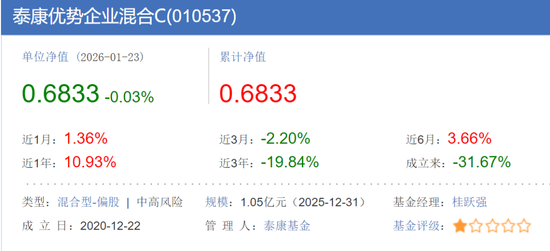
来源 :挖掘机007 你有没有想过,自己辛辛苦苦投进去的钱在亏,而那个管你钱的基金经理,却可能正用自家账户赚得盆 满钵满?这不是小说桥段,而是正在泰康基金上演的现实。 最近,业界诸多报道把这事彻底捅开了。事情主角是泰康基金一位名叫桂跃强的基金经理——他管着超 过20亿的基民资金,五年如一日死守白酒、家电这些所谓"老登股",结果基金亏了快30%;可与此同 时,他自己(或者说他太太名下)的账户却早早重仓科技股,浮盈一度超过5000万。基民血亏,他躺 赢,评论区直接炸锅。 先说说他的两只主力基金:泰康优势企业混合和泰康蓝筹优势一年持有股票。这两只都是偏股型基金, 按理说可以买全市场股票,包括港股通里的腾讯、阿里都没问题。但桂跃强偏偏不走寻常路,硬是把它 们变成了"白酒家电主题基金"。 翻开持仓记录,简直离谱。比如泸州老窖,连续21个季度雷打不动出现在前十大重仓股里,一次都没落 下过;山西汾酒、五粮液也出现了20次;美的集团18次,福耀玻璃、恒生电子各14次……这哪是做投 资,分明是打卡上班。更夸张的是,2025年四季报显示,好几只重仓股一个季度下来一股没动,仿佛账 户被冻住了。 问题是,这几年AI、半导体、新能源轮 ...
食品饮料行业深度报告:2025Q4基金食品饮料持仓分析:持仓继续下降,结构向大众品倾斜
Soochow Securities· 2026-01-26 12:24
Investment Rating - The report maintains an "Increase" rating for the food and beverage industry [1] Core Insights - The food and beverage sector continues to see a decline in holdings, with a shift towards mass-market products. The proportion of active equity funds in the food and beverage sector decreased to 4.04% in Q4 2025, down from 4.18% in Q3 2025, reflecting a 0.14 percentage point decline [9][15] - The report highlights a continued reduction in allocations to alcoholic beverages, while holdings in mass-market products have shown signs of recovery. The proportion of holdings in white liquor decreased by 0.29 percentage points to 2.92% in Q4 2025 [14][17] - Major consumer funds have reduced their allocations to alcoholic beverages, with a notable decrease of 2.22 percentage points in white liquor holdings, while overall food and beverage allocations have increased [17][21] Summary by Sections 1. Food and Beverage Holdings Continue to Decline, Structure Shifts Towards Mass-Market Products - As of Q4 2025, the total scale of active equity fund heavy holdings is approximately 19.4 trillion yuan, with food and beverage holdings at 78.4 billion yuan, reflecting a 9.01% decline [9][10] - The decline in alcoholic beverage holdings is evident, with white liquor allocations decreasing to 2.92% and beer and pre-mixed drinks also seeing slight reductions [14][15] 2. Holdings Become More Diversified, Capturing Marginal Recovery Themes - The number of heavy holdings in the food and beverage sector has become more diversified, with only Kweichow Moutai remaining in the top 20 heavy holdings [24] - The report notes that the top five stocks with the largest increase in heavy holdings include Baba Foods, Yingjia Gongjiu, Youran Dairy, Ximai Foods, and Modern Animal Husbandry [28][29] 3. Investment Recommendations - The report suggests five key directions for investment: focusing on functional health foods, improving supply chains and product/channel resonance in leading snack companies, expanding quality retail formats, investing in long-lifecycle beverage leaders, and tracking sectors with potential recovery such as dairy and large-scale dining [10][29]
2025Q4基金食品饮料持仓分析:持仓继续下降,结构向大众品倾斜
Soochow Securities· 2026-01-26 12:12
Investment Rating - The report maintains an "Increase" rating for the food and beverage industry [1] Core Insights - The food and beverage sector continues to see a decline in holdings, with a shift towards mass-market products. The proportion of active equity funds in the food and beverage sector decreased to 4.04% in Q4 2025, down 0.14 percentage points from the previous quarter [9][15] - The report highlights a continued reduction in allocations to alcoholic beverages, while holdings in mass-market products have shown signs of recovery. The proportion of holdings in white liquor decreased by 0.29 percentage points to 2.92% in Q4 2025 [14][17] - The report emphasizes the importance of capturing valuation switching opportunities in five key areas: health food and supplements, leading snack brands, quality retail chains, beverage leaders with long life cycles, and sectors expected to recover from downturns, particularly dairy [29][30] Summary by Sections 1. Holdings Decline and Shift Towards Mass-Market Products - Active equity funds' holdings in the food and beverage sector decreased by 9.01% to 784 billion yuan in Q4 2025, with a total market value of approximately 1.94 trillion yuan [9][10] - The decline in holdings is attributed to a preference for technology and other sectors, while the alcoholic beverage sector continues to face downward pressure [10][14] 2. Increased Diversification in Holdings - The number of heavily held stocks in the food and beverage sector has become more diversified, with only Kweichow Moutai remaining in the top 20 heavy holdings [24][28] - The report notes that the top five stocks with the largest increase in heavy holdings include Baba Foods, Yingjia Gongjiu, Youran Dairy, Ximai Foods, and Modern Dairy [28][29] 3. Investment Recommendations - The report suggests focusing on five areas for investment: innovative health food, leading snack brands, quality retail chains, beverage leaders, and sectors expected to recover from downturns [29][30] - It emphasizes the need to pay attention to the health food sector, which is expected to benefit from an expanding consumer base and product innovation [29][30]
基金满仓老登股血亏30%,自己买科技小登赚翻5000万!泰康基金经理神操作让基民破防了
Xin Lang Cai Jing· 2026-01-26 10:52
来源丨深蓝财经 撰文丨王鑫 基民的钱包在白酒家电的泥潭里越陷越深,同一基金经理的个人账户却在科技股的狂欢中一路高歌。这 不是电影情节,这是正在发生的现实。 基金评论区已经炸锅了。 愤怒的投资者们发现了一个令人心寒的真相:他们信任的基金经理,正用两种完全不同的策略对待资金 ——一种让基民躺平,一种留给自己躺赢。 泰康基金经理桂跃强因此被推上风口浪尖。这位管理着超20亿元资产的"资深人士",用基民的钱五年死 守白酒、家电等传统板块,基金亏损高达30%,管理费却照收不误;而据多方信源透露,他自己的账户 早已重仓科技股,一度浮盈超过5000万元。 1 五年死守"老登股", 基民血亏30% 公开资料显示,桂跃强目前管理6只基金,其中独立管理两只偏股型基金:泰康优势企业混合基金和泰 康蓝筹优势一年持有股票基金。 然而,桂跃强却选择了一条令人费解的道路:死守白酒、家电。 翻开泰康蓝筹优势一年持有股票基金的十大重仓股持仓记录,可以看到一种令人震惊的"稳定性"。 这两只基金自成立以来,业绩均表现惨淡。泰康优势企业混合基金在2020年底成立,至今已超过五年, 目前仍亏损近30%。 | 泰康优势企业混合C(010537) | | ...