
江西铜业

Search documents
2025年1-9月中国十种有色金属产量为6124.9万吨 累计增长3%
Chan Ye Xin Xi Wang· 2025-12-01 03:30
Core Viewpoint - The report highlights the growth trends in China's non-ferrous metal production, indicating a steady increase in output and providing insights into future market dynamics and trends from 2025 to 2031 [1] Group 1: Industry Overview - In September 2025, China's production of ten non-ferrous metals reached 6.95 million tons, reflecting a year-on-year growth of 2.9% [1] - From January to September 2025, the cumulative production of these ten non-ferrous metals totaled 61.249 million tons, marking a cumulative increase of 3% [1] Group 2: Companies Involved - Listed companies in the non-ferrous metal sector include Zijin Mining (601899), Luoyang Molybdenum (603993), China Aluminum (601600), Northern Rare Earth (600111), Jiangxi Copper (600362), Yunnan Copper (000878), Chihong Zn & Ge (600497), Zhongjin Gold (600489), Western Mining (601168), and Shenghe Resources (600392) [1] Group 3: Research and Analysis - The report is published by Zhiyan Consulting, a leading industry consulting firm in China, which specializes in providing in-depth industry research reports, business plans, feasibility studies, and customized services [1]


有色金属ETF(159871)涨近3%!白银突破上行,看好贵金属表现
Sou Hu Cai Jing· 2025-12-01 03:00
Core Viewpoint - The precious metals sector is experiencing a significant rally, driven by expectations of a Federal Reserve interest rate cut in December, with market pricing reflecting over 86% probability of a rate decrease [1][2]. Group 1: Precious Metals Performance - The precious metals sector saw a collective surge, with the non-ferrous metal ETF (159871) rising by 2.77% and silver reaching its daily limit up of 10% [1]. - COMEX gold increased by 4.77% and COMEX silver surged by 14.95% over the past week, indicating strong upward momentum in precious metal prices [2]. Group 2: Market Influences - The Federal Reserve has entered a quiet period before its meeting, with no significant macroeconomic data expected to alter the anticipated policy path, leading to a consensus that the December rate cut decision is "locked in" [1]. - Economic data releases have prompted some Federal Reserve officials to signal a potential rate cut in December, supporting the rebound in precious metal prices [1]. Group 3: Long-term Outlook - The long-term trend for the non-ferrous metals sector remains positive, with recommendations to focus on the non-ferrous metal ETF (159871) for structural opportunities [3]. - The ongoing process of de-dollarization is expected to continue, suggesting that investors should hold onto low-positioned assets despite market volatility [2].




港股铜业股集体走强 江西铜业股份涨超7%
Mei Ri Jing Ji Xin Wen· 2025-12-01 03:00
Core Viewpoint - The Hong Kong copper industry stocks have collectively strengthened, with significant price increases observed across various companies [1] Group 1: Company Performance - Jiangxi Copper Company (00358.HK) increased by 7.69%, reaching HKD 33.04 [1] - China Daye Non-Ferrous Metals (00661.HK) rose by 7.53%, trading at HKD 0.1 [1] - Minmetals Resources (01208.HK) saw a rise of 6.8%, priced at HKD 7.38 [1] - China Nonferrous Mining (01258.HK) gained 6.35%, with a share price of HKD 15.9 [1] - Luoyang Molybdenum (03993.HK) increased by 5.2%, now at HKD 17 [1]
有色金属ETF(512400.SH)涨近4%!白银有色涨停10%!
Sou Hu Cai Jing· 2025-12-01 02:23
Group 1 - The core viewpoint of the article highlights a bullish outlook on precious metals, particularly gold and silver, driven by recent economic data and signals from Federal Reserve officials regarding potential interest rate cuts in December [1] - The report from Guolian Minsheng Securities indicates that the expectation for a rate cut has increased significantly, rising from below 40% to over 80%, which supports the rebound in precious metal prices [1] - The silver market is experiencing accelerated inventory depletion, which may lead to a short squeeze scenario [1] Group 2 - The overall market for non-ferrous metals is supported by multiple factors, including rigid supply, expanding new demand, and improved liquidity, with the CSI Shenwan Non-ferrous Metals Index valuation at a near 10-year low, indicating solid long-term investment value [1] - The recommendation to focus on the non-ferrous metal ETF (512400.SH) is based on the favorable market conditions and the anticipated upward movement of gold and silver prices [1]
有色ETF基金(159880)涨超4.1%,全球冶炼减产在即,铜最强催化已然到来
Xin Lang Cai Jing· 2025-12-01 02:14
有色ETF基金紧密跟踪国证有色金属行业指数,国证有色金属行业指数参照国证行业分类标准,选取归 属于有色金属行业的规模和流动性突出的50只证券作为样本,反映了沪深北交易所有色金属行业上市公 司的整体收益表现,向市场提供细分行业的指数化投资标的。 数据显示,截至2025年11月28日,国证有色金属行业指数(399395)前十大权重股分别为紫金矿业 (601899)、洛阳钼业(603993)、北方稀土(600111)、华友钴业(603799)、中国铝业(601600)、赣锋锂业 (002460)、中金黄金(600489)、山东黄金(600547)、天齐锂业(002466)、云铝股份(000807),前十大权重 股合计占比52.34%。 有色ETF基金(159880),场外联接(A:021296;C:021297;接I:022886)。 截至2025年12月1日 09:48,国证有色金属行业指数(399395)强势上涨4.20%,成分股白银有色(601212)上 涨9.96%,江西铜业(600362)上涨9.72%,兴业银锡(000426)上涨9.53%,云南铜业(000878),铜陵有色 (000630)等个股跟涨 ...
AH股高开,创业板涨0.26%,白银、有色金属领涨,影视板块活跃
Hua Er Jie Jian Wen· 2025-12-01 02:12
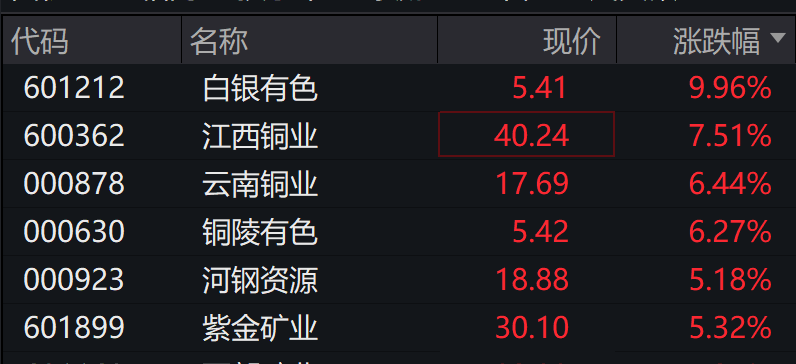
Market Overview - A-shares opened higher with the Shanghai Composite Index up 0.14% and the ChiNext Index up 0.26%, led by the non-ferrous metals and military sectors, while e-commerce stocks weakened [1] - Hong Kong stocks also opened higher, with the Hang Seng Index rising 0.34% and the Hang Seng Tech Index up 0.21%, notable gainers included New World Development up over 6% and China Metallurgical Group up over 5% [1][5] Commodity Performance - Most commodities opened higher, with silver rising 6.98%, the shipping index (European line) up 3.67%, and international copper up 2.39% [1] - The precious metals sector saw significant gains, with silver stocks hitting the daily limit, including Hunan Silver and Jiangxi Copper, both up over 6% [1] Bond Market - The bond market opened mostly lower, with the 30-year main contract down 0.01%, while the 5-year contract saw a slight increase of 0.01% [1][2] Stock Index Performance - The Shanghai Composite Index opened at 3894.21 points, up 0.14%, while the Shenzhen Component Index opened at 13038.16 points, up 0.42% [4] - The ChiNext Index opened at 3060.56 points, up 0.26%, and the CSI 300 opened at 4539.19 points, up 0.28% [4] Notable Stock Movements - Silver-related stocks showed strong performance, with Silver Holdings up 9.96% and Jiangxi Copper up 7.51% [2] - In the Hong Kong market, Meituan fell over 2% following its earnings report, while NetEase rose 1.3% and Alibaba increased nearly 1% [5]

有色金属走强,上证180ETF指数基金(530280)红盘向上
Sou Hu Cai Jing· 2025-12-01 02:04
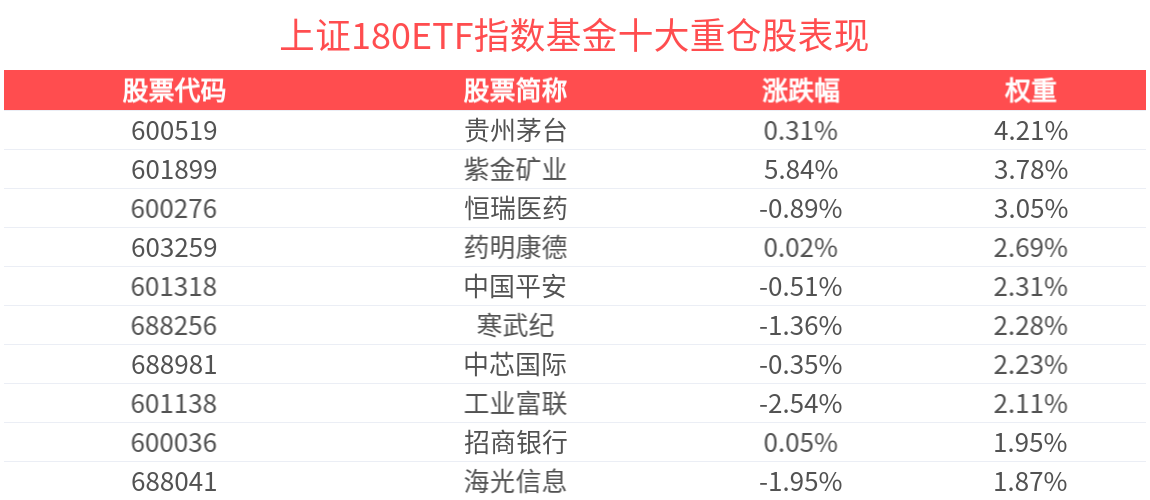
Core Insights - The A-share market is experiencing an upward trend, with expectations of a volatile structure in the short term, influenced by signals from the Federal Reserve [3] - The demand for copper is anticipated to rise due to tightening supply and increased demand from AI data center construction, while silver prices have reached historical highs [2][3] - The top ten weighted stocks in the Shanghai 180 Index account for 26.13% of the index, indicating concentrated investment opportunities [4] Group 1: Market Performance - As of December 1, 2025, the Shanghai 180 Index rose by 0.36%, with notable increases in stocks such as Jiangxi Copper (up 7.80%) and China Merchants Energy (up 6.24%) [1] - The Shanghai 180 ETF Index Fund also saw a slight increase of 0.34%, closing at 1.2 yuan [1] Group 2: Commodity Insights - Silver prices have surged significantly, with COMEX silver futures reaching a peak of $57.245 per ounce, marking a 90% increase year-to-date [1] - The Chilean state-owned copper company has raised long-term contract premiums to $350 per ton, highlighting supply constraints in the copper market [2] Group 3: Investment Opportunities - The electric aluminum sector is showing defensive characteristics with high dividends, and leading companies are seeing valuations drop to historical lows, suggesting potential for recovery [2] - Upcoming important meetings in December are expected to create investment opportunities related to economic policy and emerging industries such as AI and carbon materials [3]
万和财富早班车-20251201
Vanho Securities· 2025-12-01 02:01
Core Insights - The report highlights the recent trends in the domestic financial market, including a slight increase in the manufacturing PMI to 49.2% in November, indicating a marginal improvement in manufacturing activity [5] - The report discusses various industry dynamics, including Google's upcoming AI glasses integrated with Gemini technology, and the promotion of hydrogen energy technology by the National Development and Reform Commission [7] - It also focuses on specific companies, such as Jiangxi Copper planning to acquire shares in SolGold Plc and Hushen Electric submitting an application for H-shares listing [9] Domestic Financial Market - The manufacturing PMI for November stands at 49.2%, which is a 0.2 percentage point increase from the previous month [5] - The People's Bank of China and the Ministry of Science and Technology held a meeting to discuss the integration of technology and finance [5] Industry Dynamics - Google is set to release AI glasses that will deeply integrate with Gemini, with related stocks including Doctor Glasses and Hengxin Oriental [7] - The National Development and Reform Commission is encouraging the orderly development of hydrogen energy technology, with related stocks such as Fuan Energy and Jiaze New Energy [7] - Six departments have issued a document promoting flexible and customized models, with related stocks including Deen Precision and Zhiwei Intelligent [7] Company Focus - Jiangxi Copper is planning to acquire shares in SolGold Plc, currently in the informal offer stage [9] - Hushen Electric has submitted an application for H-shares listing on the Hong Kong Stock Exchange [9] - Enjie Co. is planning to issue shares to acquire 100% equity of Zhongke Hualian and raise matching funds [9] - Jiarong Technology intends to raise no more than 1 billion yuan through a private placement to acquire 100% equity of Hangzhou Lanran [9] Market Review and Outlook - On November 28, the market rebounded with all three major indices closing in the green, with a total trading volume of 1.59 trillion yuan, down 124 billion from the previous trading day [11] - The report notes that while the market shows signs of recovery, the trading volume has decreased, indicating potential challenges ahead if the volume does not increase [11] - The report emphasizes the need for a clear leading sector to maintain market momentum and profitability [11]
港股异动 | 江西铜业股份(00358)高开近5% 拟收购境外上市公司SolGold Plc股份
Zhi Tong Cai Jing· 2025-12-01 02:00
(原标题:港股异动 | 江西铜业股份(00358)高开近5% 拟收购境外上市公司SolGold Plc股份) 智通财经APP获悉,江西铜业股份(00358)高开近5%,截至发稿,涨4.82%,报32.16港元,成交额 1000.18万港元。 消息面上,11月30日,江西铜业公告称,公司已向伦敦证券交易所上市公司SolGold Plc提交两项非约束 性现金要约,拟以每股26便士的价格收购其全部股份。目前公司持有目标公司12.19%的股份,但该收 购事宜仍处于非正式要约阶段,且已被目标公司董事会拒绝。公司保留提出正式要约的权利,但具体是 否提出存在不确定性。根据英国《城市收购及合并守则》,公司需在2025年12月26日前发布正式要约公 告或明确放弃收购的公告。 ...
江西铜业股份(00358.HK)高开近5%
Mei Ri Jing Ji Xin Wen· 2025-12-01 01:45
每经AI快讯,江西铜业股份(00358.HK)高开近5%,截至发稿,涨4.82%,报32.16港元,成交额1000.18 万港元。 ...