DeepSeek

Search documents
年终大冲刺,中美科技大厂都杀疯了
商业洞察· 2025-12-19 09:58
Core Viewpoint - The article discusses the intensified competition among major tech companies in the AI sector as they launch new products and models towards the end of the year, marking a significant shift in the AI landscape [2][14]. Group 1: Major Product Launches - Alibaba launched the "Qianwen" app, based on its large model "Tongyi Qianwen," which is seen as a direct competitor to ChatGPT, featuring strong multilingual capabilities and a real-time translation function covering 119 languages [4][5]. - Ant Group introduced the "Lingguang" app, which emphasizes efficiency by allowing users to generate interactive applications in 30 seconds using natural language [4][5]. - Both apps quickly gained traction, with Qianwen reaching the top three in the App Store within two days and Lingguang surpassing two million downloads in six days [7]. Group 2: Competitive Landscape - ByteDance's "Doubao" launched a new AI phone assistant that integrates large model capabilities directly into hardware, allowing for complex cross-application tasks with simple voice commands [8][10]. - DeepSeek released two new models, DeepSeek-V3.2 and DeepSeek-V3.2-Speciale, aiming to enhance reasoning capabilities and cater to complex tasks, positioning itself as a competitor to Doubao [12][13]. - The competition among these companies has reached a "white-hot" level, pushing the domestic AI market to new heights [14]. Group 3: External Influences - The article highlights the influence of Silicon Valley, particularly the release of OpenAI's GPT-5.1 and Google's Gemini 3.0, which set new benchmarks for AI capabilities and prompted responses from domestic companies [16][20]. - Google's Gemini 3.0 was noted for its comprehensive upgrades and received positive feedback from industry leaders, indicating a shift towards a more collaborative AI platform [21][23]. Group 4: Strategic Timing of Releases - Major tech companies tend to launch significant AI models at the end of the year to maximize media exposure and public attention during a quieter news cycle [30][32]. - This timing allows companies to leverage the holiday season for increased visibility, as seen with the launch of ChatGPT, which coincided with the Thanksgiving to Christmas period [33]. - The end-of-year releases also serve as a strategic move for companies to define their capabilities and set competitive standards for the upcoming year [39][40]. Group 5: Future Implications - The article suggests that the current competition is shifting from merely releasing models to building comprehensive AI ecosystems that integrate model capabilities, product forms, and commercial viability [46]. - The outcomes of these year-end launches are expected to shape the future landscape of AI, indicating a new phase in the global AI race [47].




Top China Tech Plays in US Markets Amid Trade Deal Progress
ZACKS· 2025-12-18 15:21
Core Insights - Chinese technology stocks, including Tencent, Bilibili, NetEase, and PDD Holdings, have gained momentum following the U.S.-China trade agreement, with China meeting commitments such as terminating semiconductor investigations and resuming agricultural purchases [2] - SMIC achieved volume production of 5nm chips, marking a significant advancement in China's semiconductor manufacturing capabilities [3] - BYD's exports surged 326% year over year, with NEV penetration in China reaching 62% [4] - The humanoid robotics sector saw a 250% increase in investment deals, reflecting growing integration in manufacturing [6] - China's defense budget increased by 7.2% to $249 billion, with significant advancements in military technology [7] - The medical device market in China reached $172.9 billion, showing substantial growth and innovation [8] - China Railway Rolling Stock Corporation maintained a 56% global market share in rail, while Chinese shipyards secured 38% of new global LNG vessel orders [9] - The Politburo's announcement of a "moderately loose" monetary policy and Goldman Sachs raising GDP forecasts to 4.8% indicates a stabilizing economic environment [10] Company Summaries - Tencent Holdings reported record gaming sales of $10 billion internationally, with a 15% revenue growth and 43% surge in international gaming [12] - Bilibili turned profitable with a net profit of RMB469 million in Q3 2025, showing a 233% year-over-year increase in adjusted net profit [13] - NetEase's gaming revenues increased by 11.8% year over year to RMB23.3 billion, supported by a strong partnership with Blizzard [14] - PDD Holdings demonstrated a 9% revenue growth and 17% net income expansion, maintaining a strong financial position with RMB387 billion in cash reserves [15]



对我们“卡脖子”是卡不住的
Sou Hu Cai Jing· 2025-12-18 10:20
Core Viewpoint - China's manufacturing sector has achieved remarkable growth, now accounting for nearly 30% of global manufacturing value added and maintaining the world's largest scale for 15 consecutive years, showcasing strong competitiveness and innovation in various industries [1] Group 1: Historical Context - At the founding of New China, the industrial base was extremely weak, with only a few consumer goods being produced, and heavy industrial products were virtually nonexistent [3] - By the time of the first Five-Year Plan, significant projects were initiated, establishing a relatively complete modern industrial system and laying the groundwork for future manufacturing development [4] - The industrial foundation was further solidified before the reform and opening up, creating a robust industrial backbone for the nation [5] Group 2: Reform and Opening Up - The theme of Chinese manufacturing shifted from "entrepreneurship" before the reform to "innovation" post-reform, significantly enhancing productivity and integrating into the global division of labor after joining the WTO [6][7] - China's manufacturing share of global output rose from 2.7% in 1990 to 19.8% in 2010, surpassing the United States to become the world's leading manufacturing power [7] Group 3: Challenges and Responses - Despite rapid growth, concerns about the "big but not strong" nature of Chinese manufacturing emerged, highlighting weaknesses in technological innovation and positioning within the global value chain [7] - The global manufacturing landscape has changed, with Western countries pushing for re-industrialization and imposing technological barriers against China [7] Group 4: Strategic Independence - Strategic independence has been crucial for China's manufacturing resilience, with a focus on self-innovation in key sectors like automotive and high-speed rail, leading to significant advancements in domestic technology [10][11] - The balance between technology importation and independent development has been recognized as essential for maintaining competitiveness [11] Group 5: Long-term Vision and Action - China's manufacturing achievements are the result of long-term planning and consistent efforts, with significant investments in high-speed rail and electric vehicles dating back over a decade [12][13] - The commitment to innovation and the establishment of a manufacturing powerhouse has been reinforced by national policies aimed at enhancing manufacturing capabilities [15] Group 6: Future Outlook - The upcoming "14th Five-Year Plan" emphasizes the importance of manufacturing and outlines new directions for technological advancement and global competitiveness [17] - The ongoing journey of Chinese manufacturing is seen as a continuous evolution, with the potential for further breakthroughs and value expansion driven by innovation and practical efforts [17]
张予彤入主月之暗面,kimi该去哪“爆金币”?
3 6 Ke· 2025-12-18 03:54
Core Viewpoint - Zhang Yutong has transitioned from an investor at Jingshanjiang to the president of Moonlight Dark Side's Kimi, indicating a resolution of previous disputes and a focus on the company's strategic and commercial direction [1] Group 1: Company Leadership and Changes - Zhang Yutong's appointment as president of Kimi has been confirmed, suggesting that internal conflicts with Jingshanjiang have been resolved [1] - The previous legal disputes surrounding Zhang Yutong's ownership of shares in Moonlight Dark Side have seemingly settled, allowing for his continued leadership [1] Group 2: Industry Challenges and Competition - Kimi's previous technological advantages, such as long-text processing capabilities, are now considered industry standards, diminishing its competitive edge [2][3] - The rapid pace of technological iteration in the AI sector means that Kimi's innovations can be quickly replicated by competitors, leading to a crowded market with little differentiation [3][4] - The open-source nature of the AI ecosystem in China allows for swift dissemination of technological advancements, making it difficult for any single company to maintain a lasting lead [3][5] Group 3: Commercialization and Financial Viability - The transition from technological innovation to commercial viability is a significant challenge for AI startups like Kimi, which must convert operational costs into revenue [6][10] - Unlike larger tech companies, independent AI firms lack the financial backing and established user bases, making it harder to secure funding and find viable business models [7][11] - Kimi is exploring various monetization strategies, including premium features and API services, to convert high-frequency users into paying customers [11][12] - The pressure to achieve commercial success is not unique to Kimi, as even leading firms like OpenAI face similar challenges in converting their technological advancements into sustainable revenue streams [9][10]
烧掉千亿,卷完参数卷落地:中国 AI 生存之战路在何方?
Sou Hu Cai Jing· 2025-12-17 17:26
Core Insights - The competition in the AI market has shifted from a focus on technical specifications to practical applications and business models, marking a transition from a "military competition" to a "survival battle" [4][10][18] - The Chinese AI market saw a surge of over 478 foundational models in 2023, leading to a "Hundred Model War," but is now undergoing a significant market consolidation by 2025 [4][5][7] - The leading players in the current market are ByteDance, Alibaba, Jiyue Xingchen, Zhipu AI, and DeepSeek, forming a new order known as the "Five Strong Models" [7] Market Dynamics - The AI industry is entering a critical "capital realization period" where investors are looking for clear economic models rather than just large parameter counts [8][9] - Companies are exploring unique business models, such as MiniMax's Talkie application, which targets the "AI companion" market instead of competing in the crowded productivity tools space [9] - The trend of open-source development is gaining momentum, with DeepSeek's strategy significantly impacting the industry and Alibaba's Qwen model achieving over 10 million derivative models [12] Competitive Landscape - Major players are engaging in differentiated competition, focusing on their unique strengths: established giants leverage their ecosystems, while newcomers target niche markets [14][15] - The competition is characterized by a focus on high-quality data, the ability to monetize effectively, and navigating regulatory landscapes [15] - The emergence of intelligent agents is seen as crucial for bridging the gap between AI technology and real-world applications, emphasizing the need for practical solutions [17] Future Outlook - The AI industry is expected to continue evolving, with a focus on specialized applications that address specific industry needs, rather than broad, generalized solutions [18][19] - The future leaders in the AI space may not be the most vocal today but those who effectively integrate their technologies into everyday life [20]
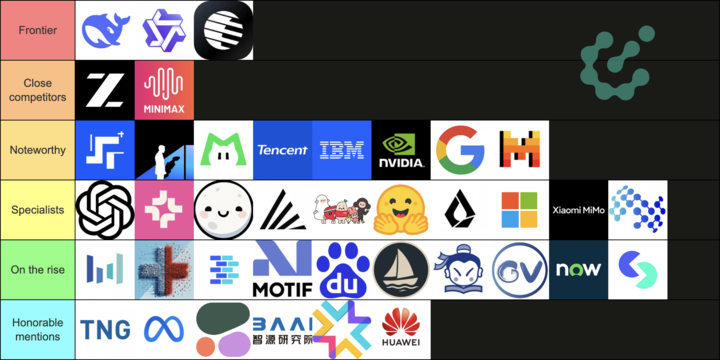
在这个开源「从夯到拉」榜单,我终于明白中国 AI 为什么能逆袭
Xin Lang Cai Jing· 2025-12-17 14:25
Core Insights - The recent ranking of open-source AI models highlights the dominance of Chinese models, with DeepSeek, Qwen, Kimi, Zhipu, and MiniMax leading the global landscape, while OpenAI and Meta's models lag behind [3][5][25]. Group 1: Performance and Market Position - Chinese open-source models are rapidly closing the performance gap with closed-source giants, excelling in dimensions such as performance, pricing, ecosystem, and usability [5][25]. - Kimi's K2 Thinking model, featuring a trillion parameters, has outperformed OpenAI's GPT-5 and Anthropic's Claude 4.5 in various benchmarks [11][14]. - MiniMax M2 has also shown strong performance, ranking fifth in comprehensive lists, surpassing competitors like Gemini 2.5 Pro and Claude Opus 4.1 [14][79]. Group 2: Technological Advancements - The introduction of interleaved thinking in models like MiniMax M2 and Kimi K2 Thinking allows for more efficient task execution by alternating between action and reflection [34][36]. - MiniMax M2 employs a full attention mechanism, which, despite increasing training and inference demands, has proven to deliver better performance compared to sparse attention models [75][78]. Group 3: Cost and Accessibility - MiniMax's API offers competitive pricing at $0.3/$1.2 per million input/output tokens, although its verbose nature leads to high token usage, which can offset cost advantages [79]. - The open-source movement in China is gaining momentum, with MiniMax's release reinforcing the leadership established by DeepSeek and other Chinese AI labs in the open-source domain [80][84]. Group 4: Community and Developer Adoption - There is a growing recognition among developers for the practicality and affordability of Chinese open-source models, with many citing them as preferable alternatives to established closed-source options like OpenAI [25][84]. - The rapid updates and releases from various Chinese companies indicate a robust and collaborative open-source ecosystem that is continuously evolving [11][14].
AI被灌入垃圾营销信息:榜单排名成重灾区,低至几千元可改变AI回答
Di Yi Cai Jing· 2025-12-17 08:52
业内人士称,AI需要建立一套可交叉验证的信源体系,使引用的内容经得起反复核对。 在AI聊天软件上要求AI推荐商品或厂家,得到的信息都是准确的吗?记者将这个问题抛给了两个GEO(生成式引擎优化)厂商负责人,得到的回答都是: AI会抓取到一些杜撰的垃圾信息。 GEO是一种基于AI回答的营销行为,是指广告营销公司为品牌客户生产、调整内容,使相应内容更容易被AI聊天软件抓取并出现在AI的回答里,达到增加 品牌曝光度或改变AI回答的效果。 如何看出是杜撰内容?按照GEO业内人士的建议,记者在DeepSeek上随意地问了一些关于产品或厂商排行的问题。当问及电脑等常见大众消费品时, DeepSeek所参考的网页多引用了权威市场研究机构的数据。但当问及一些垂直行业时,AI引用的一些网页中,信息就变得不太严谨,例如相关网页称产品 排名来自"专业测评",但并未体现测评过程就直接给出结论。有GEO业内人士告诉记者,这些内容不仅粗糙,还可能是假的。 AI引用的信息真实吗? 联网搜索的AI聊天软件通常会列出所引用网页的链接,供用户查验信息来源。除此之外,记者在DeepSeek上看到,当询问某产品或某行业厂商的排行时, DeepSeek ...
中国移动发布6G传输技术白皮书,云计算ETF天弘(517390)跟踪指数飙升涨超3%,电子ETF(159997)连续两日净流入
Sou Hu Cai Jing· 2025-12-17 06:37
Core Insights - The cloud computing ETF Tianhong (517390) has seen a significant increase in trading volume and performance, with a 3.04% turnover and a transaction value of 9.96 million yuan, while the underlying index rose by 3.13% [1] - The electronic ETF (159997) also performed well, with a transaction value of 23.28 million yuan and a 2.88% increase in the underlying index, indicating strong investor interest in both sectors [1] - The cloud computing ETF has experienced a notable growth of 619.30 million yuan over the past six months, reflecting a robust demand for cloud computing investments [1] Cloud Computing ETF Insights - The cloud computing ETF Tianhong (517390) is positioned to capture opportunities in AI-driven cloud computing, focusing on both Hong Kong and mainland technology leaders [2] - The ETF aims to leverage the growth potential of the cloud computing sector, particularly in light of the increasing demand for AI capabilities [2] Electronic ETF Insights - The electronic ETF (159997) tracks the CSI Electronic Index and is heavily weighted in semiconductor and consumer electronics sectors, including AI chips and automotive electronics [2] - The ETF has seen a net inflow of 1.55 million yuan over the last two days, indicating a positive trend in investor sentiment towards electronic technology [1] Recent Developments - NVIDIA launched the Nemotron 3 AI model series, which features a hybrid MoE architecture and a context window of 1 million tokens, enhancing multi-agent and long-sequence reasoning capabilities [4] - China Mobile released a white paper on 6G transmission technology, marking a significant step from theoretical research to system validation [5] Industry Trends - The global AI model landscape is shifting from "fast thinking" to "slow thinking," emphasizing algorithm optimization and training paradigms over sheer computational power [6] - Companies like Google and OpenAI are advancing their AI capabilities through innovative models that enhance reasoning and knowledge density, indicating a competitive shift in the industry [6]


AI投资为什么转向产业链?
虎嗅APP· 2025-12-16 10:38
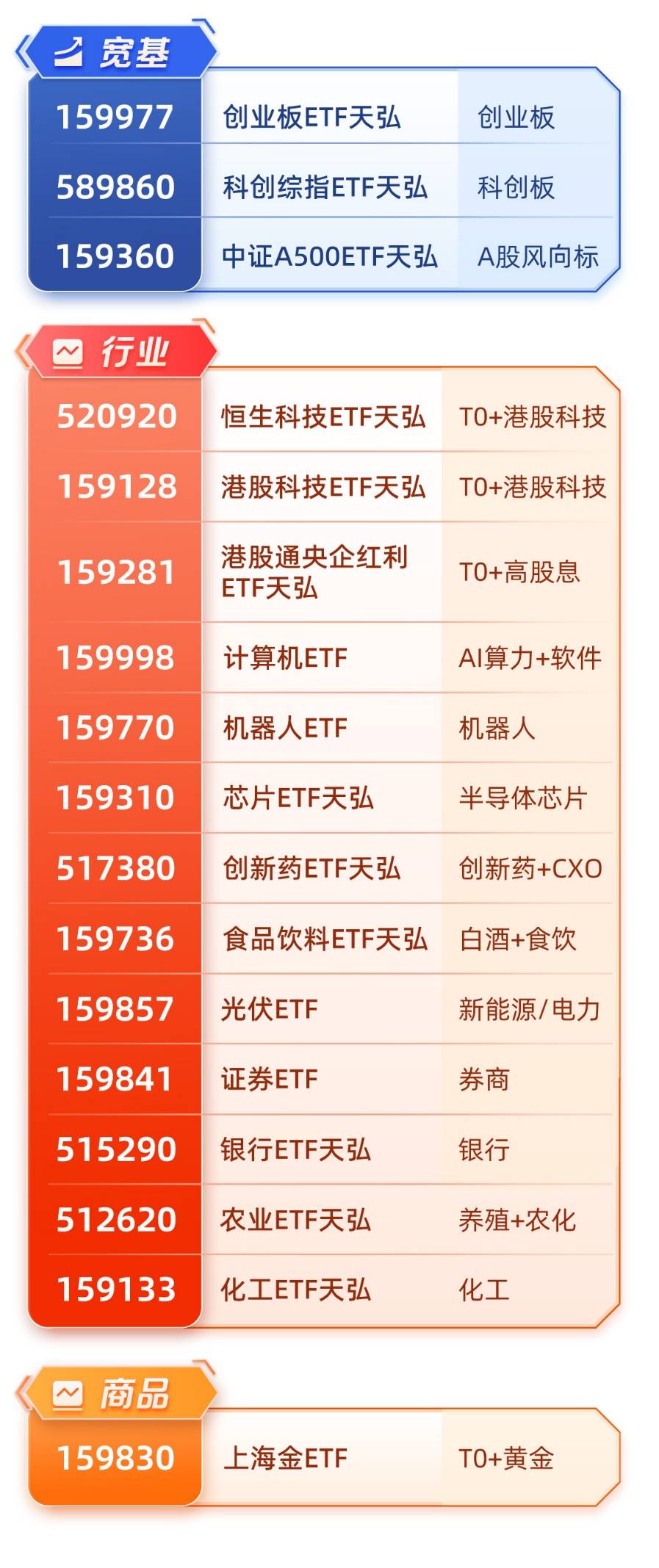
Core Viewpoint - The article emphasizes that 2025 is a "golden window period" for AI investment, driven by a deep resonance of policy, technology, and demand, transitioning the industry from "possibility" to "certainty" [4]. Policy Support - The Chinese government has elevated AI as a core engine for economic transformation, with a goal of over 70% penetration of smart terminals by 2027 and a fully intelligent society by 2035 [6]. - In Q1 2025, domestic AI-related companies received government subsidies that increased by 38% year-on-year, with subsidies for computing infrastructure and intelligent robotics exceeding 50% growth [6]. Technological Breakthroughs - OpenAI's release of the o3 and o4-mini models has advanced AI capabilities from understanding to performing tasks [6]. - The establishment of the Agentic AI Foundation (AAIF) aims to unify industry standards, enhancing AI application development efficiency by 40% and reducing implementation costs by 25% [6]. Demand Surge - Global tech giants are aggressively investing in AI infrastructure, with Microsoft planning to invest $17.5 billion in India over four years and Alibaba Cloud aiming for over 380 billion yuan in the next three years [7]. - The demand for AI has expanded from consumer entertainment to B2B applications, with smart factories improving efficiency by 30% and medical AI achieving over 92% accuracy in imaging diagnostics [7]. Investment Strategy - The complexity and volatility of the AI industry necessitate diversified investment strategies, as individual stock performance can be significantly affected by changes in policy, technology, and production schedules [9]. - Index-based investments are highlighted as a superior solution for ordinary investors, allowing them to capture industry growth while mitigating risks associated with individual stocks [9]. ETF Products - The company has developed a range of ETFs that cover the entire AI industry chain, catering to different risk appetites. These include: - The AI ETF focusing on "computing devices + software services + application scenarios" [10]. - The Sci-Tech AI ETF targeting core areas like AI chips [10]. - The Software ETF concentrating on AI software and fintech [10]. - The Robotics ETF, which has a high concentration on humanoid robots [10]. Risk Management - The company employs a robust risk management system that includes real-time monitoring and diversified asset allocation to mitigate the impact of uncertainties in the AI sector [13].
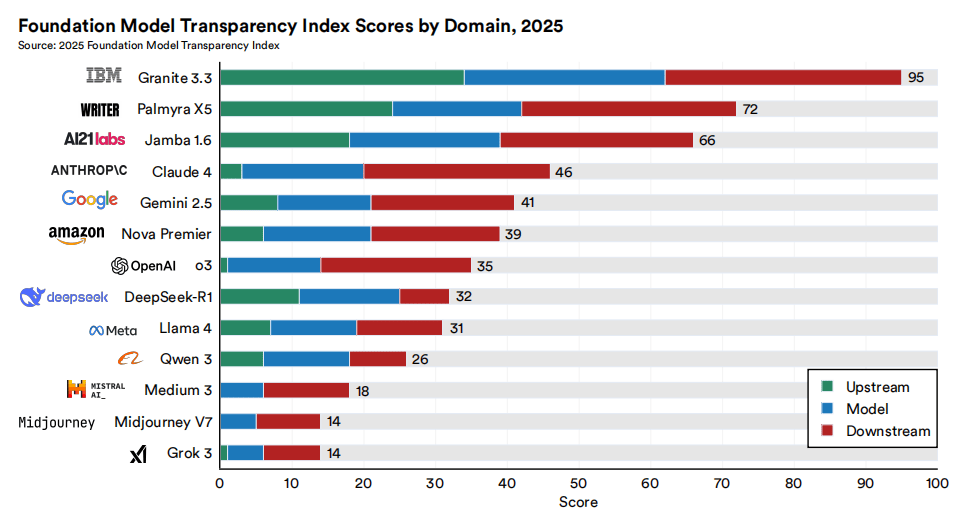
斯坦福报告:AI透明度集体倒退!IBM夺冠,马斯克xAI垫底
Sou Hu Cai Jing· 2025-12-16 10:28
(来源:The 2025 Foundation Model Transparency Index) 从报告的整体结果来看,尽管 2024 年报告显示模型透明度有短暂的改善,但 2025 年的报告指出,透明度指数正呈现倒退:各基础模型的平 均得分从 2024 年的 58 分下降到 2025 年的 40 分,几乎与 2023 年报告首次发布时的水平相当(备注:100 分为满分)。 最近,美国斯坦福大学等团队发布了一份名为《2025 年基础模型透明度指数》(FMTI,The 2025 Foundation Model Transparency Index)的报 告。其中,IBM 以透明度得分最高夺冠,xAI 和 Midjourney 则垫底。 该报告揭示了一种令人担忧的趋势:随着技术的发展,尽管基础模型在性能等各方面持续进步,但其在数据使用、模型训练和下游影响等方 面的透明度却出现了集体倒退。 这是该报告自 2023 年以来发布的第三个年度版本,就像通过量化透明度为各大基础模型开发者做一次"体检"。 本次评估共包括 13 家基础模型公司,其中既有阿里巴巴、DeepSeek 和马斯克的 xAI 等首次纳入报告的企业, ...