
中国生物制药

Search documents
医保基金数据跟踪:8月医保结余持续优化
Ping An Securities· 2025-10-14 12:44
Investment Rating - The industry investment rating is "Outperform the Market" (预计6个月内,行业指数表现强于沪深300指数5%以上) [28] Core Insights - From January to August 2025, the overall medical insurance fund income maintained positive growth, with total income reaching 18809.94 billion yuan, a year-on-year increase of 6.91%. Total expenditure was 15432.20 billion yuan, a year-on-year decrease of 1.80%. The cumulative surplus for the same period was 3377.74 billion yuan, a year-on-year increase of 79.74% [2][3][13] - The surplus rate for January to August 2025 was 17.96%, an increase of 7.28 percentage points compared to the same period in 2024. The surplus rate for August 2025 was 11.62% [2][13][15] - The medical insurance fund's performance improved compared to 2024, with only May showing a deficit in monthly surplus [13] Summary by Sections Medical Insurance Fund Performance - The medical insurance fund income from January to August 2025 was 18809.94 billion yuan, with a year-on-year growth of 6.91%. Expenditure was 15432.20 billion yuan, down 1.80% year-on-year. The cumulative surplus was 3377.74 billion yuan, up 79.74% year-on-year [2][6][13] - The surplus rate for the same period was 17.96%, which is an improvement from the previous year [2][13] Employee and Resident Medical Insurance - Employee medical insurance income for January to August 2025 was 11954.62 billion yuan, a year-on-year increase of 5.43%. In August, the income was 1452.27 billion yuan, up 1.97% year-on-year. Expenditure for the same period was 8811.88 billion yuan, a year-on-year increase of 2.24% [3][21] - For residents, the income was 6855.32 billion yuan, a year-on-year increase of 9.59%, while expenditure decreased by 6.70% [21][26] Investment Recommendations - The report suggests focusing on innovative pharmaceutical companies with rich pipelines, such as Heng Rui Medicine, BeiGene, and China National Pharmaceutical Group. It also highlights companies with significant single-product potential and those leading in advanced technology platforms [4][26] - In the CXO sector, companies like WuXi AppTec and Kelun Pharmaceutical are recommended, along with medical device companies that have been undervalued due to previous price pressures [4][26]
港交所最新宣布!又一对冲工具来了,涉及最火赛道
券商中国· 2025-10-14 12:22
Core Viewpoint - Hong Kong Exchanges and Clearing Limited (HKEX) plans to launch the Hang Seng Biotechnology Index Futures on November 28, 2025, providing effective risk management tools for the rapidly growing biotechnology sector [2][3][4]. Group 1: Product Details - The new futures contract will have the code HBI, with a contract multiplier of HKD 50 per index point, and will be available for trading in the current month, the next three months, and the following three quarterly months [3]. - The first six months of trading will be exempt from the Securities and Futures Commission transaction fees, with the margin rate to be announced later [3][4]. Group 2: Market Context - The biotechnology sector is currently one of the hottest and fastest-growing industries in the Hong Kong capital market, driven by technological innovation and global healthcare demand [4]. - The Hang Seng Biotechnology Index has recorded a 63.61% increase over the past year, significantly outperforming the Hang Seng Index, which rose by 20.62% [4]. - Year-to-date, the Hang Seng Biotechnology Index has surged by 90.33%, surpassing the Hang Seng Technology Index's increase of 37.54% [4]. Group 3: Major Constituents - The index tracks the 30 largest biotechnology, pharmaceutical, and medical device companies listed on the Hong Kong Stock Exchange, with major constituents including WuXi Biologics, BeiGene, and Innovent Biologics [4][5]. - The top ten weighted stocks in the index include: - WuXi Biologics (10.83% weight, market cap HKD 120.825 billion) - BeiGene (10.21% weight) - Innovent Biologics (9.18% weight, market cap HKD 139.0 billion) - And others, contributing to a diverse representation of the sector [5]. Group 4: Industry Growth - Since the listing reforms in 2018, the biotechnology and healthcare sectors have become the fastest-growing industries in Hong Kong, with over 260 companies listed and a total market capitalization exceeding HKD 4.8 trillion, quadrupling from approximately HKD 1.2 trillion at the end of 2018 [6].


创新药砸出“黄金坑”?520880重挫4.22%创历史最大单日跌幅!溢价逆向走高,抄底资金进场?
Xin Lang Ji Jin· 2025-10-14 11:47
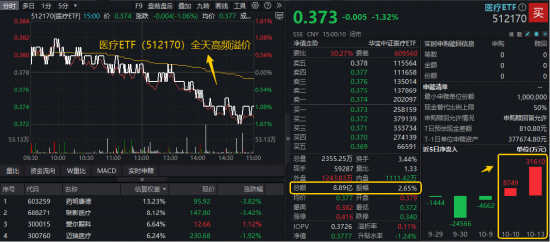
Core Viewpoint - The pharmaceutical sector, particularly innovative drugs, is experiencing significant volatility, with both A-shares and Hong Kong stocks showing sharp declines in recent trading sessions, indicating potential investment opportunities amidst market fluctuations [1][3][5]. Group 1: A-Share Market Performance - A-share market saw major declines in innovative drug stocks, with Beida Pharmaceutical dropping by 10.63%, Hengrui Medicine down 4.05%, and Baili Tianheng falling 6.18%, leading to a 2.21% drop in the only drug ETF (562050) [1]. - The CXO sector also faced declines, with WuXi AppTec falling 3.82%, while the largest medical ETF (512170) only decreased by 1.32%, indicating some resilience in the market [1]. Group 2: Hong Kong Market Performance - The Hong Kong pharmaceutical market experienced even more volatility, with innovative drug stocks like Kelun-Bio dropping 9.82% and major players like CSPC Pharmaceutical and Innovent Biologics falling over 6% [3]. - The Hong Kong Stock Connect innovative drug ETF (520880) opened up 1.86% but ended the day down 4.22%, marking its largest single-day drop since inception, with a trading volume of 4.1 billion [3]. Group 3: Investment Sentiment and Opportunities - Despite the ongoing market downturn, there is a noticeable increase in buying interest, as evidenced by a significant inflow of capital into the medical ETFs, suggesting that investors may be looking for "golden pit" opportunities in the pharmaceutical sector [5][6]. - Analysts suggest that the recent declines may be a release of short-term risks and emotional volatility, with potential for greater opportunities than risks if the market undergoes significant adjustments [5]. Group 4: Market Dynamics and Future Outlook - The fund manager of the Hong Kong Stock Connect innovative drug ETF highlighted the interconnectedness of the US and Chinese biopharmaceutical industries, suggesting that recent tariff tensions may lead to a "TACO trade" strategy, where investors anticipate a reversal of aggressive policies [6]. - The innovative drug sector is supported by strong fundamentals, including innovation capabilities and global competitiveness, which remain unchanged despite market fluctuations [6]. - With the global liquidity easing cycle initiated by the Federal Reserve, many institutions view Hong Kong stocks as undervalued and a favorable investment opportunity [7].
广发证券:首予中国生物制药“买入”评级 步入创新发展新阶段
Zhi Tong Cai Jing· 2025-10-14 08:02
Core Viewpoint - The report from GF Securities initiates coverage on China Biopharmaceutical (01177) with a "Buy" rating, projecting EPS of 0.23, 0.26, and 0.28 CNY per share for 2025-2027, and a fair value of HKD 11.54 per share, highlighting the company's transformation from a generic drug manufacturer to an R&D-driven international pharmaceutical group [1][2]. Group 1 - The company has established a strong product matrix through self-research, mergers and acquisitions, and pipeline introductions, covering four core therapeutic areas: oncology, liver disease, respiratory system, and surgical/pain management [1][2]. - R&D investment has been increasing year-on-year from 2018 to the first half of 2025, with the R&D expense ratio rising from 9.9% to 18.1%, and R&D expenses reaching CNY 3.188 billion in the first half of 2025, with approximately 78% allocated to innovative drug development [2]. Group 2 - In the oncology field, key products include: - "Defu" combination therapy with Anlotinib, which is a flagship product, and its combination with anti-PD-(L)1 for first-line indications [2]. - HER2 dual antibody ADC TQB2102, which is leading globally and has entered Phase III for treating HER2 low-expressing and HER2-positive breast cancer [2]. - CDK2/4/6 inhibitor Kumosilib, a global first, has submitted for marketing approval for HR+/HER2- breast cancer [2]. - CCR8 monoclonal antibody LM-108, a global first, is currently in Phase II [2]. - In the respiratory field, PDE3/4 inhibitors are expected to become a blockbuster drug for COPD, with TQC3721 being in the second position globally [2]. - In the liver disease area, the pan-PPAR agonist Lanifibranor may become the first MASH drug in China, while FGF21 fusion protein could be the most effective MASH drug [2]. - In the surgical and pain management sector, the company has established four transdermal patch technology platforms, solidifying its position as a leader in transdermal formulations [2].


广发证券:首予中国生物制药(01177)“买入”评级 步入创新发展新阶段
智通财经网· 2025-10-14 07:59
Core Viewpoint - GF Securities initiates coverage on China Biologic Products (01177) with a "Buy" rating, projecting EPS of 0.23, 0.26, and 0.28 CNY per share for 2025-2027, with a fair value of HKD 11.54 per share, highlighting the company's transformation from a generic drug manufacturer to an R&D-driven international pharmaceutical group [1][2] Group 1 - The company has established a strong product pipeline covering four core therapeutic areas: oncology, liver disease, respiratory system, and surgical/pain management, successfully transitioning from a generic drug company to an innovative pharmaceutical leader [1][2] - R&D investment has been increasing annually from 2018 to H1 2025, with the R&D expense ratio rising from 9.9% to 18.1%, and R&D expenses reaching CNY 3.188 billion in H1 2025, with approximately 78% allocated to innovative drug development [2] Group 2 - In the oncology field, key products include: - "DeFu" combination therapy with Anlotinib, which is a flagship product, expanding first-line indications through combination with anti-PD-(L)1 therapy, with approvals for SCLC, endometrial cancer, and renal cell carcinoma [2] - HER2 bispecific antibody ADC TQB2102, which is leading globally and is in Phase III for treating HER2 low-expressing and HER2-positive breast cancer [2] - CDK2/4/6 inhibitor Kumosi Li, the world's first of its kind, has submitted for marketing approval for HR+/HER2- breast cancer [2] - CCR8 monoclonal antibody LM-108, a global first, is currently in Phase II [2] Group 3 - In the respiratory field, PDE3/4 inhibitors are expected to become a blockbuster drug for COPD, with TQC3721 being in the second position globally [2] - In the liver disease area, the pan-PPAR agonist Lanifibranor may become the first MASH drug in China, while FGF21 fusion protein could be the most effective MASH drug [2] - In the surgical and pain management sector, the company has established four transdermal patch technology platforms, solidifying its position as a leader in transdermal formulations [2]
上市公司花了1.25亿元研发的仿制药,上市申请被否!仿制对象已“翻车”:因安全性问题在欧美市场退市
Mei Ri Jing Ji Xin Wen· 2025-10-14 05:40
Core Points - The application for the generic drug developed by Fudan Zhangjiang, which cost 125 million yuan, was rejected due to safety concerns related to its reference drug, which has been withdrawn from the European and American markets [1][2] - The original drug, Ocaliva, has faced multiple safety warnings since 2017, leading to its withdrawal from the market and suspension of all related clinical trials [3][4] - The domestic market for the generic version of Ocaliva is now highly uncertain due to the original drug's safety issues and market withdrawal [4][5] Company Summary - Fudan Zhangjiang's subsidiary, Taizhou Fudan Zhangjiang Pharmaceutical Co., received a notice from the National Medical Products Administration stating that the application for Obechol acid tablets was not approved due to non-compliance with drug registration requirements [1][5] - The company has invested approximately 125 million yuan in the development of Obechol acid tablets, but the rejection of the application is not expected to have a significant impact on its current financial status [1][5] - Other domestic companies, including Hengrui Medicine and Zai Lab, are also facing setbacks in their applications for Obechol acid generics, with several applications still pending approval [5] Industry Summary - Obechol acid, originally developed by Intercept Pharmaceuticals, was first approved in 2016 for treating primary biliary cholangitis (PBC) but has since faced serious safety concerns leading to its market withdrawal [2][3] - The prevalence of PBC in China has been increasing, reaching 21.05 per 100,000 in 2022, indicating a potential market for treatments despite the current setbacks [2] - The domestic market for Obechol acid generics is now fraught with uncertainty, as the original drug's safety risks have raised doubts about the viability of its generic counterparts [4][5]

上市公司花了1.25亿元研发的仿制药,上市申请被否!仿制对象已“翻车”:因安全性问题在欧美市场退市,所有相关临床试验被暂停
Mei Ri Jing Ji Xin Wen· 2025-10-14 05:00
Core Viewpoint - Fudan Zhangjiang (688505.SH) announced that its subsidiary, Taizhou Fudan Zhangjiang Pharmaceutical Co., Ltd., received a notice from the National Medical Products Administration stating that the application for the marketing authorization of Ocaliva (Obeticholic Acid Tablets) for the treatment of primary biliary cholangitis (PBC) was not approved due to non-compliance with drug registration requirements [1] Group 1: Drug Approval and Market Impact - The primary reason for the rejection of the marketing application is the safety issues associated with the original drug, which led to its withdrawal from the European and American markets [1][2] - Fudan Zhangjiang has invested approximately 125 million yuan in the development of Obeticholic Acid Tablets, but the company stated that the rejection will not have a significant impact on its current financial status [1][3] Group 2: Original Drug Background - The original drug, Ocaliva, developed by Intercept Pharmaceuticals, was first approved by the FDA in May 2016 and received conditional approval in Europe in December 2016 [2] - The global sales of Ocaliva showed steady growth from 2016 to 2021, reaching approximately 363 million USD in 2021, but stabilized around 300 million USD in subsequent years [2] Group 3: Safety Concerns and Regulatory Actions - Since 2017, there have been multiple safety alerts regarding Ocaliva, including reports of severe liver damage and even death, leading to the FDA placing a "black box warning" on the drug [3] - In October 2023, the European Medicines Agency recommended the withdrawal of Ocaliva's marketing authorization, which was officially revoked in September 2024 [3] Group 4: Domestic Generic Drug Landscape - Currently, there are no approved domestic versions of Obeticholic Acid, and the safety risks associated with the original drug have created significant uncertainty for its generic prospects in China [4][5] - Several domestic pharmaceutical companies, including Hengrui Medicine and Zai Lab, are also facing setbacks in their applications for Obeticholic Acid generics [5][6]

中国生物制药(1177.HK):PDE3/4抑制剂II期临床数据亮眼 市场潜力巨大
Ge Long Hui· 2025-10-14 04:52
Core Insights - China Biopharmaceutical presented positive Phase II clinical results for its PDE3/4 inhibitor TQC3721 at the European Respiratory Society 2025 conference, showing rapid improvement in lung function and symptoms for COPD patients [1][2] Group 1: Clinical Results - TQC3721 demonstrated significant improvements in FEV1 peak values compared to the placebo group, with increases of 100ml and 147ml for the 3mg and 6mg groups respectively after 4 weeks of treatment [1] - In the subgroup of patients using LAMA and LABA/LAMA, the 6mg group showed a FEV1 peak increase of 239ml compared to the placebo group [1] - The safety profile of TQC3721 was favorable, with no significant adverse effects observed in gastrointestinal, cardiovascular, or liver and kidney functions during the clinical trial [1] Group 2: Comparative Analysis - TQC3721's clinical data suggests it has best-in-class potential, with the 6mg group showing FEV1 peak values consistent with those of the recently approved drug ensifentrine [2] - The baseline characteristics of TQC3721 trial participants were poorer compared to those in the ensifentrine trials, indicating a greater potential for clinical benefit in real-world COPD patients [2] Group 3: Market Potential - The global COPD market is substantial, with nearly 480 million affected individuals worldwide, and over 100 million in China, making it a significant health and economic burden [3] - The recent acquisition of Verona by Merck for $10 billion highlights the market potential for PDE3/4 inhibitors, with ensifentrine's sales showing strong growth [3] - TQC3721, being the second globally in development and the only PDE3/4 inhibitor in Phase III trials, is positioned for significant overseas licensing opportunities [3]
医药行业周报:25Q3业绩前瞻:创新药持续快速放量 出口业务预计表现较好
Chan Ye Xin Xi Wang· 2025-10-14 02:59
Core Insights - The pharmaceutical index increased by 0.36% from September 29 to October 10, underperforming the CSI 300 index by -1.11% [1] - The "Most-Favored-Nation Pricing" agreement catalyzed significant stock price increases for U.S. MNCs, which also positively impacted Hong Kong's innovative drug sector, although there was a notable decline in the following trading days [1] - Anticipated catalysts in October include ESMO, BD, and medical insurance negotiations, which may stabilize and rebound innovative drug stocks [1] Market Performance - From September 29 to October 10, 316 stocks rose while 148 fell, with notable gainers including Zhendong Medical (+31.82%) and Wanbangde (+21.21%), while major losers included Nanxin Pharmaceutical (-28.67%) and ST Fuhua (-13.64%) [2] - Q3 performance expectations indicate a significant trend in innovative drug volume, with traditional pharmaceutical companies like Heng Rui expected to maintain Q2 trends [2] - Blood products and vaccines are projected to face continued pressure, while CXO and upstream research are expected to show good external demand growth [2] Investment Opportunities - The Chinese pharmaceutical industry has transitioned to new growth drivers, particularly in innovative drugs, with companies like Heng Rui and Han Sen making significant strides [3][4] - The demand for chronic disease treatments is increasing due to an aging population, supported by a stable growth in medical insurance revenue [4] - The AI wave is anticipated to unlock new growth logic in the pharmaceutical sector [4] Recommended Stocks - Current recommendations include Xintai, Rejing Bio, and China National Pharmaceutical, with a focus on companies like Heng Rui and Sanofi for October [5]



原研药海外退市引发连锁反应:复旦张江花了1.25亿元研发的奥贝胆酸片仿制药上市申请遭否
Mei Ri Jing Ji Xin Wen· 2025-10-13 15:55
Core Points - Fudan Zhangjiang (688505.SH) announced that its subsidiary, Taizhou Fudan Zhangjiang Pharmaceutical Co., Ltd., received a notice from the National Medical Products Administration stating that the drug application for Obeticholic Acid Tablets was not approved due to non-compliance with drug registration requirements [1] - The original drug for Obeticholic Acid faced safety issues and was withdrawn from the European and American markets, which was a significant reason for the rejection of the application [1] - The company has invested approximately 125 million yuan in the development of Obeticholic Acid Tablets, but the rejection will not have a significant impact on its current financial status [1] Industry Overview - Obeticholic Acid was first approved by the FDA in May 2016 for treating primary biliary cholangitis (PBC) and received conditional approval in Europe in December 2016 [2] - The prevalence of PBC in China has been increasing, reaching 21.05 per 100,000 in 2022 [2] - Global sales of Obeticholic Acid grew steadily from approximately $250 million in 2019 to $363 million in 2021, stabilizing around $300 million in subsequent years [2] - Safety concerns have led to multiple warnings from the FDA, including a "black box warning" and restrictions on its use in patients with liver cirrhosis [2] - In October 2023, the European Medicines Agency recommended the withdrawal of Obeticholic Acid's market authorization, and Intercept Pharmaceuticals voluntarily withdrew the drug from the U.S. market [3] - Several domestic pharmaceutical companies, including Hengrui Medicine and Zai Lab, are also facing setbacks in their applications for Obeticholic Acid generics due to the original drug's safety risks [4][5]