同花顺

Search documents
国家重拳升级虚拟货币监管,对A股的影响(附精选股票)
Sou Hu Cai Jing· 2026-02-08 03:46
Core Viewpoint - The recent regulatory policy issued by the People's Bank of China and eight other departments marks a significant strategic shift in the global financial sovereignty landscape, emphasizing a clear boundary against independent financial systems outside of state control [1] Policy Core - The new notification represents a threefold strategic upgrade from the previous version in 2021, expanding jurisdiction to include offshore activities linked to the renminbi, thereby reinforcing China's monetary sovereignty [2] - The regulatory scope has broadened to include Real World Asset (RWA) tokenization, recognizing its potential while mandating that such activities must rely on specific financial infrastructures within China [3] - The responsibility chain has been extended to hold domestic entities accountable for assisting foreign parties in illegal activities, effectively severing the supply chain for the virtual currency industry within China [4] Impact on A-shares - The policy is expected to trigger a structural re-evaluation of funds and values rather than merely being a negative signal for blockchain concepts [5] - Clear value inflow directions are established, favoring "national team" fintech infrastructure service providers that are closely tied to state-approved digital currency systems [6] - There will be increased demand for cybersecurity and financial compliance technology, as the notification calls for enhanced risk monitoring and data-sharing mechanisms [7] - Mainstream licensed financial institutions may benefit from the reduction of potential risk sources associated with virtual currencies, with some speculative funds possibly flowing into the A-share market [8] Companies Benefiting from Certainty - Companies like Hengsheng Electronics, which is a leader in IT systems for financial institutions, are positioned to benefit from compliance-driven financial infrastructure [9] Facing Pressure for Clearout and Transformation - Companies with unclear main businesses relying on concepts like "digital currency" or "NFTs" will struggle to survive in the market, as scrutiny will increase on their actual applications and revenue support [10] - Companies associated with the "mining" industry must demonstrate a complete business separation to avoid regulatory risks [12] - Firms providing technical services that facilitate cross-border virtual currency activities will face legal risks and must conduct thorough business audits [13] Macro-Level Deep Impact - The policy enhances the "firewall" effect between A-shares and global crypto asset price fluctuations, potentially stabilizing A-share pricing amid global volatility [14] Investor Strategy Reconstruction - Investors are advised to shift from speculative concepts to compliance verification, focusing on whether companies serve recognized financial infrastructures [16] - Attention should be directed towards companies' balance sheets and cash flows rather than just technological narratives [17] - Understanding "financial security" as a core pricing factor is becoming increasingly important in the context of accelerated financial digitalization [18]


新股上市时间在哪看?散户必知的4种查询方法
Sou Hu Cai Jing· 2026-02-06 23:13
Core Viewpoint - The implementation of a comprehensive registration system has led to both new stock price drops and surges, making it essential for retail investors to accurately grasp listing times and scientifically analyze subsequent trends to avoid pitfalls in new stock participation [1] Group 1: Information Sources - The official websites of the Shanghai and Shenzhen Stock Exchanges are the primary platforms for new stock information, providing accurate and timely updates without risks of delays or misleading information [3] - Securities company apps, such as those from Dongfang Caifu and Tonghuashun, offer convenient access to new stock information, including listings and subscription details, and allow for one-stop operations [4] - The China Securities Regulatory Commission (CSRC) website provides a source for compliance information, allowing investors to track the approval and registration progress of new stocks [5] - Authoritative financial platforms like Securities Times and Eastmoney aggregate new stock information, offering comprehensive data including listing times and price-earnings ratios [6] Group 2: Investment Strategy - The first step in investment strategy is to assess industry heat, as new stocks in popular sectors are more likely to attract capital and have a lower probability of price drops [7] - Preferred sectors include those supported by policies and high-growth areas such as semiconductors and TMT, which tend to receive strong capital interest [8] - An example is the stock of JN Robotics, which saw a 227.27% increase on its first day due to the favorable conditions in its sector [9] - Conversely, traditional industries with overcapacity and weak growth, such as low-end manufacturing, are more likely to experience price drops [10] Group 3: Valuation Assessment - The core reason for new stock price drops under the registration system is high valuations, necessitating a comparison of valuations before participating in new stock offerings [11] - A key indicator is the issuance price-earnings ratio; if it exceeds the industry average by more than 30%, the stock is likely overvalued, increasing the risk of price drops [12] - Practical tips include comparing the company's valuation metrics with industry leaders and avoiding participation if the valuation is significantly high [13] Group 4: Monitoring Capital Trends - The short-term performance of newly listed stocks is primarily influenced by capital sentiment, requiring close attention to trading volume and institutional movements [14] - Strong signals include significant price increases on the first day with high institutional net buying, indicating strong capital support [15] - Conversely, signals of risk include price drops on the first day with substantial institutional net selling, suggesting significant capital divergence [16] - It is important to note that under the registration system, new stocks have no price fluctuation limits in the first five days, leading to high volatility [17] Group 5: Conclusion - Retail investors should rely on authoritative channels to confirm listing times and use a three-dimensional approach of industry, valuation, and capital trends to assess value, while strictly adhering to risk management practices [18] - The new stock market is increasingly polarized under the registration system, and blind participation can lead to losses; rational inquiry and scientific analysis are crucial for retail investors [19]
全球科技(计算机)行业周报:国产AI大模型持续迭代,Clawdbot驱动智能体发展
Huaan Securities· 2026-02-06 13:25
Investment Rating - The industry investment rating is "Overweight" [1] Core Insights - Alibaba's Qwen3-Max-Thinking model has achieved significant improvements in various key dimensions, including factual knowledge, complex reasoning, instruction adherence, human preference alignment, and agent capabilities, performing comparably to top models like GPT-5.2-Thinking and Claude-Opus-4.5 in 19 authoritative benchmark tests [3][12] - The model features over one trillion parameters and enhances the native agent capabilities for autonomous tool invocation, significantly reducing hallucinations and laying the groundwork for solving real complex tasks [5][12] - The release of Clawdbot marks a new phase in the development of intelligent agents, allowing users to interact through messaging apps and execute commands via local scripts, thus transitioning from "AI providing suggestions" to "AI taking direct actions" [4][13] Summary by Sections 1. Computer Industry Insights - On January 26, Alibaba released the flagship reasoning model Qwen3-Max-Thinking, which has shown significant enhancements across multiple key performance metrics [12] - The model's core innovations include adaptive tool invocation capabilities and test-time scaling technology, which significantly boosts reasoning performance [12][14] 2. Market Performance Review - The computer industry index fell by 4.77%, underperforming the Shanghai Composite Index by 4.33 percentage points, while the year-to-date performance shows a 6.94% increase [16][17] - The computer sector ranked 28th among 31 industry indices this week, indicating a challenging market environment [16] 3. Technology Software Industry News - The "Smart Computing" initiative in Shanghai aims to enhance the AI infrastructure, with a focus on building a complete industrial chain covering chips, optical communication, and servers [23] - The launch of the "Star Computing" plan by a commercial aerospace company aims to create a space-based computing network to support AI agents with low-latency and high-reliability services [24] 4. Company Dynamics - Companies like Cambricon, Inspur, and Alibaba are highlighted as key players in the AI industry chain, suggesting investment opportunities in these firms [5][14] - Recent stock option and incentive plans from various companies indicate a focus on retaining talent and driving growth in the tech sector [35][36]

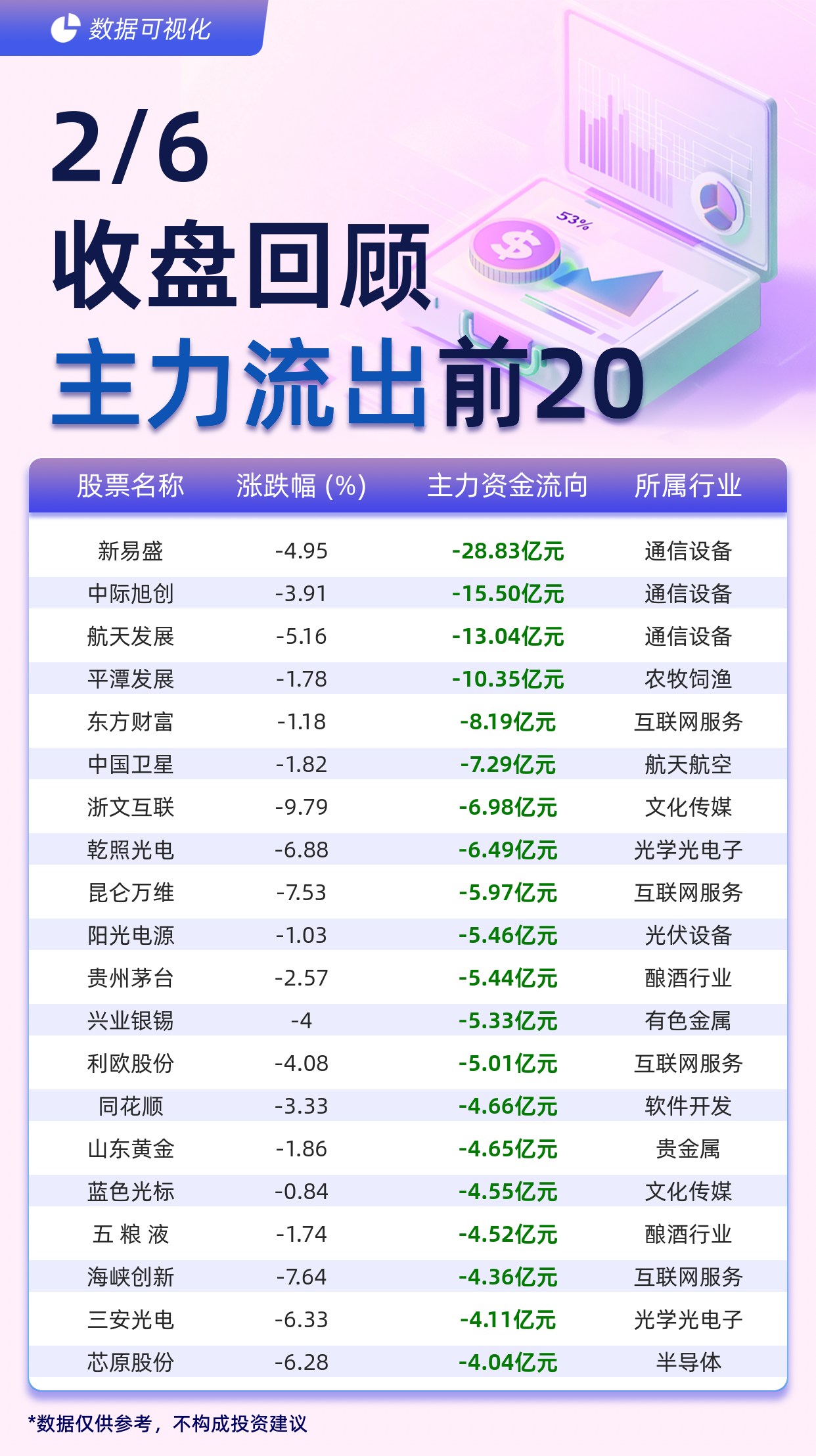
主力个股资金流出前20:新易盛流出28.83亿元、中际旭创流出15.50亿元
Jin Rong Jie· 2026-02-06 07:29
Group 1 - The main stocks with significant capital outflows include Xinyi Technology (-28.83 billion), Zhongji Xuchuang (-15.50 billion), and Aerospace Development (-13.04 billion) [1] - The sectors affected by the capital outflows primarily include communication equipment, internet services, and optical electronics [2][3] - The largest percentage decline in stock prices was observed in Zhejiang Wenlian, which fell by 9.79% [2] Group 2 - Other notable stocks with substantial capital outflows include Guizhou Moutai (-5.44 billion), Sunshine Power (-5.46 billion), and Sanan Optoelectronics (-4.11 billion) [1][3] - The overall trend indicates a negative sentiment in the market, particularly in the communication equipment and internet service sectors [2][3] - The data reflects a broader market trend of capital withdrawal, impacting various industries including agriculture, aerospace, and cultural media [1][2]


同花顺跌2.00%,成交额18.17亿元,主力资金净流出1.85亿元
Xin Lang Cai Jing· 2026-02-06 06:28
Core Viewpoint - The stock price of Tonghuashun has experienced fluctuations, with a recent decline of 2.00% on February 6, 2025, while the company shows a year-to-date increase of 7.42% [1][2]. Group 1: Stock Performance - As of February 6, 2025, Tonghuashun's stock price is reported at 346.10 yuan per share, with a trading volume of 18.17 billion yuan and a turnover rate of 1.66%, resulting in a total market capitalization of 186.06 billion yuan [1]. - Year-to-date, the stock has increased by 7.42%, but has seen a decline of 0.77% over the last five trading days and a decrease of 2.67% over the last 20 days [2]. Group 2: Financial Performance - For the period from January to September 2025, Tonghuashun achieved operating revenue of 3.261 billion yuan, representing a year-on-year growth of 39.67%, and a net profit attributable to shareholders of 1.206 billion yuan, reflecting an increase of 85.29% [2]. - The company has distributed a total of 7.991 billion yuan in dividends since its A-share listing, with 4.193 billion yuan distributed over the last three years [3]. Group 3: Shareholder Information - As of September 30, 2025, the number of shareholders for Tonghuashun is reported at 82,600, a decrease of 4.81% from the previous period, while the average circulating shares per person increased by 5.05% to 3,336 shares [2]. - The second-largest circulating shareholder is Hong Kong Central Clearing Limited, holding 14.6293 million shares, an increase of 2.3322 million shares from the previous period [3].
多模态大模型将为特定应用带来爆发式增长机会,软件ETF(159852)备受资金关注
Xin Lang Cai Jing· 2026-02-06 03:06
Group 1 - The core viewpoint of the articles highlights the significant growth in the software development sector, particularly driven by advancements in cloud and AI technologies, as evidenced by Google's Q4 2025 financial results showing Google Cloud revenue reaching $17.664 billion, a 48% year-over-year increase [1] - The software industry is shifting its value focus from license sales to intelligent service subscriptions and ecosystem collaboration, as major global tech companies adopt a "cloud + AI" heavy asset model, indicating a long-term bet on AI commercialization and computational network efficiency [1] - The rapid iteration of overseas large model technologies is expected to continuously provide direction and catalysts for domestic application innovation, with breakthroughs in multimodal large models significantly expanding application boundaries, especially in scenarios requiring understanding of the physical world [1] Group 2 - As of January 30, 2026, the top ten weighted stocks in the CSI Software Service Index include iFLYTEK, Kingsoft Office, Tonghuashun, and others, collectively accounting for 60.27% of the index [2] - The software ETF (159852) tracks the CSI Software Service Index, serving as a convenient tool for capitalizing on opportunities in the computer software industry [2] - Investors can also access AI software investment opportunities through the software ETF linked fund (012620) [3]
国泰海通|计算机:2025年计算机年报业绩预告总结:增长与下滑两极分化
国泰海通证券研究· 2026-02-05 14:00
报告导读: 2025 年计算机业绩预告中,正向增长公司占比过半,呈现增长与下滑并存的 两极分化格局,利润端改善强于营收端,高增长主要集中在硬件与 AI 应用相关方向。 中位数数据显示, 2025 年计算机公司 利润表现优于营收 。 根据统计, 238 家发布业绩预告的公司中,仅 70 家发布营收数据,营收增速的中位数为 0.97% 。归母净利润增速的中 位数为 1 7.83% ;扣非净利润增速的中位数为 28.68% 。总体而言,利润增速高于营收增速。此外,大市值公司在业绩区间 统计中更偏向增长端,在四季度业绩确定性相对更强。 2025 年计算机行业业绩正向占比过半, 增长与下滑两极分化 。 根据申万行业分类, 358 家计算机公司中发布业绩预告 238 家,占比达到了 66.5% 。根 据预计归母净利润同比增长中位数划分: 30%+ 共有 103 家,占 42.9% ; 10%~30% 27 家,占 11.3% ; 0~10% 12 家,占 5.0% ; 0~-10% 6 家,占 2.5% ; -10%~-30% 3 家,占 1.3% ; -30%+ 87 家,占 36.3% 。整体呈现"两头大、中间小"的 ...

25元批发造股神,有财经大V一年赚2000万
2 1 Shi Ji Jing Ji Bao Dao· 2026-02-05 13:53
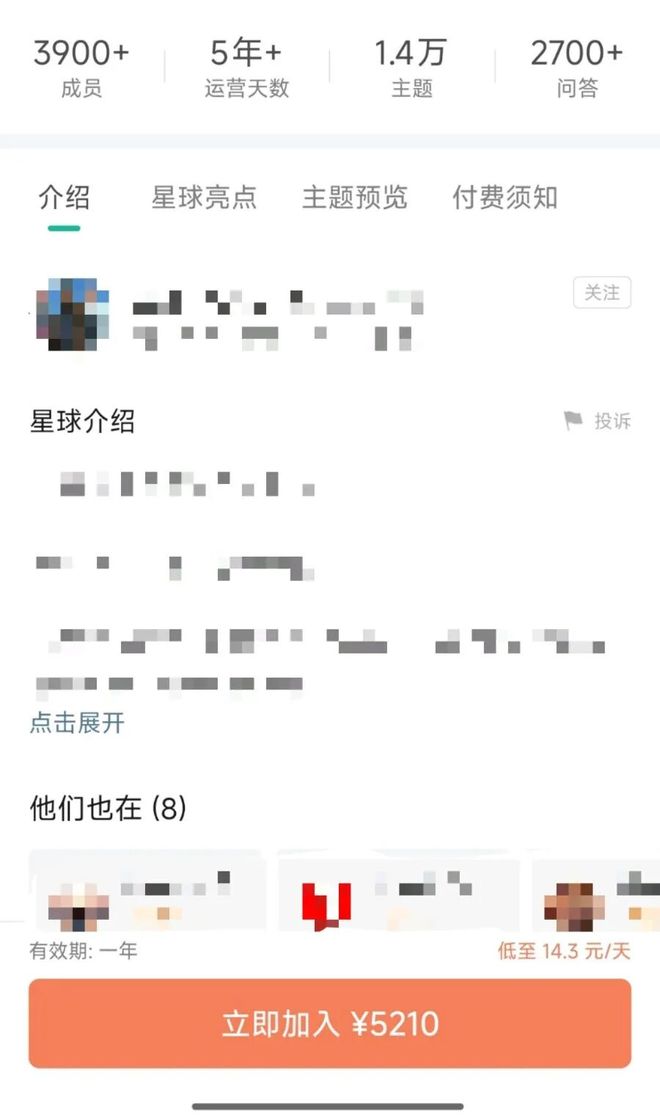
Core Viewpoint - The rise of financial "KOLs" (Key Opinion Leaders) in the knowledge payment sector has led to a mixed market, with many lacking qualifications and engaging in questionable practices to attract followers and monetize their influence [4][6][8]. Group 1: Financial KOLs and Their Practices - Many financial "KOLs" generate significant income through membership fees, with some earning over 20 million yuan annually from their platforms [4]. - The market has seen a surge in unqualified "KOLs" who use simulated trading software to fabricate impressive investment results, misleading followers [6][13]. - Some "KOLs" employ tactics such as sharing market insights on social media to build a following before directing users to paid platforms for more information [8][11]. Group 2: Regulatory Environment and Compliance Issues - Knowledge platforms like Zhishixingqiu have initiated special governance actions to address illegal content related to capital markets, focusing on unqualified courses and market manipulation [4][24]. - Despite regulatory efforts, many "KOLs" continue to find ways to circumvent rules, such as hiding stock recommendations in non-detectable formats [16][19]. - The blurred lines of compliance are evident as some "KOLs" engage in practices like IP authorization for private fund products, creating confusion about responsibility among investors [24][27]. Group 3: User Engagement and Retention Strategies - To retain followers, "KOLs" frequently update content and provide direct, actionable insights, often resorting to emotional support during market volatility [15][21]. - The community aspect is emphasized, with "KOLs" fostering a sense of belonging among followers, which enhances user loyalty [21]. - Many "KOLs" also utilize private communication channels to share sensitive information, which is harder for platforms to monitor [20][26].
基金估值科普|什么是实时估值?监管叫停背后引导行业回归长期投资
Xin Lang Cai Jing· 2026-02-05 06:14
Core Viewpoint - The recent regulatory crackdown on the "real-time valuation" feature of mutual funds across major platforms aims to address industry chaos and promote long-term investment principles [5][13]. Regulatory Actions - Major platforms have removed features like "real-time valuation," "live rankings," and "increased holdings rankings" in response to regulatory requirements [1][15]. - The China Securities Regulatory Commission (CSRC) issued a notice mandating the removal of these features by January 30, 2026, highlighting two main violations: collaboration with unqualified internet influencers and the reintroduction of previously banned features [15][16]. Reasons for Regulation - The core reasons for the removal of the "real-time valuation" feature include: 1. **Inherent Data Errors**: The data provided by third-party platforms is based on outdated reports, leading to discrepancies with actual net values, which can mislead investors and cause disputes [5][13]. 2. **Encouragement of Short-term Trading**: The feature promotes a short-term trading mentality, contrary to the fundamental principle of long-term investment, resulting in lower returns for frequent traders compared to long-term holders [5][13]. 3. **Marketing Malpractices**: Some fund companies have exploited the feature in collaboration with unqualified influencers, leading to misleading promotions and significant losses for investors [6][14]. 4. **Industry Ecosystem Upgrade**: The regulation aims to shift the focus from stimulating transactions to providing professional services, thereby enhancing investor protection [6][14]. Impact on Investors - Investors are advised to adjust their strategies post-removal of real-time valuation by focusing on: 1. **Understanding Actual Holdings**: Analyzing periodic reports for insights into the fund's top holdings and management strategies rather than relying on real-time estimates [8][16]. 2. **Evaluating Long-term Risk and Return**: Establishing performance evaluation mechanisms over longer periods to assess the fund's ability to generate excess returns and manage risks [9][16]. 3. **Implementing Dollar-Cost Averaging**: Adopting a disciplined investment approach to mitigate emotional trading and benefit from market fluctuations over time [9][17].
贵州茅台,重回市场“C位”
Zhong Guo Zheng Quan Bao· 2026-02-05 05:05
Group 1 - Guizhou Moutai (600519) has regained its position in the market, with a stock price increase of 1.41% today, reaching a peak of 1559.89 CNY per share and a market capitalization of 1.94 trillion CNY, surpassing China Petroleum [1][2] - Since the rebound on January 29, Guizhou Moutai's stock price has accumulated a rise of over 16%, leading to increased activity in consumer stocks [1] - The performance of consumer stocks has been strong, with significant gains in sectors such as beauty and personal care, tourism, and food processing [5][8] Group 2 - The recent strength of Guizhou Moutai is attributed to the recovery of the price of its flagship product, Feitian Moutai, driven by adjustments in both distribution channels and pricing systems [8] - The company launched a direct sales initiative on the "i Moutai" platform, which has attracted 6.28 million new users and generated over 2.12 million orders, indicating strong consumer demand [8] - Analysts expect that the price stabilization of Feitian Moutai around 1500 CNY will enhance market confidence and support the company's performance across economic cycles [8]