
宁波银行

Search documents
银行业周度追踪2026年第6周:商业银行四季度利润增速回升-20260224
Changjiang Securities· 2026-02-23 23:30
Investment Rating - The industry investment rating is "Positive" and maintained [11] Core Insights - The banking index fell by 1.3% this week, underperforming the CSI 300 and ChiNext indices by 1.6% and 2.5% respectively, indicating a short-term style switch in the market [6][19] - H-shares of banks led the gains, while most A-shares declined, with notable performances from Huaxia Bank and Shanghai Bank due to improved earnings and strong expectations for convertible bond conversions [6][19] - The price-to-book (PB) ratio and return on equity (ROE) of bank stocks remain undervalued, with a continued recommendation for high-quality city commercial banks in Zhejiang, Jiangsu, and Shandong provinces, including Hangzhou Bank, Ningbo Bank, Jiangsu Bank, Nanjing Bank, Qingdao Bank, Qilu Bank, and Suzhou Bank [6][19] - The report also suggests focusing on low-valuation, high-dividend, and convertible bond opportunities, particularly in Industrial Bank [6][19] Summary by Sections Market Performance - The banking sector's trading activity has decreased, with turnover rates falling, although the transaction volume share for state-owned and rural commercial banks has rebounded [8][39] - The average dividend yield for the six major state-owned banks in A-shares is 4.28%, with a spread of 249 basis points over the 10-year government bond yield, while H-shares yield 5.21% [7][29] Profit Growth and Net Interest Margin - The overall asset growth rate for commercial banks reached 9.0% year-on-year by the end of Q4 2025, with major state-owned banks seeing a growth rate of 10.8% [9][44] - The net profit growth for commercial banks was 2.3% year-on-year, indicating a positive trend, particularly among city and rural commercial banks [9][44] - The net interest margin for 2025 is projected at 1.42%, with a marginal stabilization observed, and a further narrowing of the decline expected in 2026 [9][46] Asset Quality - The non-performing loan (NPL) ratios across various banks are stable or improving, attributed to increased write-off efforts, while the provision coverage ratio continues to decline [10][49] - Capital adequacy ratios remain stable, with attention on the potential impact of the second round of fiscal injections for state-owned banks and refinancing for smaller banks in 2026 [10][49]






银行周报:25Q4银行监管指标:25年银行净利润增速回正-20260223
GUOTAI HAITONG SECURITIES· 2026-02-23 14:55
Investment Rating - The report assigns an "Overweight" rating for the banking sector [4]. Core Insights - The banking sector's net profit growth has turned positive, with a year-on-year increase of 2.33% in Q4 2025, showing an improvement compared to the previous quarters [4][10]. - The net interest margin has stabilized at 1.42%, with expectations of a narrowing decline in 2026 due to the re-pricing of high-cost long-term deposits and a slowdown in the reduction of new loan rates [4][10]. - The non-performing loan (NPL) ratio decreased to 1.50%, indicating a positive trend in asset quality [4][10]. - The capital adequacy ratio improved slightly to 15.5%, reflecting a marginal increase in capital levels [4][10]. Summary by Sections 1. Key Regulatory Indicators for Q4 2025 - Total assets of commercial banks grew by 9.0% year-on-year, with large banks showing a growth rate of 10.8% [7]. - The average capital return rate was 7.78%, and the average asset return rate was 0.60% [10]. 2. Industry and Company Dynamics - The report highlights the ongoing implementation of a moderately loose monetary policy by the central bank, aimed at stabilizing economic growth and ensuring adequate liquidity [10]. - The banking sector's focus for 2026 includes identifying banks with potential for performance growth, particularly recommending Ningbo Bank, China Merchants Bank, and Nanjing Bank [4][10]. 3. Weekly Data Tracking - The report includes weekly tracking of stock performance, with notable fluctuations in bank stock prices, indicating market volatility [18].


11家银行年报抢先看!浦发、中信规模突破10万亿,青岛银行增速领跑
Xin Lang Cai Jing· 2026-02-23 02:11
Core Insights - 11 A-share banks reported their 2025 performance, showing an average total asset growth rate of 11.32%, with city commercial banks significantly outperforming joint-stock banks in profitability [1][12]. Group 1: Performance Overview - The average growth rate of total assets for the 11 banks was 11.32%, while the average growth rate for operating income was 3.30%, and the average growth rate for net profit attributable to shareholders was 7.83% [1][12]. - Analyst Zheng Qingming from Shenwan Hongyuan Securities predicts that listed banks will exhibit stable revenue with gradually improving profit growth, expecting a 0.9% year-on-year revenue growth and a 1.9% recovery in net profit growth for 2025 [1][13]. Group 2: Joint-Stock Banks Performance - Four joint-stock banks (Shanghai Pudong Development Bank, CITIC Bank, China Merchants Bank, and Industrial Bank) reported total assets exceeding 10 trillion yuan, with Shanghai Pudong Development Bank's total assets reaching 100,817.46 billion yuan, a 6.55% increase from 2024 [2][15]. - Shanghai Pudong Development Bank achieved the fastest net profit growth among joint-stock banks, with a net profit of 500.17 billion yuan, an increase of 10.52% year-on-year [2][15]. Group 3: City Commercial Banks Performance - City commercial banks outperformed joint-stock banks in several metrics, with an average total asset growth rate of 15.1%, operating income growth of 5.73%, and net profit growth of 11% [5][19]. - Qingdao Bank emerged as the fastest-growing bank, with total assets growing by 18.12% to 8149.60 billion yuan and net profit increasing by 21.66% [5][19]. Group 4: Asset Quality and Income - Shanghai Pudong Development Bank reported a decrease in non-performing loans and a decline in the non-performing loan ratio, indicating improved asset quality [3][16]. - Several banks, including Ningbo Bank and Nanjing Bank, reported significant increases in net interest income, with Ningbo Bank achieving a 10.77% increase to 531.61 billion yuan [10][25].






2025年A股上市银行成绩单:规模质量并进,城商行会改写格局吗?
Sou Hu Cai Jing· 2026-02-22 20:27
2025年A股上市银行的年度成绩单正逐步揭晓,42家银行中已有11家率先披露了关键数据。从资产规模 到净利润增长,从不良贷款率到净息差表现,这些数字背后不仅反映了银行业的整体韧性,更暗藏着一 场关于利润与风险的深度博弈。 资产规模扩张与经营质量并重 中信银行和浦发银行双双迈入"10万亿资产俱乐部",前者资产总额达10.13万亿元,后者以10.08万亿元 紧随其后。招商银行则以超过13万亿元的资产规模和7.5%的增长率继续领跑。这些数据不仅体现了头 部银行的规模优势,也印证了中国银行业在复杂经济环境下的稳健性。然而,规模扩张只是表象,经营 质量才是核心。南京银行以两位数的营收增速脱颖而出,青岛银行归母净利润增长超过20%,齐鲁银行 和杭州银行同样实现了两位数的利润增长。城商行的亮眼表现,似乎正在打破市场对"大行垄断"的固有 认知。 资产质量改善:风险管控的精细化 不良贷款率是衡量银行资产质量的关键指标。苏农银行、中信银行、招商银行等机构的不良率均有所下 降,南京银行、杭州银行和宁波银行则保持稳定。拨备覆盖率虽小幅回落,但整体仍处于健康区间。 杭州银行拨备覆盖率超过500%,招商银行也维持在391.79%的高位, ...

国有大行主导手机银行市场,生态嵌入构筑护城河
Jing Ji Guan Cha Wang· 2026-02-18 05:47
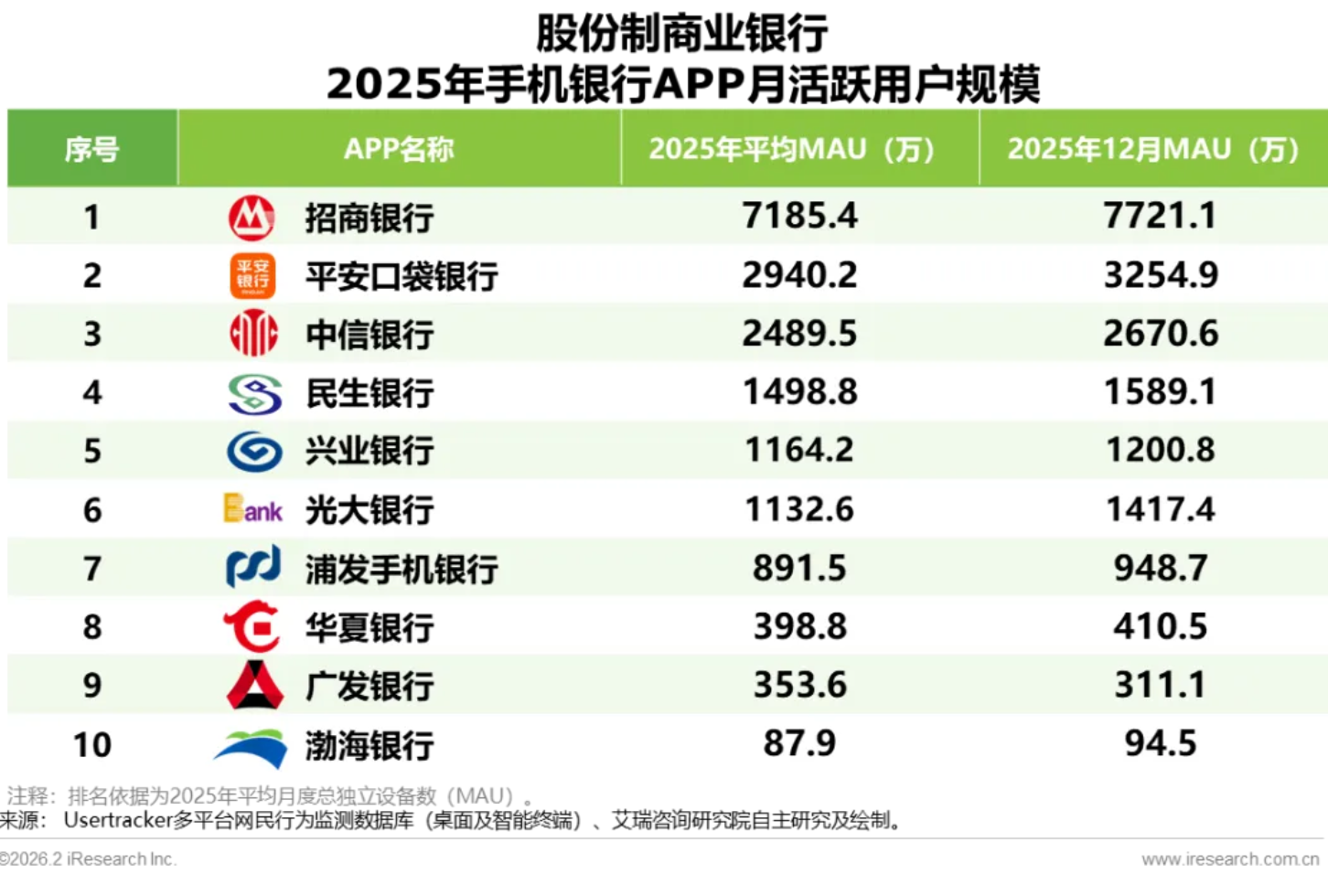
Core Insights - The Chinese mobile banking market is entering a stage of stock competition in 2025, with monthly active users (MAU) stabilizing between 648 million and 739 million [2] - State-owned commercial banks dominate the market due to their ecological embedding advantages, with Agricultural Bank of China leading at 249 million MAU, followed by Industrial and Commercial Bank of China (194 million) and China Construction Bank (109 million) [2] - Private banks are expected to collectively exit the top 50 MAU rankings in 2025 due to a lack of offline branch support and local living ecosystems [2] Group 1: Major Players - Agricultural Bank of China has the highest MAU at 249 million, followed by Industrial and Commercial Bank of China with 194 million and China Construction Bank with 109 million, forming the first tier of banks [2] - China Bank and Postal Savings Bank have MAUs exceeding 50 million, constituting the second tier [2] - China Merchants Bank leads the joint-stock banks with 71.85 million MAU, while Ping An Bank and CITIC Bank form the second tier, with other joint-stock banks generally below 20 million MAU [2] Group 2: Market Dynamics - The core advantage of state-owned banks lies in their "full-scenario integration" capabilities, embedding services deeply into high-frequency life scenarios such as government affairs, social security, healthcare, and education [2] - Agricultural Bank of China extends its services to rural areas through intelligent service matching and customer customization, while Industrial and Commercial Bank of China utilizes its "Gong Xiao Zhi" model for interactive service [2] - Regional banks like Jiangsu Bank, Beijing Bank, and Ningbo Bank show stable performance by focusing on local markets, with some rural commercial banks like Fujian Rural Credit exceeding 4.5 million MAU, indicating the sustainability of localized operations in the stock market [2]



流量红利枯竭 存量博弈下银行APP被迫断臂求生
Jing Ji Guan Cha Wang· 2026-02-18 05:44
Core Insights - The Chinese mobile banking market is transitioning from "scale expansion" to "value cultivation," indicating a saturation of user growth and the end of the traffic dividend period [2] - Different types of banks are exhibiting varied development trends in this new landscape [2] State-Owned Commercial Banks - The six major state-owned banks dominate the mobile banking market, with Agricultural Bank of China leading with over 250 million monthly active users (MAUs) [2] - The top three banks, including Industrial and Commercial Bank of China and China Construction Bank, have MAUs of nearly 200 million and over 100 million, respectively [2] - All six major banks reported positive month-on-month growth in MAUs, with ICBC leading at a 6.1% growth rate [2] Joint-Stock Commercial Banks - Joint-stock banks are seeking to carve out a niche in the saturated market, with China Merchants Bank leading among them with over 70 million MAUs [3] - Some banks like Everbright Bank and CITIC Bank showed significant month-on-month growth rates of 11.0% and 9.2%, respectively [3] - The performance of joint-stock banks is mixed, with some experiencing negative growth [3] Urban Commercial Banks - Urban commercial banks are growing rapidly, with 17 banks making it to the top 50 list, led by Ningbo Bank with 3.644 million MAUs and a growth rate of 43.9% [3] - The growth is attributed to localized strategies that enhance customer engagement [3] Rural Commercial Banks and Credit Cooperatives - Rural commercial banks and credit cooperatives also performed well, with 17 banks in the top 50, led by Fujian Rural Credit with 781.6 thousand average MAUs [4] - 12 out of these 17 banks reported positive month-on-month growth [4] Private Banks - Private banks are facing significant challenges, with only WeBank making it to the top 50 list in the first half of 2025, experiencing a 27.3% decline in MAUs [4] - The competitive landscape has shifted, making it difficult for online-only private banks to maintain their initial advantages [4] Conclusion - State-owned banks leverage "ecosystem" advantages to solidify their market position, while joint-stock banks focus on "professional" opportunities [5] - Urban commercial banks establish a strong local presence, whereas private banks struggle to survive in the competitive environment [5] - The future of banking will require a focus on creating irreplaceable value for users through technology and insights into user behavior [5]

2.7分钟定生死 手机银行存量厮杀谁在“断臂”,谁在“吃肉”?
Jing Ji Guan Cha Wang· 2026-02-18 04:57
Core Insights - The report by iResearch indicates that the monthly active users (MAU) of mobile banking apps in China have stabilized after fluctuating between 648 million and 739 million, signaling a ceiling in user growth and a shift from acquiring new users to enhancing existing user engagement [2] - User behavior is undergoing a structural reversal, with the effective daily usage time per device dropping from 4.9 minutes in 2023 to around 2.7 minutes by mid-2025, leading to a focus on high-frequency, short-duration, and functional usage [2] - Financial institutions are compelled to streamline operations and focus resources on core transaction scenarios to survive in this competitive landscape, where efficiency and precision are paramount [2] Mobile Banking Market Overview - The top three banks in terms of MAU are Agricultural Bank of China (2.49 billion), Industrial and Commercial Bank of China (1.94 billion), and China Construction Bank (1.09 billion), with all six major state-owned banks ranking in the top ten [3][5][6] - Private banks, represented by WeBank and MYbank, have faced significant setbacks, with many dropping out of the top 50 MAU rankings by 2025 [4] Competitive Landscape - State-owned banks are solidifying their dominance through extensive customer bases and integrated ecosystems, leveraging services embedded in high-frequency life scenarios such as government services and healthcare [7] - Joint-stock commercial banks are adopting a "specialized and precise" survival strategy, with China Merchants Bank leading among them with 71.85 million MAU, focusing on wealth management and intelligent interaction [8][10] - Regional banks are thriving by deeply engaging with local markets, while private banks struggle due to high customer acquisition costs and lack of local ecosystem support [13][14] Future Outlook - The mobile banking market is transitioning from a phase of scale expansion to one of value cultivation, with state-owned banks building moats through ecosystems, joint-stock banks seeking niches through specialization, and regional banks solidifying their local roots [14] - The ability to create irreplaceable value in a limited user engagement environment will be crucial, with technology applications such as AI reshaping service processes and enhancing risk management [15][16]

黄金跌了价,2026年2月17日,国内黄金新价格、人民币黄金新价格
Sou Hu Cai Jing· 2026-02-18 02:32
Core Viewpoint - The international precious metals market is experiencing significant volatility, with gold prices under pressure due to high interest rate expectations and liquidity tightening, while silver has seen dramatic fluctuations, indicating a deep adjustment period in the market [1] Group 1: International Precious Metals Market Dynamics - On February 17, 2026, spot gold was reported at $5038.5 per ounce, having dipped to $4910 during trading, with bearish sentiment dominating as indicated by technical indicators [1] - Spot silver increased by 2.55% to $77.11 per ounce after a sharp decline, having previously reached a historical high of $121.65 at the end of January, followed by a single-day drop exceeding 36% [1] - The gold-silver ratio compressed to 47-49, significantly below the normal range of 50-80, indicating a potential for corrective pressure on silver prices [1] Group 2: Domestic Retail Gold Prices - Domestic retail prices for gold jewelry show significant differentiation, with wholesale prices in Shenzhen's Shui Bei at 1300 RMB per gram, the lowest in the country, while brand stores price gold between 1529 and 1548 RMB per gram [3] - The highest quoted brand is Lao Feng Xiang at 1548 RMB per gram, while other brands like Chow Tai Fook and Luk Fook Jewelry are priced at 1529 RMB per gram [3] - A comparison of consumer purchases shows a 37.5-gram gold piece priced at approximately 57375 RMB at China Gold, while the same weight at Shui Bei costs about 48750 RMB, highlighting the impact of brand premiums and processing costs on retail prices [3] Group 3: RMB Denominated Gold Market - Data from the Shanghai Gold Exchange indicates a general decline in RMB gold prices, with AuT D at 1108.50 RMB per gram, down 16.55 RMB, a decrease of 1.47% [4] - Au9999 fell to 1109.00 RMB per gram, while Au9995 dropped to 1080.05 RMB per gram, reflecting tightening liquidity and potential pricing anomalies [4] - The price of silver T D plummeted to 19270 RMB per kilogram, marking a 3.26% decline, indicating its high volatility [4] Group 4: Market Adjustments by Financial Institutions - In response to price volatility, several banks and gold stores are tightening their precious metals business, with announcements from China Gold and Cai Bai regarding the suspension of gold buybacks and implementation of daily limits [11] - Notably, banks like Industrial Bank and Postal Savings Bank have ceased personal gold trading services, reflecting a broader trend among at least 11 banks to restrict new positions and purchases [11] - These actions indicate heightened vigilance from regulators and financial institutions regarding market risks, particularly following significant drops in silver LOF funds [13] Group 5: Market Outlook - The current volatility in the precious metals market is primarily driven by speculative funds and the bursting of a price bubble, particularly in silver, which has seen inventory depletion leading to extreme market conditions [14] - Future price movements will depend on inflation data, Federal Reserve policy directions, and the recovery of market liquidity, with consumers advised to focus on wholesale market prices for practical insights [14]



天弘永定成长基金经理换将,产品业绩不达标是主因?
Xin Lang Cai Jing· 2026-02-15 11:54
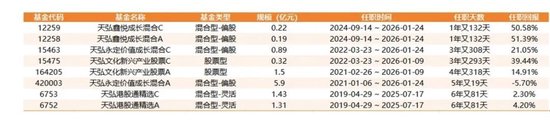
Core Viewpoint - Tianhong Fund Management announced the departure of fund manager Liu Guojiang from the Tianhong Yongding Value Growth Mixed Securities Investment Fund due to personal reasons, following a period of underperformance in fund returns [1][7]. Group 1: Fund Performance - During Liu Guojiang's management, the Tianhong Yongding Growth Fund recorded a return of -5.7% and an annualized return of -1.15%, significantly underperforming compared to the average of similar products [1][8]. - The fund's annual returns from 2021 to 2025 were -4.94%, -15.98%, -15.31%, 17.44%, and 19.32%, indicating a volatile performance with recent recovery [3][10]. - The fund has a total scale of approximately 6.79 billion yuan as of the end of 2025, with the Tianhong Yongding Value Growth Fund being the largest at 5.9 billion yuan [2][11]. Group 2: Manager Background and Transition - Liu Guojiang joined Tianhong Fund in April 2017 and took over the Tianhong Yongding Growth Fund in January 2021, having previously worked at several other asset management firms [2][8]. - Following Liu's departure, Wang Haishan, who has a dual bachelor's degree in economics and engineering and is a CPA and CFA holder, will continue to manage the fund [5][11]. - Liu Guojiang's exit is seen as a response to investor demands for better performance, highlighting the importance of consistent returns in building trust in the asset management industry [6][12].
银行行业2026年1月金融数据点评:政府债发力明显,股市活跃推动存款搬家
Zhong Guo Yin He Zheng Quan· 2026-02-15 06:24
Investment Rating - The report maintains a "Recommended" rating for the banking sector, highlighting its high dividend and low valuation attributes that continue to attract long-term capital [5]. Core Insights - The banking sector is experiencing a significant contribution from government bonds to social financing growth, with a notable increase in government bond issuance in January 2026 [5]. - The report indicates that while social financing has increased year-on-year, the growth rate has decreased compared to the previous month, primarily due to weaker RMB loans and fluctuating demand from the real economy [5]. - The capital market's activity is driving a "deposit migration" process, as increased market engagement leads to higher liquidity in the banking sector [5]. Summary by Sections Banking Industry - In January 2026, new social financing reached 7.22 trillion yuan, an increase of 165.4 billion yuan year-on-year, with government bonds being the main contributor [5]. - RMB loans increased by 4.9 trillion yuan, which is a decrease of 319.4 billion yuan year-on-year, influenced by demand fluctuations and debt restructuring [5]. - The report notes that short-term loans in the real sector have increased, while medium and long-term loans remain weak, particularly in the real estate sector, which saw a 28.5% decline in sales for major developers [5]. Market Activity - The report highlights that M1 and M2 growth rates are at 4.9% and 9% respectively, indicating an increase in liquidity [5]. - Financial institutions' RMB deposits increased by 9.9% year-on-year, with a monthly increase of 8.09 trillion yuan, driven by both household and corporate deposits [5]. - The report emphasizes the role of an active capital market in attracting deposits, with a 58% increase in average daily trading volume in January [5].
