牧原股份

Search documents
猪价持续“磨底” 企业借期货工具破周期之困
经济观察报· 2026-01-11 04:40
Core Viewpoint - The article discusses the transformation of pig farming enterprises from passive risk management to active risk management through the establishment of professional futures teams and refined hedging operations in response to ongoing price pressures in the pig market [2][4]. Group 1: Market Overview - In 2025, the pig market faced significant challenges, with average prices significantly lower than in 2023 and 2024, reaching a low of 11 yuan/kg in October, leading to deep industry losses [2][4]. - The average price of lean pigs in 2025 was 13.80 yuan/kg, with a downward trend observed throughout the year, particularly after mid-September when prices fell below the industry cost line [4]. - The overall pig farming industry has experienced four complete cycles of the "pig cycle" since 2006, with the current phase being the most painful "bottoming" stage of the fifth cycle [2]. Group 2: Supply and Demand Dynamics - In 2025, the total pig output is expected to reach 747 million heads, a year-on-year increase of 6.4%, with pork production exceeding 60 million tons for the first time [5]. - The average PSY (pigs weaned per sow per year) increased from 21 in 2024 to 26 in 2025, enhancing the supply capacity by 23.8% under the same breeding stock [5]. - Demand for pork is declining due to macroeconomic factors affecting consumer willingness, with traditional peak seasons seeing a 10%-15% year-on-year decrease in consumption [5]. Group 3: Financial Performance of Companies - Leading companies like Muyuan Foods reported a total sales volume of 77.981 million pigs in 2025, an increase of 6.379 million heads from 2024, but total sales revenue decreased by approximately 3.4 billion yuan due to lower average selling prices [6]. - The cost of pig farming is currently estimated to be between 12 and 13 yuan/kg, with top companies achieving lower costs through management advantages [4]. Group 4: Risk Management Strategies - Companies are increasingly adopting futures hedging as a critical strategy for risk management, moving away from traditional sales models that do not guarantee stable profits [8][9]. - Futures hedging has become a normalized part of operations, focusing on locking in profits rather than speculative trading [9][11]. - The implementation of futures contracts allows companies to stabilize their profits and manage risks effectively, as demonstrated by various companies' experiences in the market [10][12].



饲料市场2025年回顾及2026年展望
Xin Lang Cai Jing· 2026-01-11 02:41
Group 1 - The core viewpoint of the articles indicates that the feed raw material prices are expected to rise significantly in 2025, with corn, soybean meal, and rapeseed meal increasing by over 10%, 9%, and 8% respectively, while the market dynamics show differentiation in trends [1][2] - In 2025, the total production of pig feed is projected to recover, with a year-on-year increase of 9.0% in April, driven by a rebound in breeding demand, while the market is characterized by regional differentiation and concentration among leading producers [3] - Major feed companies are expected to maintain robust profitability in 2025, with Hai Da Group reporting a net profit of 2.639 billion yuan in the first half of the year, a year-on-year increase of 24.16%, and New Hope Liuhe achieving a net profit of 755 million yuan, a significant increase of 162% [4] Group 2 - For 2026, the supply side anticipates corn production to exceed 300 million tons, with soybean imports remaining above 100 million tons, while the demand side expects stable total feed production around 330 million tons, indicating a slowdown in growth due to a reduction in breeding capacity [5] - At the beginning of 2026, major companies are expected to implement price increases of 50-100 yuan per ton for various feed products, driven by rising raw material costs and the need to ensure product quality [6] - The price dynamics in early 2026 show a two-round price increase driven by rising raw material costs, with the first round occurring in December 2025 and the second round at the beginning of 2026, influenced by seasonal stocking demands [7]



东方证券农林牧渔行业周报(20260105-20260111):12月猪企出栏延续增量降重-20260110
Orient Securities· 2026-01-10 14:56
Investment Rating - The report maintains a "Positive" investment rating for the agricultural industry [5] Core Insights - The report highlights a structural shortage in the pig market, with expectations for a price turning point in Q2 2026 due to ongoing capacity reduction and favorable policies [3][9] - The report emphasizes the potential for long-term performance improvement in the pig farming sector, driven by policy and market forces [3][9] Summary by Sections Investment Recommendations - The report recommends focusing on the pig farming sector, anticipating a price recovery in Q2 2026, with suggested stocks including Muyuan Foods (002714, Buy), Wens Foodstuff Group (300498, Buy), and Shennong Group (605296, Not Rated) [3] - It also suggests looking at the animal health sector, which may benefit from profit transmission down the supply chain, with recommended stocks including Haida Group (002311, Buy) and Reap Bio (300119, Not Rated) [3] - In the planting chain, the report notes a confirmed upward trend in grain prices, highlighting investment opportunities in large-scale planting, with suggested stocks including Suqian Agricultural Development (601952, Not Rated) and Beidahuang (600598, Not Rated) [3] - The pet food sector is also highlighted, with growth driven by increasing domestic brand recognition and overseas market expansion, recommending stocks such as Guibao Pet (301498, Not Rated) and Zhongchong Co. (002891, Not Rated) [3] Industry Fundamentals - The report indicates that December saw a continued increase in pig output, with 13 listed pig companies collectively reporting an output of 18.72 million heads, a month-on-month increase of 7.11% and a year-on-year increase of 6.8% [13] - The average selling price for pigs in December remained low, with a range from 10.66 yuan/kg to 12.54 yuan/kg, and an overall average around 11.5 yuan/kg [15] - The average weight of pigs sold in December was 124.85 kg, reflecting a decrease of 1.8 kg from the previous month, indicating a trend of accelerated inventory reduction [15][16] Market Trends - The report notes that the natural rubber market is experiencing price strength, with futures prices reaching 16,030 yuan/ton, a week-on-week increase of 2.72% [47] - The report also highlights a stable upward trend in grain prices, with corn and wheat prices showing slight declines while soybean meal prices have increased [37]



猪价持续“磨底” 企业借期货工具破周期之困
Jing Ji Guan Cha Bao· 2026-01-10 04:57
Core Viewpoint - The Chinese pig market faced significant challenges in 2025, characterized by a prolonged downturn in prices, deepening losses for pig farming enterprises, and a shift towards proactive risk management strategies in response to ongoing supply-demand imbalances and regulatory pressures [1][2][3]. Group 1: Market Conditions - In 2025, the average price of lean pigs was 13.80 yuan/kg, with prices dropping significantly, reaching as low as 11 yuan/kg in October, marking a period of deep losses for the industry [2][4]. - The overall pig output in 2025 was projected at 747 million heads, a year-on-year increase of 6.4%, with pork production exceeding 60 million tons for the first time [3]. - The average PSY (pigs weaned per sow per year) increased from 21 in 2024 to 26 in 2025, enhancing the supply capacity and exacerbating the supply pressure [3]. Group 2: Financial Performance - Leading company Muyuan Foods sold 77.981 million pigs in 2025, an increase of 6.379 million from 2024, but its total sales revenue fell to 132.811 billion yuan, a decrease of approximately 3.4 billion yuan from the previous year due to lower sales prices [4]. - By December 2025, self-breeding and external purchasing models faced significant losses, with average losses of 62 yuan per head for self-breeding and 210 yuan per head for purchased piglets [2]. Group 3: Risk Management Strategies - Companies are increasingly adopting proactive risk management strategies, including forming specialized futures teams and implementing detailed hedging operations to mitigate the impacts of price volatility [1][5]. - Futures hedging has become a critical component of business operations, allowing companies to lock in profits and stabilize earnings despite low market prices [6][8]. - The participation of over 3,000 industry clients in pig futures trading indicates a growing trend towards using futures as a risk management tool, with 24 out of 32 major pig enterprises engaging in futures transactions [7][8].
养猪业供需失衡 全产业链布局成关键
Zhong Guo Jing Ying Bao· 2026-01-09 20:14
Core Viewpoint - The pig farming industry in China is experiencing a prolonged period of low prices and losses due to supply-demand imbalances, with a shift towards fine-tuned operations expected in the future [2][6]. Supply and Demand Imbalance - The industry is currently facing losses primarily due to high production capacity, with the number of breeding sows remaining elevated at 39.9 million as of October 2025, which is 102.3% of the normal level [4]. - The average price of live pigs was reported at 12.25 yuan/kg as of December 28, 2025, still below the breakeven cost of 14 yuan/kg [2]. Price Trends and Profitability - The average price of live pigs for the entire year of 2025 is projected to be between 13.9 and 14 yuan/kg, with significant price drops observed from August onwards [3]. - By December 26, 2025, the losses for self-breeding and purchased pig farming were reported at -130 yuan/head and -163 yuan/head, respectively [3]. Production Capacity and Adjustments - The number of breeding sows has decreased by approximately 400,000 from a peak of 4.39 million in December 2022, but the current level remains high [4]. - Despite efforts to reduce production capacity, the pace of adjustment has been slow, with major companies like Wens Foodstuffs and Zhengbang Technology already meeting their annual output targets by November 2025 [5]. Cost Reduction and Efficiency - Companies are focusing on cost reduction and efficiency improvements, with some achieving significant reductions in production costs, such as Muyuan Foods at 11.3 yuan/kg and Wens Foodstuffs at 12.2-12.4 yuan/kg [8]. - The industry consensus indicates that relying solely on scale is no longer sufficient for profit growth, leading to a transition towards a micro-profit era [9]. Industry Trends and Future Outlook - The industry is expected to undergo a transformation towards sustainable development, emphasizing collaboration across the supply chain, including feed production, breeding, and processing [10]. - The involvement of large agricultural groups and cross-industry capital is anticipated to intensify competition and capacity expansion in the short term, while promoting modernization and stability in the long term [10].


【财经分析】生猪期货五周年:熨平周期波动 产业风险管理走向成熟
Xin Hua Cai Jing· 2026-01-09 12:30
Core Insights - The volatility of the "pig cycle" has become increasingly unpredictable, prompting pig farming companies to adopt a multifaceted approach to ensure profitability, including extending the industrial chain, enhancing digital management, and utilizing pig futures as a financial tool [1][2] Group 1: Industry Overview - The pig price has experienced significant downward pressure due to supply and demand imbalances, with the average price dropping below 11 yuan/kg in mid-October 2025, and the main pig futures contracts seeing a cumulative decline of 15.31% in the third and fourth quarters [2] - The number of live pigs in China reached 43.68 million by the end of the third quarter of 2025, a year-on-year increase of 2.3%, while the output volume for the first three quarters was 52.99 million, up 1.8% year-on-year [2] - The pig industry has faced multiple challenges over the past five years, including the recovery of production capacity post-African swine fever, high feed costs, and changing consumer demand, leading to a more extended downward cycle and shorter upward cycles [2] Group 2: Financial Tools and Risk Management - The introduction of pig futures has allowed companies to hedge against price volatility, with firms able to lock in future sales prices by selling futures contracts in advance [4][5] - Companies like DeKang Group have successfully utilized futures to offset losses in the spot market, achieving over 1,000 yuan profit per head through effective hedging strategies [5] - The futures market has evolved to become a critical tool for risk management, with companies increasingly relying on futures prices to guide production and sales decisions [5][9] Group 3: Operational Strategies - Companies are focusing on cost reduction and efficiency improvements through various strategies, including optimizing feed formulas, breeding technologies, and digital management [3][4] - The integration of the supply chain, from feed production to meat sales, has been emphasized to ensure stable supply and controllable costs, enhancing profitability during price fluctuations [3] - Collaboration between different departments within companies is essential for effective hedging, as misalignment can hinder the execution of risk management strategies [6][7] Group 4: Market Development and Future Expectations - The Dalian Commodity Exchange has made several adjustments to the pig futures contract rules to better align with market needs, including changes to delivery quality standards and the establishment of additional delivery warehouses [8][9] - The trading volume of pig futures has significantly increased, with total transactions reaching 17.993 million contracts in 2025, indicating a growing acceptance and utilization of these financial instruments within the industry [9] - The industry anticipates further expansion of the pig futures market to better meet the risk management needs of upstream and downstream enterprises [9]
猪价去年12月旺季触底,上市猪企普遍承压,行业去产能进行中
Feng Huang Wang· 2026-01-09 09:58
Core Viewpoint - The pig price in December 2025 reached a new low, with the industry experiencing a prolonged period of price inversion, indicating ongoing challenges in the market [1][2]. Group 1: Market Performance - The December 2025 pig sales data revealed that the expected peak season did not materialize, with average sales prices dropping over 25% year-on-year, ranging between 11 CNY/kg and 12 CNY/kg [2]. - Major companies like Muyuan Foods reported a 14.75% decrease in sales volume to 6.98 million pigs in December, resulting in a 36.06% decline in sales revenue to 9.667 billion CNY [2]. - Some companies, such as Zhengbang Technology, saw significant increases in sales volume, with a 73.26% rise to 1.0286 million pigs and a 25.75% increase in revenue to 914 million CNY [2]. Group 2: Price Trends - The pig price exhibited a fluctuating trend in December, with a brief recovery mid-month due to seasonal demand, but ultimately ended with a slight month-on-month decline [3]. - The average price of white strip pork decreased by 26.21% year-on-year, despite a 15.22% increase in daily slaughter volume, indicating persistent downward pressure on prices [3]. Group 3: Capacity Reduction - The industry is gradually initiating capacity reduction, but the pace remains slow, with many companies still maintaining high levels of breeding sows [4]. - As of December 2025, Muyuan Foods reported a breeding sow inventory of 3.232 million heads, reflecting a decrease, but overall industry capacity reduction is not yet substantial [4]. - Analysts suggest that the current high levels of breeding sow inventory will continue to exert pressure on supply, limiting price recovery potential [4]. Group 4: Future Outlook - Industry experts predict that the effects of capacity reduction will become evident in the second half of 2026, with the first half expected to remain in a downward price cycle [5].

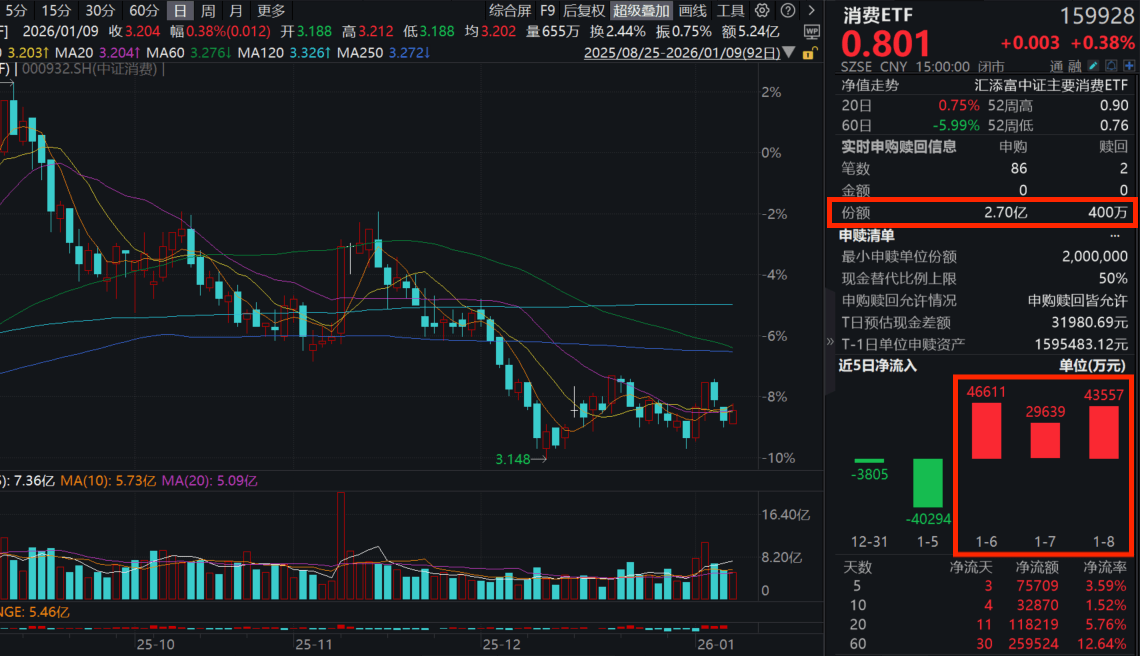
12月CPI环比由降转涨,核心CPI上涨1.2%!消费ETF(159928)再度飘红,连续第4日大举净流入超2.1亿元,累计揽金超14亿元!
Xin Lang Cai Jing· 2026-01-09 09:49
Core Viewpoint - The Chinese stock market shows positive momentum with the Shanghai Composite Index rising by 0.92% and surpassing the 4100-point mark, driven by favorable CPI data and significant inflows into consumer ETFs [1][3]. Economic Indicators - The National Bureau of Statistics reported that the Consumer Price Index (CPI) increased by 0.8% year-on-year in December, with a month-on-month rise of 0.2%. The core CPI, excluding food and energy, rose by 1.2% year-on-year [3][7]. - The Producer Price Index (PPI) saw a month-on-month increase of 0.2% but a year-on-year decline of 1.9%, indicating a mixed outlook for industrial pricing [3][6]. Market Performance - The Consumer ETF (159928) experienced a net inflow of 2.66 million units, accumulating over 14 billion yuan in total, with its latest scale exceeding 218 billion yuan, leading its peers in the same category [1][3]. - The valuation of the Consumer ETF's underlying index stands at a TTM P/E ratio of 19.29, which is in the 2.76% percentile over the past decade, indicating a favorable valuation compared to historical levels [3]. Sector Insights - The Hong Kong Stock Connect Consumer 50 ETF (159268) also saw a rise of 0.22%, with significant trading volume, highlighting investor interest in consumer stocks [5]. - The consumer sector is characterized by a "K-shaped" consumption pattern, where high-end and high-value products are favored by some consumers, while others seek high utility and low-cost options [10][11]. Investment Opportunities - The consumer ETF's underlying index is noted for its resilience across economic cycles, with top holdings including leading liquor brands and major agricultural companies, indicating strong fundamentals in the consumer sector [11].
缺乏指引,生猪震荡运行
Rui Da Qi Huo· 2026-01-09 09:12
Report Industry Investment Rating - Not provided in the report Core Viewpoints - The supply of live pigs has slightly recovered but the pressure is average, and the demand is in the peak season but has declined from the high level. The supply - demand relationship shows a weak balance, and the fundamentals have not changed much. Therefore, the live pig price will mainly fluctuate [6] Summary by Directory 1. 周度要点小结 - The live pig price fluctuated slightly downwards, with the main contract 2603 falling 0.21% weekly [6][10] - According to Mysteel data, the sample enterprises' slaughter plan in January decreased month - on - month. The slaughter rhythm of large - scale farms has recovered compared with that after the Spring Festival, but the overall slaughter volume is average. After the New Year's Day, the demand for cured meat decreased, and the terminal consumption tolerance was limited after the price increase. The slaughter enterprises'开工 rate dropped from the high level [6] 2. 期现市场 Futures Market - The futures fluctuated this week, and the main contract 2603 fell 0.21% weekly [8][10] - As of January 9, the net short position of the top 20 holders in live pig futures was 51,549 lots, a decrease of 49 lots from last week, and the number of futures warehouse receipts was 918, a decrease of 95 lots from the previous week [16] - The price difference between lh2603 and lh2605 contracts was - 445, and the price difference between lh2603 and lh2607 contracts was - 1,125 [20] Spot Market - The basis of the live pig January contract this week was 950 yuan/ton, and the basis of the March contract was 1,130 yuan/ton [25] - The national average live pig market price this week was 12.45 yuan/kg, an increase of 0.15 yuan/kg from last week. The average price of 15 - kg weaned piglets was 24.48 yuan/kg, an increase of 0.76 yuan/kg from last week [35] - According to the Ministry of Agriculture and Rural Affairs, in the week of December 31, the national pork market price was 22.80 yuan/kg, an increase of 0.32 yuan/kg from the previous week. The average price of binary sows last week was 32.47 yuan/kg, an increase of 0.01 yuan/kg from the previous week [39] - As of the week ending December 31, 2025, the pig - grain ratio was 5.40, an increase of 0.16 from the previous week [44] 3. 产业情况 Upstream - In October 2025, the official inventory of reproductive sows was 39.9 million, a month - on - month decrease of 450,000 tons (1.12%) and a year - on - year decrease of 2.038%. According to Mysteel data, in December, the inventory of reproductive sows in 123 large - scale farms decreased 0.18% month - on - month and 0.47% year - on - year, and that in 85 small and medium - sized farms decreased 1.19% month - on - month and 1.54% year - on - year [49] - At the end of the third quarter of 2025, the live pig inventory was 436.8 million, a month - on - month increase of 2.9% and a year - on - year increase of 2.3%. According to Mysteel data, in December, the live pig inventory of 123 large - scale farms decreased 0.23% month - on - month and increased 4.72% year - on - year, and that of 85 small and medium - sized farms decreased 0.09% month - on - month and increased 8.17% year - on - year [53] - According to Mysteel data, in December, the live pig slaughter volume of 123 large - scale farms increased 3.68% month - on - month and 6.64% year - on - year, and that of 85 small and medium - sized farms increased 6.39% month - on - month and 13.67% year - on - year. The average slaughter weight of live pigs this week was 123.32 kg, a decrease of 0.03 kg from last week [58] Industry - As of January 9, the loss of purchasing piglets for breeding was 2.31 yuan/head, with the loss narrowing by 40.03 yuan/head; the loss of self - breeding and self - raising live pigs was 11.54 yuan/head, with the loss narrowing by 23.05 yuan/head. The egg - laying hen breeding profit was - 0.29 yuan/head, a week - on - week increase of 0.1 yuan/head, and the 817 meat - crossbred chicken breeding profit was 0.25 yuan/head, a week - on - week decrease of 0.04 yuan/head [63] - From January to November 2025, China's cumulative pork imports were 920,000 tons, a year - on - year decrease of 6.12%. In November, the pork import volume was 60,000 tons, a year - on - year decrease of 33.33% [68] - As of the week of January 9, the price of白条 chicken was 13.5 yuan/kg, a decrease of 0.6 yuan/kg from last week. As of the week of January 8, the average price difference between standard and fat pigs was - 0.61 yuan/kg, a decrease of 0.18 yuan/kg from last week [72] - As of January 9, the spot price of soybean meal was 3,248.46 yuan/ton, an increase of 79.03 yuan/ton from the previous week, and the corn price was 2,351.86 yuan/ton, a decrease of 4.22 yuan/ton from the previous week [77] - As of January 9, the closing price of the Dalian Commodity Exchange live pig feed cost index was 906.26, and the price of finishing pig compound feed was 3.34 yuan/kg, the same as last week [80] - As of November 2025, the monthly feed output was 29.77 million tons, a month - on - month increase of 209,000 tons. In November, the sales of piglet feed increased 0.42% month - on - month and 53.28% year - on - year [85] - As of December 2025, China's CPI increased 0.8% year - on - year [89] Downstream - In the second week of 2026, the slaughter enterprises'开工 rate was 36.63%, a decrease of 3.71 percentage points from last week and an increase of 0.68 percentage points year - on - year. The fresh sales rate was 87.54%, a decrease of 0.59% from last week, and the frozen product storage rate was 17.62%, a decrease of 0.29% from last week [92] - As of November 2025, the slaughter volume of designated live pig slaughtering enterprises was 39.57 million, a month - on - month increase of 3.21% and a year - on - year increase of 24.04%. In November 2025, the national catering revenue was 605.7 billion yuan, a year - on - year increase of 3.2% [97] Live Pig Stocks - The report shows the trend charts of Muyuan Co., Ltd. and Wens Co., Ltd., but no specific analysis is provided [98]
养殖业板块1月9日跌0.22%,福成股份领跌,主力资金净流出4.25亿元
Zheng Xing Xing Ye Ri Bao· 2026-01-09 08:52
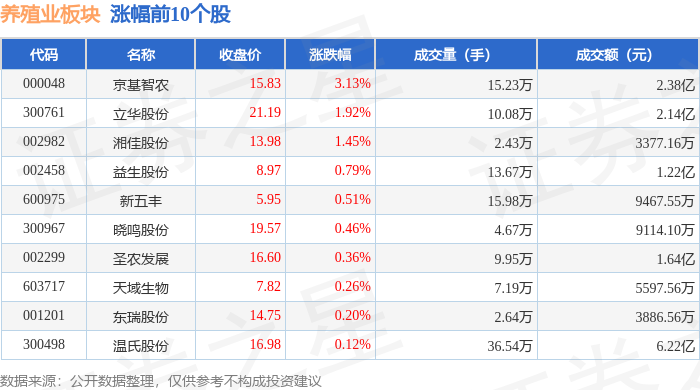
证券之星消息,1月9日养殖业板块较上一交易日下跌0.22%,福成股份领跌。当日上证指数报收于 4120.43,上涨0.92%。深证成指报收于14120.15,上涨1.15%。养殖业板块个股涨跌见下表: | 代码 | 名称 | 收盘价 | 涨跌幅 | 成交量(手) | 成交额(元) | | --- | --- | --- | --- | --- | --- | | 600965 | 福成股份 | 5.77 | -1.70% | 21.10万 | 1.22亿 | | 000735 | 罗牛山 | 8.55 | -1.04% | 63.01万 | 5.41亿 | | 002714 | 牧原股份 | 49.76 | -0.80% | 34.58万 | 17.25亿 | | 002157 | 正邦科技 | 3.27 | -0.61% | 156.83万 | 5.13亿 | | 002234 | 民和股份 | 8.90 | -0.45% | 6.89万 | 6119.44万 | | 002124 | 天邦食品 | 2.76 | -0.36% | 36.38万 | 1.00亿 | | 301116 | 益客食品 | 11. ...