泸州老窖

Search documents
2025,中小酒企“渡劫”之年
Sou Hu Cai Jing· 2026-01-08 09:37
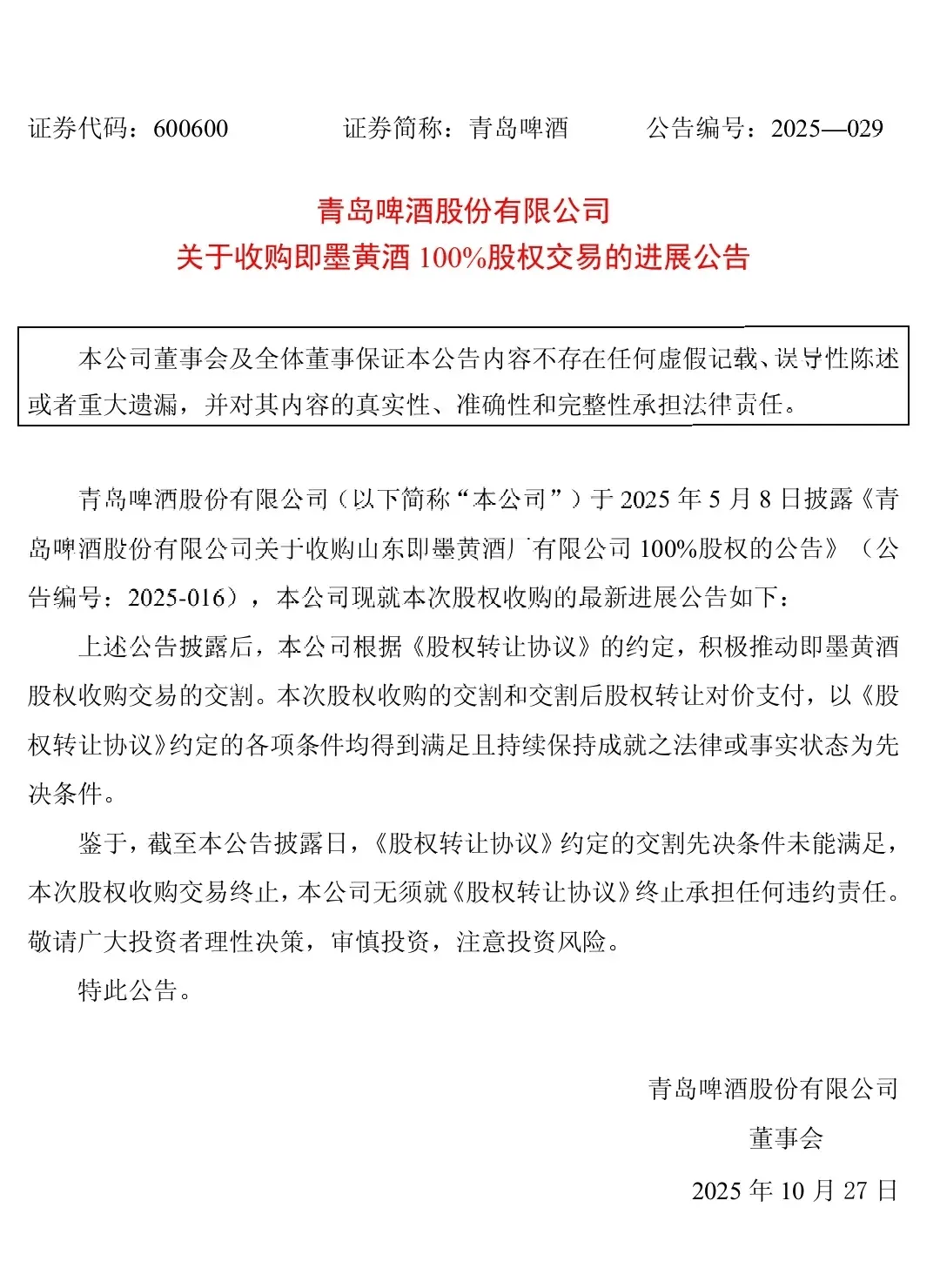
Core Viewpoint - The year 2025 is characterized by significant adjustments in the liquor industry, particularly affecting small and medium-sized enterprises (SMEs), which face survival challenges amid industry-wide turmoil and transformation [1][2]. Industry Overview - The survival crisis for SMEs in the liquor industry has escalated from individual operational difficulties to a collective industry-wide predicament, with a noticeable acceleration in market clearing [2]. - Capital activity in the sector has been marked by frequent mergers and acquisitions, with state-owned enterprises actively consolidating quality regional assets during this downturn [2]. - Conversely, some companies are witnessing capital withdrawal, as evidenced by Qingdao Beer terminating its acquisition of a yellow wine company and a tech firm divesting its stake in a liquor business due to underperformance [2]. Financial Strain - Many SMEs are under increased pressure due to cautious capital, with some previously rumored acquisition deals failing to materialize, indicating hidden risks within these companies [5]. - The industry is experiencing a surge in financial distress, with companies like Guizhou Wuyou Liquor facing significant debt issues, including a total of 62.55 million yuan in execution orders [5][6]. - The overall inventory pressure in the liquor industry remains high, with total inventory exceeding 300 billion yuan and an average turnover period of 900 days, reflecting a 10% year-on-year increase [7]. Market Dynamics - The competitive landscape has shifted, with national brands dominating local markets, leading to diminished sales for regional liquor brands [8]. - SMEs are struggling to maintain their market presence as larger brands penetrate deeper into local markets, eroding the competitive advantages that SMEs once held [8][9]. - The rapid expansion of production capacity during previous market booms has left many SMEs with excess inventory and financial burdens as demand wanes [9]. Strategic Responses - To survive, SMEs are advised to focus on their core markets and avoid blind expansion, emphasizing product quality and differentiation [13][15]. - Some SMEs are adopting strategies to target specific consumer segments and exploring innovative business models, such as integrating tourism with liquor production [13][15]. - The current industry reshuffle is seen as an opportunity for capable SMEs to carve out niches in the market, emphasizing the importance of recognizing their new roles within the industry ecosystem [15].

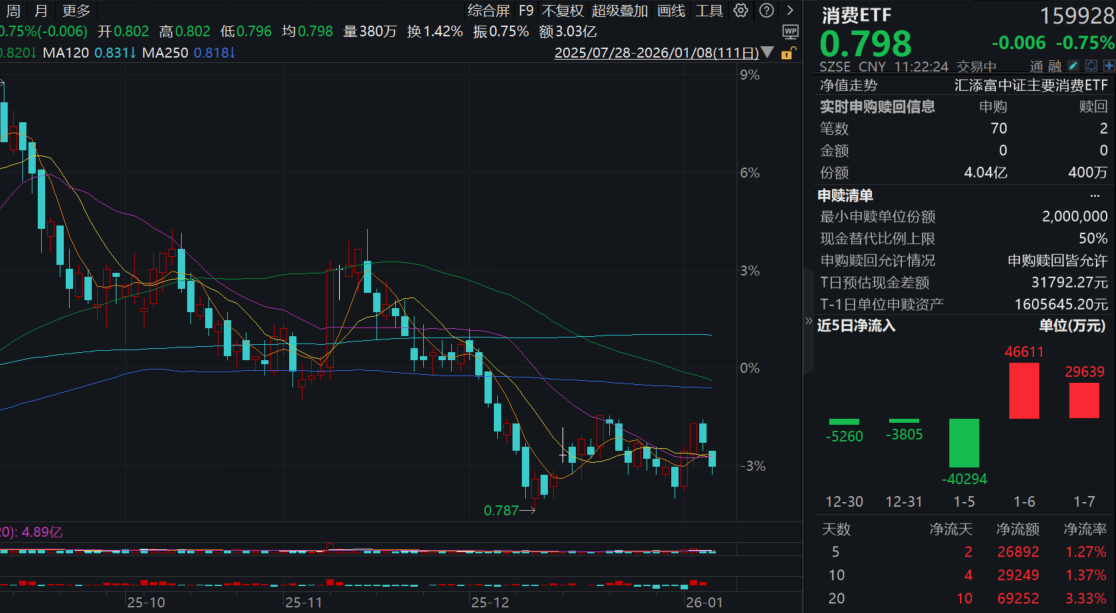
伊利董事长拟减持不超过0.98%股份!消费ETF(159928)弱势两连阴,近3日超10亿元资金布局!大消费当前估值性价比如何?
Sou Hu Cai Jing· 2026-01-08 03:52
Market Overview - The Shanghai Composite Index experienced a slight increase, while the consumer sector faced a second consecutive day of decline, with the Consumer ETF (159928) retreating by 0.75% after two days of gains [1] - The trading volume for the Consumer ETF exceeded 300 million yuan, with a net inflow of over 760 million yuan in the previous two days, and an additional net subscription of 460 million units [1] Company News - Yili Group announced that its Chairman and CEO, Pan Gang, plans to reduce his holdings by up to 62 million shares, accounting for 0.98% of the company's total shares. The proceeds will be used to repay expired stock pledge financing loans [3] - The Consumer ETF (159928) has a current scale exceeding 21.5 billion yuan, leading its peers in the same category [3] Industry Insights - Guolian Minsheng Securities highlighted that the food and beverage sector is showing signs of recovery, with expectations for CPI to turn positive by 2026, which may benefit the liquor and food segments [7] - The liquor industry is expected to see a phase of recovery in 2026, with a projected 20% decline in demand during the Spring Festival, but potential improvement by the Dragon Boat Festival [8] - The traditional consumption sector is experiencing a reversal of difficulties, with demand hitting bottom and supply chain adjustments underway [9] - The health and wellness sector is benefiting from the aging population and increased health awareness among younger consumers, with significant growth in the health supplement market [10] ETF Composition - The Consumer ETF (159928) includes major stocks with over 68.55% weight in the top ten holdings, including four leading liquor stocks accounting for 32% and major players like Yili Group (10%) and Haitian Flavoring (4%) [10]

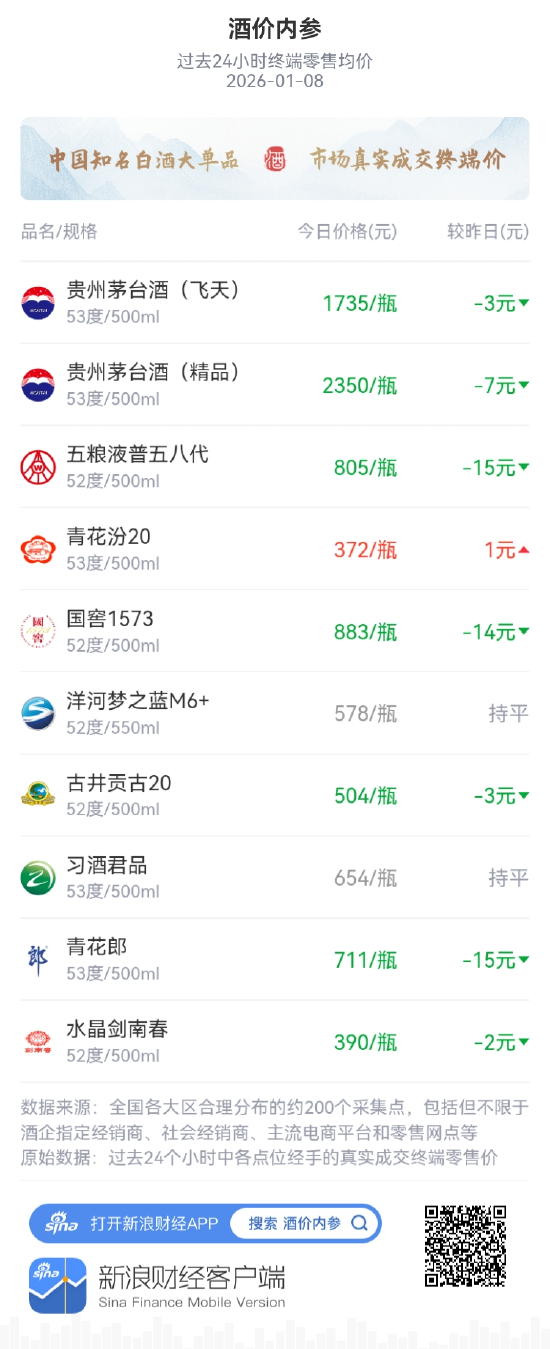
酒价内参1月8日价格发布 精品茅台价格下跌7元/瓶
Xin Lang Cai Jing· 2026-01-08 01:25
Core Insights - The core viewpoint of the news is that the Chinese liquor market, particularly the top ten liquor products, has experienced a significant decline in retail prices, indicating a downward pressure on the market and a lack of confidence among consumers [1][6]. Price Trends - The average retail price of the top ten liquor products has decreased, with a total price of 8982 yuan for a bundled sale, down 58 yuan from the previous day, marking a new low since November 18 of the previous year [1][6]. - Seven out of the ten products have seen price declines, with notable drops including Wuliangye (down 15 yuan/bottle) and Qinghua Lang (down 15 yuan/bottle) [7][1]. - Other products such as Guojiao 1573 and premium Moutai also experienced price reductions of 14 yuan and 7 yuan per bottle, respectively [7][1]. Market Sentiment - The overall market is characterized by a broad decline, reflecting insufficient confidence among consumers, as indicated by the simultaneous price drops of leading brands and core products [7][1]. Data Collection Methodology - The data for the liquor price reference is sourced from approximately 200 collection points across various regions, including designated distributors, social distributors, mainstream e-commerce platforms, and retail outlets, aiming to provide objective and traceable market price data [2][7]. ESG Rankings - Five liquor companies were included in the "2025 China ESG Top 100" list published by Sina Finance, with rankings as follows: Kweichow Moutai (27th), Wuliangye (53rd), Gujing Gongjiu (74th), Shanxi Fenjiu (89th), and Shede Jiuye (97th) [2][7]. - The rankings are based on a comprehensive evaluation of ESG performance among over 5,000 A-share listed companies and Hong Kong-listed mainland enterprises, utilizing 18 industry-specific ESG evaluation models [2][7].






酒价内参1月8日价格发布 市场普跌探底整体价格创新低
Xin Lang Cai Jing· 2026-01-08 01:01
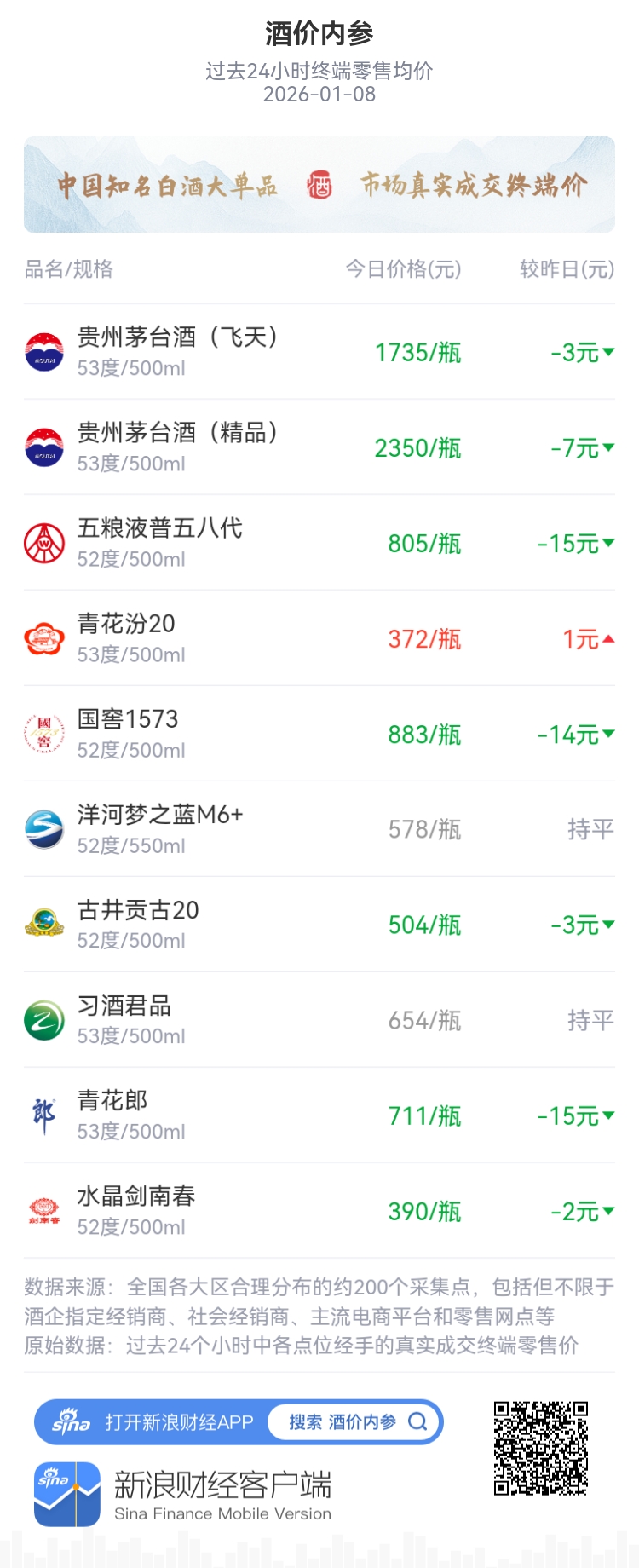
Core Insights - The Chinese liquor market is experiencing a significant decline in retail prices for the top ten products, with an overall drop in market confidence [1] - The total retail price for a bundled sale of the top ten products is 8,982 yuan, marking a decrease of 58 yuan from the previous day, the lowest since November 18 of the previous year [1] Price Movements - Seven out of the ten major liquor products saw price declines, with notable drops including: - Wuliangye (普五八代) down 15 yuan per bottle - Qinghua Lang (青花郎) down 15 yuan per bottle - Guojiao 1573 (国窖1573) down 14 yuan per bottle - Premium Moutai (精品茅台) down 7 yuan per bottle - Feitian Moutai (飞天茅台) down 3 yuan per bottle - Ancient Liquor (古井贡古20) down 3 yuan per bottle - Crystal Jiananshun (水晶剑南春) down 2 yuan per bottle [1][3][4] - The only product to see a price increase was Qinghua Fen (青花汾20), which rose by 1 yuan per bottle [1] Market Sentiment - The overall market is characterized by a downward trend, reflecting a lack of confidence among consumers and investors [1] - The price adjustments across leading brands indicate a broader issue within the industry, as multiple core products are experiencing simultaneous price declines [1]
2026年中国果酒行业发展趋势十大预判丨争鸣
Sou Hu Cai Jing· 2026-01-07 22:47
2025年是中国果酒行业深度整理、整合和重新出发的一年,是中国果酒行业人士埋头苦干、暗自攒劲的一年,是未来三年众多即将出现的新品牌重 生的元年。 文|周劲松 《中国果酒产业年度发展报告》主编 中国果酒产业年度发展大会创办人 CFWA中国果酒大奖赛组委会主席 四川省葡萄酒与果酒行业协会执行会长、秘书长 与前几年相比,2025年的中国果酒行业显得相对平淡无奇,无论是媒体的曝光度、资本的介入热度,还是行业活动或者各家生产企业、品牌企业的活跃 度,都明显减少了很多。 四是低度化与无醇化成为新赛道。2025年CFWA中国果酒大奖赛参赛产品中,低醇/起泡酒类别占比达到近20%,获奖产品中不乏低度果酒、无醇果酒等产 品,体现出企业对健康饮酒与场景细分的重视。 正如有人所说,2025年是中国果酒行业深度整理、整合和重新出发的一年,是中国果酒行业人士埋头苦干、暗自攒劲的一年,是未来三年众多即将出现的 新品牌重生的元年。 已经到来的2026年,中国果酒行业又会有哪些发展趋势或者变化呢? 但是,这并不代表中国果酒行业的2025年没有作为,没有可圈可点的亮点。 仅仅通过2025年第四届CFWA中国果酒大奖赛的相关数据分析,我们明显地 ...

又是“秒空”!马年茅台下调购买门槛
Guo Ji Jin Rong Bao· 2026-01-07 12:23
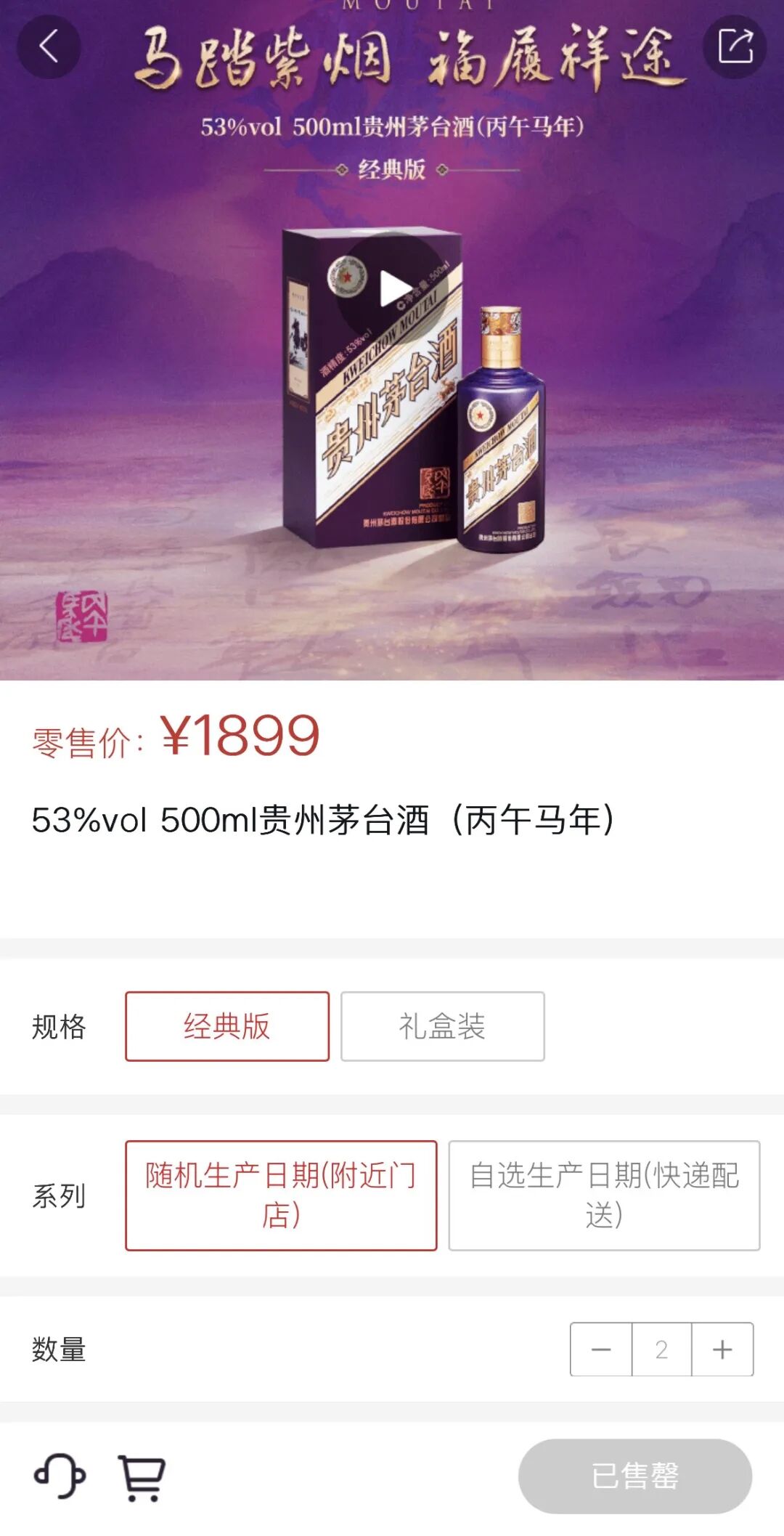
1月7日9时,贵州茅台(600519)新品马年生肖酒再次上演"上线秒售罄"的盛况。 昨天,马年生肖茅台正式在i茅台app上市发售,在白酒行业调整加剧的大背景下,变化正在发生——过去五年生肖茅台的官方指导价都是2499元/瓶, 今年购买门槛有所降低:提供了经典版、礼盒装和珍享版三个版本,官方定价分别为1899元/瓶、3789元/盒(两瓶)和2499元/瓶。其中,经典版和礼盒装 还支持自选生产日期。 从二级市场表现来看,目前经典版马年生肖茅台普遍溢价50—100元/瓶,珍享版则因投放量较小,身价暴涨至超6000元。 水芙蓉/摄 今年的马年生肖茅台会延续以往的高投放量吗? 从产品结构来看,生肖酒被视为茅台"金字塔"系列中的"塔腰"产品,兼具消费与收藏需求任务。重要的是,今年茅台明确提出会"尽努力避免价格炒 作",取消了分销机制、并将飞天茅台上线i茅台app,以激发真实消费需求,提高开瓶率。 马年春节将至,除了茅台,五粮液、洋河、泸州老窖、古井贡酒等多家头部酒企已推出生肖酒产品。 | 相较于普通版飞天茅台,生肖酒具有一定的收藏和文化属性。 | | | --- | --- | | 值得一提的是,上一轮马年茅台生肖酒(2 ...
1月7日深证国企ESG(970055)指数跌0.32%,成份股云铝股份(000807)领跌
Sou Hu Cai Jing· 2026-01-07 10:46
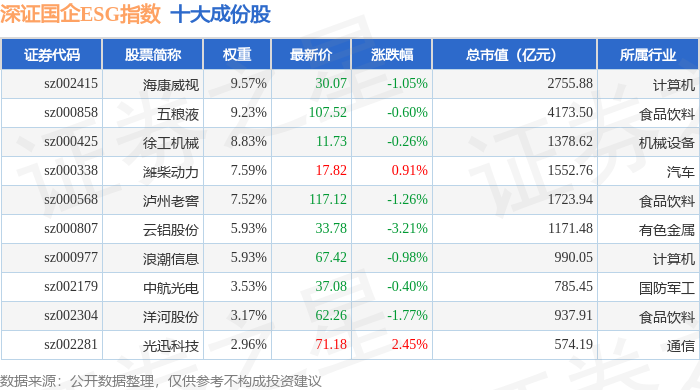
Core Viewpoint - The Shenzhen State-owned Enterprise ESG Index (970055) closed at 1436.92 points, down 0.32%, with a trading volume of 43.67 billion yuan and a turnover rate of 1.69% [1] Group 1: Index Performance - On the day, 19 constituent stocks rose, with Zhongtung High-tech leading with a 7.67% increase, while 29 stocks fell, with Yun Aluminum leading the decline at 3.21% [1] - The index's constituent stocks experienced a net outflow of 222 million yuan from institutional investors and a net outflow of 127 million yuan from retail investors, while retail investors saw a net inflow of 348 million yuan [1] Group 2: Top Constituents - The top ten constituents of the Shenzhen State-owned Enterprise ESG Index are as follows: - Hikvision (sz002415) with a weight of 9.57%, latest price at 30.07, and a decrease of 1.05% [1] - Wuliangye (sz000858) with a weight of 9.23%, latest price at 107.52, and a decrease of 0.60% [1] - Xugong Machinery (sz000425) with a weight of 8.83%, latest price at 11.73, and a decrease of 0.26% [1] - Weichai Power (sz000338) with a weight of 7.59%, latest price at 17.82, and an increase of 0.91% [1] - Luzhou Laojiao (sz000568) with a weight of 7.52%, latest price at 117.12, and a decrease of 1.26% [1] - Yun Aluminum (sz000807) with a weight of 5.93%, latest price at 33.78, and a decrease of 3.21% [1] - Inspur Information (sz000977) with a weight of 5.93%, latest price at 67.42, and a decrease of 0.98% [1] - AVIC Optoelectronics (sz002179) with a weight of 3.53%, latest price at 37.08, and a decrease of 0.40% [1] - Yanghe Distillery (sz002304) with a weight of 3.17%, latest price at 62.26, and a decrease of 1.77% [1] - Guangxun Technology (sz002281) with a weight of 2.96%, latest price at 71.18, and an increase of 2.45% [1]



15只白酒股下跌 贵州茅台1423.36元/股收盘
Bei Jing Shang Bao· 2026-01-07 09:44
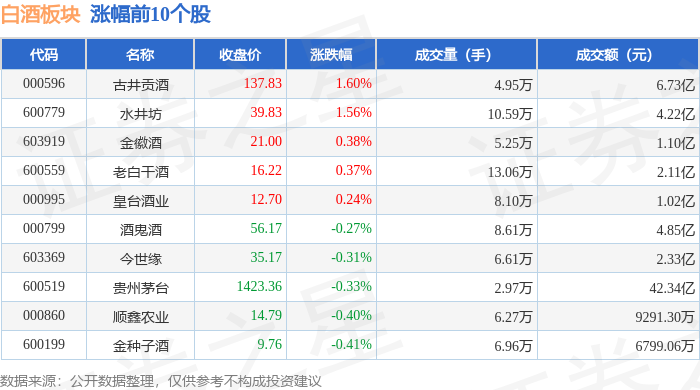
北京商报讯(记者刘一博冯若男)1月7日尾盘,三大指数集体上涨,沪指4085.77点上涨0.05%。白酒板块 以2198.30点收盘,下跌0.21%,其中15只白酒股下跌。 从个股来看,贵州茅台(600519)收盘价达1423.36元/股,下跌0.33%;五粮液(000858)收盘价达 107.52元/股,下跌0.60%;山西汾酒(600809)收盘价达177.49元/股,下跌0.89%;泸州老窖 (000568)收盘价达117.12元/股,下跌1.26%;洋河股份(002304)收盘价达62.26元/股,下跌1.77%。 国盛证券(002670)在其发布研报称,白酒2025年充分释放风险,2026年有望迎"供给先行、需求渐 进"双改善,当下动销、价盘、报表三重底部,短期元春动销环比改善正向催化,中期维度动销、价 盘、报表有望相继修复,配置短期基于供给角度,中期基于格局与分红。 ...

白酒板块1月7日跌0.47%,*ST岩石领跌,主力资金净流出2.44亿元
Zheng Xing Xing Ye Ri Bao· 2026-01-07 08:58
Core Viewpoint - The liquor sector experienced a decline of 0.47% on January 7, with *ST Rock leading the drop, while the Shanghai Composite Index rose by 0.05% and the Shenzhen Component Index increased by 0.06% [1]. Group 1: Market Performance - The closing prices and performance of key liquor stocks showed mixed results, with Guizhou Moutai at 1423.36 yuan (-0.33%), and Wuliangye at 107.52 yuan (-0.60%) [1][2]. - The total net outflow of main funds from the liquor sector was 244 million yuan, while retail investors saw a net inflow of 437.07 thousand yuan [2]. Group 2: Trading Volume and Value - Guizhou Moutai had a trading volume of 29,700 hands and a transaction value of 4.234 billion yuan, while Wuliangye had a trading volume of 123,100 hands and a transaction value of 1.326 billion yuan [1][2]. - The trading volume for the liquor sector was highlighted, with notable transactions including Luzhou Laojiao at 93,700 hands and a transaction value of 1.102 billion yuan [2]. Group 3: Fund Flow Analysis - Guizhou Moutai saw a main fund inflow of 76.40 million yuan, while *ST Rock experienced a main fund outflow of 4.17 million yuan [3]. - The fund flow analysis indicated that retail investors contributed positively to some stocks, such as Tianyoude Liquor, which had a retail net inflow of 121.59 thousand yuan [3].


搜狐酒馆第50期|肖竹青:酒业转型,未来胜负手是“谁离消费者更近”
Sou Hu Cai Jing· 2026-01-07 08:09
Core Insights - The digital transformation of the liquor industry has evolved from initial channel attempts to a new phase centered on "direct-to-consumer" strategies, requiring unprecedented operational capabilities from companies [2] - The competition in the liquor industry has shifted to a direct contest for consumers, emphasizing the need for companies to establish direct sales models and build proprietary private domain operations [2][3] - The success of platforms like iMoutai, which boasts over 76 million registered users and over 10 million monthly active users, signifies a fundamental shift in marketing strategies from channel-driven to brand-led approaches [3][4] Group 1: Strategic Intent - The core strategic intent of companies is to increase direct sales, enhancing profit margins by moving from distributor sales to direct sales [4] - Companies aim to ensure authenticity in sales and gain precise consumer data, marking a significant advancement in marketing models [4] - The shift from B2B to B2C strategies is being led by top companies, indicating a broader industry trend towards direct consumer engagement [4] Group 2: Market Dynamics - The current market environment necessitates direct sales due to saturated traditional channels and high inventory levels, pushing companies to bypass intermediaries [5] - The price disparity between official and market prices in the high-end liquor market is being addressed through direct sales strategies, expanding the consumer base [6] - Companies are focusing on middle-tier price segments (300-500 yuan) to enhance quality and value, rather than solely targeting high-end markets [7] Group 3: Future Outlook - The ideal future structure of the liquor market includes a diverse product range, increased online-offline channel integration, and a concentration of market share among leading brands [7][8] - Young consumers and international markets present significant opportunities, but require genuine product innovation and cultural adaptation for successful penetration [9] - Recommendations for consumers emphasize choosing well-known brands, particularly state-owned enterprises, for quality assurance and reliability [10]