
伊利股份

Search documents
2026年国补政策再升级!5000亿红包来袭,这些领域将迎来爆发
Sou Hu Cai Jing· 2025-12-11 15:45
Core Insights - The 2026 "National Subsidy" policy will continue the "old-for-new" consumption initiative with an increased budget of 500 billion yuan, aimed at stimulating consumption and stabilizing economic growth [1][3][16] Group 1: Policy Overview - The "National Subsidy" policy has shown significant results since its launch in 2024, generating over 2.5 trillion yuan in sales and benefiting 360 million people [3] - The policy will focus on three main upgrades: increasing the subsidy amount, expanding coverage to new sectors, and optimizing the distribution process [4][10] Group 2: Sectoral Impacts - Traditional consumption sectors like home appliances and automobiles are expected to see a second wave of growth, with home appliance subsidies potentially increasing from 12.84 million units to 15 million units [6][8] - The service consumption sector, particularly in tourism and health, is anticipated to become a new focal point, with over 100 billion yuan in tourism vouchers expected to be issued [6][10] - Digital and green consumption will be enhanced, with subsidies for smartphones and energy-efficient appliances, benefiting companies like Apple and Huawei [8][10] Group 3: Economic Implications - The policy aims to boost domestic demand and counter economic pressures, with expectations for retail sales growth to rebound to 5%-6% in 2026 [10] - It promotes industrial upgrades by leading consumption upgrades, encouraging innovation in sectors like electric vehicles and smart home appliances [10][14] Group 4: Investment Opportunities - Key investment targets include essential consumer goods like dairy products and condiments, as well as discretionary items like home appliances and new energy vehicles [15] - The policy is seen as a long-term opportunity for investors, with potential for valuation recovery and growth in the consumer sector [16]






伊利股份:公司的伊刻活泉矿泉水和现泡茶还处于发展初期
Zheng Quan Ri Bao Zhi Sheng· 2025-12-11 12:41
Group 1 - The core viewpoint of the article is that Yili Group is in the early development stage of its products, specifically the Yike Huoquan mineral water and freshly brewed tea, focusing on key cities, e-commerce, and convenience store channels [1] - Yili's Yike Huoquan freshly brewed tea is the first of its kind in China to use a screw cap design, featuring a patented fresh-lock technology that allows for instant dissolution in 3 seconds, providing a differentiated drinking experience [1] - The company plans to enhance product quality and brand strength while expanding its distribution channels and regions to reach a broader consumer base in the future [1]

冰淇淋巨头如何应对中国市场本土品牌“围剿”?
Mei Ri Jing Ji Xin Wen· 2025-12-11 12:37
Core Viewpoint - The Magnum Ice Cream Company has officially gone public in Amsterdam, London, and New York, marking a significant milestone in the global ice cream market with a market capitalization of approximately €79.41 billion (about ¥653 billion) on its first trading day [1][2]. Group 1: Company Overview - The Magnum Ice Cream Company, previously part of Unilever, has been established as an independent entity, allowing for more targeted and flexible strategies and diversified financing platforms [2][5]. - The company holds a 21% market share in the global ice cream market, leading ahead of competitors like Froneri, which has an 11% share [3][4]. - The company has four of the five major global ice cream brands, including Wall's, Cornetto, Magnum, and Ben & Jerry's [3]. Group 2: Financial Performance - The company reported a revenue of €4.503 billion and a net profit of €464 million for the first half of 2025, showing slight year-on-year increases [3]. - The company’s revenue is projected to be €3.17 billion and €2.7 billion in the Chinese market for 2024 and the first half of 2025, respectively [8]. Group 3: Market Challenges and Strategies - The company faces challenges in the competitive Chinese market, where it has experienced sales fluctuations due to consumer shifts towards more cost-effective products [8][10]. - The company has increased its advertising and promotional spending in China, launching 31 new products in January, the highest number in its history [7][8]. - The company is focusing on high-end market segments while also exploring new distribution channels, including convenience stores and e-commerce [12][14]. Group 4: Competitive Landscape - The main competitors in the Chinese market are Yili and Mengniu, with the company holding the second-largest market share [9][10]. - The company is experiencing pressure from emerging local brands and changing consumer preferences, particularly towards high-quality, handmade ice creams [16].
食品饮料行业2026年度投资策略报告(一):需求多元、供给升级,大众消费的嬗变与曙光-20251211
Guoxin Securities· 2025-12-11 08:04
Investment Rating - The report maintains an "Outperform" rating for the food and beverage industry [1][4][5] Core Viewpoints - The food and beverage sector is experiencing a transformation driven by diverse consumer demands and supply upgrades, with structural opportunities expected to persist in 2026 despite a moderate recovery in overall demand [2][29] - The report highlights the importance of adapting to new retail channels and consumer preferences, emphasizing the need for product differentiation and quality enhancement [2][29] Summary by Sections Review of 2025 - The overall industry performance was weak, with a decline of 5.3% in the food and beverage sector, underperforming the CSI 300 index by 19.4 percentage points [1][25] - Consumer confidence remained low, with urban residents' disposable income growth slowing to 4.4% year-on-year [1][12] - The soft drink sector maintained relative strength, while the snack industry showed mixed results, with leading companies continuing to expand [1][20] Outlook for 2026 - Structural opportunities are anticipated, with a focus on channel diversification and supply upgrades [2][29] - The report predicts a shift in consumer preferences towards high-quality, reasonably priced products, with an emphasis on additional value attributes such as convenience and health [2][29] - The beverage sector is expected to benefit from the development of non-traditional channels and the introduction of differentiated products [33][47] Investment Recommendations - The report suggests focusing on companies that enhance product quality and service, such as Baba Foods and Wanchen Group [3][4] - It highlights high-growth categories with health attributes, recommending companies like Dongpeng Beverage and Nongfu Spring [3][4] - The report also identifies companies with strong performance recovery potential, such as Anjijia Foods and Yihai International [3][4] Key Company Earnings Forecasts and Investment Ratings - Companies such as Yanjing Beer, Weilong Delicious, and Yili Group are rated as "Outperform" with projected earnings per share (EPS) growth [4][5] - The report provides detailed earnings forecasts and price-to-earnings (PE) ratios for various companies, indicating a generally positive outlook for the sector [4][5]
食品饮料行业 2026 年度投资策略报告(一):需求多元、供给升级,大众消费的嬗变与曙光-20251211
Guoxin Securities· 2025-12-11 08:02
Group 1 - The report indicates that the food and beverage industry experienced a slowdown in 2025, with a 5.3% decline in the sector, underperforming the CSI 300 index by 19.4 percentage points [1][25] - The soft drink sector maintained relative strength, while the snack industry showed mixed performance, with leading companies continuing to expand [1][20] - Consumer confidence remained low, with the disposable income growth rate for urban residents at 4.4% year-on-year, reflecting weak internal demand [12][20] Group 2 - Looking ahead to 2026, the report identifies structural opportunities in the consumer goods sector, driven by channel differentiation and supply upgrades [2][29] - The report emphasizes the need for consumer goods companies to adapt to new retail channels and enhance product differentiation to meet evolving consumer preferences [2][29] - The anticipated recovery in consumer confidence and macroeconomic policies is expected to shift consumer focus from extreme price competition to a preference for quality and added value [2][29] Group 3 - Investment recommendations for 2026 include focusing on high-quality and differentiated products, with specific companies highlighted such as Babi Foods and Wanchen Group [3][4] - The report suggests that companies with strong performance recovery expectations, such as Anjui Foods and Yihai International, should be considered for investment [3][4] - High dividend or comprehensive shareholder return stocks, such as Yili Group, are also recommended for investors [3][4] Group 4 - The report provides earnings forecasts and investment ratings for key companies, indicating a positive outlook for companies like Yanjing Beer and Nongfu Spring [4][5] - The food and beverage sector's overall revenue and profit growth rates have weakened, with the industry experiencing a cumulative revenue growth of only 0.3% and a profit decline of 4.5% in the first three quarters of 2025 [20][22] - The snack sector's revenue growth was primarily driven by the expansion of Wanchen Group, while other segments faced challenges [20][22]



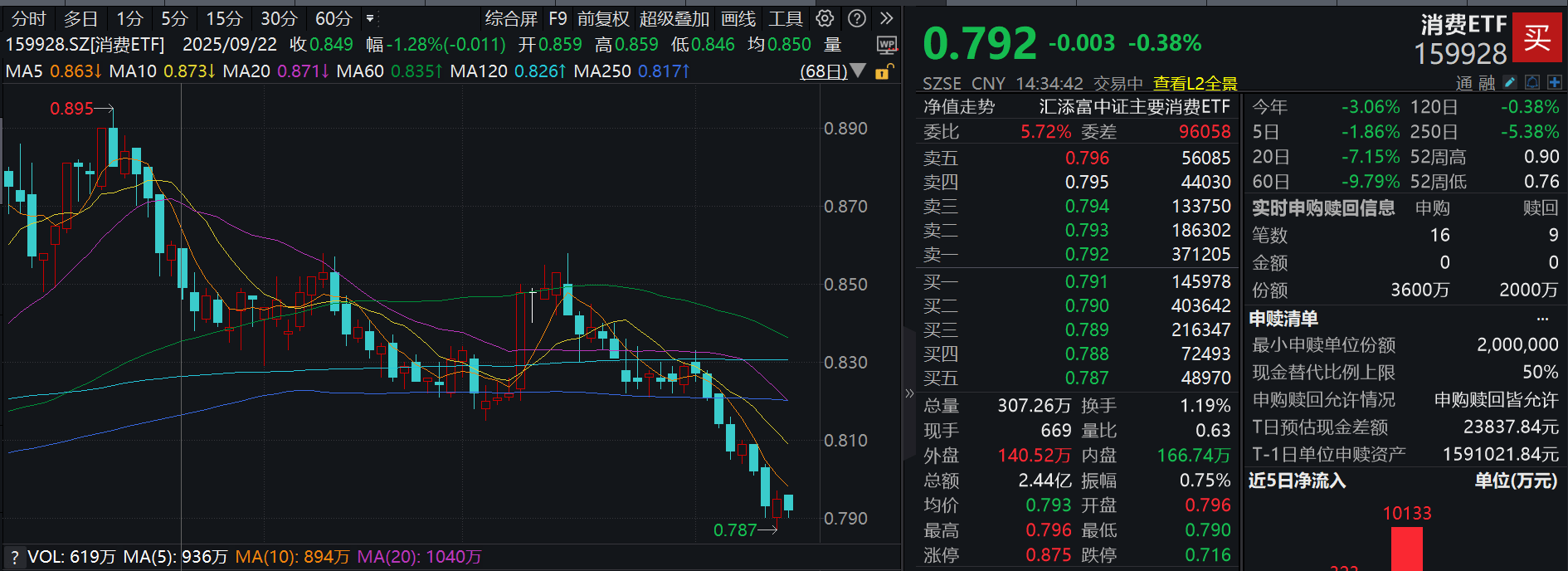
飞天茅台批价“回归”指导价!白酒迎来新一轮“挤泡沫”?消费ETF(159928)、港股通消费50ETF(159268)双双回调,再受资金青睐!
Sou Hu Cai Jing· 2025-12-11 06:54
Group 1: Market Overview - A-shares showed divergence with major consumer indices experiencing slight pullbacks, as the Consumption ETF (159928) fell by 0.38% with a trading volume exceeding 250 million yuan, while it received a net inflow of 16 million units during the session [1] - The Hong Kong stock market also saw a minor pullback in the new consumption sector, with the Hong Kong Stock Connect Consumption 50 ETF (159268) declining by 0.32% and a trading volume over 65 million yuan, marking a fourth consecutive day of significant net inflow [4] Group 2: Alcohol Industry Insights - The wholesale price of Feitian Moutai has dropped to 1,500 yuan per bottle, marking a 20% year-on-year decline and a 40% decrease compared to two years ago, while Wuliangye is set to reduce its dealer invoice price from 1,019 yuan to 900 yuan starting in 2026 [3][8] - Analysts suggest that the price adjustments in high-end liquor, particularly by leading brands like Moutai and Wuliangye, may signal a broader industry correction, potentially leading to a new round of "deflating bubbles" in the sector [9][10] Group 3: Consumer Sector Valuation - The Consumption ETF (159928) is currently trading at a TTM P/E ratio of 19.32, which is in the 2.84% percentile of the past decade, indicating a high valuation attractiveness compared to historical levels [6] - As the year-end approaches, market trends may shift towards undervalued stocks, with seasonal patterns suggesting a potential change in investment styles during Q4 [6] Group 4: Economic Indicators - November CPI data showed a year-on-year increase of 0.7%, driven by a rebound in food prices, particularly fresh vegetables, which rose by 7.2% month-on-month [11][12] - The core CPI, excluding food and energy, remained stable with a year-on-year increase of 1.2%, indicating ongoing consumer demand recovery amidst economic adjustments [12][13] Group 5: ETF Composition - The top ten holdings of the Consumption ETF (159928) account for over 68.55% of its weight, with four leading liquor companies comprising 32% of the total, alongside significant positions in pork production and other consumer staples [13][14]


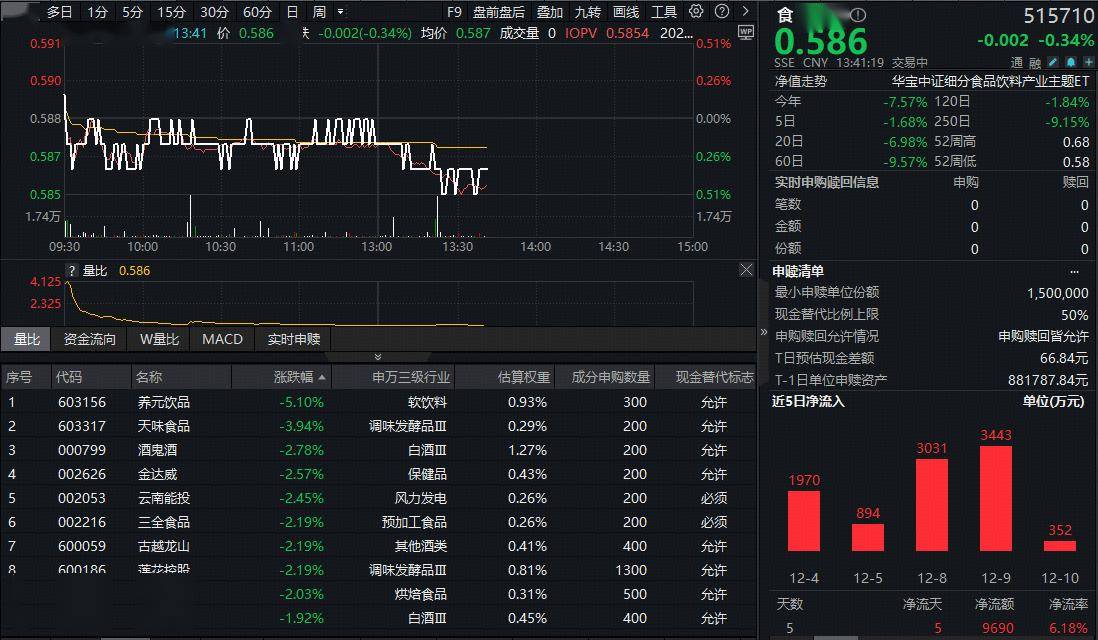
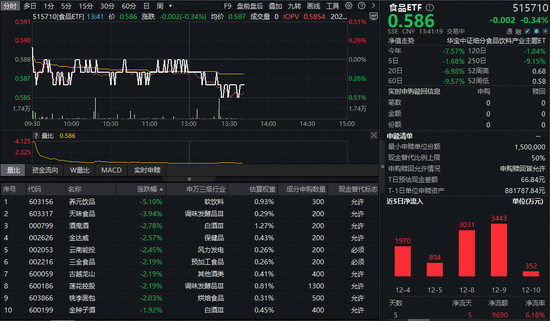
ETF盘中资讯|茅台五粮液狂派400亿红包!资金越跌越买,食品ETF(515710)近5日吸金超9600万元!
Sou Hu Cai Jing· 2025-12-11 06:11
Core Viewpoint - The food and beverage sector is experiencing a pullback, with the Food ETF (515710) showing a decline of 0.34% as of the latest update, driven by poor performance in consumer staples and certain liquor stocks [1] Group 1: Market Performance - The food and beverage sector has seen significant capital inflow, with over 96 million yuan invested in the Food ETF (515710) over the past five trading days [3] - Major liquor companies, Guizhou Moutai and Wuliangye, announced interim dividend distributions totaling approximately 40 billion yuan, with Moutai distributing 30 billion yuan and Wuliangye distributing 10 billion yuan [3] Group 2: Valuation and Investment Opportunities - The valuation of the food and beverage sector is at a historical low, with the price-to-earnings ratio of the Food ETF's underlying index at 19.99, placing it in the 4.7% percentile of the last decade [4] - Analysts suggest that the current market conditions present a favorable opportunity for left-side positioning in the sector, particularly in high-quality assets like liquor and consumer staples [4] - Recommendations include focusing on leading companies with stable demand and strong risk resilience, as well as those actively developing new products and channels [4] Group 3: ETF Composition - The Food ETF (515710) tracks the CSI Sub-Industry Food and Beverage Index, with approximately 60% of its holdings in high-end and mid-range liquor stocks, and nearly 40% in beverage, dairy, seasoning, and beer sectors [5] - The top ten weighted stocks in the ETF include major brands such as Moutai, Wuliangye, and Yili [5]
富瑞:中国强劲盈利动能驱动15%上行空间 看好高增长科技制造业
智通财经网· 2025-12-11 05:57
Group 1 - The core viewpoint of the report is that Asian stock markets have risen approximately 25% this year, driven by a revaluation of price-to-earnings ratios, with strong support from a resilient macro environment and robust corporate earnings momentum [1] - The report highlights that South Korea and China maintain strong momentum, while India's stock market continues to reach new highs. Japan remains attractive amid accelerated reforms, and the Australian market shows steady performance [1] - The report anticipates that by mid-2026, the reality of AI returns will be tested, with a peak in the US dollar exchange rate, which will help Asian and emerging markets outperform the broader market [1] Group 2 - In China, strong earnings momentum is expected to drive a 15% upside potential, with a consensus forecast of 16% earnings growth per share by 2026. The private sector and high-tech manufacturing are expected to lead this growth [2] - The report identifies key sectors for 2026, including alternative energy (lithium batteries, solar), automotive, beauty, healthcare, industrial automation, internet technology, and semiconductors, while maintaining a cautious stance on materials and durable consumer goods [2] Group 3 - The report recommends several thematic stocks for 2026, including Tencent, CATL, Sungrow Power Supply, Mindray, Yili, Geely, Galaxy Entertainment, Huahai Pharmaceutical, Yihua Healthcare, and InnoCare Pharma [3]




茅台五粮液狂派400亿红包!资金越跌越买,食品ETF(515710)近5日吸金超9600万元!
Xin Lang Ji Jin· 2025-12-11 05:55
Group 1 - The food and beverage sector experienced a decline on December 11, with the Food ETF (515710) down by 0.34% [1][2] - Major consumer goods stocks, particularly some liquor stocks, performed poorly, with Yangyuan Beverage dropping over 5% and others like Jiu Gui Jiu and San Quan Food down more than 2% [1][2] - Conversely, leading liquor brands such as Kweichow Moutai and Wuliangye showed slight gains despite the overall sector downturn [1] Group 2 - Kweichow Moutai and Wuliangye announced interim dividend distributions of approximately 40 billion yuan combined, with Moutai distributing 30 billion yuan and Wuliangye 10 billion yuan [3] - These two companies are the top-weighted stocks in the Food ETF (515710), with respective holdings of 14.89% and 14.65% as of Q3 2025 [3][4] Group 3 - The valuation of the food and beverage sector is currently at a historical low, with the Food ETF's underlying index P/E ratio at 19.99, placing it in the 4.7% percentile over the past decade [4] - Analysts suggest that this may present a good opportunity for left-side positioning in the sector [4] Group 4 - Citic Securities noted that the recent price drop of Moutai is temporarily suppressing sector performance, but potential policy-driven consumption catalysts in December could provide support [5] - The food and beverage sector is showing signs of relative return as market styles shift, with recommendations to focus on stable demand leaders and companies innovating in new products and channels [5] Group 5 - The Food ETF (515710) tracks the CSI sub-index for the food and beverage industry, with approximately 60% of its holdings in high-end and mid-range liquor stocks, and nearly 40% in beverage, dairy, seasoning, and beer leaders [5] - Investors can also consider the Food ETF linked funds (Class A 012548/Class C 012549) for exposure to core assets in the food and beverage sector [5]
梦龙称独立后将更加敏捷与专注,国内冰品市场部分低中价产品被催热、品牌抢跑上新
Cai Jing Wang· 2025-12-11 05:05
Core Viewpoint - The successful spin-off of the ice cream business from Unilever into a standalone company, Magnum Ice Cream Company, marks a significant milestone, with shares starting to trade on major exchanges and a clear strategy for growth and reinvestment outlined by the CEO [1][2]. Company Overview - Magnum Ice Cream Company has completed its spin-off from Unilever, with shares listed on the Amsterdam Euronext, London Stock Exchange, and New York Stock Exchange starting December 8 [1]. - The company has issued 612 million shares with a nominal value of €3.50 each, and on its first trading day, the stock prices increased by 6.31% in Amsterdam, 2.19% in New York, and 2.04% in London [1]. - The company aims to enhance agility, focus, and ambition as an independent entity, with a clear strategy for growth and productivity improvement [1]. Financial Performance - The company projects revenues of €7.9 billion for 2024, capturing a 21% share of the global ice cream retail market [2]. - Revenue is expected to grow from €4.394 billion in the first half of 2025 to €4.503 billion [2]. - In China, the company ranks second in retail sales among its top ten markets, with projected revenues of €317 million for 2024 and €270 million for the first half of 2025 [2]. Market Dynamics - The Chinese ice cream market is highly competitive, with the company focusing on high-end positioning to navigate this landscape [2][3]. - The overall ice cream market in China is experiencing a decline in both sales volume and revenue, with a notable shift in consumer preferences towards lower-priced products [4]. - The top ten brands in the Chinese market are seeing a concentration of market share, with the leading brand, Yili, holding approximately 33% [3]. Innovation and Product Strategy - The company emphasizes innovation in product offerings to meet evolving consumer demands, particularly in flavor diversity and premium positioning [4][5]. - New product launches are increasingly occurring earlier in the year to capture consumer attention and market share [5]. - The company is also investing in advertising and promotional activities, particularly in China, to support its growth strategy [2]. Competitive Landscape - The competitive landscape is characterized by a mix of established players and new entrants, with brands needing to align their strategies with market trends and consumer preferences [6]. - The trend towards premium and low-cost products is reshaping the market, with brands focusing on unique flavors and health-oriented options to maintain pricing power [5][6].
