吉利汽车

Search documents
周观点 | 人形机器人春晚破圈 国产链+T链齐飞【国联民生汽车 崔琰团队】
汽车琰究· 2026-02-23 09:20
Market Performance - The automotive sector outperformed the market this week, with A-share automotive index rising by 1.35%, ranking 12th among Shenwan sub-industries, compared to the CSI 300's increase of 0.04 percentage points [3][38]. - Within sub-sectors, commercial trucks, motorcycles and others, automotive parts, and automotive services saw increases of 4.56%, 1.92%, 1.68%, and 1.32% respectively, while passenger cars and commercial passenger vehicles experienced declines of 0.32% and 0.10% [3][38]. Investment Recommendations - The core investment focus for the month includes companies such as Geely Automobile, Xpeng Motors, BYD, Bertley, Top Group, New Spring, Chuanfeng Power, Weichai Power, China National Heavy Duty Truck Group, and Kingood [4][9]. - For passenger vehicles, the recommendation is to pay attention to the bottom opportunities in demand, particularly for Geely, Xpeng, and BYD, with a suggestion to also consider Jianghuai Automobile [7][18]. - In the parts sector, recommendations include intelligent driving companies like Bertley, Horizon Robotics, and Kobot, as well as new force industry chains such as Xingyu and Huguang [7][22]. Policy and Demand Outlook - Various regions have begun implementing the 2026 vehicle replacement subsidy, which, combined with the upcoming auto shows post-Spring Festival, is expected to stabilize and increase automotive sales [6][10]. - The National Development and Reform Commission and the Ministry of Finance have allocated 62.5 billion yuan for 2026 national subsidies, which will support consumer demand for vehicle purchases [11][50]. - The January wholesale volume of passenger vehicles was 1.973 million units, a year-on-year decrease of 6.2%, with new energy vehicles accounting for 864,000 units, down 3.3% year-on-year [6][10]. Robotics Sector - Four domestic humanoid robot companies showcased their technologies during the 2026 CCTV Spring Festival Gala, with Yushutech's "Wu BOT" performance being particularly impressive, creating a breakout effect [5][9]. - The mid-term outlook for the robotics sector is optimistic, with Tesla's mass production and technological iterations expected to be a core driving force [5][9]. Motorcycle Market - The motorcycle market is experiencing growth, with sales of 250cc and above motorcycles reaching 69,000 units in December 2025, a year-on-year increase of 1.8% [28]. - The domestic sales of 250cc+ motorcycles in December were 28,000 units, up 32.8% year-on-year, while exports were 41,000 units, down 12.1% year-on-year [29][30]. - The recommendation for the motorcycle sector includes leading companies such as Chuanfeng Power and Longxin General [32]. Heavy Truck Market - The heavy truck market saw sales of approximately 105,000 units in January 2026, a year-on-year increase of about 46% [33]. - The expansion of the vehicle replacement subsidy policy is expected to stimulate demand for heavy trucks, particularly with the focus on replacing older vehicles [34][35].




机器人激光雷达销量全球第一,速腾聚创盈利突破驱动价值重估
Ge Long Hui· 2026-02-23 09:01
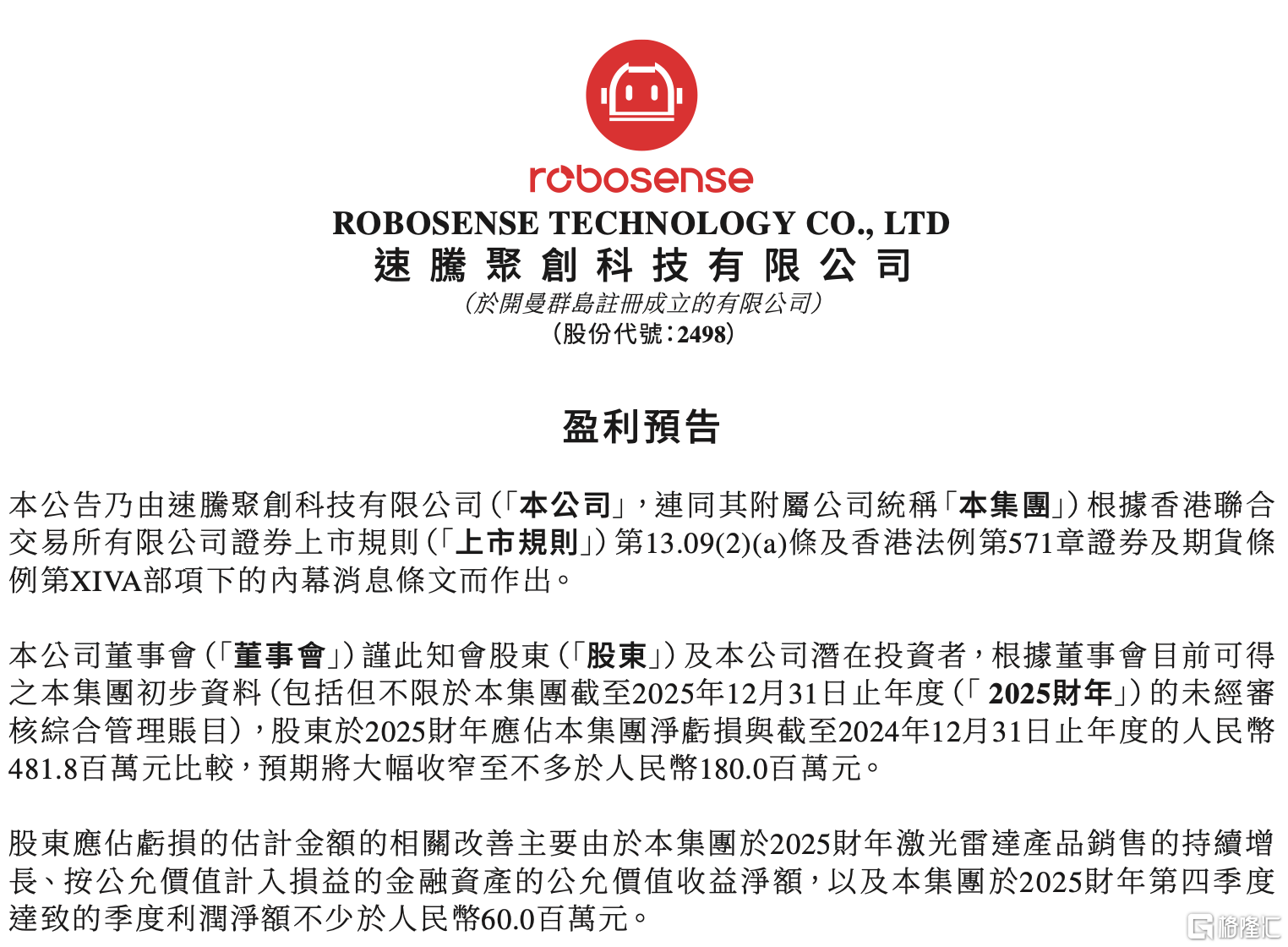
Core Viewpoint - The company, SUTENG, has achieved a significant milestone by announcing its first quarterly profit, which has boosted investor confidence and is expected to lead to a reevaluation of the laser radar industry's value [2][8][24]. Group 1: Financial Performance and Market Reaction - On February 20, the company's stock price opened high and surged to HKD 39.8, reflecting a maximum increase of over 15%, indicating strong investor recognition of the company's performance [2]. - The CEO of SUTENG, Qiu Chunchao, stated that the fourth quarter would be a critical point for continued operational improvement, and the company has exceeded its breakeven expectations [2][4]. - The announcement of profitability is seen as a landmark event in the laser radar industry, which has historically struggled to transition from technological leadership to commercial success [2][8]. Group 2: Business Segments and Growth Drivers - As of November 2025, SUTENG has secured 144 models for global front-mounted production, with significant partnerships across major automotive brands [6]. - The company's robot business, particularly in lawn mowing robots, has seen explosive growth, achieving the highest global sales in 2025, with a total of 30.3 million units sold, marking an over 11-fold increase year-on-year [7]. - The robot business is now a core growth driver alongside the ADAS business, with its sales proportion rising from less than 5% in 2024 to nearly 50% in 2025 [7]. Group 3: Industry Context and Competitive Advantage - The laser radar industry has historically been evaluated based on technological advancement and future market potential, but SUTENG's confirmed profitability has broken this valuation cycle [8]. - The company is positioned at a critical juncture in the AI terminal ecosystem, where its unique product capabilities align with the growing demand in smart automotive and robotics applications [12][14]. - SUTENG's technological leadership, particularly in SPAD-SoC and VCSEL digital chip architecture, has created a significant competitive edge over rivals, enhancing its attractiveness to downstream customers [13]. Group 4: Future Outlook and Market Potential - The company is expected to maintain strong profitability growth, driven by its dual business model in automotive and robotics, with a projected order scale exceeding 2 million units [17]. - The market for laser radar in passenger vehicles is anticipated to double, with a penetration rate of 20.48% for new energy vehicles by 2025 [18]. - SUTENG's collaboration with leading robot companies and its focus on expanding into various verticals will further enhance its market position and profitability [18]. Group 5: Valuation and Investment Sentiment - The company's current price-to-sales (PS) ratio of 9.20 is considered low compared to its potential, indicating that the market has not fully priced in its growth prospects [19]. - Major investment banks have issued "buy" or "hold" ratings for SUTENG, with target prices suggesting a potential increase of over 70% from current levels, reflecting confidence in the company's future [22]. - The recent stock price increase is viewed as a long-term recognition of the company's technological advantages and commercial potential, marking the beginning of a new phase of sustainable profitability [24][25].

吉利汽车(00175)2月23日斥资1126.3万港元回购65.9万股
Zhi Tong Cai Jing· 2026-02-23 08:58
智通财经APP讯,吉利汽车(00175)发布公告,于2026年2月23日该公司斥资1126.3万港元回购65.9万股, 回购价格为每股16.99-17.18港元。 (原标题:吉利汽车(00175)2月23日斥资1126.3万港元回购65.9万股) ...
开车过新年丨在北欧,遇见“中国智造”
Bei Ke Cai Jing· 2026-02-23 08:49
Core Insights - The article highlights the increasing presence of "Chinese smart manufacturing" in everyday life across Nordic countries, showcasing various Chinese brands and products that have integrated into local culture and transportation systems [2][22]. Group 1: Transportation - In Finland, the largest transportation company, Pohjolan Liikenne, has purchased 400 buses from Chinese manufacturer Yutong, including both electric and fuel buses, which are now a common sight in Helsinki [6]. - BYD vehicles are also seen on the streets of Denmark, indicating the growing acceptance of Chinese electric vehicles in the region [7]. - MG, a brand acquired by China's SAIC Motor, sold 307,000 units in Europe in 2025, marking its 11th consecutive year as the top-selling Chinese brand in the region [9]. Group 2: Technology and Consumer Products - DJI, a leading global drone manufacturer from China, has established a presence in Copenhagen, becoming a preferred brand for aerial photography enthusiasts in Europe [17]. - LEGO has launched limited edition products for the Chinese New Year, marking its eighth consecutive year of creating special items for this occasion, showcasing the brand's adaptation to local cultural events [19]. - Pop Mart, known for its collectible toys, has also made inroads into the Nordic market, appealing to local youth with its trendy products [20]. Group 3: Cultural Integration - The article emphasizes a shift in perception of Chinese manufacturing from being associated with low-cost goods to being recognized for technological innovation and quality, as evidenced by the integration of Chinese products into daily life in Nordic countries [22].

吉利汽车(00175.HK)2月23日耗资1126.3万港元回购65.9万股
Ge Long Hui· 2026-02-23 08:48
格隆汇2月23日丨吉利汽车(00175.HK)公告,2月23日耗资1126.3万港元回购65.9万股。 ...
吉利汽车(00175) - 翌日披露报表
2026-02-23 08:38
FF305 翌日披露報表 (股份發行人 ── 已發行股份或庫存股份變動、股份購回及/或在場内出售庫存股份) | 第一章節 | | | | | | | | | --- | --- | --- | --- | --- | --- | --- | --- | | 1. 股份分類 | 普通股 | 股份類別 | 不適用 | | 於香港聯交所上市 | 是 | | | 證券代號 (如上市) | 00175 | 說明 | | | | | | | 多櫃檯證券代號 | 80175 | RMB 說明 | | | | | | | A. 已發行股份或庫存股份變動 | | | | | | | | | | | | 已發行股份(不包括庫存股份)變動 | | 庫存股份變動 | | | | | 事件 | 已發行股份(不包括庫存股份)數 目 | | 佔有關事件前的現有已發 行股份(不包括庫存股 份)數目百分比 (註3) | 庫存股份數目 | 每股發行/出售價 (註4) | 已發行股份總數 | | 於下列日期開始時的結存(註1) | 2026年2月20日 | | 10,817,104,297 | | 14,358,000 | | 10,831,46 ...
平安证券(香港)港股晨报-20260223
Ping An Securities Hongkong· 2026-02-23 07:57
Market Overview - The Hang Seng Index closed at 23831 points, down 145 points or 0.61%, with a trading volume of 827.99 billion [1] - The Hang Seng Technology Index fell by 2.91% to 5211.5 points, while the Hang Seng China Enterprises Index decreased by 1.22% to 8959.56 points [5] - The market saw a net inflow of 4.84 million from the Hong Kong Stock Connect, with the Shanghai and Shenzhen Connect contributing 2.83 million and 2.01 million respectively [1] Key Sector Performance - Local real estate, software, and 5G concept sectors experienced significant declines, while gold stocks performed well [1] - The AI model sector showed resilience, with companies like Zhiyuan rising nearly 43% and MiniMax increasing over 14%, both surpassing a market capitalization of 300 billion [1] US Market Insights - On February 20, US stock indices opened lower but closed higher, with the Dow Jones up 0.47%, S&P 500 up 0.69%, and Nasdaq up 0.90% [2] - Major tech stocks led the gains, with Alphabet rising nearly 4% and Amazon up about 2.5% [2] Future Market Outlook - The report anticipates that both Hong Kong and A-shares will see positive performance in 2026, with net inflows of 69 billion Hong Kong dollars in January [3] - The focus on "technological self-reliance" and AI applications is expected to be a core theme for future market developments, with leading companies in these sectors likely to benefit [3] - The Ministry of Industry and Information Technology's recent policy on national computing power interconnectivity is expected to boost domestic computing and communication sectors [3] Investment Recommendations - Continued focus on sectors supported by "technological self-reliance" policies, including AI applications, semiconductors, and industrial software [3] - Attention to sectors benefiting from "expanding domestic consumption" policies, such as sports apparel and non-essential services [3] - Consideration of state-owned enterprises with relatively low valuations and high dividends across various industries [3] Market Trends - The report highlights the ongoing improvement in the supply-demand dynamics of the storage chip industry, with major players like SK Hynix indicating a shift to a seller's market in 2026 [11] - The anticipated price increases in storage chips are expected to benefit design, manufacturing, and testing sectors, particularly those related to AI computing [11] - Companies with technological advantages in the semiconductor space, such as SMIC and Hua Hong Semiconductor, are expected to see significant benefits [11]
海外过年的中国车商:不做一锤子买卖,在最前沿扎根
Di Yi Cai Jing· 2026-02-23 06:15
Core Viewpoint - The Chinese automotive industry is experiencing rapid growth in overseas markets, transitioning from quantity expansion to qualitative improvement, with brands like BYD, Chery, Geely, and Great Wall gaining market share and improving brand reputation [3]. Group 1: Market Dynamics - The Chinese automotive export market has shifted from a phase where customers actively sought suppliers to a competitive environment where traders are vying for clients, leading to reduced profit margins for traders [4]. - The perception of Chinese automotive brands has evolved, with consumers in regions like the Middle East increasingly recognizing the quality of these vehicles, moving away from the previous low-quality, low-price stereotype [3]. Group 2: Business Strategies - Companies are moving away from short-term speculative trading models and are focusing on establishing long-term business relationships by deeply understanding local market rules and customer needs [5]. - A new collaboration is being established with an overseas dealer in the Middle East, involving the investment in a KD factory, which will require careful planning for after-sales services and operational details [5].

【申万宏源研究春节见闻】黑龙江大庆:从新中国石油工业的长子到北方高端智造高地
Xin Lang Zheng Quan· 2026-02-23 05:44
Core Viewpoint - The article explores the transformation of Daqing from a traditional oil city to a modern chemical and manufacturing hub, highlighting its historical significance in China's oil industry and its ongoing industrial evolution. Group 1: Historical Significance of Daqing Oilfield - Daqing Oilfield, discovered in 1959, marked a significant milestone in China's oil industry, contributing to the country's self-sufficiency in oil production by the early 1960s [5][9]. - From 1960 to 1963, Daqing produced 11.66 million tons of oil, accounting for 51.3% of the national total, and by 1963, its production capacity reached 4.393 million tons, representing 67.8% of the national output [9]. - Daqing maintained high production levels, achieving over 5 million tons annually from 1976 to 2002, and stabilized production above 4 million tons from 2003 to 2014 [10]. Group 2: Transition to a Chemical Industry - Daqing has transitioned from a single oil extraction base to a comprehensive chemical manufacturing city, focusing on refining and chemical production [10]. - The city has implemented strategies to enhance oil recovery and develop shale oil, while also upgrading its refining capabilities, leading to a significant increase in the production of chemical raw materials [10]. - Daqing now features a modern petrochemical base with a capacity for 10 million tons of refining and 1 million tons of ethylene, promoting a collaborative development of oil extraction and green chemistry [10]. Group 3: Development of the Automotive Industry - Daqing has actively engaged with the global high-end automotive industry, notably through the establishment of a Volvo manufacturing plant, which has become a key pillar of the local economy [11]. - Since the opening of the Volvo factory in 2013, Daqing has produced over 560,000 vehicles, generating nearly 120 billion yuan in output value and over 11 billion yuan in tax revenue by 2025 [11]. Group 4: Broader Economic Context - The Northeast region of China, historically known for its industrial contributions, faces challenges such as population outflow and limited high-end job opportunities, necessitating a shift towards innovation-driven growth [15]. - Daqing's evolution serves as a model for resource-based cities aiming for high-quality revitalization and sustainable economic development [10][15].


在海外过年的中国车商:不做“一锤子买卖”,在最前沿扎根
Di Yi Cai Jing Zi Xun· 2026-02-23 05:38
Core Viewpoint - The article highlights the rapid development of Chinese automotive exports, transitioning from quantity expansion to quality improvement, with a focus on the increasing competitiveness and market dynamics in overseas markets [2][3]. Group 1: Market Dynamics - Chinese automotive brands have shifted from being perceived as low-quality, low-cost options to gaining recognition and market share in overseas markets, particularly in the Middle East [3]. - The competition in the overseas automotive market has intensified, moving from a phase where customers sought out suppliers to a scenario where traders are competing fiercely for clients [4]. Group 2: Business Strategies - Companies are moving away from short-term profit strategies and are focusing on long-term relationships with clients, emphasizing the importance of market research and customer engagement [4]. - The establishment of local production facilities, such as KD factories, is becoming a key strategy for Chinese automotive companies to enhance their service offerings and deepen partnerships with overseas distributors [4]. Group 3: Challenges and Adaptations - The market is witnessing the exit of traders who lack a deep understanding of local demands and rely solely on low pricing, leading to a more discerning customer base that compares options before making decisions [4]. - Companies are adapting by conducting thorough market research and maintaining a presence in overseas markets to build trust and long-term partnerships with clients [4].