荣耀

Search documents
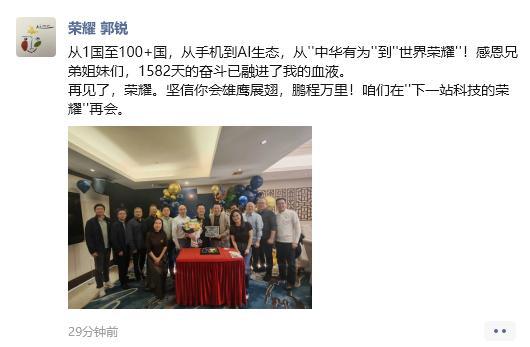
荣耀品牌营销总裁郭锐官宣离职
Guan Cha Zhe Wang· 2025-12-12 09:51
Core Insights - Guo Rui, the President of Brand Marketing at Honor, announced his departure from the company after over four years, expressing confidence in Honor's future [1] - Guo Rui is expected to venture into a second entrepreneurial endeavor in the technology sector [1] Company Overview - Guo Rui holds a PhD from Peking University and joined Honor in August 2021 as a founding management team member after its independence [6] - He previously served as CMO for Huawei's Greater China region from 2017 to 2021 and held key management positions at Procter & Gamble, COFCO, and Mengniu [6] Market Position - As of Q3 2025, Vivo leads the Chinese smartphone market with a 17.3% share, followed by Apple, Huawei, and Xiaomi, while OPPO holds a 14.5% share, showing a slight year-on-year increase of 0.4% [6] - Honor is in close competition with OPPO for market share [6] - By December 2024, Honor's overseas sales accounted for over 50% of its total sales, achieving profitability in multiple regions [6]

20cm速递|科创芯片ETF国泰(589100)涨超1.3%,市场关注国产GPU自主化与存储芯片格局变化
Mei Ri Jing Ji Xin Wen· 2025-12-12 05:59
Core Insights - The global semiconductor market is projected to reach $208 billion by Q3 2025, marking the first time it surpasses the $200 billion threshold, with a quarter-on-quarter growth of 15.8%, the highest quarterly growth rate since 2009 [1] - The demand for computing power driven by the AI wave is significantly increasing the value across various segments, including servers, AI chips, optical chips, storage, and PCBs [1] - The storage prices have bottomed out and are beginning to recover, while the utilization rates in the packaging and testing segment are gradually improving [1] Industry Trends - Over the next three years, "advanced process expansion" will be a key focus for self-controlled development, with domestic equipment making continuous progress in advanced process breakthroughs and validations [1] - CoWoS and HBM technologies are positioned to align with AI industry trends, highlighting the growing importance of advanced packaging [1] - In the consumer electronics sector, the successful application of foldable machine hinges by Honor and OPPO, along with increased investment from Apple, is accelerating the penetration of 3D printing technology [1] Market Performance - The global shipment of foldable smartphones in Q3 has increased by 14% year-on-year, reaching a historical high, with a continuous rise in high-end market penetration [1] - The Guotai ETF (589100), which tracks the semiconductor index (000685), experienced a daily fluctuation of 20%, reflecting the performance of listed companies across the semiconductor materials, equipment, design, manufacturing, and packaging testing sectors [1]
一条视频看懂手机智能体的来龙去脉
2 1 Shi Ji Jing Ji Bao Dao· 2025-12-12 01:13
Core Insights - The emergence of mobile AI assistants has significantly transformed the smartphone landscape, with predictions that 2025 will be the "year of AI assistants" [1] - Major smartphone manufacturers like Xiaomi, Honor, Vivo, OPPO, Huawei, and Samsung have integrated their own AI assistants, while third-party options like Doubao from ByteDance have also gained traction [1] - Initial capabilities of these AI assistants were overhyped, with only a few able to successfully perform tasks like food delivery [1] Technology Routes - The intent framework route focuses on collaboration between apps and mobile AI assistants, offering high efficiency and controllable safety, but faces challenges in convincing each app to cooperate [2] - The GUI Agent route allows AI assistants to interact with the screen like a human user, simplifying processes but requiring higher technical standards and raising privacy concerns [2] - The cloud phone route addresses issues with accessibility permissions but still requires screen reading capabilities [3] Security and Compliance Risks - Mobile AI assistants pose privacy risks due to their ability to read screens, which can expose sensitive information, and the potential for AI-induced errors [3] - The industry faces systemic data security risks and the potential exploitation of accessibility services by malicious entities [3] Commercial Dynamics - A power struggle exists between internet apps and mobile AI assistants, as the latter can replace human operations, leading to efficiency gains for users but a loss of power for apps [5] - Major platforms like WeChat and Alipay have restricted operations of Doubao shortly after its launch, indicating resistance from established players [5] - Ongoing disputes over the authorization of AI assistants highlight the need for clear regulations regarding user and app permissions [6] Future Developments - The industry is expected to continue evolving, with major companies vying for control over rule-making in response to the changes brought by AI assistants [6] - A new round of assessments on mobile AI assistants is planned for the end of the year to provide updated insights and foster discussions [6]
合集回顾:手机智能体的来龙去脉 4个问题带你看
2 1 Shi Ji Jing Ji Bao Dao· 2025-12-12 00:49
Core Insights - The article discusses the evolution of mobile AI assistants, highlighting their transition from basic chatbots to advanced personal assistants capable of performing tasks on behalf of users, thus reshaping the AI ecosystem [1][3][4] Group 1: Core Capabilities - Mobile AI assistants are changing the reliance on traditional apps, with major brands like Xiaomi, Honor, Vivo, OPPO, Huawei, and Samsung integrating their own AI assistants into devices [3][4] - Initial capabilities of these AI assistants were overhyped, with real-world success rates for tasks like food delivery being below 3% for most [3][4] - Two main technical routes for mobile AI assistants are identified: intent frameworks that require app cooperation and GUI agents that simulate user actions, with the latter being more prevalent [4][5] Group 2: Privacy and Security - The use of screen-reading capabilities by mobile AI assistants raises significant privacy concerns, as they can access sensitive information like chat logs and banking details [6][7] - The transfer of control to AI assistants poses risks, including potential misinformation and execution errors, which could lead to legal issues [6][7] - Systemic data security risks arise from high-privilege applications operating without external oversight, leading to potential misuse [7][8] Group 3: Commercial Dynamics - The competition between internet apps and mobile AI assistants is intensifying, with concerns that AI could replace human interactions, impacting app engagement metrics and advertising revenues [10][11] - The introduction of AI assistants like Doubao has sparked discussions about the future of app ecosystems and the potential for apps to become mere tools for AI [10][11] - The ongoing struggle for control over user data and the implications of AI's role in transactions highlight the need for clear regulations and responsibilities [12][13] Group 4: Future Considerations - The article emphasizes the necessity for transparent authorization mechanisms and clear accountability in AI operations to establish trust and legitimacy [13][14] - Proposals for giving AI assistants a distinct identity and establishing a regulatory framework are discussed as potential solutions to current challenges [14][15]
Mate80发布后,华为连续两周重夺中国手机市场第一
Xin Hua Cai Jing· 2025-12-11 13:51
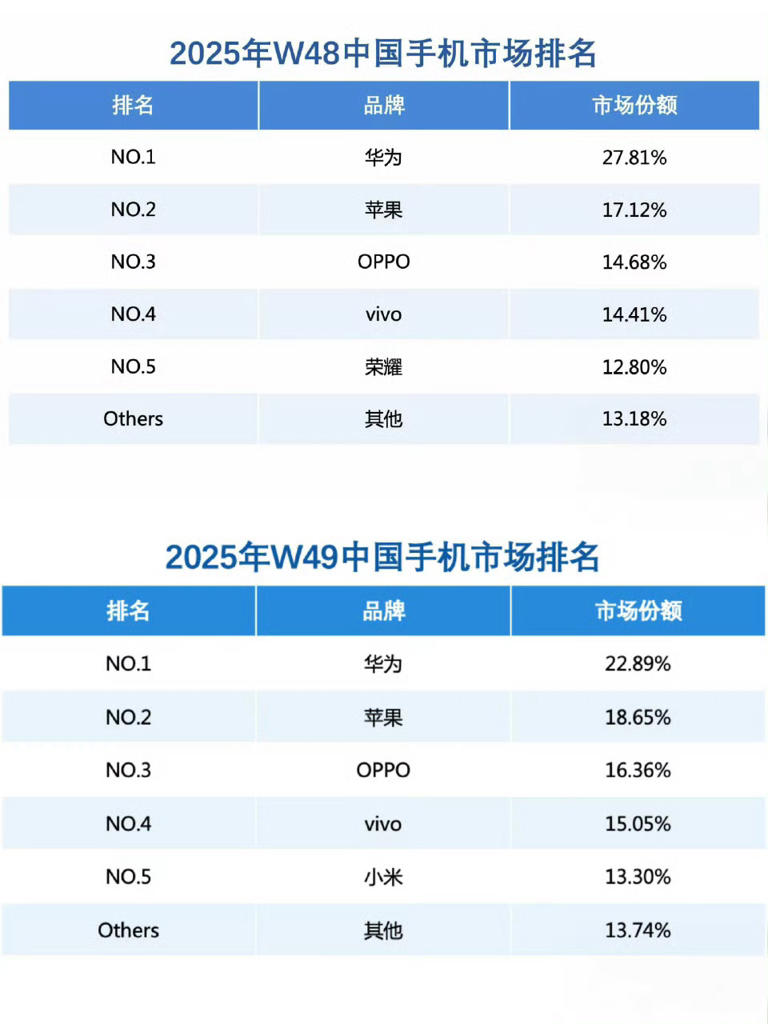
Core Insights - Huawei has regained the top position in the domestic smartphone market, surpassing Apple for two consecutive weeks since the launch of the Mate80 series [1][6]. Market Share Summary - In week 48, Huawei achieved a market share of 27.81%, significantly ahead of Apple's 17.12%. OPPO, vivo, and Honor ranked third to fifth with shares of 14.68%, 14.41%, and 12.80% respectively [3]. - In week 49 (December 1-7), Huawei maintained its lead with a market share of 22.89%, while Apple followed with 18.65%. OPPO and vivo ranked third and fourth with shares of 16.36% and 15.05%, and Xiaomi was fifth with 13.30% [5]. Pricing Strategy - Despite a global increase in storage prices, Huawei has reduced the pricing of its new models compared to the previous generation. This is attributed to improved yield rates of self-developed chips and the maturation of the Harmony OS [5].

豆包和智谱,二线手机厂商的救命稻草
Tai Mei Ti A P P· 2025-12-11 12:35
Core Insights - Elon Musk predicts that traditional smartphones and standalone apps will disappear within the next 5 to 6 years, evolving into "AI reasoning edge nodes" that rely on cloud and local AI for complex tasks [2] - The launch of the "Doubao AI phone" in collaboration with ZTE has sparked significant market interest, with initial sales of 30,000 units selling out quickly and prices on secondary markets reaching as high as 36,000 yuan [2][3] Group 1: AI Phone Market Dynamics - The concept of AI phones has transitioned from a novelty to a practical tool capable of cross-app operations and comprehensive price comparisons, significantly increasing market appeal [3] - The introduction of the Doubao AI phone has led to a surge in AI phone-related stocks, indicating a strong investor interest in this emerging market [4] - The new generation of AI phones integrates "edge AI models" directly into devices, allowing for independent processing of complex tasks without needing constant internet connectivity [7] Group 2: Technological Advancements - The Doubao AI phone utilizes a system-level integration of its AI model, enabling it to perform automated operations across applications, such as price comparisons and order placements, with minimal user input [7][8] - The AutoGLM model from Zhiyu provides robust capabilities for understanding and executing complex tasks across over 50 popular Chinese applications, enhancing user experience through voice commands [8] Group 3: Market Challenges and Responses - Despite initial excitement, the Doubao AI phone faced restrictions from multiple platforms within three days of launch, prompting the company to adjust features to comply with security regulations [9] - Industry experts acknowledge the impressive capabilities of the Doubao AI phone but highlight the inherent data security risks associated with its ability to control system functions [10] Group 4: Competitive Landscape - The competition between Doubao and Zhiyu reflects two distinct strategies: Doubao focuses on deep integration of its AI into existing devices, while Zhiyu promotes an open-source approach to foster a collaborative ecosystem among manufacturers [11][15] - The AI phone market is projected to see significant growth, with an estimated 147 million units expected to ship in China by 2026, representing a 31.6% year-on-year increase [17] Group 5: Future Considerations - The emergence of AI agents capable of managing multiple applications could disrupt traditional app ecosystems, potentially diminishing the role of major internet companies as gatekeepers of user engagement [18][19] - Establishing a compliance framework for AI operations on mobile devices will be crucial to differentiate between legitimate assistance and potential misuse, highlighting the need for a balanced approach to user experience, business interests, and security [20]
当AI手机开始“越权”:豆包的颠覆体验,动了谁的奶酪?
3 6 Ke· 2025-12-11 09:38
Core Insights - The article emphasizes the transformation of user experience in the smartphone industry, particularly with the introduction of AI-driven functionalities that enhance interaction and efficiency [1][10][18] Industry Trends - The report from the First New Voice Think Tank highlights a shift towards vertical and general AI agents, indicating a potential concentration of traffic entry points towards a few general agents [1] - The global penetration rate of AI smartphones is projected to reach 32% by 2025, indicating a significant growth trajectory for AI integration in mobile devices [15] Company Developments - The launch of the Doubao AI phone by ByteDance and ZTE has generated significant consumer interest, leading to a scarcity of the product and even price premiums in the second-hand market [1] - Despite initial success, the Doubao AI phone faced challenges with various applications from Alibaba and Tencent blocking access due to security concerns, highlighting a conflict between AI functionality and platform control [10][11] Technological Innovations - The Doubao AI phone introduces a new era of "one-click management," allowing users to execute complex tasks across multiple applications seamlessly, which marks a departure from traditional AI assistants [2][6] - The phone's ability to handle cross-application operations and its simplified interaction model represent significant advancements in user experience [3][5] User Experience Enhancements - The Doubao AI phone features a memory function that allows for highly personalized interactions, enabling users to store and retrieve information effortlessly [7][8] - The integration of memory with execution capabilities allows the AI to plan and execute tasks based on user history and preferences, enhancing the overall user experience [9][12] Competitive Landscape - The primary competition for the Doubao AI phone is not other smartphone manufacturers like Apple, but rather the established internet companies that control app ecosystems [10][11] - The article suggests that the future of smartphones will depend on the ability to integrate AI capabilities that enhance user experience while navigating the challenges posed by existing platform monopolies [13][18]

深圳经济生机勃勃 向“新”向“高”发展活力奔涌
Zhong Guo Fa Zhan Wang· 2025-12-11 09:28
Economic Performance - In 2024, Shenzhen's R&D investment reached 245.307 billion yuan, ranking second among major cities in China [1] - Shenzhen's total foreign trade import and export volume ranked first in the country, achieving 32 consecutive months of export growth [1] - By the end of 2024, Shenzhen's industrial output value and industrial added value ranked first in the country for three consecutive years [1] - The GDP of Shenzhen for the first three quarters was 27,896.44 billion yuan, with a year-on-year growth of 5.5% [1] Innovation and R&D - Shenzhen's R&D investment intensity reached 6.67%, the highest among major cities in China [2] - Basic research funding in Shenzhen grew by 21.2% in 2024, with a total of 11.591 billion yuan, outpacing overall R&D funding growth by 11.5 percentage points [3] - The city has established a scientific alliance with Dongguan to promote collaborative innovation in the Guangdong-Hong Kong-Macao Greater Bay Area [3] Industrial Development - Shenzhen has over 74,000 companies related to robotics, leading the nation, with 34 listed companies in this sector [5] - The city is recognized as a global leader in the low-altitude economy, having implemented the first national legislation on low-altitude economic development [4] - Shenzhen's policies have fostered a complete ecosystem for robotics, from core components to application scenarios [5] Foreign Investment - Since the 14th Five-Year Plan, Shenzhen has seen the establishment of 34,600 foreign-invested enterprises, accounting for 14.7% of the national total [7] - The actual utilization of foreign capital reached approximately 274.23 billion yuan, 1.2 times that of the previous five-year period [7] - Shenzhen has become a strategic hub for foreign investment, with over 200 active foreign R&D centers and more than 30,000 R&D personnel [7]


豆包手机十日谈:戳破互联网围墙花园,动了谁的流量蛋糕?
Tai Mei Ti A P P· 2025-12-11 08:57
Core Viewpoint - The launch of Doubao AI phone by ByteDance and ZTE has generated significant market interest, showcasing the potential for AI integration in smartphones, but it faces resistance from major applications due to threats to their traditional business models [1][3][17]. Group 1: Product Launch and Market Response - Doubao AI phone was launched on December 1, selling out on its first day, indicating strong market demand and consumer anticipation for its AI features [1]. - The second-hand market for the phone shows high resale prices, ranging from 3,499 yuan to 12,900 yuan, reflecting its perceived value and scarcity [1]. - ZTE's stock initially surged but faced declines in the following days, indicating mixed investor sentiment regarding the partnership with Doubao [2]. Group 2: Industry Dynamics and Competition - Major application developers, including WeChat and Alibaba, have begun restricting access to the Doubao AI phone, highlighting the competitive pushback from established players [3][5]. - The traditional business models of leading apps rely on user engagement through ads, which the Doubao AI phone disrupts by enabling direct actions without app navigation [4][5]. - Other smartphone manufacturers like Huawei, Xiaomi, and OPPO are also developing their AI capabilities, indicating a competitive landscape that could intensify [6]. Group 3: User Interaction and Market Challenges - The Doubao AI phone aims to shift user interaction from traditional manual operations to voice commands, but user habits may pose a barrier to widespread adoption [8]. - Concerns over privacy and the potential for AI to manipulate purchasing decisions could affect user trust and market acceptance [9]. Group 4: Market Potential and Future Outlook - The Chinese smartphone market has a vast user base, with over 1.116 billion mobile internet users projected by mid-2025, presenting significant growth opportunities for the Doubao AI phone [14]. - Doubao's strong user base in the AIGC app market, with over 50 million monthly active users, provides a solid foundation for the phone's promotion [15]. - The need for differentiation and innovation in AI technology will be crucial for the Doubao AI phone to succeed against established competitors [16].
万咖壹联获Apple Ads官方认证:从Android 巨头到iOS生态关键玩家的历史性一跃
Zhi Tong Cai Jing· 2025-12-11 07:57
Core Insights - The article highlights that 万咖壹联 has achieved a significant milestone by becoming an official Apple Ads partner, marking a strategic turning point in its development and positioning within the mobile marketing industry [1][3]. Group 1: Certification Significance - The Apple Ads partnership certification is a recognition of 万咖壹联's AI advertising technology, data compliance, and global service network, allowing the company to bridge the gap between Android and iOS platforms [3][4]. - The certification provides 万咖壹联 access to core data interfaces from Apple, enhancing its advertising precision on iOS and creating a competitive edge over ordinary agencies [5]. Group 2: Revenue Growth and Market Expansion - In the first half of 2025, 万咖壹联's overseas revenue surged to 41.9 million yuan, a year-on-year increase of 439.1%, driven by its local team in Singapore servicing Southeast Asian advertisers [6]. - The company anticipates that its overseas revenue will exceed 200 million yuan for the entire year, indicating a significant growth trajectory [7]. Group 3: Ecosystem Dominance - 万咖壹联 is positioned as the only third-party platform globally that integrates Android, iOS, and HarmonyOS, enhancing its market dominance [7][8]. - The company has established itself as a core agent for major Android manufacturers and has deep partnerships with Apple and Huawei, solidifying its competitive barrier [9]. Group 4: Future Industry Evolution - The article discusses the transition of the advertising industry from a focus on CPI/CPM to a model based on AI data services and transaction commissions, predicting a substantial increase in ARPU values in the coming years [10][11]. - 万咖壹联 is preparing for this shift by developing capabilities in AI data collection and establishing itself as a key player in the future AI ecosystem [12]. Group 5: Valuation and Market Potential - The management of 万咖壹联 has provided clear guidance on future growth, projecting a tenfold increase in overseas revenue and over 50% growth in AI marketing business revenue by 2025 [13]. - The current market valuation of 万咖壹联 is significantly lower than the average for AI marketing companies, suggesting a potential for substantial revaluation as the company transitions to an AI technology platform [15][16].