长安汽车

Search documents
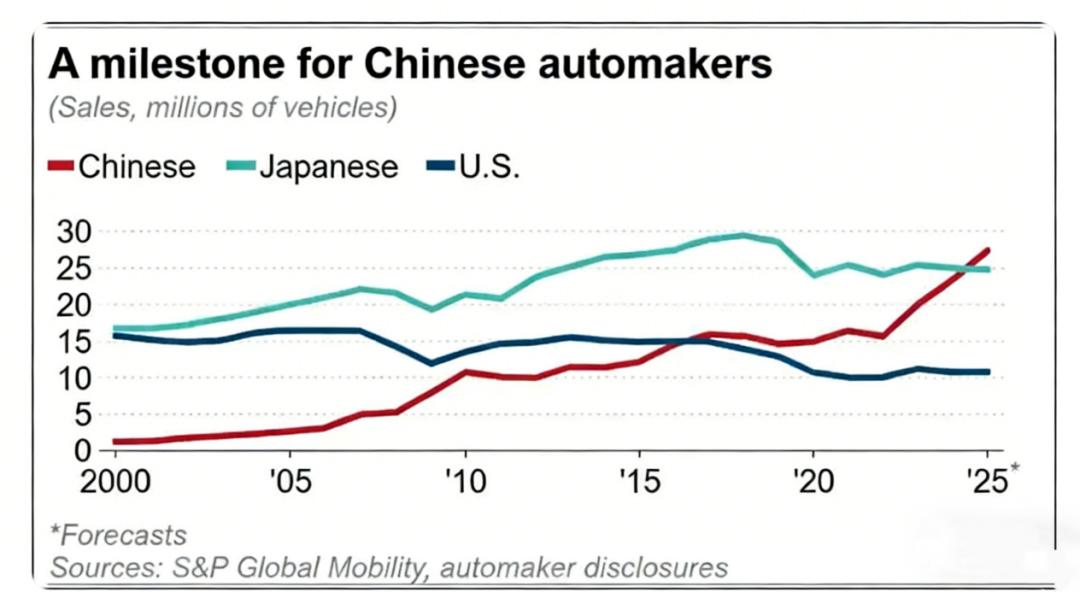
汽车行业周报:如何展望2025Q4业绩?-20260112
Changjiang Securities· 2026-01-12 11:22
Investment Rating - The investment rating for the automotive industry is "Positive" and maintained [9] Core Insights - The wholesale sales of passenger vehicles in Q4 2025 are expected to be approximately 8.76 million units, a year-on-year decrease of 1% but a quarter-on-quarter increase of 14%. The profitability in Q4 may show differentiation compared to the same period last year, with expectations for a quarter-on-quarter improvement [2][5] - The revenue from automotive parts is anticipated to grow steadily quarter-on-quarter, but profitability may face pressure due to factors such as raw material costs and exchange rates [2][5] - The wholesale sales of heavy trucks are projected to be 314,000 units in Q4 2025, representing a year-on-year increase of 43.6% and a quarter-on-quarter increase of 11.5% [2][5] - The overall sales of buses are expected to see a significant quarter-on-quarter increase during the peak season, with sales of large and medium buses reaching 44,000 units, a year-on-year increase of 8.8% and a quarter-on-quarter increase of 42.2% [2][5] - The total sales of motorcycles are estimated to be around 4.73 million units in Q4 2025, reflecting a year-on-year increase of 11.0% but a quarter-on-quarter decrease of 6.2% [2][6] Summary by Sections Passenger Vehicles - Q4 2025 wholesale sales are expected to be about 8.76 million units, down 1% year-on-year but up 14% quarter-on-quarter. New energy vehicle sales are projected at 4.84 million units, up 13% year-on-year and 21% quarter-on-quarter [5] Automotive Parts - Revenue is expected to grow steadily quarter-on-quarter, but profitability may be pressured by raw material and exchange rate factors [5] Heavy Trucks - Q4 2025 wholesale sales are projected at 314,000 units, with a year-on-year increase of 43.6% and a quarter-on-quarter increase of 11.5% [5] Buses - Large and medium bus sales are expected to reach 44,000 units in Q4 2025, with a year-on-year increase of 8.8% and a quarter-on-quarter increase of 42.2% [5] Motorcycles - Total motorcycle sales are estimated at 4.73 million units in Q4 2025, reflecting an 11.0% year-on-year increase but a 6.2% quarter-on-quarter decrease [6]



泰州姜堰:10亿元项目,审批办理仅用时0.5个工作日
Zhong Guo Fa Zhan Wang· 2026-01-12 10:45
姜堰区数据局掌握项目信息后,第一时间主动对接开发区和企业,得知项目急需开工,迅速启动"开工 一件事"优化方案,详细说明办理流程、材料清单与相关要求,为企业提供精准高效全程指导,海锟项 目施工许可与临时供水报装集成办理"一路绿灯",审批办理仅用时0.5个工作日,顺利实现开工建设。 中国发展网讯 "提交系统当天上午就领取到了施工许可等手续,整个过程实在太高效了!"1月6日,泰 州市姜堰区"开工一件事"改革带来的便捷,让江苏海锟精密智造有限公司汽车差速器电子锁研发生产项 目负责人王素芳发出由衷赞叹。 姜堰区数据局负责同志表示,建设项目开工"一件事"改革已在全区全面推行,线上线下合力推进。线下 设立"一件事"服务专窗、依托线上咨询服务平台,主动对接项目并全程指导,将施工许可、消防审查、 垃圾处置、排水许可及临时水电报装等多个审批事项整合为"一站式"办理。通过优化流程、协同联办, 实现数据共享和材料精简,审批时限压缩86%,有效破解了项目开工前手续杂、周期长、材料重复等难 题,以更优营商环境显著提升了企业的获得感和满意度。(吴安娜 许雅 姜存义) 江苏海锟汽车差速器电子锁项目为泰州市重点项目,总投资10亿元,系国家级专 ...
年终盘点2025汽车市场的“龙门一跃”:油退电进,全球登顶
3 6 Ke· 2026-01-12 10:37
Core Insights - The penetration rate of new energy vehicles (NEVs) in China has surpassed 50%, marking a significant shift in the automotive market dynamics, transitioning from a "policy-driven" to a "product-driven" model [1][10] - The year 2025 is seen as a pivotal moment for the Chinese automotive industry, with the market experiencing a fundamental transformation akin to a "Nokia moment" [1] - The competition is evolving from price wars to value wars, emphasizing technology and product quality over mere volume [11] Industry Overview - In 2025, China's automotive manufacturers are projected to achieve global sales of 27 million vehicles, securing the top position in the global new car sales rankings for the first time [2] - China has overtaken Japan to become the world's largest automobile exporter, with NEVs accounting for a significant portion of this growth [4] - The domestic market's NEV sales are nearing 60%, reflecting a structural change in consumer preferences [4] Sales and Market Penetration - By November 2025, the retail penetration rate of NEVs reached 53.6%, with projections for the full year estimating a rate of 54.0% [6] - The rapid increase in NEV penetration is attributed to a combination of policy support, technological advancements, infrastructure development, and market demand [7] Policy and Technological Developments - The exit of purchase subsidies in 2023 has been offset by continued tax exemptions and various local incentives, which have helped maintain consumer interest in NEVs [7] - 2025 is expected to be a year of technological breakthroughs in NEVs, with advancements in high-voltage platforms, solid-state batteries, and smart driving technologies [8] Infrastructure and Consumer Experience - The expansion of charging infrastructure is crucial for alleviating consumer concerns about range anxiety, with projections of 20 million charging stations by the end of 2025 [9] - The cost advantages of NEVs are becoming increasingly apparent, with electric vehicles offering significantly lower operating costs compared to traditional fuel vehicles [9] Competitive Landscape - The shift from price competition to value competition is reshaping the industry, with companies focusing on technological innovation and profitability [11] - Some companies, like Leap Motor, have emerged as strong competitors, achieving significant sales growth and profitability [13] Global Expansion - In 2025, China's automotive exports are expected to exceed 7 million units, with NEV exports alone projected to reach 2.315 million units, marking a 102.9% increase [21] - Chinese automakers are transitioning to a "global + local" model, emphasizing localized production and R&D to better penetrate international markets [22] Challenges and Future Outlook - Despite rapid growth, challenges such as trade protectionism and compliance costs remain significant hurdles for Chinese automakers in global markets [24] - The automotive industry is expected to continue evolving, with a focus on sustainable growth and value creation as it navigates the transition from a subsidy-driven to a market-driven environment [25]



上汽集团总裁贾健旭拜访华为任正非,商讨尚界品牌合作再深化
Sou Hu Cai Jing· 2026-01-12 10:32
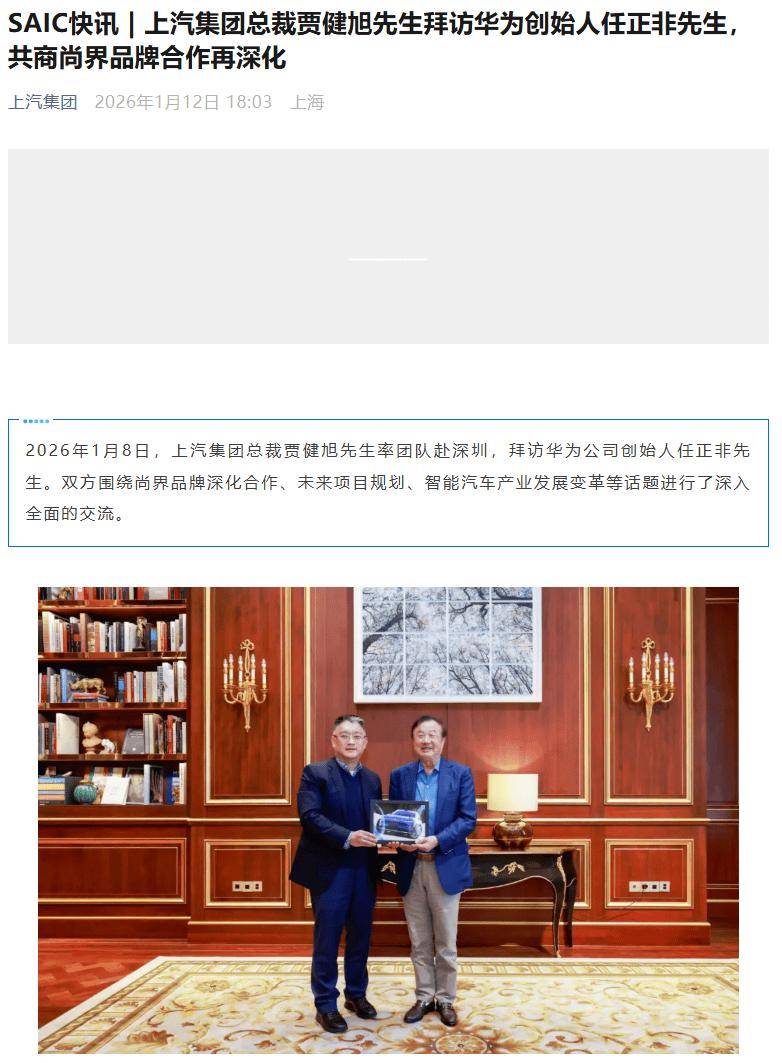
Group 1 - SAIC Group's President Jia Jianxu visited Huawei's founder Ren Zhengfei on January 8, 2026, to discuss deepening cooperation on the Shangjie brand and future project planning in the smart automotive industry [1] - Both companies aim to explore broader cooperation opportunities and jointly promote the upward development of the Shangjie brand [4] - On January 5, executives from Jiangqi Group also visited Ren Zhengfei to discuss trends in the intelligent transformation of the automotive industry and future project plans [5] Group 2 - In 2025, executives from several automotive companies, including Xpeng Motors, GAC Group, Changan Automobile, Dongfeng Motor, and Chery Automobile, also visited Ren Zhengfei [5]
汽车行业周报:全年销量符合预期,智驾引领再提速-20260112
Guoyuan Securities· 2026-01-12 09:47
Investment Rating - The report maintains a "Recommended" investment rating for the automotive and automotive parts industry [6] Core Insights - The overall sales of passenger vehicles met expectations with a year-on-year growth of 9%, while new energy passenger vehicles saw a growth of 25% [1][2] - In December 2025, the retail sales of passenger vehicles were 2.296 million units, a year-on-year decrease of 13%, but a month-on-month increase of 3%. Cumulatively, retail sales for the year reached 23.779 million units, a year-on-year increase of 4% [1][20] - The report highlights the rapid advancements in intelligent driving technologies, with multiple automakers updating their systems and competing in the autonomous driving sector [3][4] Summary by Sections Sales Performance - In December 2025, wholesale sales of passenger vehicles were 2.759 million units, a year-on-year decrease of 10%, with cumulative wholesale sales for the year reaching 29.524 million units, a year-on-year increase of 9% [1][20] - For new energy vehicles, December retail sales were 1.387 million units, a year-on-year increase of 7%, with cumulative retail sales for the year at 12.859 million units, a year-on-year increase of 18% [1][20] Industry Developments - Several automakers, including Zeekr and Geely, are enhancing their intelligent driving systems, indicating a shift towards integrated decision-making models in vehicle technology [3][4][32] - The report emphasizes the importance of continued policy support for the automotive industry and the potential investment opportunities arising from advancements in autonomous driving technology [4] Market Trends - The automotive sector saw a 2.53% increase in the week of January 3-9, 2026, with most related sub-sectors also experiencing growth [12] - The report notes that the intelligent driving technology is becoming a key competitive area among automakers, with significant investments and innovations being made [3][4][39]
【月度排名】2025年12月厂商销量排名快报
乘联分会· 2026-01-12 09:28
Core Viewpoint - The article highlights the performance of the Chinese automotive market in December 2025, noting a decline in retail sales for traditional vehicles while emphasizing growth in the new energy vehicle (NEV) sector and exports. The market is expected to transition into 2026 with a focus on new energy vehicles and a recovery in demand [4]. Sales Performance - In December 2025, the domestic narrow passenger car market retail sales reached 2.261 million units, a year-on-year decrease of 14.0% but a month-on-month increase of 1.6%. Cumulative sales for the year totaled 23.744 million units, reflecting a year-on-year growth of 3.8% [2]. - The wholesale sales ranking for December 2025 shows BYD leading with 414,784 units sold, followed by Geely and Chery with 236,817 and 234,736 units, respectively. Notably, BYD's sales decreased by 12.7% month-on-month and 18.6% year-on-year [5]. - For the entire year of 2025, BYD also topped the wholesale sales with 4.545 million units, marking a 6.9% increase year-on-year, while Geely's sales surged by 39.0% to 3.025 million units [6]. New Energy Vehicle Market - In December 2025, the NEV wholesale sales ranking was led by BYD with 414,784 units, despite a month-on-month decline of 12.7% and a year-on-year drop of 18.6%. Geely followed with 154,264 units, showing a year-on-year increase of 38.7% [9]. - The retail sales for NEVs in December 2025 also saw BYD at the forefront with 339,854 units sold, a month-on-month increase of 10.9% but a year-on-year decrease of 15.7% [13]. - For the full year, BYD maintained its dominance in the NEV sector with 3.485 million units sold, although this represented a year-on-year decline of 6.3% [14]. Market Trends and Future Outlook - The article notes that the end of the year typically sees a surge in vehicle purchases, but the depletion of subsidy funds across provinces has tempered this effect, leading to a more stable demand outlook heading into 2026 [4]. - The performance of various manufacturers indicates a competitive landscape, with traditional automakers facing challenges while NEV manufacturers like BYD and Geely continue to show resilience and growth potential [6][9].



【行业政策】一周要闻回顾(2026年1月5日-1月11日)
乘联分会· 2026-01-12 09:28
Core Viewpoint - The article discusses the implementation of the "Artificial Intelligence + Manufacturing" initiative, which aims to enhance the integration of AI technologies in the manufacturing sector, with specific goals set for 2027 [3][6]. Summary by Sections Overall Requirements - By 2027, China aims to achieve reliable supply of key AI technologies, maintain a leading position in industry scale and empowerment levels, and promote the deep application of 3 to 5 general large models in manufacturing [6]. Innovation Foundation - The initiative emphasizes the need to solidify the foundational technologies that empower AI applications in manufacturing [4]. Intelligent Upgrade - It focuses on expanding and promoting high-value application scenarios for AI in manufacturing [4]. Product Breakthrough - The goal is to construct new intelligent products and business models, fostering innovation in product development [4]. Main Body Cultivation - The initiative aims to cultivate 2 to 3 globally influential leading enterprises and a number of specialized small and medium enterprises, as well as service providers that understand both AI and industry [6]. Ecological Expansion - It highlights the importance of optimizing resource allocation to strengthen the industrial ecosystem [4]. Safety Assurance - The initiative includes measures to enhance safety and security in AI applications [4]. International Cooperation - It aims to create new competitive advantages through international collaboration in AI and manufacturing [4]. Support Measures - The initiative outlines comprehensive policy support to ensure the successful implementation of the outlined goals [4].

整车主线周报:12月新能源批发符合预期,看好26年景气度向上-20260112
Soochow Securities· 2026-01-12 09:10
Investment Rating - The industry investment rating is "Overweight," indicating an expected outperformance of the industry index relative to the benchmark by more than 5% over the next six months [33]. Core Insights - The report highlights a positive outlook for the passenger vehicle sector, anticipating a recovery in demand in Q1 2026 due to the implementation of subsidy policies. Key players include Jianghuai Automobile, Geely, Great Wall Motors, and BYD, focusing on high-end electric vehicles and established export leaders [23][24]. - The heavy truck segment is projected to see a slight increase in domestic sales in 2026, with expectations of 800,000 to 850,000 units sold, reflecting a 3% year-on-year growth. Recommended companies include China National Heavy Duty Truck Group and Weichai Power [28]. - The bus market is expected to benefit from the continuation of subsidy policies, with a conservative estimate of 40,000 units sold in 2026, representing a 5% increase year-on-year. Key recommendations include Yutong Bus and King Long [27]. - The motorcycle sector is forecasted to grow by 14% in total sales in 2026, with a significant increase in large-displacement motorcycles. Recommended companies include Chunfeng Power and Longxin General [24]. Summary by Sections Passenger Vehicles - The report emphasizes a recovery in the passenger vehicle market in Q1 2026, driven by subsidy policies. Key stocks to watch include Jianghuai Automobile and Geely, with a focus on high-end electric vehicles [23][24]. Heavy Trucks - In 2025, heavy truck wholesale sales reached 1.14 million units, a 26% increase year-on-year. The report forecasts 800,000 to 850,000 units for 2026, with a 3% growth expectation. Recommended companies include China National Heavy Duty Truck Group and Weichai Power [28]. Buses - The bus market is projected to see a slight increase in sales due to favorable policies, with an expected 40,000 units sold in 2026. Key recommendations include Yutong Bus and King Long [27]. Motorcycles - The motorcycle industry is expected to grow by 14% in 2026, with large-displacement motorcycles seeing a 31% increase. Recommended companies include Chunfeng Power and Longxin General [24].
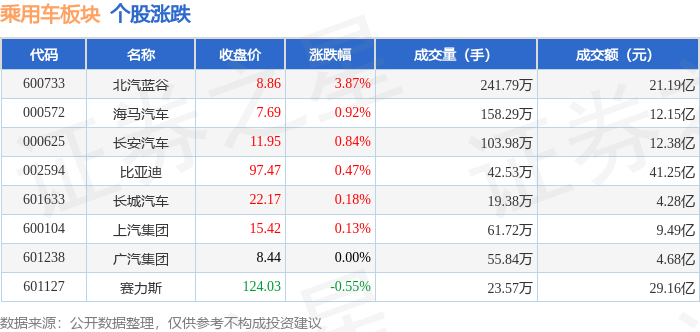
乘用车板块1月12日涨0.34%,北汽蓝谷领涨,主力资金净流出4.12亿元
Zheng Xing Xing Ye Ri Bao· 2026-01-12 09:04
Market Overview - The passenger car sector increased by 0.34% compared to the previous trading day, with Beiqi Blue Valley leading the gains [1] - The Shanghai Composite Index closed at 4165.29, up 1.09%, while the Shenzhen Component Index closed at 14366.91, up 1.75% [1] Individual Stock Performance - Beiqi Blue Valley (600733) closed at 8.86, with a rise of 3.87%, trading volume of 2.4179 million shares, and a transaction value of 2.119 billion [1] - Changan Automobile (000625) closed at 11.95, up 0.84%, with a transaction value of 1.238 billion [1] - BYD (002594) closed at 97.47, up 0.47%, with a transaction value of 4.125 billion [1] - Great Wall Motors (601633) closed at 22.17, up 0.18%, with a transaction value of 428 million [1] - SAIC Motor (600104) closed at 15.42, up 0.13%, with a transaction value of 949 million [1] - GAC Group (601238) remained unchanged at 8.44, with a transaction value of 468 million [1] - Seres (601127) closed at 124.03, down 0.55%, with a transaction value of 2.916 billion [1] Capital Flow Analysis - The passenger car sector experienced a net outflow of 412 million from institutional investors and 218 million from retail investors, while retail investors saw a net inflow of 629 million [1] - Beiqi Blue Valley had a net inflow of 106 million from institutional investors, while retail investors contributed a net inflow of 12.5965 million [2] - Great Wall Motors had a net inflow of 10.2787 million from institutional investors, with retail investors contributing a net inflow of 21.3553 million [2] - BYD experienced a net outflow of 559.3 million from institutional investors, with retail investors contributing a net inflow of 14.6 million [2] - Seres faced a significant net outflow of 344 million from institutional investors, while retail investors had a net inflow of 26.97 million [2]




61亿元融资遭误读!深蓝汽车邓承浩直言:现金流非常好
Sou Hu Cai Jing· 2026-01-12 08:28
Group 1 - The core point of the news is that Deep Blue Automotive has successfully completed a C-round financing of 6.122 billion yuan, marking a significant step in its strategic development [2][3] - The financing was led by major stakeholders, including Changan Automobile, which invested 3.122 billion yuan, maintaining a 50.9959% ownership stake, and Chongqing Yufu Holdings Group, which invested 2.5 billion yuan to become the second-largest shareholder with a 12.0934% stake [3] - Deep Blue Automotive's registered capital increased from 328 million yuan to 466 million yuan following the completion of this financing round [3] Group 2 - The chairman of Deep Blue Automotive, Deng Chenghao, clarified that the financing is not due to cash flow issues but is a strategic move to enhance the company's capabilities in intelligent and electric vehicle technologies, as well as global brand development [5] - Revenue projections for Deep Blue Automotive are expected to rise from 15.677 billion yuan in 2022 to 37.224 billion yuan in 2024, with a forecast of achieving monthly profitability by Q4 2024 [5] - In January 2026, Deep Blue Automotive not only secured financing but also obtained one of the first large-scale L3 autonomous driving licenses in China, with plans to launch the Deep Blue S09 and accelerate product iterations [5]