华泰柏瑞

Search documents
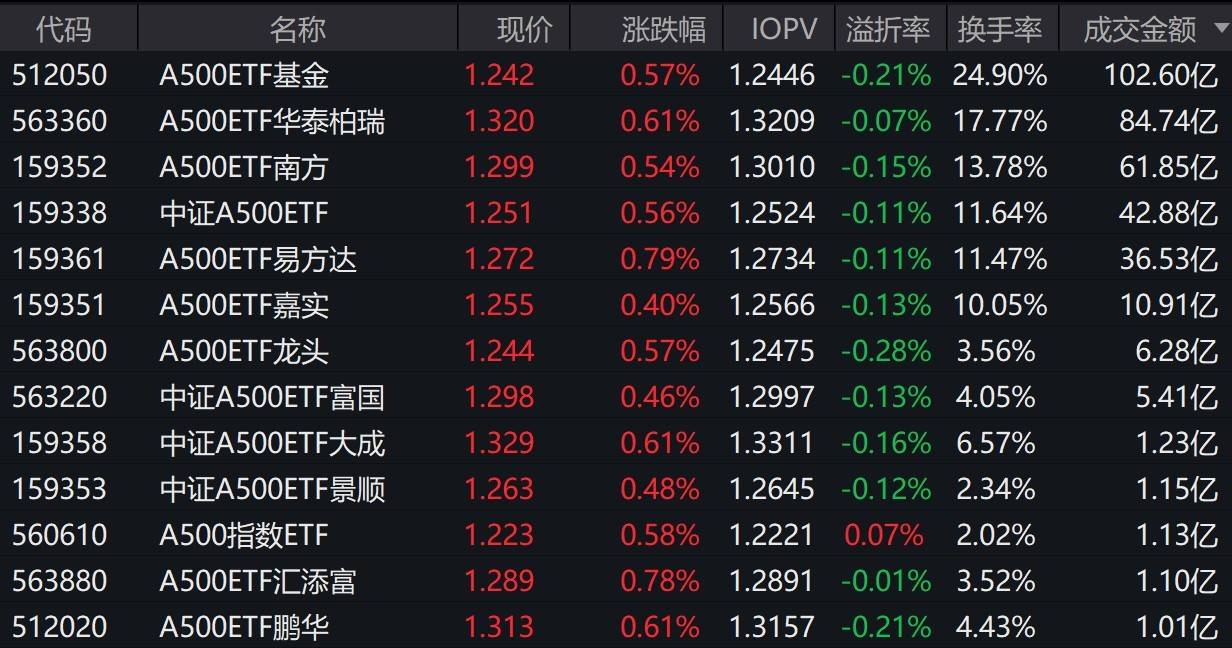
市场早盘震荡拉升,中证A500指数上涨0.56%,2只中证A500相关ETF成交额超84亿元
Sou Hu Cai Jing· 2026-01-21 03:57
Group 1 - The market experienced fluctuations in early trading, with the ChiNext Index initially opening low but rising over 1%, while the CSI A500 Index increased by 0.56% [1] - The precious metals sector continued to surge, the chip industry chain saw expanded gains, and lithium mining concepts rebounded, while the consumer sector collectively weakened, particularly in the liquor and tourism hotel sectors [1] - As of the morning close, ETFs tracking the CSI A500 Index saw slight increases, with 13 related ETFs having transaction volumes exceeding 100 million yuan, and 2 surpassing 8.4 billion yuan [1] Group 2 - Specific ETFs related to the CSI A500 Index showed varying performance, with A500 ETF Fund at 1.242 yuan (up 0.57%) and A500 ETF Huatai-PB at 1.320 yuan (up 0.61%) [2] - Other notable ETFs included A500 ETF Southern at 1.299 yuan (up 0.54%) and A500 ETF E Fund at 1.272 yuan (up 0.79%) [2] - The trading rates for these ETFs varied, with A500 ETF Fund showing a liquidity rate of 24.90% and A500 ETF Huatai-PB at 17.77% [2]

1月20日宽基ETF资金流出压力未减:沪深300单日净流出近319亿元,相较前日再增12亿元
Xin Lang Cai Jing· 2026-01-21 02:31
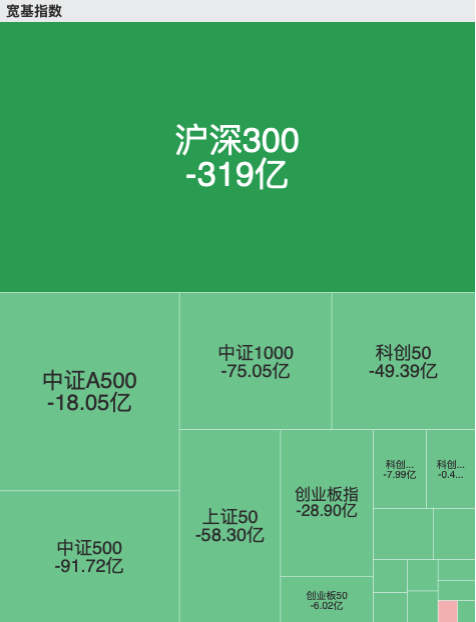
Wind数据显示,1月20日的ETF市场资金流向延续了宽基指数产品面临的赎回压力。整体来看,主要宽 基ETF呈现净流出态势,其中以沪深300为代表的大盘宽基指数依然是资金流出的主要方向。 从指数层面看,沪深300相关ETF净流出规模最为显著,合计达到318.86亿元,相比前日(1月19日)净 流出规模增加近12亿元。中证1000指数ETF同样出现明显流出,净流出额为75.05亿元。此外,上证 50、科创50、中证500等主流宽基指数ETF也均呈现资金净流出,规模分别为58.30亿元、49.39亿元和 91.72亿元。 数据来源:Wind,截止至 20260120 | 数据来源:Wind,截止至 | | --- | 20260120 至20260120 具体到产品层面,华泰柏瑞沪深300ETF(510300.SH)净流出109.84亿元,成为当日资金流出最多的 ETF。其他沪深300相关产品如嘉实沪深300ETF(159919.SZ)、易方达沪深300ETF(510310.SH)和华 夏沪深300ETF(510330.SH)也分别净流出73.42亿元、68.48亿元和64.70亿元。此外,南方中证500ETF ...
基金早班车丨QDII规模逼近万亿,全球化配置需求升温
Sou Hu Cai Jing· 2026-01-21 00:42
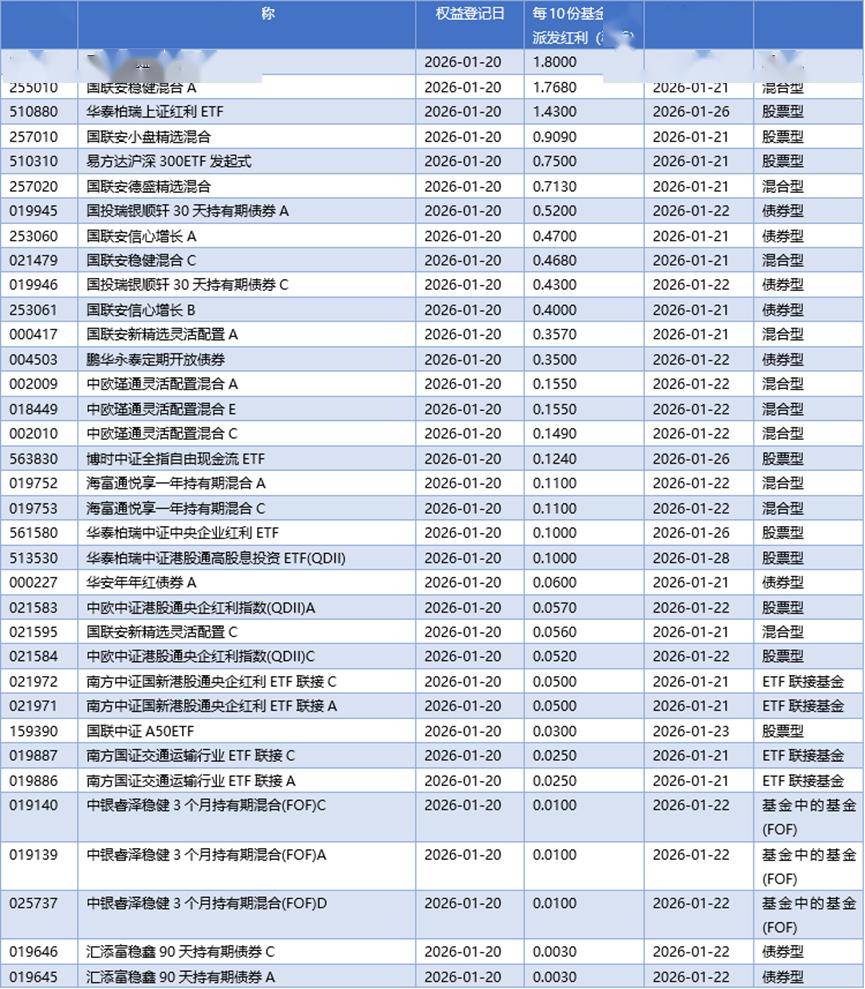
数据显示,截至1月20日,QDII基金总规模达9700亿元,较去年同期大增59%,距离万亿关口仅一步之遥,占全市场基金比 重升至2.6%。全球资产配置需求升温、美股及亚太市场赚钱效应显现,叠加美元强势预期,推动资金借道QDII"出海";尽 管体量仍低于股票、债券等主流品种,但跨境投资潜力持续释放,后续额度扩容与新品落地有望进一步提速。 1月20日,A股三大股指高开低走,探底后震荡回升,截止收盘,沪指跌0.01%,报4113.65点,深成指跌0.97%,报14155.63点,创业板指 跌1.79%,报3277.98点,科创50指数跌1.58%,报1482.99点。沪深两市成交额2.78万亿,全市场超3100只个股下跌。 二、基金要闻 一、交易提示 | | 标 | 权益登记日 | 每10份整 | | | | --- | --- | --- | --- | --- | --- | | | | | 派发红利( | 0 | | | | 28 | 2026-01-20 | 1.8000 | | | | 255010 | 国际安稳健混合 A | 2026-01-20 | 1.7680 | 2026-01-21 | 常见照 ...
“不争气”的中证A500
虎嗅APP· 2026-01-20 13:20
Core Viewpoint - The article discusses the dramatic fluctuations in the scale of the CSI A500 ETF, highlighting its rapid growth at the end of 2025 followed by a significant decline in early 2026, primarily driven by market speculation regarding the potential launch of options for the ETF [2][4]. Group 1: Scale Fluctuations - The CSI A500 ETF experienced a "historic" surge in scale in December 2025, with a net inflow of nearly 100 billion, pushing its total scale above 300 billion [2]. - After the peak, the ETF faced continuous net outflows, dropping below 300 billion, indicating that the initial inflow was not based on investment value but rather on incentives offered by fund companies [4]. - The top five A500 ETFs saw significant reductions in circulation shares during early January 2026, with losses of 22 billion, 36 billion, 21 billion, 13 billion, and 22 billion shares respectively [4]. Group 2: Competitive Landscape - The CSI A500 ETF is viewed as a potential challenger to the dominant CSI 300 ETF, but it has not yet demonstrated the ability to threaten its position, with its scale being less than one-fourth that of the CSI 300 [5][10]. - The marketing efforts for the A500 ETF were unprecedented, but despite being the second-largest broad-based index ETF, it has not shown significant competitive strength against the CSI 300 since its launch [5][6]. - The A500 ETF's performance is more growth-oriented compared to the value-stable CSI 300, which has led to its underperformance during bear markets [9][10]. Group 3: Institutional Investment Dynamics - The lack of significant purchases of the A500 ETF by state-owned funds is attributed to its timing and the established preference for the CSI 300 ETF, which has a more extensive ecosystem and familiarity among institutional investors [16][18]. - Institutional investors have not heavily allocated to the A500 ETF due to its relatively short history and the absence of comprehensive derivative tools, which are crucial for hedging and core asset allocation [18][19]. - The A500 ETF's growth potential is hindered by its current scale and liquidity limitations, making it less attractive for large institutional investments compared to the CSI 300 ETF [20][21]. Group 4: Future Outlook - In the medium to long term, the A500 ETF may have the potential to compete with the CSI 300 ETF, especially as it aligns with the government's push for new productive forces and technology-driven economic growth [22]. - The introduction of options and other derivative tools for the A500 ETF in the coming years could attract more institutional capital, enhancing its market position [22][29]. - The competitive landscape among A500 ETFs is expected to stabilize, with a "3+2" tier structure emerging among the leading products, influenced by factors such as options qualification and marketing strategies [25][29].

“不争气”的中证A500
Hu Xiu· 2026-01-20 07:05
Core Viewpoint - The China Securities A500 ETF experienced a dramatic increase in scale at the end of 2025, with nearly 100 billion net inflow in December, but has since faced rapid outflows in 2026, dropping below 300 billion in total scale [1][3]. Fund Flow and Market Dynamics - The surge in A500 ETF's scale was primarily driven by expectations of options being introduced in Q1 2026, leading to intense competition among major public funds for "options eligibility" [3]. - Following the quarter-end, there was a significant outflow of funds, indicating that the initial inflow was not based on the investment value of A500 but rather to secure "thank you fees" from fund companies [3][4]. Performance Comparison - The A500 ETF, launched in October 2024, has not yet demonstrated a significant challenge to the dominant CSI 300 ETF, with its scale being less than a quarter of the CSI 300 ETF [4][9]. - In terms of investment value, the CSI 300 is more value-stable, while the A500 is more growth-oriented, particularly performing better in a tech bull market [6][7]. Historical Performance - Over the past three years, during the bear market of 2023 and 2024, the CSI 300 outperformed the A500 slightly, with returns of -11.38% and 14.68% for the CSI 300 compared to -11.42% and 12.98% for the A500 [8]. - In a growth-style bull market in 2025, the A500 showed a return of 22.43%, outperforming the CSI 300's 17.66% [8]. Institutional Investment Behavior - The lack of significant investment from state-owned funds in the A500 ETF is attributed to its timing and the established preference for the CSI 300 ETF, which has a more extensive operational history and familiarity [12][13]. - Institutional investors, including insurance and pension funds, have not heavily allocated to the A500 ETF, primarily due to its smaller scale and lack of derivative tools compared to the CSI 300 ETF [14][15]. Competitive Landscape - The A500 ETF has formed a competitive "3+2" tier structure among fund companies, with top players like Huatai-PineBridge and Southern Asset Management leading in scale [18][19]. - Future competition may hinge on the qualification for options, which could create a significant advantage for leading products, potentially widening the gap with other funds [20][21]. Future Outlook - In the short to medium term (1-2 years), the A500 ETF is unlikely to surpass the CSI 300 ETF in scale due to the absence of large-scale buying from state-owned funds [16]. - However, in the long term (5-10 years), the A500 ETF may have the potential to compete with the CSI 300 ETF as it aligns more closely with new economic growth sectors, provided it develops a robust ecosystem and derivative tools [17].
ETF连续六周净申购后首现净赎回
Jin Rong Jie· 2026-01-19 23:17
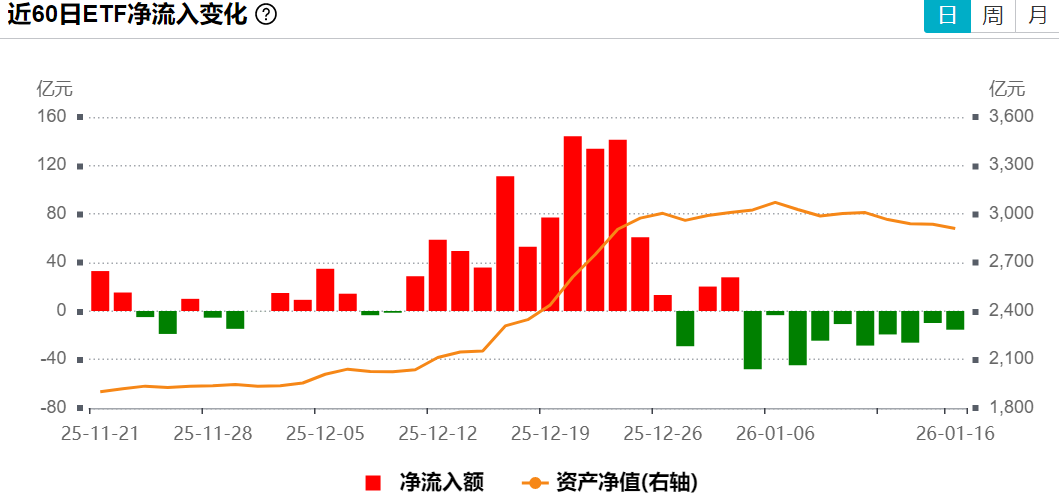
Core Insights - Recent data indicates a decline in risk appetite among large funds and institutions, as evidenced by a significant net redemption of 12.113 billion shares from ETFs after six consecutive weeks of net inflows [1] Group 1 - The recent trend shows that large-scale ETFs, including E Fund's SSE Science and Technology Innovation Board 50 ETF and Huatai-PB's CSI 300 ETF, experienced substantial redemptions during the past week [1]
我加仓红利的逻辑~2026年1月19日 市场温度
Xin Lang Cai Jing· 2026-01-19 13:06
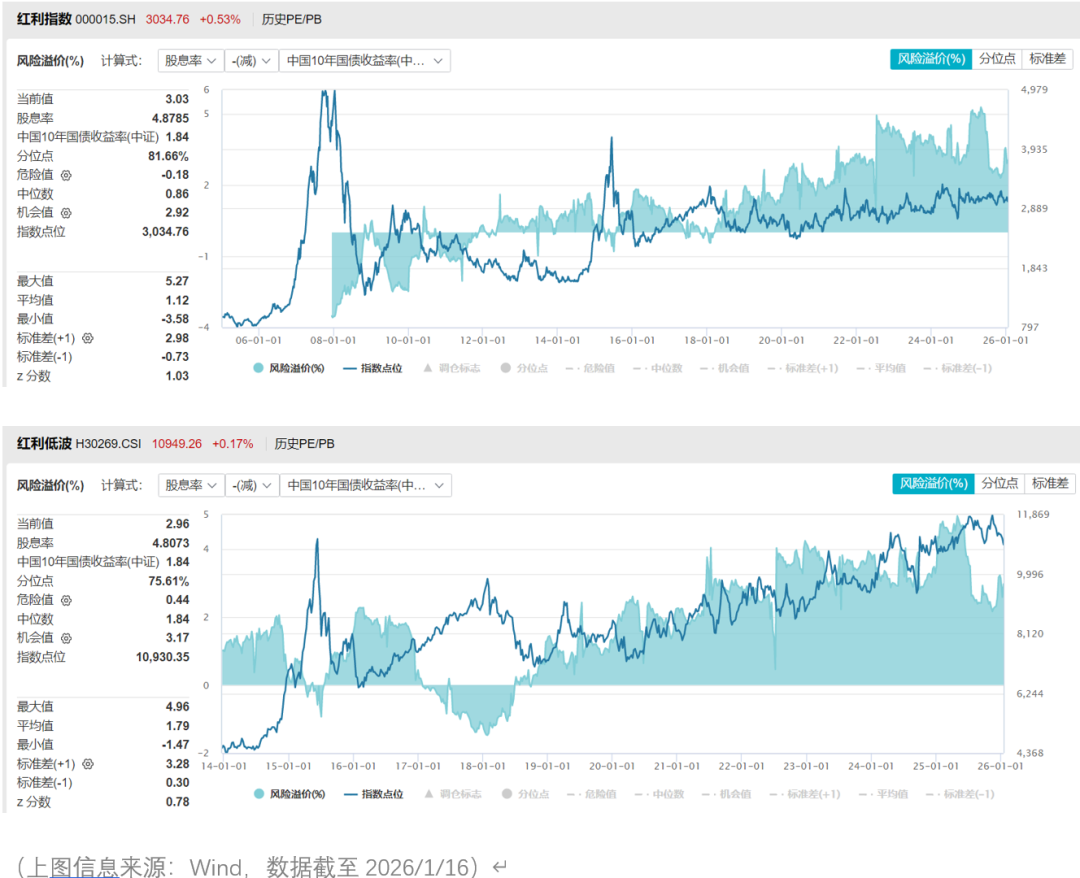
Group 1 - The company has three main investment accounts: an on-market ETF account, an off-market fund account, and an off-market advisory portfolio account [1] - The on-market ETF account reported a loss of 0.06 million (assets of 2.6 million), while the off-market fund account reported a loss of 0.05 million (assets of 5.5 million), totaling a combined loss of 0.11 million, which is a loss ratio of 0.14% [1] - Despite the current market conditions, the company continues to gradually increase its allocation to dividend products, indicating a long-term positive outlook on dividend returns [1][2] Group 2 - A recent article from Huatai-PB suggests that while dividends may be challenging in the short term, their long-term returns remain stable, reinforcing the need for dividend investments [2][3] - The company emphasizes the importance of maintaining a balanced portfolio to manage volatility, particularly in high-risk sectors like commercial aerospace, which can experience significant price swings [4] - The company is optimistic about technology growth but acknowledges the need to reduce exposure to mitigate overall portfolio volatility, suggesting that dividend yields of 5%-6% may be the only stable option in the current low-interest-rate environment [5] Group 3 - The risk premium for dividend indices has been historically high, with the dividend index risk premium exceeding its historical average 81.66% of the time since its inception [9] - The company highlights the defensive nature of high dividend yields, which can provide some recovery even when prices decline [9] - Huatai-PB has been a pioneer in dividend index products since launching the first dividend-themed ETF in 2006, and has since expanded its offerings to include a variety of dividend products covering both A-shares and Hong Kong stocks [9] Group 4 - The current market temperature for A-shares is at 70.60, indicating a slight increase of 0.6 degrees from the previous trading day, while the Hong Kong market temperature is at 51.73, showing a decrease of 0.2 degrees [10][11] - The temperature metrics suggest that buying should commence below 30 degrees and selling should begin above 50 degrees, providing a framework for investment decisions [10]
宽基ETF,再度放量
Shang Hai Zheng Quan Bao· 2026-01-19 08:26
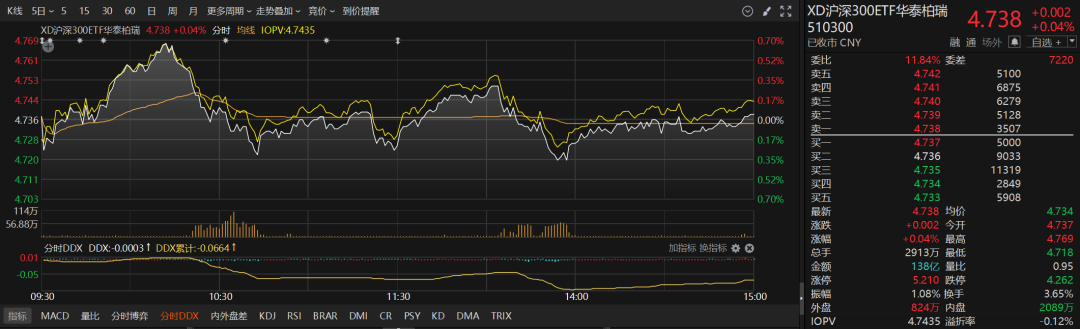
Group 1 - The core viewpoint of the article highlights a significant increase in trading volume for major broad-based ETFs, specifically the Huatai-PB CSI 300 ETF and the Southern CSI 500 ETF, on January 19 [1][3][5] - During the period from January 14 to 16, stock ETFs (excluding cross-border ETFs) experienced a net outflow of 163.54 billion yuan, with broad-based ETFs alone seeing a net outflow of 198.48 billion yuan [9] - Despite the outflows, the new fund issuance market remains active, with some funds announcing early closure of fundraising due to high demand [12] Group 2 - The Huatai-PB CSI 300 ETF recorded a trading volume of 138 billion yuan on January 19, with notable spikes in trading activity during specific time frames [3] - The Southern CSI 500 ETF also showed significant trading volume, reaching 127 billion yuan for the day, indicating a similar trend to the Huatai-PB CSI 300 ETF [5] - Other ETFs, such as the Huatai-PB CSI A500 ETF and the Huaxia CSI A500 ETF, also exceeded 100 billion yuan in trading volume, reflecting a broader trend in the market [7] Group 3 - Certain thematic ETFs, such as the Harvest Software ETF and the Southern Nonferrous Metals ETF, attracted significant inflows, indicating a divergence in investor interest within the ETF market [10] - The market outlook suggests increased volatility in 2026, but structural opportunities remain significant, particularly in sectors like AI, solid-state batteries, robotics, and innovative pharmaceuticals [13]
十大宽基ETF,单周净流出近2000亿元
3 6 Ke· 2026-01-19 07:29
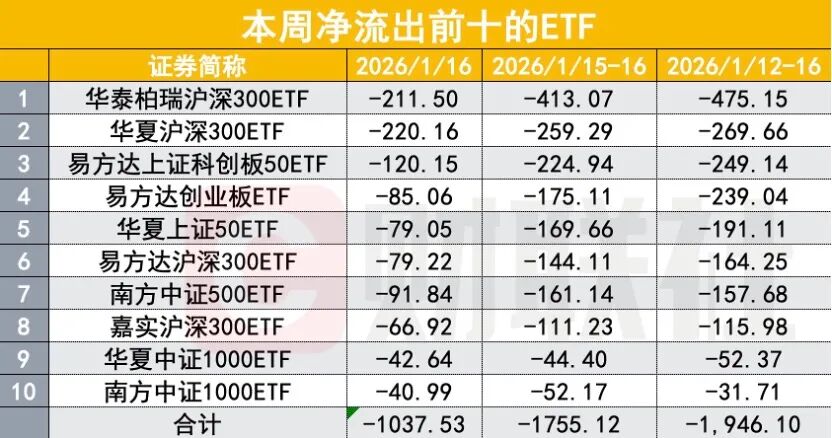
Core Viewpoint - The recent data reveals a significant outflow of funds from broad-based ETFs, with a total net outflow of 191.4 billion yuan during the week of January 12-16, marking a historical high for domestic ETFs [1][2]. Summary by Category Fund Flows - Broad-based ETFs experienced a net outflow of 1,914 billion yuan, with the CSI 300 ETF, ChiNext ETF, and SSE 50 ETF being the main contributors to this outflow [1]. - The CSI 300 ETF led the outflow with 1,037.5 billion yuan, where 935.24 billion yuan was withdrawn in the last two trading days, accounting for 90% of the total outflow [1][2]. - Eight ETFs recorded a net outflow exceeding 10 billion yuan, with the total outflow from the top ten broad-based ETFs reaching 1,946.1 billion yuan, setting a new record in the history of domestic ETFs [2][3]. Specific ETF Performance - The top outflowing ETFs included: - Huatai-PB CSI 300 ETF: -475.15 billion yuan - Huaxia CSI 300 ETF: -269.66 billion yuan - E Fund Sci-Tech 50 ETF: -349.14 billion yuan - E Fund ChiNext ETF: -239.04 billion yuan - Huaxia SSE 50 ETF: -191.11 billion yuan [2][3]. - The A500 ETF, the second-largest broad-based ETF, saw a net outflow of 74 billion yuan, dropping its scale below 300 billion yuan [5]. Industry ETFs - In contrast, industry-specific ETFs saw a net inflow of nearly 600 billion yuan, with significant investments in the Hong Kong Stock Connect Internet ETF, Software ETF, Satellite Communication ETF, and Non-ferrous Metals ETF [1][7]. - Specific industry ETFs that attracted substantial inflows included: - E Fund Sci-Tech Chip ETF: nearly 20 billion yuan - Guotai Semiconductor Materials Equipment ETF: over 10 billion yuan - Southern Non-ferrous Metals ETF: over 10 billion yuan [7][8]. Market Context - The total scale of domestic ETFs approached 6.3 trillion yuan as of January 12, despite the significant outflow, the current scale remains around 6.1 trillion yuan [3]. - The regulatory environment is tightening, with measures aimed at cooling down the overheated market, including increased margin requirements and scrutiny of stocks with excessive short-term gains [9][10].
竞逐科技与高端制造,公募ETF发行大爆发
Huan Qiu Wang· 2026-01-19 06:28
Core Viewpoint - The A-share market has entered a new round of structural trends in 2026, with sectors like commercial aerospace, new energy, and artificial intelligence (AI) applications showing strong performance, leading to a significant increase in the issuance of thematic ETFs and their net asset values [1] Group 1: Thematic ETF Performance - The Satellite ETF managed by Yongying Fund has achieved a return of 17.92% year-to-date and a 99.10% increase over the past six months, with its scale rising from 2.4 billion to 17 billion yuan, making it the first satellite-themed ETF to exceed 10 billion yuan in size [1] - The Huaan Gold ETF has surpassed 100 billion yuan in scale, becoming the first gold ETF in China to enter the "billion club" due to rising gold and silver prices [1] Group 2: Fund Company Activities - Multiple fund companies are actively launching thematic ETFs focused on "pan-technology + high-end manufacturing," targeting investment directions such as electric utilities, sub-sectors of the Sci-Tech Innovation Board, and battery themes that are not yet overcrowded [2] - The Invesco Great Wall Fund's electric utility ETF raised 1.667 billion yuan in just 7 days, indicating strong investor interest in the electric sector [2] - The Tianhong Fund's chip design thematic ETF raised 607 million yuan in 8 days, while the Southern Fund's AI ETF raised 514 million yuan in only 6 days [2] Group 3: New Energy and Resource ETFs - In the new energy sector, battery-themed ETFs are experiencing "same-topic competition," with the Dacheng Fund's battery ETF raising 442 million yuan in just 4 days, the shortest subscription period in the market [4] - Several fund companies have reported new ETFs focused on industrial metals, indicating a strong interest in upstream resource sectors [4] Group 4: ETF Issuance Trends - The number of new ETFs issued has surged from 281 in 2021 to 363 in 2025, with technology, new energy, and pharmaceutical thematic ETFs showing remarkable performance [5] - The Huaxia Hang Seng Internet Technology ETF's shares have increased from 7.555 billion at issuance to 66.869 billion, an expansion of nearly 8 times [5] - However, there is a notable trend of divergence within thematic ETFs, with some products experiencing a rapid decline in scale, highlighting the importance of long-term sector attractiveness and product differentiation [5] Group 5: Market Outlook - Analysts suggest that the recent surge in thematic ETF issuance is closely linked to the structural trends in the A-share market in 2026, with institutional investors quickly positioning themselves in popular sectors [6] - If the related industries maintain their growth, these ETFs may become a significant direction for capital inflow, but fund companies must focus on lifecycle management and market demand to avoid resource wastage [6]