海富通基金

Search documents
1月19日ETF资金观察:宽基ETF延续流出,沪深300产品净流出超306亿元
Xin Lang Cai Jing· 2026-01-20 03:29
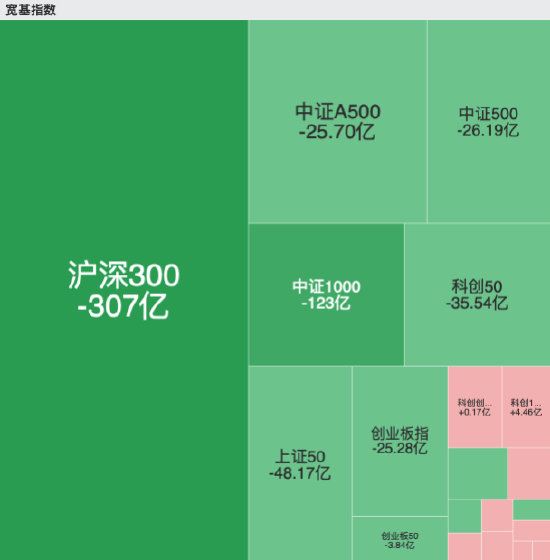
Group 1 - The ETF market experienced significant redemption pressure on January 19, with major broad-based ETFs showing a net outflow of funds, particularly the CSI 300 index ETFs [1][9] - The CSI 300 index ETFs had the most notable single-day net outflow, amounting to -30.694 billion yuan, while the CSI 1000 index ETF also saw a substantial outflow of -12.250 billion yuan [1][9] - Other mainstream broad-based index ETFs, including the SSE 50, STAR 50, and CSI 500, also experienced varying degrees of net outflows ranging from -2.5 billion to -4.8 billion yuan [1][9] Group 2 - Specific products such as the Huatai-PineBridge CSI 300 ETF (510300.SH) had the highest net outflow of -8.982 billion yuan, followed by the Harvest CSI 300 ETF (159919.SZ) and the China Asset Management CSI 300 ETF (510330.SH) with net outflows of -8.428 billion yuan and -7.649 billion yuan, respectively [4][15] - The total net outflow from these four leading CSI 300 ETFs exceeded 30.694 billion yuan [4][15] - Conversely, certain thematic industry ETFs, such as those related to semiconductor materials and specialized chemicals, saw inflows, with the semiconductor materials ETF gaining +1.633 billion yuan and the specialized chemicals ETF gaining +1.595 billion yuan [4][15]

客户迁移完成!国泰海通母公司整合落定,公募牌照整合难题待解
2 1 Shi Ji Jing Ji Bao Dao· 2026-01-20 02:31
Core Viewpoint - Guotai Junan successfully completed the integration of over 100 IT information systems and migrated more than 20 million clients' data to its next-generation distributed core trading system, marking the completion of major integration projects for the parent company [1][2]. Group 1: Integration Completion - The integration process took 8 months, starting from January 2025, and included infrastructure, system expansion, account, and commission integration [2]. - The integration was executed in three phases: gray-scale switching, pilot switching, and overall switching, ensuring seamless transitions across 21 batches [2]. - The new trading system now supports over 43 million clients, making it the largest full-stack core system in the industry [2]. Group 2: Future Development - The completion of the integration opens a new chapter for the company, allowing for deeper development and integration of its subsidiaries [3][6]. - The company is currently addressing issues related to competition among subsidiaries and is working on the integration of asset management subsidiaries [6][9]. - Future plans include enhancing customer service capabilities and core competitive advantages to establish a leading investment bank with international competitiveness [6]. Group 3: Financial Performance - For the first three quarters of 2025, Guotai Junan reported revenues of 45.892 billion yuan, a year-on-year increase of 101.60%, and a net profit of 22.074 billion yuan, up 131.80% [10]. - The significant growth in performance is attributed to the absorption of Haitong Securities, which expanded the company's business scale and increased net investment income, brokerage fees, and interest income [10]. Group 4: Fund Management Integration - The company is required to consolidate its public fund resources due to regulatory requirements, as it currently controls multiple fund companies, which violates the "one participation, one control, one license" policy [9][10]. - There are four potential merger scenarios for the two major public fund companies under Guotai Junan, including various combinations of acquisitions and sales [10].

电网设备ETF领涨;ETF市场首现万亿机构丨ETF晚报
2 1 Shi Ji Jing Ji Bao Dao· 2026-01-19 09:19
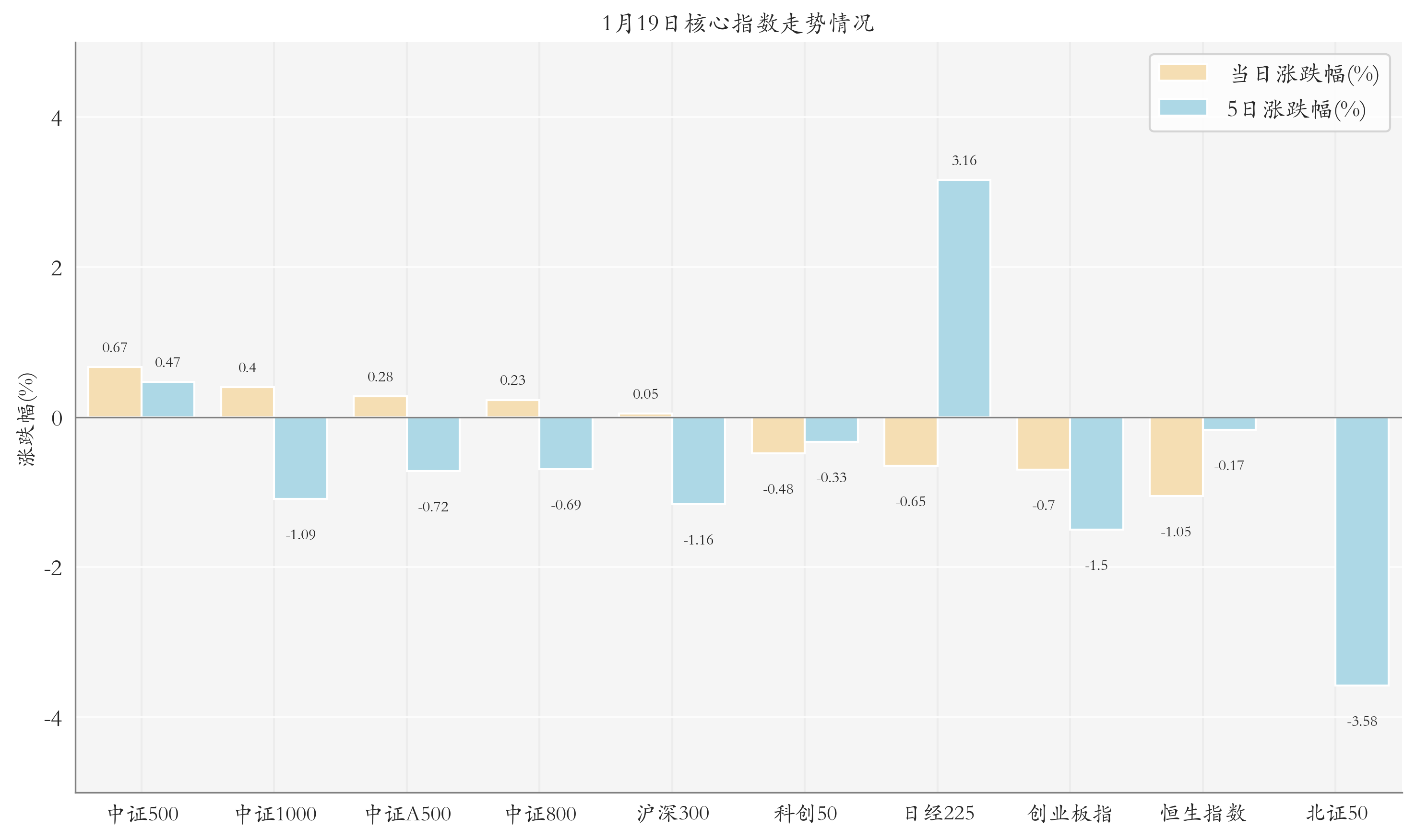
ETF Industry News - The three major indices mostly rose, with several ETFs in the power equipment sector leading the gains. The grid equipment ETF (159326.SZ) rose by 7.76%, the grid ETF (561380.SH) by 7.18%, and another grid ETF (159320.SZ) by 7.03%. In contrast, several ETFs in the pharmaceutical and biotechnology sector declined, with the Sci-Tech Pharmaceutical ETF (588130.SH) down by 2.21% and the Innovative Drug ETF (517110.SH) down by 2.17% [1] ETF Market Highlights - In the first two weeks of 2026, two ETFs reached the "trillion" mark in size, specifically those managed by Huaxia Fund and the cross-border ETF. This indicates a significant scale in the ETF market, which has accumulated over 6 trillion in assets over 20 years with nearly 60 managers. Major players like Huaxia and E-Fund continue to grow due to scale advantages, while smaller firms leverage differentiated strategies [2] - The number of ETFs included in the "ETF Connect" has expanded to 364, with 98 ETFs officially added to the Northbound Stock Connect. This represents a more than 30% increase from the previous total of 273. A total of 29 fund companies had products included, with Huaxia Fund leading with 14 new ETFs [3] - Recent market dynamics show a significant internal shift in ETF funds, with large redemptions in low-risk products like broad-based ETFs, bond ETFs, and money market ETFs. Conversely, commodity ETFs, cross-border ETFs, and narrow-based ETFs have become key areas for fund inflows, reflecting a shift in investor preferences [4] Market Performance Overview - On January 19, the A-share market showed mixed results, with the Shanghai Composite Index rising by 0.29% to 4114.0 points, while the Shenzhen Component Index rose by 0.09% to 14294.05 points. The ChiNext Index fell by 0.7% to 3337.61 points [5] - In terms of sector performance, the basic chemical, oil and petrochemical, and power equipment sectors led the gains with daily increases of 2.7%, 2.08%, and 1.84%, respectively. In contrast, the computer, communication, and banking sectors lagged behind with declines of -1.55%, -0.96%, and -0.6% [8] ETF Market Overview - The average performance of various ETF categories indicates that commodity ETFs performed the best with an average increase of 1.21%, while cross-border ETFs had the worst performance with an average decline of -1.14% [11] Top Performing ETFs - The top five ETFs in different categories include: - Stock ETFs: Grid Equipment ETF (159326.SZ), Grid ETF (561380.SH), and others [14] - Bond ETFs: Convertible Bond ETF (511380.SH), Shanghai Composite Convertible Bond ETF (511180.SH), and others [14] - Commodity ETFs: Gold ETF (159834.SZ), Gold ETF (518850.SH), and others [14] - Cross-border ETFs: Hong Kong Central Enterprise Dividend ETF (520660.SH), Sino-Korean Semiconductor ETF (513310.SH), and others [15] Trading Volume Statistics - The top three stock ETFs by trading volume were A500 ETF (563360.SH) with 14.083 billion, CSI 300 ETF (510300.SH) with 13.793 billion, and A500 ETF Fund (512050.SH) with 12.891 billion [16][17]
基金双周报:ETF市场跟踪报告-20260119
Ping An Securities· 2026-01-19 08:47
1. Report Industry Investment Rating - Not provided in the content 2. Core Viewpoints of the Report - As of January 16, recent two - week ETF products performed well. Among domestic major broad - based ETFs, Science and Technology Innovation 100 had the largest increase, and among industry and thematic products, technology - themed ETFs had the largest increase. The Science and Technology Innovation 100ETF had net capital inflows, while the CSI 300ETF had significant net capital outflows. Also, in the past two weeks, cyclical and pharmaceutical ETFs had accelerated capital inflows, technology, consumer, military, and financial real - estate ETFs turned to net capital inflows, dividend and other large - manufacturing ETFs turned to net capital outflows, and new - energy ETFs had accelerated capital outflows. For bond ETFs, credit - bond, treasury - bond, and local - bond ETFs turned from net inflows to net outflows, convertible - bond ETFs turned to net inflows, and policy - financial - bond and short - term - financing ETFs had accelerated net outflows [2][9][16] 3. Summary According to the Table of Contents 3.1 ETF Market Review - **Performance and Capital Flow**: As of January 16, in the past two weeks, among domestic major broad - based ETFs, Science and Technology Innovation 100 had the largest increase, and among industry and thematic products, technology - themed ETFs had the largest increase. The Science and Technology Innovation 100ETF had net capital inflows, while the CSI 300ETF had significant net capital outflows. Cyclical and pharmaceutical ETFs had accelerated capital inflows, technology, consumer, military, and financial real - estate ETFs turned to net capital inflows, dividend and other large - manufacturing ETFs turned to net capital outflows, and new - energy ETFs had accelerated capital outflows. For bond ETFs, credit - bond, treasury - bond, and local - bond ETFs turned from net inflows to net outflows, convertible - bond ETFs turned to net inflows, and policy - financial - bond and short - term - financing ETFs had accelerated net outflows [2][9][16] - **Product Structure Distribution**: As of January 16, in the past two weeks, 9 new ETFs were established, with a total issuance of 5607 million shares, all being stock ETFs. Compared with the end of 2025, the scales of industry + dividend ETFs, commodity ETFs, and QDII - ETFs increased by 14.33%, 9.87%, and 6.05% respectively, while the scales of bond ETFs and broad - based ETFs decreased by 9.78% and 3.98% respectively [2][23] - **Fund Manager Scale Distribution**: As of January 16, China Asset Management had the largest on - exchange ETF scale of 96.4259 billion yuan. The ETF management scales of China Asset Management and E Fund expanded by over 26 billion yuan compared with a year ago [24] 3.2 Classification of ETF Tracking - **Technology - Themed ETF**: Products tracking semiconductor materials and equipment had the highest net capital inflows in the past two weeks, while products tracking the National Securities Chip index had net capital outflows [28] - **Dividend - Themed ETF**: Products tracking the low - volatility dividend had the highest net capital inflows in the past two weeks, while products tracking the CSI Dividend index had net capital outflows [31] - **Consumer - Themed ETF**: Products tracking the S&P 500 Consumer Select Index had a relatively high premium rate. ETFs tracking the CSI 800 Consumer index had the highest net capital inflows in the past two weeks, while products tracking the CSI Liquor index had net capital outflows [34] - **Pharmaceutical - Themed ETF**: ETFs tracking medical devices had the highest net capital inflows in the past two weeks, while products tracking the CSI Medical index had net capital outflows [37] - **Large - Manufacturing - Themed ETF**: Products tracking the satellite industry had the highest net capital inflows in the past two weeks, while products tracking robots had net capital outflows [40] - **QDII ETF**: Products tracking the Hang Seng Technology index had the highest net capital inflows in the past two weeks, while ETF products tracking the Hang Seng Healthcare index had net capital outflows [43] 3.3 Popular Themed ETF Tracking - **AI - Themed ETF**: AI - themed products mostly rose in the past two weeks, with an average return of 10.88%. Products tracking cloud computing had the largest increase. Since 2025, there has been an overall net capital inflow, with a large inflow from mid - February to April, a continuous outflow from May to August, and a large inflow since mid - August. In the past two weeks, there was a significant net capital inflow of 18.301 billion yuan [55] - **Robot - Themed ETF**: Robot - themed products performed well in the past two weeks, with an average return of 7.17%. Products tracking the robot index had the largest increase. After February 2025, capital showed a rapid inflow trend as a whole, and there was a net capital outflow of 3.909 billion yuan in the past two weeks [59] - **New - Energy - Themed ETF**: New - energy - themed products mostly rose in the past two weeks, with an average return of 4.10%. Products tracking the CSI New Energy index had the largest increase. There was a continuous outflow before August 2025, a large inflow from August to October, and a large outflow since late October. In the past two weeks, there was a net capital outflow of 3.111 billion yuan [65] - **Satellite and Commercial Space - Themed ETF**: Satellite and commercial space - themed products mostly rose in the past two weeks, with an average return of 14.38%. Products tracking the satellite industry had the largest increase. There was a small inflow in late August 2025 and a large inflow since mid - December. In the past two weeks, there was a significant net capital inflow of 17.542 billion yuan [70] - **Central Huijin, Guoxin, and Chengtong - Held ETF**: As of June 30, 2025, the scale of ETFs held by Central Huijin, Guoxin, and Chengtong totaled 39.1336 billion shares. In the past two weeks, there was a net capital outflow of 172.9 billion yuan. In the past two weeks, China AMC CSI 500 ETF, Harvest CSI 500 ETF, and Guotai SSE 180 Financial ETF had the highest capital inflows [74]
开年两个“万亿”,ETF“非对称”优势如何突围?
券商中国· 2026-01-19 02:31
Core Viewpoint - The article highlights the significant growth and evolution of ETFs in China, with two major records achieved in early 2026, indicating a robust and competitive market landscape. The focus is on the "Matthew Effect," where leading players like Huaxia and E Fund continue to dominate, while smaller firms carve out niches through differentiated strategies [1][2]. Group 1: ETF Market Overview - As of January 16, the total size of all listed ETFs reached 6.07 trillion yuan, managed by 58 fund companies. Huaxia Fund's ETF surpassed 1 trillion yuan on January 12, later adjusting to 964.82 billion yuan due to market fluctuations [2]. - The top five fund companies account for 53.21% of the total ETF market size, with E Fund and Huatai-PB following Huaxia in scale [2][3]. Group 2: Competitive Dynamics - The article discusses the "liquidity moat" and "institutional allocation preference" as key factors contributing to the scale disparity among ETF managers. Larger ETFs tend to attract more institutional investments due to better liquidity, reinforcing the dominance of leading firms [3][5]. - The analysis indicates that the competition among ETF managers is shifting from simple scale to a more complex ecosystem approach, focusing on product differentiation and comprehensive solutions for investors [8][9]. Group 3: Product Differentiation and Strategy - Smaller fund companies are encouraged to focus on niche markets and innovative strategies to compete effectively against larger firms. The article emphasizes the importance of creating unique products that meet specific investor needs [6][10]. - The future of ETFs is seen as moving towards "solution-oriented competition," where the emphasis is on providing complete investment solutions rather than just tracking indices [8][9]. Group 4: Future Trends and Innovations - The article notes that the global market for actively managed ETFs is expected to grow significantly, with a projected size of 1.84 trillion USD by the end of 2025, indicating a shift in investor preferences towards active management strategies [10]. - Companies like Pengyang Fund are exploring new product categories, such as long-term bond ETFs, to enhance their offerings and meet evolving market demands [6][10].

债市投资2026:固收基金经理重构攻防体系
Shang Hai Zheng Quan Bao· 2026-01-18 18:25
Group 1 - The bond market has faced adjustments since the second half of 2025, with rising yields and increased volatility, putting pressure on bond funds known for their stability [1][2] - Fund managers are focusing more on drawdown control and investment strategy iteration, with "negative duration" risk hedging strategies gaining attention [1][4] - The bond market is expected to present a volatile pattern in 2026, with traditional strategies regaining effectiveness and the allocation of convertible bonds and equity assets becoming important for enhancing returns [1][8] Group 2 - Over the past six months, bond market yields have continued to rise, with the 10-year government bond yield increasing from approximately 1.65% in early July 2025 to nearly 1.9% by January 7, 2026, a rise of 25 basis points [2] - The net value of pure bond funds has been under pressure, with the pure bond fund index rising only 0.05% over the past six months, while the mid-to-long-term pure bond fund index fell by 0.51% [2] - The current challenges for bond investments include poor odds and changes in traditional pricing logic, with institutional behavior and risk asset performance becoming more influential [2][3] Group 3 - The "negative duration" strategy is gaining attention as it allows for capital gains during rising interest rate cycles by constructing a portfolio with short-term liabilities and long-term assets [4][5] - This strategy has practical value in specific market conditions, particularly when interest rates are clearly on the rise and the yield curve steepens [4] - Fund managers are advised to be cautious with the "negative duration" strategy due to its high entry barriers, significant trading costs, and potential risks if interest rate directions are misjudged [6] Group 4 - In a volatile market, the ability to control drawdowns is crucial, but fund managers must also be able to generate excess returns to demonstrate their value [7] - The bond market is expected to experience a wide range of fluctuations in 2026, with traditional strategies like riding strategies, leverage strategies, and variety rotation strategies becoming more effective [7][8] - Fund managers are encouraged to adapt their strategies to the changing market dynamics, focusing on high-yield assets and maintaining flexibility in their investment approaches [8][9]
最新!个人养老金基金再扩容
Zhong Guo Ji Jin Bao· 2026-01-18 05:20
Core Viewpoint - The personal pension fund list in China has expanded, with 7 new products added, bringing the total to 309 funds as of the end of last year [1][3]. Group 1: Fund Expansion - The latest list of personal pension funds includes 309 products, an increase of 7 from the end of the third quarter last year [3]. - The newly added products consist of ordinary index funds, enhanced index funds, stable pension target funds, and target date funds [3]. Group 2: Sales Institutions - The number of sales institutions for personal pension funds remains unchanged at 52 [3]. - Securities companies lead with 25 institutions, followed by commercial banks with 19, and independent fund sales institutions with 8 [3]. Group 3: Performance and Scale - The personal pension funds have seen significant performance and scale growth, with an average net value growth rate of 17.54% for 279 funds that have been established for over a year [5]. - As of the end of the third quarter of 2025, the total scale of personal pension fund Y shares reached 15.107 billion yuan, marking a 65.32% increase from the end of 2024 [5]. Group 4: Industry Insights - Public funds are recognized as pioneers in the personal pension business and play a crucial role in the personal pension ecosystem [6]. - The industry is expected to enhance product diversity, demonstrate long-term investment value, and foster collaborative efforts among market participants to promote effective operation of personal pensions [6].
ETF市场跟踪与配置周报-20260117
Xiangcai Securities· 2026-01-17 12:21
Report Industry Investment Rating No relevant content provided. Core Views - PB-ROE framework's ETF rotation strategy recommends next week to focus on the communication, agriculture, forestry, animal husbandry, and transportation industries, corresponding to their industry ETFs; the ETF redemption sentiment indicator model suggests focusing on the Science and Technology Innovation 50 ETF, SSE 50 ETF, Medical ETF, Photovoltaic ETF, and Robot ETF [9][40] - Combining PB and ROE for industry configuration may be a better choice; the third quadrant's high PB high ROE and the fifth quadrant's low PB medium ROE are key focus areas; combining the third and fifth quadrants to construct a comprehensive PB-ROE strategy has an annualized return of 11.93% and an annualized excess return of 13.22% [32][33] Summary by Directory 1. Recent Market Overview (January 12 - January 16, 2026) - Index performance: Shanghai Composite Index closed at 4101.91, down 0.45% for the week; Shenzhen Component Index closed at 14281.08, up 1.14%; ChiNext Index closed at 3361.02, up 1.00%; Beijing Stock Exchange 50 closed at 1548.33, up 1.58%; Hang Seng Index closed at 26844.96, up 2.34%. The average daily trading volume of the Shanghai and Shenzhen stock markets was 34250.96 billion yuan, and the total trading volume for the week was 17.13 trillion yuan [12] - Industry performance: Among 31 Shenwan primary industries, 13 industries rose and 18 fell. The top three gainers were computer (up 3.82%), electronics (up 3.77%), and non-ferrous metals (up 3.03%); the top three losers were national defense and military industry (down 4.92%), real estate (down 3.52%), and agriculture, forestry, animal husbandry, and fishery (down 3.27%) [5][12] - Main funds: Main funds had net outflows for 5 trading days and no net inflows, with a total net outflow of 2752.39 billion yuan for the week. The industries with more net inflows were banks, public utilities, and coal; the industries with more net outflows were national defense and military industry, power equipment, and computer [5][13] 2. Recent ETF Market Performance (January 12 - January 16, 2026) - Overall situation: As of January 16, 2026, there were 1411 ETFs in the Shanghai and Shenzhen stock markets, with a total asset management scale of 60766.01 billion yuan. There were 1101 equity ETFs (38892.41 billion yuan), 53 bond ETFs (7479.66 billion yuan), 27 money market ETFs (1529.88 billion yuan), 17 commodity ETFs (2751.84 billion yuan), 207 cross-border ETFs (10070.46 billion yuan), and 6 unlisted ETFs (41.76 billion yuan) [20] - Newly listed and established ETFs: 8 ETFs were newly listed, all equity ETFs; 7 ETFs were newly established, with a total issuance scale of 51.24 billion yuan [21] - Equity ETFs: The median weekly increase or decrease was 0.59%. Science and technology semiconductor ETFs and semiconductor equipment ETFs performed well, with the Science and Technology Semiconductor ETF Peng Hua rising the most at 12.46%; aerospace and high-end equipment ETFs performed poorly, with the Aerospace ETF falling the most at 6.88%. The average weekly share change was a decrease of 19.4716 million shares. Software ETFs and media ETFs had more share increases, while the Science and Technology Innovation 50 ETF and CSI 300 ETF had more share decreases [24] - Bond ETFs: The median weekly increase or decrease of 53 bond ETFs was 0.12%. The convertible bond ETF had the highest increase of 0.91%, while the science and technology innovation bond ETF had the highest decrease of 0.00%. As of January 16, 2026, the Haifutong CSI Short-term Financing ETF had the largest scale of 631.50 billion yuan [27] - Cross-border ETFs: The median weekly increase or decrease was 1.18%. The China-South Korea Semiconductor ETF and Hong Kong Stock Connect Internet ETF had the highest increases, with the China-South Korea Semiconductor ETF rising 6.11%; the Hong Kong Securities ETF and Nasdaq Biotechnology ETF had the highest decreases, with the Hong Kong Securities ETF falling 2.28%. Since the beginning of the year, the median increase or decrease was 3.82%, with the China-South Korea Semiconductor ETF and Hong Kong Medical ETF having higher increases, and the Nasdaq ETF and Nasdaq Technology ETF having higher decreases [29] 3. PB-ROE Framework's ETF Rotation Strategy Tracking - Factor effectiveness: PB factor and PB quantile factor show certain stratification ability, and PB quantile factor is more effective; ROE factor's effectiveness declined after 2018; using ROE factor is better than ROE quantile factor; expected ROE factor is better than expected ROE year-on-year factor. Combining PB and ROE for industry configuration may be a better choice [32] - Key quadrants: The third quadrant's high PB high ROE and the fifth quadrant's low PB medium ROE are key focus areas. From 2017 to February 2024, the compound annualized excess returns of the third and fifth quadrant portfolios were 4.27% and 1.55% respectively [32] - Strategy improvement: After supplementing the PB-ROE framework with four dimensions, the annualized excess returns of the third and fifth quadrant strategies were 4.78% and 3.94% respectively. Combining the two strategies, the annualized return was 11.93% and the annualized excess return was 13.22% [33] - Recent performance: This week, the strategy focused on the communication, agriculture, forestry, animal husbandry, and transportation industries, with a cumulative return of -0.86%, and an excess return of -0.29% compared to the CSI 300 Index [8][34] - Performance since 2023: The cumulative return was 26.03%, with an excess return of 3.81% compared to the CSI 300 Index [8][36] - Performance since 2022: The cumulative return was 7.77%, with an excess return of 11.99% compared to the CSI 300 Index [39] 4. Investment Recommendations - PB-ROE framework: Focus on the communication, agriculture, forestry, animal husbandry, and transportation industries next week, corresponding to their industry ETFs [9][40] - ETF redemption sentiment indicator model: Focus on the Science and Technology Innovation 50 ETF, SSE 50 ETF, Medical ETF, Photovoltaic ETF, and Robot ETF next week [9][40]
年初债基频现大额赎回 债市或延续震荡趋势
Xin Lang Cai Jing· 2026-01-16 14:57
Core Viewpoint - The bond market continues to face challenges at the beginning of 2026, with pure bond funds, especially medium to long-term ones, experiencing significant declines, while convertible bond funds show relatively strong performance [1][2]. Group 1: Market Performance - As of January 14, 2026, 20% of pure bond funds have reported zero or negative returns, with 477 out of 492 underperforming funds being medium to long-term pure bond funds [1][2]. - The average return for bond funds in 2025 was approximately 2.73%, a significant drop from 4.42% in 2024, indicating a nearly halved yield for bond funds [2]. - Notably, some pure bond funds have seen declines exceeding 0.5%, with specific funds like Guotai's Tianrui One-Year Open Bond Fund reporting a return of -0.82% [2][3]. Group 2: Fund Flows and Redemptions - The bond market's poor performance has led to significant capital outflows, with bond ETFs losing over 70 billion yuan since the start of 2026 [4]. - Specific bond ETFs, such as the Sci-Tech Bond ETF, have seen their scales shrink by over 12.1 billion yuan, while a few convertible bond ETFs have experienced net inflows [4][5]. - Several bond funds have announced increases in net asset value calculation precision due to large redemptions, a common measure to mitigate the impact of significant withdrawals [5][6]. Group 3: Market Outlook - Short-term factors contributing to the decline in pure bond fund yields include rising long-term bond rates, with the 10-year government bond yield reaching 1.89% [7]. - Analysts express caution regarding the short-term outlook for the bond market, anticipating continued volatility, but believe the long-term downside risk is limited [7][8]. - The overall economic environment suggests that while the bond market faces pressure, the risk of significant declines remains relatively low due to supportive monetary policies [8][9].
尚太科技股价跌5.16%,海富通基金旗下1只基金重仓,持有26.54万股浮亏损失119.16万元
Xin Lang Cai Jing· 2026-01-16 05:38
Group 1 - The core point of the news is that Shangtai Technology's stock price has dropped by 5.16% to 82.46 CNY per share, with a trading volume of 500 million CNY and a turnover rate of 3.21%, resulting in a total market capitalization of 21.506 billion CNY [1] - Shangtai Technology, established on September 27, 2008, and listed on December 28, 2022, specializes in the research, production, and sales of lithium-ion battery anode materials and carbon products [1] - The company's main business revenue composition includes: anode materials at 91.57%, graphitized coke at 4.29%, others at 3.62%, and diamond carbon source at 0.52% [1] Group 2 - Hai Futong Fund has one fund heavily invested in Shangtai Technology, specifically the Hai Futong Carbon Neutral Mixed A Fund (013175), which held 265,400 shares, accounting for 3.73% of the fund's net value, ranking as the ninth largest holding [2] - The Hai Futong Carbon Neutral Mixed A Fund, established on September 24, 2021, has a latest scale of 253 million CNY, with a year-to-date return of 2.97%, ranking 5441 out of 8847 in its category, and a one-year return of 66.88%, ranking 955 out of 8094 [2] - The fund manager, Fan Tingfang, has been in position for 6 years and 145 days, with total assets under management of 1.484 billion CNY, achieving the best fund return of 183.62% and the worst return of -31.98% during the tenure [3]