洋河股份

Search documents
行业投资策略:底部布局,柳暗花明
KAIYUAN SECURITIES· 2025-11-14 06:46
食品饮料 2025 年 11 月 14 日 投资评级:看好(维持) 行业走势图 数据来源:聚源 -24% -12% 0% 12% 24% 2024-11 2025-03 2025-07 食品饮料 沪深300 相关研究报告 《白酒底部布局,兼顾成长型标的— 行业周报》-2025.11.9 《三季报业绩压力增大,白酒报表持 续出清—行业周报》-2025.11.2 《底部修复,柳暗花明—行业投资策 略》-2025.10.31 底部布局,柳暗花明 ——行业投资策略 | 张宇光(分析师) | 张恒玮(分析师) | 张思敏(分析师) | | --- | --- | --- | | zhangyuguang@kysec.cn | zhanghengwei@kysec.cn | zhangsimin@kysec.cn | | 证书编号:S0790520030003 | 证书编号:S0790524010001 | 证书编号:S0790525080001 | | 市场表现:食品饮料年初至今跑输大盘 | | | 食品饮料跑输大盘,零食板块表现较好。2025 年 1-10 月食品饮料板块下降 1.1%, 跑输沪深 300 约 3 ...
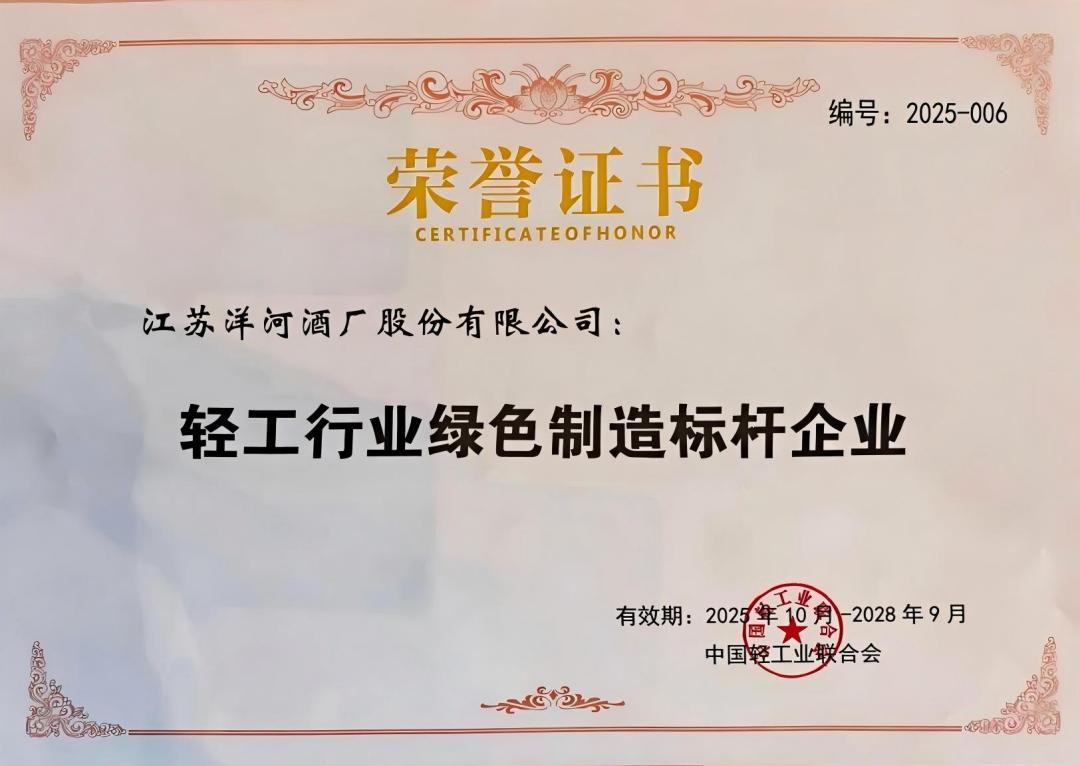
洋河股份荣膺2025轻工行业绿色制造标杆企业、节能降碳先进技术两项荣誉
Zhong Guo Ji Jin Bao· 2025-11-14 02:31
Core Points - The company was awarded the title of "2025 Green Manufacturing Benchmark Enterprise" at the "Light Industry Technology Innovation and Green Development Conference" held in Nanjing [1] - The company's "Digital Smart Energy Management Technology for Liquor Enterprises" was included in the "Directory of Advanced Technologies for Energy Conservation and Carbon Reduction in Key Areas of Light Industry (2025 Edition)" [1] Group 1 - The selection of green manufacturing benchmark enterprises is organized by the China Light Industry Federation to promote the green low-carbon transformation of the industry and establish leading enterprises in green development [1] - The evaluation process included self-assessment by enterprises, targeted recommendations, expert reviews, and comprehensive recognition [1] Group 2 - The company adheres to the green development philosophy and actively promotes the "1257" dual carbon strategy, increasing investment in energy conservation and environmental protection [3] - The company has achieved significant results in new technology research, energy structure optimization, water resource protection, and resource recycling [3] Group 3 - The company has established the first zero-carbon workshop in the liquor industry and has been certified through a carbon management system [4] - The company was recognized as a leader in carbon peak by being included in the 2024 list of China's industrial carbon peak leaders and has received honors as an ESG demonstration enterprise [4] - The company has developed a carbon neutrality practice path suitable for the Chinese liquor industry, setting a benchmark for the industry's green low-carbon transformation [4]


酒价内参11月14日价格发布 飞天茅台终端价微跌2元
Xin Lang Cai Jing· 2025-11-14 00:29
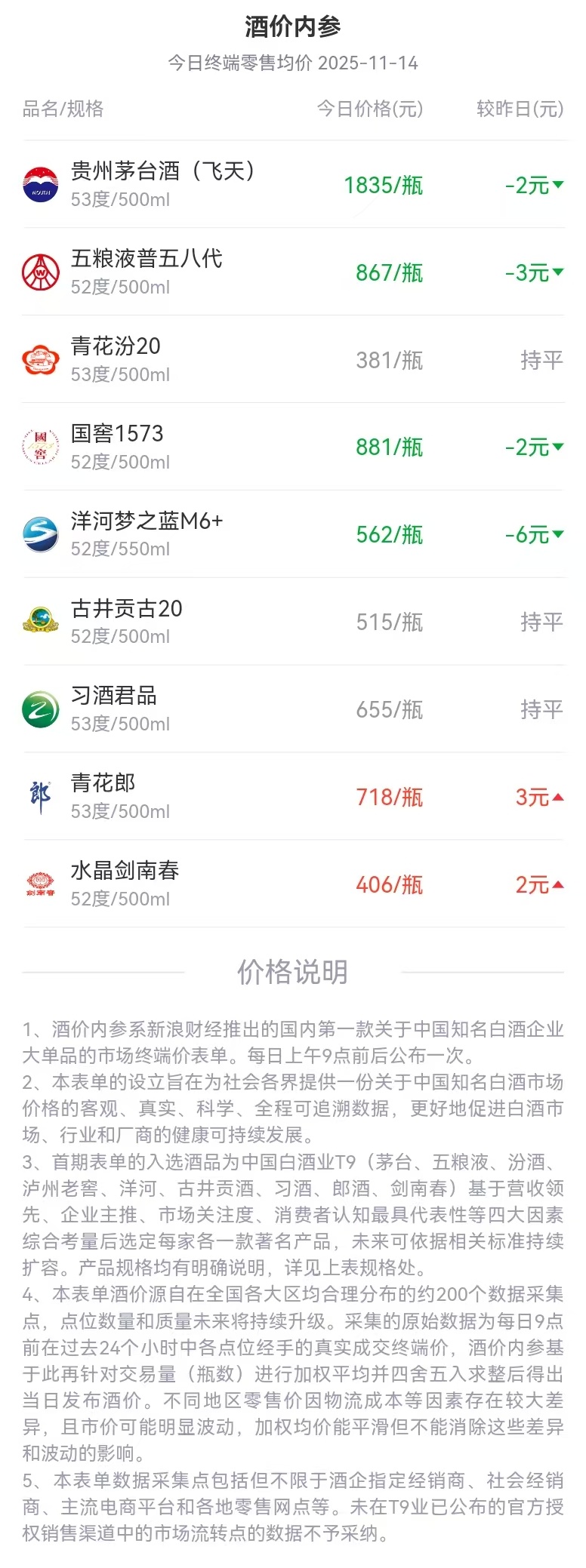
Core Insights - The average retail price of major Chinese liquor brands has shown a slight decline, with Moutai's price dropping by 2 yuan per bottle compared to the previous day [1][3] - Other notable brands, such as Wuliangye and Guojiao 1573, also experienced minor price reductions of 2-3 yuan per bottle, while Yanghe's Dream Blue M6+ saw a more significant drop of 6 yuan per bottle [1][3] - The overall retail price for a bundled package of the nine major products decreased by 8 yuan compared to the previous day, indicating a trend of price stabilization among certain products [1] Price Summary - Moutai (Feitian): 1835 yuan/bottle, down 2 yuan [3] - Wuliangye (Pu Wuliang): 867 yuan/bottle, down 370 yuan [3] - Qinghua Fen 20: 381 yuan/bottle, stable [3] - Guojiao 1573: 881 yuan/bottle, down 2 yuan [3] - Yanghe Dream Blue M6+: 562 yuan/bottle, down 6 yuan [3] - Gujing Gong 20: 515 yuan/bottle, stable [3] - Xijiu Junpin: 655 yuan/bottle, stable [3] Data Collection and Methodology - The price data is collected from approximately 200 points across major regions in China, ensuring a comprehensive representation of the market [6][7] - The data reflects actual transaction prices from the past 24 hours, weighted by transaction volume to provide an average price [6][7] - The initiative aims to provide an objective and traceable dataset to promote the healthy and sustainable development of the liquor market [6]




中高端啤酒,正在成为年轻人的“精神食粮”
3 6 Ke· 2025-11-13 12:11
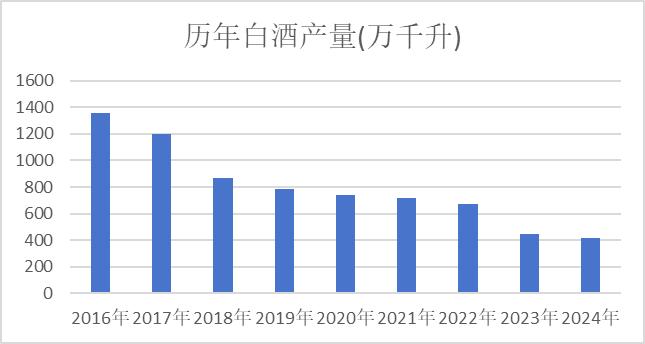
Core Insights - The overall alcohol market is experiencing a decline, with both the baijiu and beer industries facing significant challenges, including a projected 1% decrease in global beer sales in 2024 [1][9] - Despite the downturn, the high-end beer segment is witnessing growth, with high-end and super high-end beers in China and the U.S. showing positive growth rates of 1% and 2% respectively in 2024 [2][9] Industry Overview - The baijiu industry has seen a continuous decline in production, dropping from 13.58 million kiloliters in 2016 to approximately 4.14 million kiloliters in 2024, with projections indicating it may fall below 4 million kiloliters in 2025, marking a 20-year low [4][7] - High-end baijiu prices have also plummeted, with notable brands like Moutai and Wuliangye hitting record lows in wholesale prices [7][8] - The beer industry is similarly struggling, with a 0.6% decline in production for major Chinese breweries in 2024, amounting to 35.21 million kiloliters, which is about 70% of the peak production in 2013 [9] High-End Beer Growth - High-end beer is driving revenue growth for breweries, with companies like Yanjing Beer reporting that mid-to-high-end products accounted for 70.11% of their sales, achieving a revenue growth of 9.32% [9][12] - The trend towards high-end beer consumption is largely driven by younger consumers, who are increasingly willing to pay for quality and unique experiences [12][14] Consumer Behavior - A significant portion of young consumers (over 77%) prefer the concept of "quality over quantity" in their beer choices, indicating a shift in consumption patterns [13] - The younger demographic is motivated by both quality and status, viewing high-end beer as a lifestyle choice rather than just a beverage [14][15] Market Dynamics - The high-end beer market is projected to grow, with the industry’s high-end rate expected to reach 30% by 2026 [19][20] - However, not all companies are successfully transitioning to high-end products, as seen with Budweiser and Tsingtao, which have faced challenges in maintaining sales and profitability in this segment [21][22] Challenges in High-End Transition - The transition to high-end products requires strong brand recognition, effective distribution channels, and cultural resonance with consumers, which many domestic brands struggle to achieve [22][23] - The competition in the high-end market is intensifying, and companies must innovate and connect with younger consumers to succeed [18][24]


洋河:以海天梦想筑起民族担当
Bei Jing Wan Bao· 2025-11-13 09:06
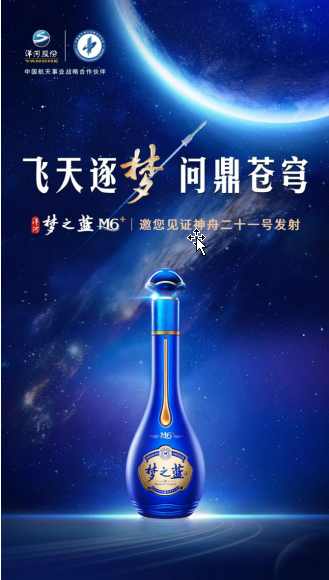
Core Viewpoint - The article highlights the deep connection between the Chinese aerospace industry and the national brand "Yanghe," showcasing how the company integrates its brand ethos with national aspirations and social responsibility through various initiatives and partnerships [1][2][13]. Group 1: Company Initiatives - Yanghe has committed to a long-term partnership with the Chinese aerospace industry, pledging an additional 15 million yuan in donations from 2023 to 2025, bringing the total investment to over 30 million yuan for aerospace technology research and public education [4]. - The "Million Aerospace Partners Program" allows consumers to contribute to the aerospace public welfare fund with each purchase of a specific product, raising over 5 million yuan and engaging over a million consumers in the "aerospace dream" [4][5]. - Yanghe has established "Aerospace Classrooms" in remote schools, reaching thousands of children and promoting interest in aerospace through interactive learning experiences [5]. Group 2: Cultural and Educational Contributions - Yanghe's "Dream Plan" has invested 13 million yuan over four years to support underprivileged students in Guizhou, helping 201 students gain admission to top universities [9]. - The company launched the "Dunhuang Guardian Plan" to protect and digitize cultural heritage, integrating Dunhuang culture into product design, thereby promoting cultural awareness [10]. - Yanghe's commitment to education and cultural preservation reflects its broader social responsibility, aiming to nurture future generations while preserving national heritage [10][12]. Group 3: Community Engagement and Disaster Response - Yanghe has demonstrated its commitment to community support by donating 10 million yuan for disaster recovery efforts following a recent earthquake in Tibet, showcasing its role as a responsible corporate citizen [12]. - The company's proactive response to various natural disasters highlights its dedication to social responsibility and community welfare [12][13]. - Yanghe's initiatives are designed to resonate with the public, reinforcing the idea that corporate responsibility is intertwined with national and community needs [13].
19只白酒股上涨 贵州茅台1470.38元/股收盘
Bei Jing Shang Bao· 2025-11-13 08:04
从个股来看,贵州茅台收盘价达1470.38元/股,上涨0.36%;五粮液收盘价达121.20元/股,上涨0.68%; 山西汾酒收盘价达201.00元/股,上涨1.25%;泸州老窖收盘价143.32元/股,上涨1.02%;洋河股份收盘 价达70.39元/股,上涨0.13%。 申万宏源发布研报称,Q3白酒板块加速出清,预计26Q3迎来基本面拐点从报表端看,自24Q4部分企业 开始下滑,但由于25Q1动销仍然有韧性,头部品牌仍然实现了增长。25Q2自外部需求结构显著扰动以 来,行业需求环境明显承压,消费场景大量缺失,头部品牌报表端开始出清,25Q3报表端进一步加速 出清,开始触底。 北京商报讯(记者 刘一博 冯若男)11月13日尾盘,三大指数集体上涨,沪指4029.50点上涨0.73%。白 酒板块2372.47点收盘上涨0.61%,其中19只白酒股上涨。 ...
第四届中国酒业活态文化·国际化大会在太原举行
Zhong Guo Xin Wen Wang· 2025-11-13 06:25
会议同期启动"中国酒业口述史团体标准"起草工作,并成立"中国酒业口述史研究中心"。该中心作为活 态文化传承重要平台,将通过口述史方式系统记录酿酒业"心口相传"的技艺、记忆与经验,实现活态记 忆的规范化记录与传承,有效保存濒临失传的口头技艺和行业故事,为酒业活态文化发展提供有力支 撑。 中国酒业协会理事长宋书玉以《民族的就是世界的》为题发表主旨演讲,开篇即精准点明活态是中国酒 业新文化的本质特征。他指出,中国美酒的活态魅力,根植于千年传承却生生不息的酿造技艺,流淌于 社交场景的民俗礼仪,彰显于持续迭代的生活美学,承载着文化、文明、酿造、生活四重自信,推动国 际化已成为全行业的自觉行动。针对酒业出海的痛点难点,他明确五大"认知破壁"关键方向:打破"中 国白酒难出海"的思维定势、完成"中国美酒"到"世界名酒"的文化跨越、适配"中西合璧"的多元消费场 景、重塑"稀缺珍贵"的价值标签、升级"全球产业"的发展格局;同时给出四大实践路径:推动产业抱团 出海形成协同合力、实现从产品出口到产能输出的进阶升级、推进中国酒业"世界双遗"申报、聚焦香型 特色开展精准国际传播,为行业国际化发展指明方向。 帝亚吉欧大中华区公共事务与传播 ...
食品饮料行业点评:内需政策提振及宏观数据持续修复下,食品饮料相关子行业有望回暖
Bank of China Securities· 2025-11-13 05:37
Investment Rating - The industry investment rating is "Outperform the Market" [1][19] Core Viewpoints - The food and beverage industry is expected to recover due to domestic demand policies and continuous macroeconomic data improvement. The focus on increasing residents' consumption power is a key goal in the "14th Five-Year Plan," making consumption enhancement a future policy priority. The recovery of the food and beverage sub-industries is anticipated under these conditions [2][4] - The report suggests prioritizing investments in sub-sectors benefiting from the recovery of dining consumption scenarios, such as frozen foods, condiments, and the broader dining supply chain. Key companies to watch include Anjijia Food, Yihai International, Baba Food, and Guoquan [2][4] Summary by Relevant Sections Macroeconomic Data - Since March, core CPI has been recovering, with September and October figures at 1.0% and 1.2%, respectively. The CPI turned positive in October at 0.2%, indicating a positive price trend. Retail sales of consumer goods from January to September increased by 4.5% year-on-year, with goods consumption outperforming dining consumption [4][2] Policy Environment - The report emphasizes that enhancing residents' consumption rates is a key goal in the "14th Five-Year Plan," with domestic demand playing a crucial role in economic growth. The contribution of final consumption expenditure to GDP growth has been higher than that of capital formation in recent years, indicating significant potential for consumption growth in China [4][2] Sub-Industry Performance - The liquor sector is showing signs of bottoming out, with revenue and net profit growth rates for the first three quarters of 2025 at -5.8% and -6.9%, respectively. The report notes that while the industry is currently at a low point, it is transitioning from "over-competition" to "orderly competition" [4][2] - The performance of leading companies in the consumer goods sector demonstrates resilience, particularly in frozen foods, beer, and dining chain formats. The report highlights that leading companies are adapting to market changes and improving their performance [4][2]
年轻人不买账,白酒这次真要凉?
3 6 Ke· 2025-11-13 03:02
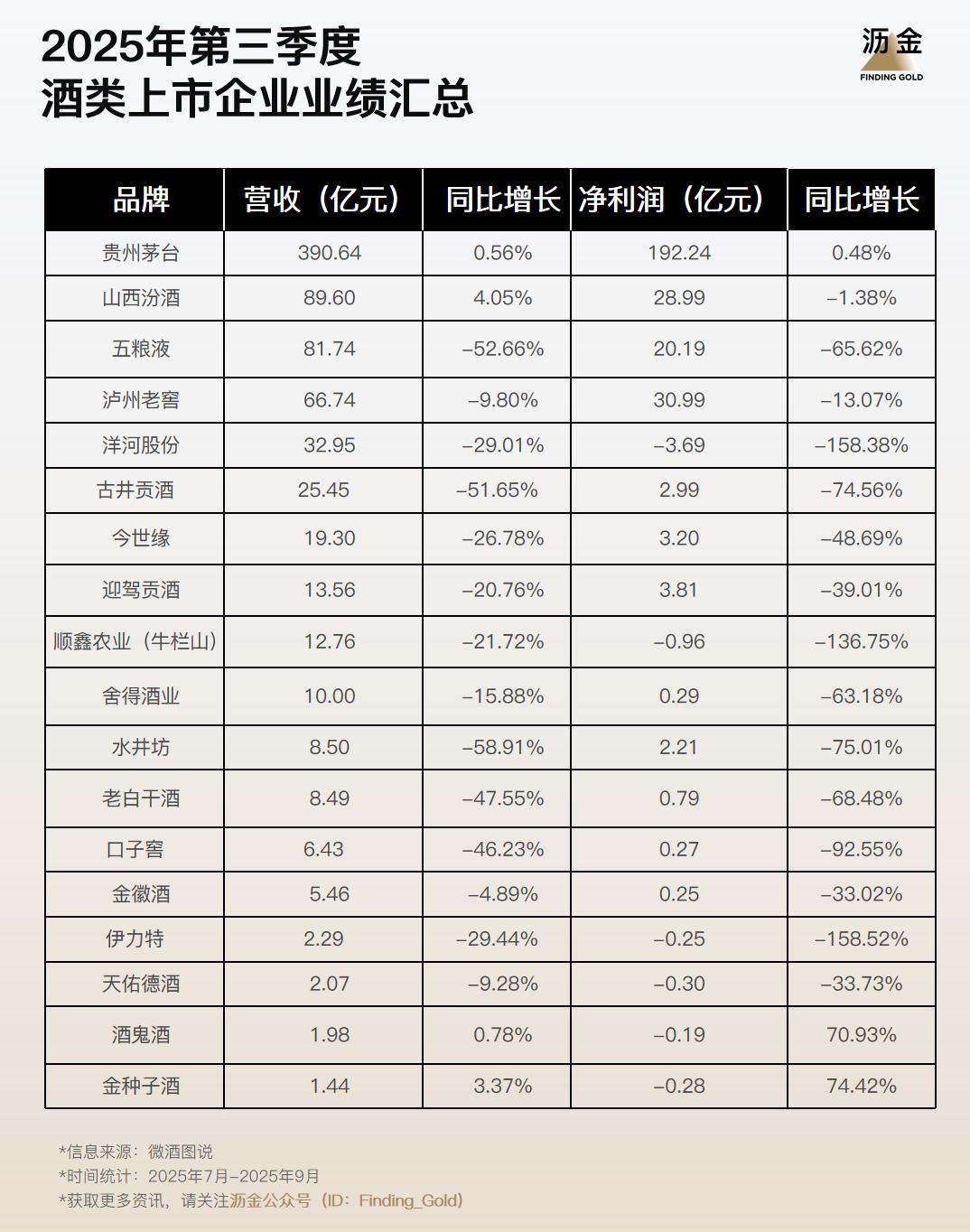
Core Viewpoint - The Chinese liquor industry, particularly the baijiu sector, is experiencing significant revenue and profit declines, with most companies facing challenges except for a few leading brands [1][4]. Financial Performance - Major brands like Kweichow Moutai reported a revenue of 39.064 billion yuan with a slight growth of 0.56%, while others like Wuliangye saw a drastic revenue drop of 52.66% to 8.174 billion yuan [2]. - The net profit for Kweichow Moutai was 19.224 billion yuan, reflecting a growth of 0.48%, whereas Wuliangye's net profit plummeted by 65.62% to 2.019 billion yuan [2]. - Other brands such as Yanghe and Gujing Gongjiu also reported significant declines in both revenue and net profit, indicating a broader industry downturn [2]. Market Sentiment and Public Perception - The introduction of the "ban on alcohol" in June is viewed as a catalyst for the current downturn, leading to reduced consumption in both public and business settings [1][4]. - Social media discussions have intensified around the notion that "baijiu is failing," with extreme expressions of pessimism emerging [3][4]. - The price of Kweichow Moutai's scattered bottles fell below 1,500 yuan, reflecting market panic and a loss of confidence [4]. Historical Context and Cycles - The baijiu industry has undergone four significant downturns since the establishment of New China, with each cycle characterized by structural adjustments and eventual recovery [6][11]. - The current downturn is seen as a continuation of a long-term structural adjustment rather than a sudden collapse, with historical patterns suggesting potential for recovery [8][11]. Cultural and Generational Shifts - The narrative surrounding baijiu has shifted, with younger generations perceiving it as a symbol of social pressure rather than a status symbol, leading to a disconnect in cultural significance [20][21]. - The traditional values associated with baijiu are being challenged by changing social dynamics, where younger consumers prioritize personal identity over societal expectations [22][23]. Future Outlook - The baijiu industry faces the challenge of redefining its narrative to resonate with contemporary consumers, particularly the younger demographic that shapes public discourse [25][27]. - Recovery will depend not only on price stabilization but also on rebuilding cultural relevance and consumer trust in the brand [28].
酒价内参11.13价格发布 飞天茅台终端价再小涨
Xin Lang Cai Jing· 2025-11-13 00:08
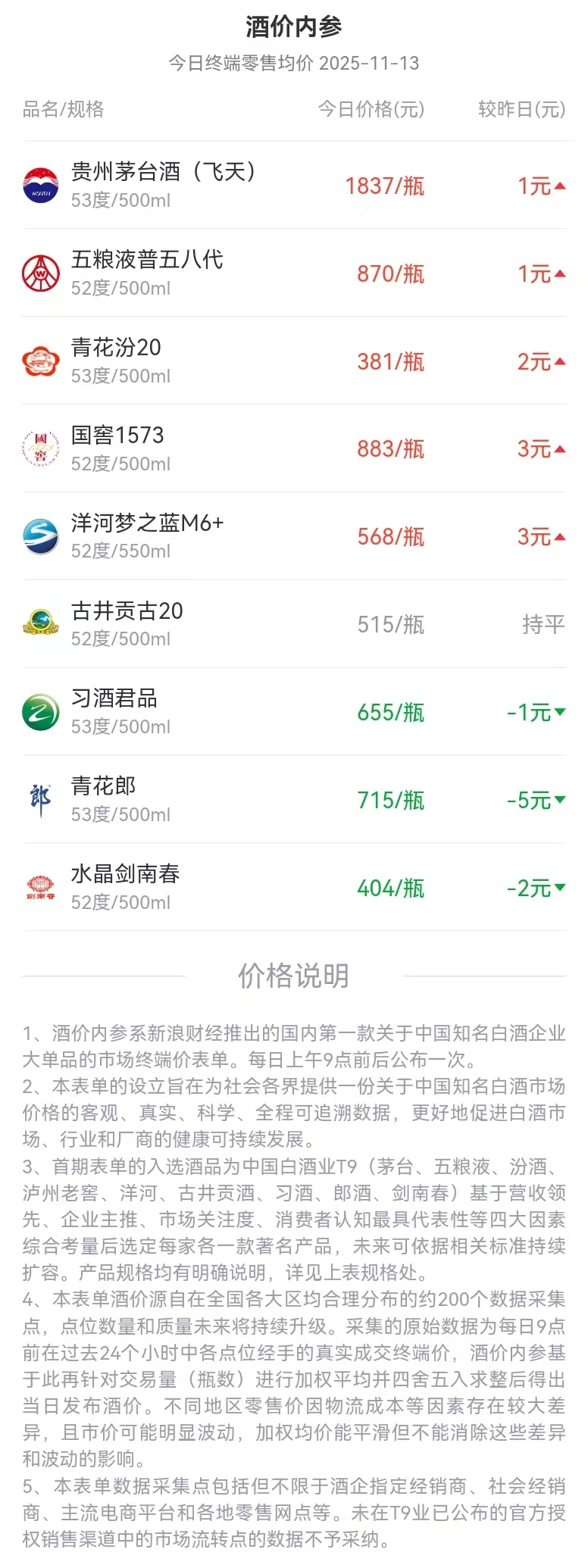
Core Insights - The average retail price of major Chinese liquor brands has shown a slight increase following the Double Eleven shopping festival, indicating a stable market trend for the industry [1] Price Trends - Moutai's Feitian liquor saw a price increase of 1 yuan per bottle, reaching 1837 yuan [3] - Other notable brands such as Guojiao 1573 and Yanghe Dream Blue M6+ both increased by 3 yuan per bottle, indicating a leading price rise among major products [1][3] - Wuliangye's Pu Wuhai edition increased by 1 yuan, showing signs of price stabilization [1] - Qinghua Fen 20 also experienced a price rise of 2 yuan, while Guqingong Gu 20 remained stable [1] - On the downside, Qinghua Lang saw a significant drop of 5 yuan per bottle, while Xijiu Junpin and Shuijing Jianan Chun decreased by 1-2 yuan, which is considered normal market fluctuation [1] Data Collection and Reporting - The price data is collected from approximately 200 points across major regions, including authorized distributors and retail outlets, ensuring a comprehensive representation of the market [6][7] - The data is published daily by Sina Finance, aiming to provide an objective and traceable overview of the Chinese liquor market [6]