储备多元化

Search documents
美国务卿:美元已不是全球储备货币,多国正寻找美元替代品
Sou Hu Cai Jing· 2026-02-13 08:49
Core Viewpoint - The U.S. Secretary of State Rubio revealed that nearly half of the countries no longer view the U.S. dollar as the global reserve currency, marking a significant acknowledgment from the U.S. government about the declining status of the dollar [1][3] Group 1: Dollar's Declining Status - A majority of countries have stopped holding dollar assets as reserve currencies, indicating a shift in global financial dynamics [3] - The total U.S. national debt has surpassed $38 trillion, with annual interest payments exceeding $1.3 trillion, raising concerns about the sustainability of the dollar [5] - The weaponization of the dollar and fluctuating U.S. policies have created unease among global central banks, complicating the dollar's role in international trade [5] Group 2: Shift in Asset Preferences - Central banks are increasingly diversifying their reserves to avoid reliance on U.S. debt, with countries like China strategically reducing their holdings of U.S. Treasury bonds [7] - If confidence in the dollar wanes, funds will seek new safe havens, with gold being one option, though its limitations prevent it from fully replacing the dollar [9] - The euro is seen as a potential successor to the dollar, but internal complexities within the Eurozone raise concerns among investors [9] Group 3: Future of Currency Dynamics - The current trend of de-dollarization is more about reserve diversification rather than a revolutionary shift away from the dollar [11] - The U.S. government is taking measures to stabilize the dollar's position by seeking control over key resources, such as oil in Venezuela and rare earth elements in Greenland [13] - China's efforts to internationalize the renminbi are progressing, particularly in cross-border transactions and commodity pricing, positioning it as a reliable alternative in specific trade areas [13]

ATFX:暴跌后狂飙重上5000美元 黄金再次王者归来
Xin Lang Cai Jing· 2026-02-09 14:42
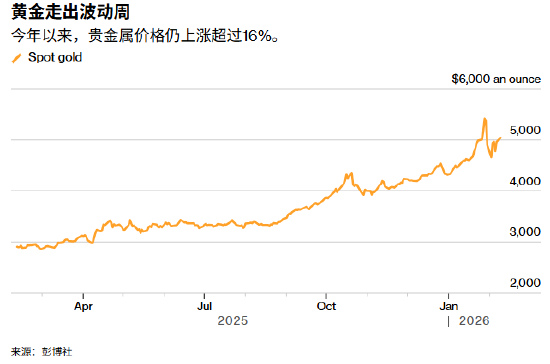
Core Viewpoint - The gold market has experienced significant volatility, but buying on dips has returned, with gold prices rising above $5000 per ounce, supported by a decline in the dollar and a 4% increase last week, resulting in a 1.9% weekly gain [1][4]. Group 1: Market Dynamics - Gold prices saw a 1.7% increase during early trading on Monday, driven by the election of Japan's Prime Minister Kishi Nobuo, which raised expectations for loose fiscal policies and continued pressure on the yen, supporting gold as a value storage asset [4][10]. - Following a substantial drop from historical highs, gold prices fell approximately 11% from the peak on January 29, yet have risen 15% year-to-date, indicating a strong underlying demand despite recent volatility [4][10]. - The market is currently in a high volatility state, awaiting key U.S. economic data, including non-farm payrolls and CPI, which will shape expectations regarding the Federal Reserve's interest rate decisions and influence gold's potential for a strong rebound [5][11]. Group 2: Long-term Trends - The continuous increase in gold purchases by the Chinese central bank over the past 15 months reflects a long-term trend of "de-dollarization" and diversification of reserves, providing a solid demand foundation for the gold market [6][12]. - Major financial institutions like Deutsche Bank and Goldman Sachs have reiterated their bullish outlook on gold, shifting market focus from short-term fluctuations to long-term drivers such as global debt and currency credit hedging, stabilizing market sentiment [6][12]. - The recent rebound in gold prices is characterized as a technical recovery following a sharp decline, supported by long-term positive factors, but its sustainability will depend on the performance of upcoming U.S. economic data [7][12].
ATFX:暴跌后狂飙重上5000美元,黄金再次王者归来?
Sou Hu Cai Jing· 2026-02-09 10:21
Core Viewpoint - The gold market has experienced a rebound after a week of unusual volatility, with prices rising above $5,000 per ounce, supported by a decline in the US dollar and buying interest at lower levels [1][4]. Group 1: Market Dynamics - Gold prices increased by approximately 4% last week and are up 1.9% on a weekly basis, despite a significant drop from historical highs [1][4]. - Silver has also rebounded from a one-and-a-half-month low, indicating a broader recovery in precious metals [1]. - The recent election victory of Japan's Prime Minister Fumio Kishida has strengthened expectations for continued fiscal easing and pressure on the yen, providing additional support for gold [4]. Group 2: Investor Sentiment - Following a historic drop, gold prices have recovered about half of their losses, driven by buying interest from investors who believe the market has adjusted sufficiently [4][5]. - The upcoming US non-farm payroll and CPI reports are expected to shape market expectations regarding the Federal Reserve's interest rate decisions, which will be crucial for gold's potential rebound [4][6]. Group 3: Long-term Outlook - Central banks, particularly the People's Bank of China, have been increasing gold reserves for 15 consecutive months, reflecting a long-term trend of "de-dollarization" and diversification of reserves, providing a solid demand base for gold [5]. - Major institutions like Deutsche Bank and Goldman Sachs maintain bullish views on gold, shifting focus from short-term volatility to long-term drivers such as global debt and currency credit hedging [5].
38万亿美债崩盘,全球割肉抛售,中国疯狂买金,逆势翻盘
Sou Hu Cai Jing· 2026-02-05 20:21
Core Viewpoint - The surge in U.S. federal debt, which surpassed $38 trillion, is not merely a market spectacle but a systemic risk that will shape global wealth distribution for the next decade [1] Group 1: Debt and Interest Dynamics - U.S. federal debt has increased by $10.73 trillion over five years, with an average interest rate rising to 3.362%, creating a self-reinforcing spiral of fiscal deficit and interest burden [1] - Interest expenditures are projected to reach $970 billion in FY 2025, accounting for 13.8% of total expenditures, with forecasts indicating that interest will exceed $1 trillion in FY 2026, rivaling defense spending [3] Group 2: Foreign Investment Trends - Foreign ownership of U.S. Treasury bonds has decreased from a peak of 40% to approximately 15%, indicating a gradual but firm shift in investment strategy [5] - Central banks are selling U.S. debt and significantly increasing gold purchases, with India doubling its gold reserves, reflecting a long-term redesign of reserve structures [5] Group 3: Global Currency Dynamics - The share of the U.S. dollar in global foreign exchange reserves has fallen to 56.32%, the lowest in 30 years, indicating a shift in risk perception among asset holders [7] - The International Monetary Fund has warned that global public debt is nearing 100% of GDP, with U.S. debt at 124% of GDP, reminiscent of post-World War II levels [7] Group 4: Market Reactions and Asset Shifts - Gold prices have surged from $2,607 to a peak of $4,310, a 65% increase, driven by central bank and sovereign wealth fund purchases, highlighting gold's renewed importance as a value anchor [9] - China's actions include increasing gold reserves significantly while reducing U.S. Treasury holdings from $784.3 billion to $68.26 billion, marking the lowest level since 2008 [9] Group 5: Policy Implications and Strategic Responses - The rapid expansion of debt and rising interest rates are attributed to misalignments in fiscal and monetary policies, with attempts to print money potentially leading to market confidence erosion [11] - Emerging markets, including China, are advised to diversify foreign exchange reserves, enhance currency swap mechanisms, and deepen domestic capital markets to mitigate reliance on a single reserve currency [15] Group 6: Structural Changes in Global Finance - The current situation is characterized as a significant reshuffling of the global reserve and trust system, necessitating proactive adjustments to convert risks into opportunities [17] - The ongoing geopolitical tensions are driving countries to explore non-dollar settlement options, indicating a shift towards regional financial cooperation and currency diversification [13]
黄金的十字路口
对冲研投· 2026-02-02 08:46
Core Viewpoint - The article emphasizes the fluctuating dynamics of the gold market, highlighting the interplay between demand, supply, and geopolitical factors that influence gold prices and investment strategies [5][25]. Group 1: Gold Market Dynamics - Gold has regained attention as it experiences a technical correction after reaching a peak, influenced by profit-taking and concerns over the U.S. Federal Reserve's policy direction following the nomination of a hawkish chairman [5]. - The largest gold ETF, SPDR, has not surpassed the 1200 tons high from 2020, indicating insufficient allocation by residents and institutions compared to central bank purchases, which may allow for future capital inflows [5]. - Global gold demand in 2025 surpassed 5000 tons for the first time, with investment demand growing significantly, driven by a 84% year-on-year increase in gold investment demand [8][9]. Group 2: Investment Demand and Trends - In 2025, global gold ETF holdings increased by 801 tons, marking the second-highest annual increase on record, with North America leading in demand [9]. - The demand for gold bars and coins reached a 12-year high at 1374.1 tons, with notable increases in India and China, reflecting strong retail investor interest [12]. - Central banks purchased 863 tons of gold in 2025, maintaining a high level of demand despite a slight slowdown compared to previous years, indicating a long-term trend of diversification away from the U.S. dollar [13][15]. Group 3: Price and Consumption Trends - Gold jewelry demand fell to a five-year low of 1542.3 tons in 2025, down 18% year-on-year, as high prices suppressed consumer purchasing power [17]. - Despite the decline in volume, the total value of gold jewelry consumption rose by 18% to a record $172 billion due to rising gold prices [17]. - The demand for technology-related gold remained stable at 322.8 tons, supported by growth in AI applications, despite fluctuations in the consumer electronics sector [18]. Group 4: Supply Side Analysis - Global gold supply increased by 1% in 2025, reaching a record high of 5002 tons, driven by slight increases in mine production and recycled gold supply [19]. - The increase in mine production was primarily from new mines in Canada and Australia, while some regions faced production issues [19]. - The recovery of gold supply only grew by 3% to 1404 tons, reflecting a reluctance among holders to sell due to high prices and expectations of further price increases [19]. Group 5: Future Outlook - Geopolitical tensions and expectations of a shift in global monetary policy are likely to continue influencing gold prices, with central bank demand expected to remain high [25]. - The article suggests that while gold prices may remain elevated, jewelry demand will likely continue to face pressure, and significant increases in recycled gold supply are unlikely [25]. - The anticipated economic conditions, including potential U.S. recession and geopolitical developments, may pose risks to gold prices in the latter half of 2026 [25].

贵金属期货周报:举行会晤-20260202
Dong Ya Qi Huo· 2026-02-02 02:57
Report Industry Investment Rating - Not provided in the report Core Viewpoints - The demand for precious metals lies in the choice of sovereign funds in the context of de - dollarization. The trends of de - dollarization and reserve diversification continue. The medium - term depreciation of the US dollar and the decline of the near - end yield curve support precious metals. There has been a relatively significant increase in domestic gold warehouse receipts and a relatively significant decrease in US gold warehouse receipts. Domestic and foreign silver warehouse receipts have dropped sharply [2][3] Summary by Relevant Catalogs Gold AU and Silver AG Viewpoints - The demand for precious metals is due to sovereign funds' choices in the de - dollarization context. De - dollarization and reserve diversification trends are ongoing. The medium - term depreciation of the US dollar and the decline of the near - end yield curve support precious metals. Domestic gold warehouse receipts have risen notably while US gold warehouse receipts have fallen notably, and domestic and foreign silver warehouse receipts have plunged [2][3] Fundamentals - The US released a defense strategy report, prioritizing homeland security and its interests in the Western Hemisphere. The US military convened generals from 34 Western Hemisphere countries to strengthen anti - drug military cooperation. Trump said that Iran is having "serious" talks with the US and hopes to reach an acceptable agreement. US media reported that the US is signaling negotiations with Iran, and the two sides may meet in Turkey. The Federal Reserve paused rate hikes in its January meeting, keeping the interest rate in the 3.5 - 3.75% range. Milan and Waller supported a 25 - basis - point rate cut. Powell reiterated that the interest rate is at the upper end of the neutral range and said that if tariff - related inflation peaks and then falls, it indicates that policy can be loosened. Trump announced the nomination of Kevin Warsh as Fed chairman, expecting him to push for rate cuts. The White House is confident that Warsh's nomination will be quickly confirmed [2][3] Gold and Silver Market Overview - One - Week Policy and Fundamental Review - The US Treasury took initial steps to intervene in the foreign exchange market. The US released a defense strategy report and strengthened anti - drug military cooperation in the Western Hemisphere. The US is pressuring Bolivia to expel suspected Iranian spies and discussing similar actions in other countries. The Trump administration is considering a naval blockade on Cuba's oil imports. Trump said the US obtained oil from a seized Venezuelan oil tanker. The Japanese yen suddenly rose nearly 200 points, and Japanese officials are closely monitoring the foreign exchange market. Trump increased the reciprocal tariff rate on South Korea from 15% to 25%. The EU will fully ban the import of Russian liquefied natural gas in January 2027 and Russian pipeline gas by the end of September. The Federal Reserve paused rate hikes, and some officials supported rate cuts. South Korea is expected to discuss a $350 billion investment program with the US. Trump will announce the Fed chairman nominee and called for a 2 - 3 percentage - point rate cut. Trump said Putin agreed to a one - week ceasefire in parts of Ukraine. Iran will conduct live - fire naval exercises in the Strait of Hormuz. The EU listed the Iranian Revolutionary Guard as a "terrorist organization". The US Treasury did not list any economy as a currency manipulator. The World Gold Council said that central banks' net gold purchases in Q4 were 230 tons, and strong gold demand in 2026 is expected to continue. OPEC+ eight member countries will maintain the plan to suspend the increase in oil production in March. The US government entered a partial "shutdown" state, but the House Speaker is confident to end it. SpaceX applied to deploy one million satellites to build an orbital AI data center network [7] Gold and Silver Market Overview - Gold Market Tracking - **COMEX Futures and Options**: The latest long - position of managed funds is 122,450, and the short - position is 35,978. The 5 - day change in the long - position is - 4%, and in the short - position is - 1%. The 1 - week change in the long - position is - 5,556, and in the short - position is 2,599 [8] - **ETF Holdings**: The latest total ETF holding of gold is 1,447 tons, with SPDR's holding at 862 tons and iShares' at 402 tons. The 5 - day changes are - 2% and - 4% respectively [8] - **Futures Positions and Warehouse Receipts**: The latest futures position of gold in Shanghai is 407,927 hands, and the Shanghai warehouse receipt is 3 tons. The 5 - day change in the futures position is 16,492 hands, and the 1 - week change in the warehouse receipt is - 1 ton [8] Gold and Silver Market Overview - Silver Market Tracking - **COMEX Futures and Options**: The latest long - position of managed funds is 44,277, and the short - position is 27,801. The 5 - day change in the long - position is 57, and in the short - position is 58. The 1 - week change in the long - position is - 4,423, and in the short - position is - 4,757 [12] - **ETF Holdings**: The latest total ETF holding of silver is 23,620 tons, and SLV's holding is 13,802 tons. The 5 - day changes are 58 and 78,420 respectively [12] - **Futures Positions and Warehouse Receipts**: The latest futures position of silver in Shanghai is 971,795 hands, and the Shanghai warehouse receipt is 1,075 tons. The 5 - day change in the futures position is 78,420 hands, and the 5 - day change in the warehouse receipt is - 7 tons [12] Gold and Silver Market Overview - Gold and Silver Import Profit Tracking - The import gold hedging profit margin and import silver hedging profit margin are presented in a time - series graph, with data from July 15, 2024, to January 15, 2026 [19] Factors Affecting Precious Metal Price Movements - US Dollar Index Futures Position Tracking - The non - commercial net long - position of the US dollar index and the total futures and options positions of the US dollar index are presented in time - series graphs, with data from July 1, 2025, to January 27, 2026 [21][22][23] Factors Affecting Precious Metal Price Movements - US Treasury Futures Position Tracking - The non - commercial net long - positions of 2 - year, 5 - year, and 10 - year US Treasury futures and options, as well as the total futures positions of US Treasuries, are presented in time - series graphs, with data spanning multiple years [26][27] Factors Affecting Precious Metal Price Movements - US Inflation Expectation - The break - even inflation rates for 5 - year, 7 - year, and 10 - year periods are presented in a time - series graph, with data from December 5, 2025, to February 1, 2026 [31] Factors Affecting Precious Metal Price Movements - US Real Interest Rate - The real yield curves of 5 - year, 7 - year, and 10 - year US Treasuries are presented in a time - series graph, with monthly data from March 2006 to September 2025 [33] Factors Affecting Precious Metal Price Movements - US Interest Rate Term Structure - The US Treasury interest rates, inflation expectations (interpolated linearly within the year), and real interest rates (based on PCE, interpolated linearly within the year) for different maturities (1M - 30Y) are presented [35] Factors Affecting Precious Metal Price Movements - 2 - Year Treasury Yield Spreads between the US and Major Non - US Countries - The yield spreads between the 2 - year US Treasury and 2 - year Treasuries of the UK, Japan, China, and Germany are presented in time - series graphs, with data from December 5, 2025, to February 1, 2026 [39]
今日1.27金价:大家不必等待了,接下来,金价有可能会重演历史
Sou Hu Cai Jing· 2026-01-27 16:44
Core Viewpoint - Central banks globally have significantly increased their gold reserves, surpassing the euro to become the world's second-largest reserve asset, indicating a strategic shift towards gold as a reliable asset amidst concerns over fiat currency stability [1][3]. Group 1: Central Bank Behavior - Since 2022, central banks have been purchasing over 1,000 tons of gold annually, nearly double the average of the previous decade, with countries like China, Poland, and Turkey leading the charge [1]. - The proportion of gold purchases by central banks has risen from 14.8% in 2018 to 23% of total gold demand, indicating their role as a stabilizing force in the gold market [5][6]. - China's central bank has consistently increased its gold holdings for 14 months, demonstrating a long-term commitment to gold as a strategic asset [6]. Group 2: Changing Perception of Gold - The traditional pricing formula for gold, which relied on the strength of the dollar and real interest rates, has become less effective since 2022, as gold prices have risen even when U.S. Treasury yields increased [3][11]. - The new valuation logic for gold centers around the concept of "credit," particularly a reassessment of the trust in sovereign currencies, especially the U.S. dollar [3][5]. Group 3: Market Dynamics - The global gold ETF holdings reached a historical peak of 4,025 tons by the end of November 2025, with a significant inflow of $89 billion in 2025 alone, reflecting strong investor interest [6]. - Geopolitical tensions and economic uncertainties have led to a sustained demand for gold as a long-term hedge, reinforcing its status as a "safe-haven" asset [8][11]. Group 4: Silver Market Insights - Silver has experienced a remarkable price increase of nearly 150% in 2025, driven by both its financial attributes as "shadow gold" and its industrial demand in sectors like solar energy and electric vehicles [9]. - The U.S. has elevated silver's strategic importance by designating it as a "critical mineral," further enhancing its market appeal [9]. Group 5: Price Trends - Gold prices have reached unprecedented levels, breaking through $4,000 for the first time on October 8, 2025, and climbing to $4,531 by December 24, 2025, with further increases into 2026 [11]. - The evolving role of gold is now seen as a core asset for pricing uncertainties in sovereign credit, moving beyond its traditional functions as an inflation hedge or crisis refuge [11].

黄金:受美元走弱支撑,央行或继续净买入
Sou Hu Cai Jing· 2026-01-26 05:37
Group 1 - The core viewpoint is that gold prices may continue to be supported by a weakening US dollar, according to analyst Alexandra Symeonidi from William Blair [1] - Rising geopolitical risks and macroeconomic uncertainties have justified the recent increase in gold prices [1] - The ongoing trend of reserve diversification indicates that central banks may continue to be substantial net buyers of gold this year [1]
白银价格突破100美元,因中国需求确实“爆表”
2026-01-26 02:49
Summary of Key Points from the Conference Call Industry Overview - The conference call discusses the silver market, particularly focusing on the recent surge in silver prices, which have surpassed $100 per ounce for the first time in history [5][16]. Core Insights and Arguments - **Record Silver Prices**: The spot price of silver has reached an all-time high, driven by unprecedented demand from China, described as "off the charts" [5][16]. - **Speculative Activity**: Despite the record prices, speculative positions in New York and Shanghai remain near historical lows, indicating a cautious market sentiment [6][10]. - **Diversification of Reserves**: The demand for silver is not solely driven by risk hedging but also by a broader trend of reserve diversification, with significant participation from speculative capital [7]. - **Physical Demand from China and India**: The physical demand from China and India, particularly from retail sectors, is identified as a key driver of the current price surge [9][11]. - **Market Dynamics**: The tight supply in the domestic market, influenced by strong exports from China, has led to significant price increases in both the Shanghai Futures Exchange (SHFE) and the New York Commodity Exchange (CMX) [14][13]. Additional Important Insights - **Holding Positions**: Despite high prices and increased macro attention, the holding positions in the Chicago Mercantile Exchange (CMX) and SHFE are surprisingly low, with a notable increase in put options compared to call options [10]. - **Chinese Export Dynamics**: Approximately 90% of China's silver exports are directed to India via Hong Kong, contributing to the current physical premium observed in Hong Kong [14]. - **Tightness in the London Silver Market**: The London Bullion Market Association (LBMA) is experiencing relative tightness due to previous strong imports, although this flow is beginning to reverse [15]. - **Caution from Analysts**: Analysts from Goldman Sachs express that while prices are excessively high, they are reluctant to short the market until they see a decline in physical premiums [18].

人民币占比8.9%!超越日元英镑,成全球第二大储备货币
Sou Hu Cai Jing· 2026-01-24 20:45
Core Insights - The position of the Chinese yuan in global foreign exchange reserves has been gradually increasing, currently estimated to be between 1.9% and 2.88% by 2025, ranking fifth overall [2][4] - The US dollar remains dominant at approximately 58%, followed by the euro at over 20%, the Japanese yen at 5.8%, and the British pound at 4.7% [2] Group 1: Yuan's Growth and Internationalization - The yuan's share in Special Drawing Rights (SDR) started at 1.08% in 2016 and has more than doubled, driven by trade relations and policy support [4] - Emerging market countries are increasingly including the yuan in their reserve baskets to diversify risk and facilitate trade with China [4] - The yuan's payment share in the SWIFT international payment system is projected to fluctuate between 2.9% and 4.6% by 2025, occasionally ranking fourth or fifth globally [7] Group 2: Trade and Economic Factors - Chinese enterprises are conducting business with countries along the Belt and Road Initiative using yuan contracts, which helps avoid dollar-related costs [6] - China's economic scale and trade volume, being the world's largest in goods trade, provide a solid foundation for the yuan's internationalization [10] - The stability of China's foreign trade and its complete supply chain enhance the competitiveness of Chinese manufacturing, encouraging the use of local currency for settlements [10] Group 3: Policy and Global Trends - Policy measures such as joining the SDR, promoting financial market openness, and establishing bilateral currency swap agreements have facilitated the yuan's internationalization [11] - The trend of de-dollarization is gaining traction globally, with the dollar's reserve share declining from a peak of 70% to around 58%, with a notable portion shifting to other currencies, including the yuan [14] - Countries are increasingly seeking to diversify their reserves, especially in light of frequent use of sanctions, leading to a rise in gold reserves as a hedge against single-country control [13] Group 4: Future Outlook - The internationalization of the yuan is progressing steadily, emphasizing market-driven approaches and mutual benefits, with potential for further growth if trade and investment facilitation continues to improve [15] - The choice of central banks to hold yuan reserves reflects confidence in China's stable economic fundamentals and consistent policies [17]