存款活化

Search documents
“存款活化”大潮开启,银行负债端迎来松绑,布局正当时
Mei Ri Jing Ji Xin Wen· 2025-11-06 02:52
Core Viewpoint - The upcoming third quarter of 2025 marks a significant window for the maturity of high-interest deposits, leading many clients to shift their matured funds into higher-yielding wealth management products, which will increase the total market scale of wealth management to 32.13 trillion yuan, a year-on-year increase of 9.42% [1] Group 1: Market Dynamics - The maturity repricing of deposits will positively impact banks' cost structures, directly lowering liability costs and alleviating the pressure from narrowing net interest margins [1] - With the recovery of the capital market, there is an increased willingness among residents to invest their demand deposits into stocks and funds [1] Group 2: Future Projections - According to CITIC Securities, from 2025 to 2026, the repricing of high-interest deposits combined with "deposit activation" is expected to accelerate the decline in existing deposit rates [1] - CITIC Securities estimates that just considering the repricing of time deposits, banks could see a downward adjustment of approximately 30 basis points in liability costs each year [1] Group 3: Investment Opportunities - As banks relieve their liability burdens, their profitability is expected to improve further, suggesting potential investment opportunities in bank ETF funds (515020) and other index investment tools [1] - Market analysts indicate that the current market conditions present an optimal time for strategic investments during dips [1]
“存款活化”遇上“到期窗口” 重定价助银行负债卸包袱
Zhong Guo Zheng Quan Bao· 2025-11-03 20:11
Core Insights - The attractiveness of wealth management products has increased as deposit rates decline, leading to a shift in asset allocation from traditional savings to diversified financial products [1][3][6] - A significant amount of high-interest deposits are maturing, prompting customers to invest in wealth management products, which is contributing to the growth of the wealth management market [2][3] - The trend of increasing demand for liquid deposits is changing the liability structure of banks, with a notable rise in the proportion of demand deposits [4][5] Wealth Management Market Growth - As of the end of Q3 2025, the total number of wealth management products in the market reached 43,900, a year-on-year increase of 10.01%, with a total scale of 32.13 trillion yuan, up 9.42% year-on-year [3] - The decline in deposit rates has led to a noticeable shift in customer behavior, with many opting for wealth management products that offer higher returns compared to traditional savings [2][3] Changes in Deposit Structure - The marginal improvement in demand deposits is evident, with a reported balance of 12.69 trillion yuan in demand deposits by the end of September 2025, reflecting a year-to-date increase of 502.3 billion yuan, or 4.12% [4][5] - The proportion of demand deposits has decreased by 1.21 percentage points compared to the beginning of the year, but the rate of decline has slowed, indicating a stabilization trend [5] Impact on Bank Profitability - The re-pricing of maturing high-interest deposits is expected to alleviate the pressure on net interest margins for banks, with potential downward adjustments in deposit interest rates by approximately 30 basis points per year [6][7] - The ongoing decline in deposit rates is anticipated to create new opportunities for monetary policy and capital markets, as banks can lower their funding costs [6][7]
“存款活化”遇上“到期窗口”重定价助银行负债卸包袱
Zhong Guo Zheng Quan Bao· 2025-11-03 20:11
Core Insights - The attractiveness of wealth management products has increased as deposit rates decline, leading to a shift in asset allocation from traditional savings to diversified financial products [1][2][4] Wealth Management Product Growth - The number of wealth management products in the market reached 43,900 by the end of Q3 2025, marking a year-on-year growth of 10.01% [2] - The total scale of these products was 32.13 trillion yuan, reflecting a year-on-year increase of 9.42% [2] Changes in Deposit Structure - There has been a marginal improvement in demand for demand deposits, with a notable increase in their growth rate [3] - As of the end of September, the balance of demand deposits in one bank was 12.69 trillion yuan, with a year-to-date increase of 502.3 billion yuan, representing a growth rate of 4.12% [3] Impact of Market Conditions - The capital market's recovery has led to a shift in residents' asset allocation, with stocks and funds becoming primary alternatives to traditional savings [2][3] - The A-share market has seen a 20% increase since June 23, 2025, contributing to the growing appeal of capital market investments [2] Interest Rate Dynamics - The repricing of high-interest deposits is expected to alleviate the pressure on banks' net interest margins, with potential downward adjustments of 30 basis points per year anticipated for deposit rates [4][5] - The decline in deposit rates is projected to continue, benefiting banks by reducing their funding costs [4][5] Asset Allocation Trends - There is a noticeable shift in residents' asset allocation from "single savings" to "diversified financial management," driven by the decreasing attractiveness of low-interest deposits [4][5] - The preference for fixed-term deposits has been influenced by the need for capital preservation and risk aversion in the current financial environment [5]
理财市场“吸金”效应凸显,存款到期重定价为银行负债端“减负”
Zhong Guo Zheng Quan Bao· 2025-11-03 12:11
Group 1 - The core viewpoint is that the recent maturity of high-interest deposits is leading customers to diversify their investments into wealth management products, as these products currently offer higher yields compared to similar-term deposits [1][2][3] - The banking industry is experiencing a shift in deposit structure, with an increase in demand for wealth management products, stocks, and funds as alternatives to traditional savings [1][3] - As of the end of Q3 2025, the total number of wealth management products in the market reached 43,900, a year-on-year increase of 10.01%, with a total scale of 32.13 trillion yuan, up 9.42% year-on-year [2] Group 2 - Recent reports from listed banks indicate a growth in demand for demand deposits, with a notable increase in the proportion of these deposits, suggesting a positive trend in the banking sector [3] - The decline in deposit rates is expected to accelerate the re-pricing of high-interest deposits, which may alleviate the pressure on banks' net interest margins and create room for future monetary easing [4] - The overall trend indicates that as the capital market stabilizes, there is a growing need for asset reallocation among residents, further influencing the banking liability structure [3][4]




2026年债市展望:蛰伏反击
HTSC· 2025-11-03 05:50
Group 1: Macroeconomic Outlook - The report highlights that both the US and China are entering critical years, with global investment driven by three and a half engines: AI investment, defense spending, and industrial restructuring [1][14] - The nominal GDP growth rate is expected to recover, with a focus on domestic demand and technology as key policy areas [1][2] - The transition from old to new economic drivers in China is anticipated to gain momentum, leading to a rebalancing of supply and demand [2][11] Group 2: Policy Environment - The "15th Five-Year Plan" sets a supportive policy tone, with monetary policy expected to remain accommodative, albeit with less room than in the current year [3][15] - Fiscal policy is projected to maintain a certain level of expansion, with total tools estimated at 15.7 trillion yuan, an increase of approximately 1.2 trillion yuan from this year [3][15] - The report emphasizes the importance of structural tools and the coordination between monetary and fiscal policies to support various sectors [3][15] Group 3: Supply and Demand Dynamics - The narrative of "asset scarcity" in the bond market is expected to weaken, with a focus on the verification of corporate profits and capacity utilization [4][18] - The report notes that government bond supply is likely to increase, but market pressure will be manageable due to central bank support [4][18] - Institutional behavior is identified as a major source of market volatility, with a reduction in stable funding leading to increased market fluctuations [4][18] Group 4: Bond Market Strategy - The bond market is expected to maintain a "low interest rate + high volatility" characteristic, with the central rate likely remaining stable or slightly increasing [5][18] - The report suggests a strategy of segment trading, coupon strategies, and equity exposure as priorities over duration adjustment and credit downgrading [5][18] - The ten-year government bond yield is projected to fluctuate between 1.6% and 2.1%, with a widening of term spreads anticipated [5][18]
固收点评:存款活化进行时
Tianfeng Securities· 2025-10-16 06:13
1. Report Industry Investment Rating No information provided. 2. Core Viewpoints - In September, the growth rate of social financing continued to decline moderately, the supporting effect of government bonds weakened, and medium - and long - term corporate loans and short - term household loans remained under pressure. However, there were also structural improvements, such as reduced bill padding, better year - on - year performance of medium - and long - term household loans, and increased capital activation [1][18]. - For the bond market, the data of structural repair has not yet exerted obvious pressure, but the supporting strength is also relatively limited. The market trend may depend more on institutional behavior and marginal changes in liquidity. Attention should be paid to the impact of deposit currentization and non - bank deposit trends on the micro - structure of bank liabilities, which may amplify the instability of liabilities and periodic frictions in the money market, so caution is still needed [1][18]. 3. Summary by Directory 3.1 Social Financing Growth Rate Continues to Decline Slightly, and Corporate Bonds Perform Well - In September, the newly added social financing was 353.38 billion yuan, a year - on - year decrease of 22.97 billion yuan; the year - on - year growth rate of social financing was 8.7%, a 0.1 - percentage - point decline from the previous month; the social financing growth rate (excluding government bonds) was 5.9%, a 0.002 - percentage - point increase from the previous month [7]. - The growth rate of social financing stock continued to decline slightly, and the contribution of government bonds was negative. Due to the high - base effect of government bond issuance last August, its driving effect on social financing was limited. Without the early use of debt - resolution quotas in the fourth quarter, the social financing growth rate may continue to decline this year [2][7]. - At the end of the quarter, there was credit padding, and the year - on - year increase continued to be lower. The bill interest rate rose slowly during the month, but the padding intensity in traditional large - credit months may be relatively limited. The time - point effect was prominent in the first half of this year, but weakened in the third quarter [2][7]. - Corporate bonds showed a bright year - on - year performance. Although the overall yield to maturity of corporate bonds increased in September, it may have benefited from policy support for science and technology innovation bonds and private enterprise bonds, boosting corporate financing willingness [2][7]. 3.2 Medium - and Long - Term Household Loans Recover - In September, the newly added RMB loans were 129 billion yuan, a year - on - year decrease of 30 billion yuan. Short - term household loans decreased by 12.79 billion yuan year - on - year, medium - and long - term household loans increased by 2 billion yuan year - on - year, short - term corporate loans increased by 25 billion yuan year - on - year, medium - and long - term corporate loans decreased by 5 billion yuan year - on - year, bill financing decreased by 47.12 billion yuan year - on - year, and non - bank loans decreased by 3.56 billion yuan less year - on - year [10]. - Medium - and long - term corporate loans still faced pressure. In September, the manufacturing PMI rebounded, and sub - items such as new orders, new export orders, and production all rebounded, indicating improved demand. Affected by credit padding at the end of the quarter, the BCI corporate financing environment index and bill interest rate both increased. However, with the intensive implementation of "anti - involution" policies, the production arrangements and capital expenditure willingness of some enterprises may be cautious, suppressing financing demand. If the investment progress of new policy - based financial instruments accelerates, it is expected to boost credit and support medium - and long - term corporate loans [3][10]. - Short - term corporate loans continued to increase year - on - year in September. On the one hand, it may have benefited from the improvement in business prosperity, increasing the demand for short - term capital turnover. On the other hand, since May, short - term corporate loans have shown a bright year - on - year performance, with positive growth in all months except July, which may be supported by the expanded structural monetary policy tools at the beginning of May [3][10]. - Household credit performance was polarized, with medium - and long - term loans improving and short - term loans under pressure. The performance of commercial housing transactions improved slightly in September, which may have supported medium - and long - term household loans. Short - term loans still faced some pressure. Although the loan interest subsidy policy was implemented in September, its effect on boosting household leverage willingness needs further observation [3][11]. 3.3 The Gap between M2 and M1 Narrows to a New Low - M2 increased by 8.4% year - on - year, M1 increased by 7.2% year - on - year, and the gap between them narrowed. In September, RMB deposits were 221 billion yuan, a year - on - year decrease of 153 billion yuan. Among them, household deposits increased by 76 billion yuan year - on - year, non - financial enterprise deposits increased by 14.94 billion yuan year - on - year, fiscal deposits decreased by 60.42 billion yuan year - on - year, and non - bank deposits decreased by 197 billion yuan year - on - year [16]. - The gap between M2 and M1 further narrowed to a new low, reflecting the continuous enhancement of capital activation. Driven by the improvement of market risk appetite and the profit - making effect of the equity market, current deposits increased [4][16]. - Affected by the high - base effect of the stock market's "924" market last year, non - bank deposits decreased more year - on - year, and household deposits increased more year - on - year. However, the transfer of household deposits is not over. The equity market still attracts funds. With the maturity of high - interest time deposits in the fourth quarter, some funds may flow to asset management products or the stock market [4][16]. - In the future, the trends of deposit currentization and non - bank deposit will continue, which may lead to marginal changes in the micro - structure of bank liabilities, further amplifying the instability of liabilities. As a result, the bank system's dependence on central bank liquidity injection may increase, and periodic frictions in the money market will also intensify [4][16].
9月末M1增速升至7.2% 专家释疑居民存款“搬家”
Zheng Quan Shi Bao Wang· 2025-10-15 09:40
Core Insights - The People's Bank of China reported a significant increase in narrow money (M1) growth, which rose by 7.2% year-on-year as of the end of September, marking a substantial acceleration of 1.2 percentage points from the previous month and a 7.1 percentage point increase from the year's low in February [1] - The narrowing of the "scissors difference" between M1 and broad money (M2) to 1.2 percentage points in September indicates a recovery in corporate production and personal consumption demand [1] - The revised M1 statistics now include both corporate and personal demand deposits, reflecting changes in deposit behaviors amid a recovering capital market and declining interest rates [1] Financial Market Dynamics - The concept of "deposit migration" represents a reallocation of residents' assets, where individuals shift savings from banks to other assets based on changes in return rates [2] - In the first three quarters of this year, resident deposits increased by 12.73 trillion yuan, showing a notable growth compared to the previous eight months, while deposits in non-bank financial institutions rose by 4.81 trillion yuan, indicating a decline in growth compared to earlier in the year [2] - Experts suggest that "deposit migration" is a result of changes in yield relationships across different financial markets, leading funds to flow from lower-yielding assets to higher-yielding ones [2]
策略季报:从“先信资本”到存款活化(2025年4季度)
Jin Yuan Tong Yi Zheng Quan· 2025-09-29 11:27
Market Review - The report highlights a "deposit migration" phenomenon in July, indicating that residents are increasing their allocation to risk assets, which should be considered when interpreting capital market statistics [1] - In September, despite technical indicators showing signs of divergence, major indices did not experience significant adjustments but instead consolidated at high levels, with residents buying risk assets on dips, effectively limiting the downside of indices [1] - The market exhibited structural differentiation, with strong performance in technology innovation sectors, particularly semiconductors and photovoltaics, while low valuation and dividend styles underperformed, and the financial sector saw a significant decline [1] Economic Environment - In August, investment, consumption, and export growth rates showed a downward trend, but monetary data remained positive; PPI year-on-year growth continued to decline but narrowed significantly compared to July [2] - From January to August, industrial enterprise profits turned positive year-on-year, with a slight recovery in operating income profit margins [2] - By the end of August, the year-on-year growth rate of non-financial enterprises' RMB demand deposits increased by 6.7%, up 2.3 percentage points from the previous month, aligning with the stabilization of M1 growth [2] Policy Environment - The policy focus in the third quarter continued to emphasize technological innovation while significantly strengthening the directions of "anti-involution" and "promoting consumption," with supply-side optimization combined with demand-side guidance [3] - An important article published in "Qiushi" magazine emphasized the need to build a unified national market, which is crucial for constructing a new development pattern and gaining international competitive advantages [3] Investment Strategy - Over the past year, policies have gradually advanced various reform and innovation measures, with effects being released and results becoming evident [4] - The report suggests that investors who believe in policies have already experienced the transition of the securities market from bearish to bullish; the market is now entering a new phase driven by performance recovery and deposit activation [6] - The report recommends maintaining a "barbell" allocation strategy focusing on dividend assets and technological innovation, while avoiding chasing highs and lows during the index consolidation period [6] Market Performance - As of September 26, major indices such as the London Gold and Ho Chi Minh Index led the performance among major asset classes, with London Gold reaching a historical high of $3758.78 per ounce, up 43.2% year-to-date [10] - The A-share market saw significant gains, with the total return of the entire A-share market at 24.0% year-to-date, and the ChiNext Index and Sci-Tech 50 leading with gains of 47.2% and 46.7%, respectively [11] - The report notes that 87.1% of the 27 Shenwan first-level industries have risen year-to-date, with the communication sector leading with a cumulative increase of 63.6% [17] Fund Flow - Southbound capital inflows reached a new high, with a cumulative net inflow of 48,514.8 billion HKD as of September 26, marking a monthly net inflow of 1,746.9 billion HKD in September [25] - The margin financing balance reached a historical high of 24,273.7 billion CNY, with a significant increase compared to the previous month and year-end [27]
东吴证券:还有多少存款可以搬家到股市 ?
Xin Lang Cai Jing· 2025-09-21 13:08
Core Viewpoint - The large-scale influx of capital into the market has not yet arrived, with a significant peak in high-interest fixed deposits maturing in the next two years [1] Group 1: Market Dynamics - A peak of over 11 trillion yuan in excess fixed deposits is expected to mature in 2025, followed by 4 trillion yuan in 2026, providing substantial potential funds for the market [1] - A "deposit activation" process has begun, driven by the concentration of maturing fixed deposits from Chinese households and enterprises [1] Group 2: Strategic Roadmap - Morgan Stanley proposed a three-phase roadmap to guide savings into the market by restoring confidence, reshaping inflation expectations, and reforming social security [1]

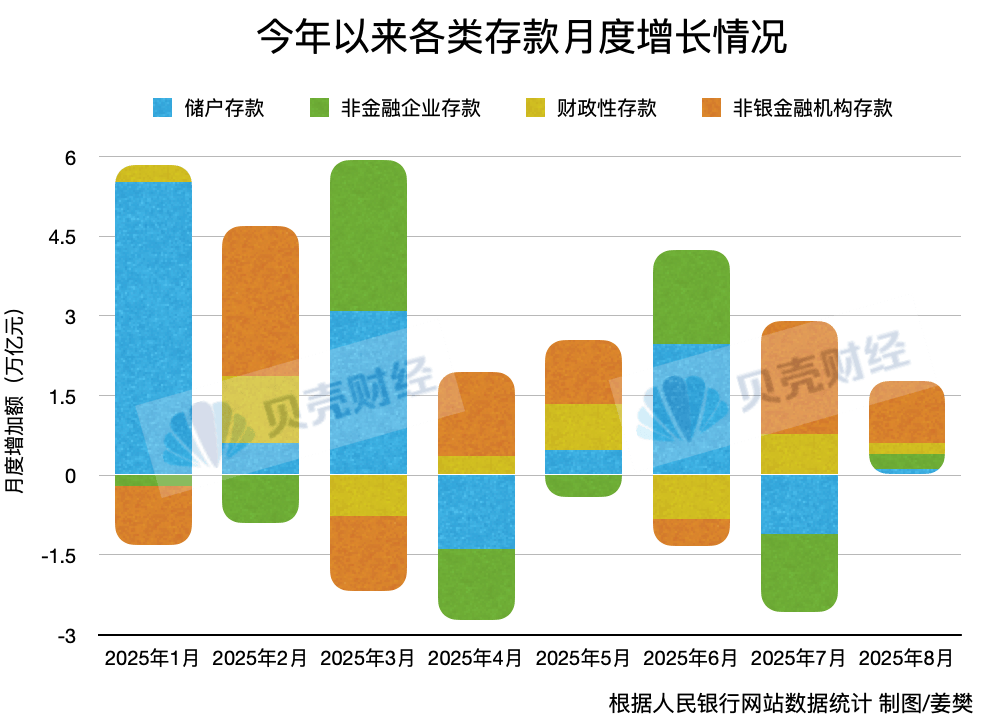
存款去哪儿了?8月央行金融数据揭秘路径:投资等成主要去处
Sou Hu Cai Jing· 2025-09-12 14:40
Core Viewpoint - The recent financial data from the central bank indicates a significant increase in RMB deposits, with a notable shift towards more liquid forms of savings, suggesting a potential influx of funds into the capital markets as consumer and investment activities gain momentum [1][3][4]. Group 1: Deposit Trends - In the first eight months of the year, RMB deposits increased by 20.5 trillion yuan, with August alone contributing 2.06 trillion yuan [1]. - Household deposits rose by 110 billion yuan in August, marking one of the lowest monthly increases this year [1]. - The increase in non-bank financial institution deposits, which rose by 1.18 trillion yuan in August, indicates heightened investment activity [3][9]. Group 2: Money Supply Dynamics - The growth rate of narrow money (M1) has rebounded, while the growth rate of broad money (M2) remained stable, leading to a narrowing "scissors gap" between M1 and M2, which suggests more funds are being converted into demand deposits [3][4]. - As of August, M2 stood at 331.98 trillion yuan, growing by 8.8% year-on-year, while M1 reached 111.23 trillion yuan, with a year-on-year growth of 6% [4][8]. Group 3: Investment Shifts - Analysts suggest that the trend of "deposit migration" is becoming evident, with excess household savings potentially moving into the market, estimated at 5 trillion to 7 trillion yuan [3][10]. - The decline in the attractiveness of fixed-term deposits is noted, as lower interest rates have led to a decrease in customers opting for these products [8][9]. - The capital market's increased activity has prompted a shift in the nature of household deposits from savings to trading needs, further accelerating the entry of funds into the market [9][10].