
经济风险

Search documents
黄金:展望更新 -估值与散户投资者参与度是风险信号-Global_Commodities_Gold_outlook_update__valuation_and_retailinvestor_breadth_are_red_flags-Global_Commodities
2026-02-02 02:42
Citi Research Metal Matters January 30, 2026 Gold outlook update – valuation and retail/investor breadth are red flags Maximilian LaytonAC Global Head | Commodities max.layton@citi.com +44 20 7986 4556 Gold and silver prices and miner margins are astonishingly high Gold prices have rallied to record levels in nominal and real terms, and have disconnected from the marginal cost of mining production, with forward prices substantially higher than spot -500 500 1500 2500 3500 4500 5500 1979 1981 1983 1985 1987 ...
世行预测2026年乌兹别克斯坦将跻身中亚增长最快经济体行列
Shang Wu Bu Wang Zhan· 2026-01-30 15:02
(原标题:世行预测2026年乌兹别克斯坦将跻身中亚增长最快经济体行列) 总体来看,尽管面临多重不确定性,乌仍保持地区最具活力的经济体之一 地位,有望继续实现稳健增长,并积极参与各类国际合作倡议。 乌兹日报网1月14日报道,根据世界银行1月发布的《全球经济展望》报 告,2026年乌兹别克斯坦与吉尔吉斯斯坦、塔吉克斯坦将跻身欧洲和中亚 (ECA)地区22个发展中经济体GDP增速排名前列。 世行预测,2026年ECA地区经济平均增速2.4%。通胀水平回落、金融条件 改善、欧盟资金吸收力度加大以及国防支出增加,将对区域内需形成支撑。中 亚仍将是ECA地区经济增速最快的次区域。2025年,哈萨克斯坦、吉、塔和乌 GDP合计增长6.2%,2026年预计放缓至5%。受石油产量趋稳和全球大宗商品 价格回落影响,哈经济增速预计放缓至4.5%。黄金价格高企将为其他中亚国家 经济提供支撑,吉(6.5%)、塔(6.2%)和乌(6%)仍将保持较高增长水 平,继续位居地区GDP增速前列。 报告指出,ECA地区经济前景仍面临显著风险。俄乌冲突若持续或升级, 可能加剧地缘政治不确定性并抑制经济活动。在通胀仍处高位的背景下,居民 消费可能走弱 ...
百利好晚盘分析:地缘风险下降 黄金应声回落
Sou Hu Cai Jing· 2026-01-22 09:12
Group 1: Gold Market - Gold prices fell below the support level of $4800 due to a decrease in market risk appetite following Trump's change in stance on Greenland [2] - Trump announced the cancellation of threatened tariffs on European countries, indicating a framework for future agreements regarding Greenland, which may ease trade tensions [2] - Despite the temporary agreement, underlying distrust between the US and Europe remains, with geopolitical and economic risks still present [2] - Technically, gold has not broken below the moving average support, indicating potential for further price movement [2] Group 2: Oil Market - The oil market is currently in a state of adjustment, with geopolitical risks providing less support to oil prices, while oversupply remains a significant issue [3] - The IEA's latest report predicts a slight increase in global oil demand, with growth expected to rise from 860,000 barrels per day to 930,000 barrels per day this year [3] - Global oil supply growth has been adjusted to 2.5 million barrels per day, up from a previous forecast of 2.4 million barrels per day, but still lower than last year's 3 million barrels per day [3] - Technically, oil prices are experiencing small upward movements but face resistance above, indicating potential for long-term volatility [3] Group 3: US Dollar Index - The US dollar index has shown weakness recently, with improved US-EU relations failing to provide strong support due to the anticipated interest rate cuts by the Federal Reserve [4] - The market expects a 95% probability that the Federal Reserve will not cut rates in January, with expectations for rate cuts to begin in June [4] - Core PCE inflation in the US has risen to 2.8%, above the 2% target, which may justify the Fed's decision to maintain current rates in the short term [5] - The dollar index is experiencing a short-term bullish trend but faces long-term bearish pressures due to expected rate cuts [5] Group 4: Nikkei 225 - The Nikkei 225 index has closed with a bullish candle, indicating a potential reversal from previous downward trends, with clear support at lower levels [6] - The price has re-entered a previous trading range, suggesting a trend reversal may be underway [6] Group 5: Copper Market - Copper prices have shown small fluctuations but are likely to remain in a consolidation phase, with a potential downward continuation pattern forming [7] - Short-term support is noted at $5.60, indicating a critical level to watch for price movements [7]


地缘经济对抗预计将成为2026年首要威胁
Shang Wu Bu Wang Zhan· 2026-01-16 16:10
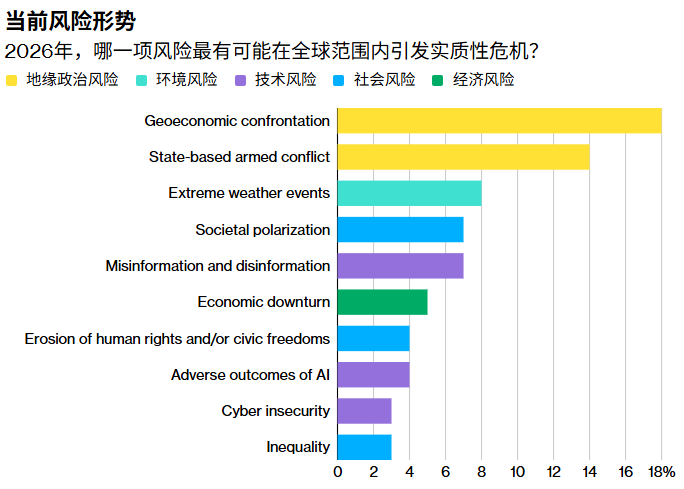
Core Insights - The World Economic Forum (WEF) identifies geopolitical economic confrontation as the largest risk for 2026, followed by inter-state conflict, extreme weather, social polarization, and the spread of misinformation [1] Economic Risks - Economic risks are expected to peak in 2026 and 2027, with concerns over economic slowdown, inflation, rising public debt, and asset bubbles under geopolitical tensions [1] Environmental Risks - The overall environmental risks remain severe, with extreme weather events, biodiversity loss, and significant changes in Earth's systems being the primary issues [1] - Approximately 75% of surveyed experts predict that environmental conditions will be extremely unstable in the coming years [1] Artificial Intelligence Risks - The risks associated with artificial intelligence are rapidly increasing, with concerns about its negative impacts on labor, safety, and social structures rising from 30th place in two-year forecasts to 5th place in ten-year outlooks [1]
世界经济论坛指出摩洛哥经济面临五大风险
Shang Wu Bu Wang Zhan· 2026-01-16 02:26
Core Insights - The World Economic Forum's "Global Risks Report 2026" indicates that the world is entering a period of uncertainty and turmoil, with geopolitical economic confrontation being the most severe risk for the next two years, surpassing misinformation and social division [1] Summary by Categories Economic Risks - Debt, inflation, and uncertainties in technology investment are driving a rapid increase in global economic risks [1] Risks Specific to Morocco - The primary risks for Morocco from 2026 to 2028 include a lack of economic opportunities and unemployment [1] - Insufficient public services and social security, including education, infrastructure, and pensions, are seen as critical issues that could weaken social cohesion due to inequality [1] - Inflationary pressures are directly impacting purchasing power and exacerbating social tensions [1] - Shortages of natural resources, particularly food and water, pose significant risks [1] - Wealth income inequality is further intensifying the risk of social division [1]
【环球财经】世界经济论坛报告:地缘经济对抗是2026年首要风险
Xin Hua She· 2026-01-14 22:44
Core Insights - The World Economic Forum's "Global Risks Report 2026" identifies geopolitical and economic risks as escalating in a new competitive era, with geopolitical economic confrontation being the primary risk for 2026 [1][2] - Other significant risks for 2026 include armed conflict between nations, extreme weather, social polarization, and misinformation, with economic risks rising the fastest [1] - The report highlights worsening debt issues and potential asset bubbles, compounded by geopolitical economic conflicts, which could trigger a new wave of turmoil [1] Short to Medium-Term Risk Outlook - Geopolitical economic confrontation is deemed the most severe risk in the short to medium term (next two years) [2] - The World Economic Forum's Executive Director, Sadia Zahidi, states that the world has entered a new competitive era, impacting all subsequent global risks [2] - The President and CEO of the World Economic Forum, Borge Brende, emphasizes that the changing competitive landscape has altered the global cooperation dynamic, underscoring the importance of collaborative pathways and dialogue [2] Expert Contributions - The report consolidates insights from over 1,300 global experts, analyzing current, short-term, and long-term risks faced worldwide [3]
达沃斯论坛“前哨”报告:地缘政治经济对抗跃升头号威胁,全球或进入“动荡两年”
智通财经网· 2026-01-14 11:47
Core Viewpoint - The World Economic Forum's survey indicates that by 2026, global conditions will increasingly be threatened by trade disputes and geopolitical conflicts, with the upcoming meeting in Switzerland focusing on these issues [1][3]. Group 1: Risks Identified - Respondents highlighted "geoeconomic confrontation" and "state-based armed conflict" as the two primary risks, aligning with the geopolitical tone of the upcoming Davos meeting [3]. - The survey reflects decision-makers' anxiety over Trump's aggressive trade and geopolitical tactics, which could intimidate both allies and adversaries, leading to retaliatory actions from sanctioned countries [4]. Group 2: Survey Insights - The report, based on a survey conducted from August 12 to September 22, involved global leaders and experts from academia, business, government, international organizations, and civil society [5]. - Half of the respondents expect a "turbulent" outlook in the next two years, a significant increase compared to the previous year's report, with concerns about economic risks, including recession, inflation, and asset bubbles [8]. Group 3: Upcoming Events - Key figures, including Trump and other G7 leaders, will be the focus of the upcoming meeting, with Trump scheduled to speak on Wednesday afternoon [10].
印度经济超越日本
Sou Hu Cai Jing· 2026-01-01 00:43
Group 1 - India's GDP has officially surpassed $4 trillion, marking a significant milestone as it becomes the world's fourth-largest economy, overtaking Japan [1][3] - The report indicates that India is expected to surpass Germany within the next two to three years, aiming for a position among the top three global economies [1] - Despite the impressive GDP growth, India's per capita GDP remains low at $2,694 in 2024, significantly below Japan's $32,487 and Germany's $56,103, highlighting a disparity in economic benefits [3][5] Group 2 - Over a quarter of India's 1.4 billion population is aged between 10 to 26, necessitating the creation of more quality jobs to absorb the incoming workforce and achieve inclusive growth [3][5] - The challenge of uneven growth distribution has been observed in other major economies, and India faces a similar risk if it cannot generate sufficient employment opportunities [5][7] - Global economic uncertainties, including trade unpredictability and fluctuating energy prices, pose significant challenges for India's economic future, with U.S. sanctions being a notable concern [5][7] Group 3 - India's path to sustained economic growth is fraught with uncertainties, and the ability to manage its large, young workforce and structural unemployment will be crucial for its future [7] - While India may temporarily surpass Japan, achieving a stable position among the top three economies will require time and strategic management [7]
大行评级|Piper Sandler:上调花旗目标价至130美元,维持“增持”评级
Ge Long Hui· 2025-12-30 01:59
Group 1 - Piper Sandler raised Citigroup's target price from $120 to $130 while maintaining an "overweight" rating [1] - The firm lowered its earnings per share forecast for Citigroup from $7.6 in 2025 to $7.2, and from $9.93 in 2026 to $9.83 [1] - Piper Sandler warned of risks related to a prolonged slowdown in U.S. or global economic activity, declining credit quality, and capital market trading volumes falling below expectations [1]

瑞典央行维持利率不变 释放政策观望信号
Xin Hua Cai Jing· 2025-11-05 09:30
Core Viewpoint - The Swedish central bank has decided to maintain the benchmark interest rate at 1.75%, aligning with market expectations, signaling the potential end of the current easing cycle [1][2]. Group 1: Economic Outlook - The central bank's policy statement indicates that the overall outlook for inflation and economic activity remains largely unchanged [1]. - The bank expects the policy rate to stay at the current level for the foreseeable future, suggesting a shift towards a more neutral stance [2]. - There are indications that the economy is moving towards recovery, with some signs of improvement in the labor market [1]. Group 2: Risk Assessment - The central bank acknowledges the presence of risks both domestically and internationally that could impact economic development and future economic trends [1]. - The risks mentioned may include geopolitical tensions, global trade uncertainties, and spillover effects from major economies [1]. - Since September, the overall risk assessment has not changed significantly, but the central bank remains vigilant regarding ongoing developments [2].