金融衍生品

Search documents
市场缩量反弹,后市仍具不确定性
Zhong Xin Qi Huo· 2026-03-25 02:36
Group 1: Report Industry Investment Ratings - No relevant content provided Group 2: Core Views of the Report - The stock market had a volume - shrinking rebound, and the right - side signal for the future market is not clear. There is a possibility of a callback to build a bottom again. It is recommended to wait and see in the short term [3][9] - The implied volatility of stock index options declined, and the sentiment has not fully warmed up. It is recommended to continue holding the call option defense strategy [4][10] - The market priced in the easing of the US - Iran situation, and the sentiment of the long - end of the bond market warmed up. The long - end of treasury bond futures may be volatile, and the short - end has relatively strong support [5][10] Group 3: Summaries According to Relevant Catalogs Stock Index Futures - Yesterday, the stock market had a volume - shrinking rebound. The Shanghai Composite Index rose 1.78%, the CSI 1000 rose 2.59%, and the Science and Technology Innovation Composite Index rose 3.24%. The trading volume of the two markets decreased by more than 36 billion compared with the previous day. Small and micro - cap stocks were strong. The weak - dollar and anti - inflation sectors were strong, and the energy sector pulled back [3][9] - Overseas risks have not subsided, the stock market volume shrank significantly, and the support of institutional funds for broad - based ETFs is uncertain. So, it is recommended to wait and see in the short term [3][9] Stock Index Options - On Tuesday, the underlying market showed a "W" - shaped trend. The total trading volume of financial options decreased significantly. The implied volatility of each variety decreased during the day but was still higher than last week's level. The PCR of positions among varieties was divergent, and the skew index mostly increased, indicating a cautious view of the future market [4][10] - Considering the high uncertainty of external events, it is risky to bet on medium - term short - volatility or reversal strategies too early. It is recommended to continue holding the call option defense strategy [4][10] Treasury Bond Futures - Yesterday, the long - and short - end trends of the main contracts of treasury bond futures continued to diverge. The prices of T and TL rose, while the prices of TF and TS fell. The T main contract opened higher and closed up after fluctuating [5][10] - The central bank's 7 - day reverse repurchase had a net withdrawal of 3.35 billion yuan, and the capital market remained stable. The market priced in the easing of the US - Iran situation, and the long - end sentiment of the bond market warmed up [5][10] - The result of the US - Iran negotiation is undetermined. It is necessary to pay attention to the Middle East geopolitical conflict and inflation concerns. The central bank will renew 500 billion MLF on the 25th, and the short - end has relatively strong support, while the long - end may be volatile [5][10]
股市隐波整体回落,债市曲线整体?平
Zhong Xin Qi Huo· 2026-03-06 02:26
Group 1: Report Industry Investment Rating - Not provided in the content Group 2: Core Viewpoints of the Report - Overall, the stock market's implied volatility declined, and the bond market curve flattened. The equity market showed pressure in the afternoon, the implied volatility of index options decreased, and the bond market curve flattened [1]. - For stock index futures, the resource stocks + technology sector remains the absolute main line for the year, but it is recommended to wait and see due to uncertainties in economic data and geopolitical situations. For index options, it is advisable to continue buying options for defense as the market's concerns persist. For bond futures, the market may be volatile in the short - term, and strategies like arbitrage should be considered [1][2][3]. Group 3: Summary by Related Catalogs Stock Index Futures - **Viewpoint**: Pressure emerged in the afternoon [1][7]. - **Logic**: The equity market rose first and then fell on Thursday. The external environment improved the morning sentiment, but the afternoon saw a callback. The two - market trading volume was about 2.4 trillion, indicating strong wait - and - see sentiment. The policy supports anti - involution and technology security, with resource + technology as the annual main line. However, the verification of economic data and geopolitical situations are uncertain [1][7]. - **Operation Suggestion**: Reduce positions to a wait - and - see state [7]. Index Options - **Viewpoint**: Implied volatility declined overall [2][7]. - **Logic**: The option ratio PCR reached a high the previous day, and the market rebounded on Thursday. The intraday implied volatility was negatively correlated with the underlying. The decrease in market momentum in the afternoon led to the implied volatility hitting the bottom and then rising, indicating that the market's concerns have not completely subsided. The skewness of some varieties increased, and call option positions decreased, possibly reflecting the profit - taking of option - buying funds [2][7]. - **Operation Suggestion**: Continue to use option - buying for defense, and consider switching to in - the - money options to hedge [2][7]. Bond Futures - **Viewpoint**: The bond market curve flattened [3][7][8]. - **Logic**: The main bond futures contracts fell, the yields of major inter - bank interest - rate bonds mostly fluctuated, and the yields of ultra - long - term bonds declined slightly. The central bank's net liquidity withdrawal, the improvement of risk appetite in the equity market, and the moderate fiscal expansion scale in 2026 all affected the bond market. The issuance of 1.3 trillion yuan of ultra - long - term special bonds in 2026 is the same as last year, alleviating the market's concerns about ultra - long - term bond supply [3][7][8]. - **Operation Suggestion**: The trend strategy is to expect volatility. For the hedging strategy, pay attention to short - hedging at low basis levels. For the basis strategy, focus on ultra - long - term arbitrage opportunities. For the curve strategy, pay attention to the flattening of the 30Y - 10Y spread in the short - term [8].
股市领涨?业再度切换,债市?盈动?或有所上升
Zhong Xin Qi Huo· 2026-02-13 01:13
Group 1: Report Industry Investment Rating - Not provided in the content Group 2: Core Views of the Report - The leading sectors in the stock index futures market have switched again, and it is still recommended to allocate long positions in IM [1][7] - For stock index options, it is mainly recommended to continue holding call options for defense [2][7] - In the treasury bond futures market, the motivation for taking profits may increase, and the market may be volatile in the short term [3][8] Group 3: Summary by Relevant Catalogs Stock Index Futures - On Thursday, the equity market was generally warm, with the ChiNext and STAR Market leading the gains, followed by CSI 500 and CSI 1000. The leading sectors switched to growth sectors such as electronics, new energy, and computers [1][7] - A-share and Hong Kong stock markets showed a split performance, with the Hang Seng Technology Index falling. However, the possibility of Hong Kong stocks dragging down A-shares during the holiday is considered low [1][7] - It is recommended to hold IM long positions [7] Stock Index Options - The equity index fluctuated and consolidated yesterday. The trading volume of each option variety rebounded, but the trading volume this week was still relatively stable compared with the previous two weeks [2][7] - The implied volatility was relatively strong during the day. Considering the approaching holiday and expiration date, it is still recommended to continue holding call options for defense [2][7] Treasury Bond Futures - Yesterday, the performance of treasury bond futures was divided, with T and TF rising and TL and TS falling, but the changes were not significant [8] - The central bank was still active in open market operations, with significant net capital injection, which supported the bullish sentiment in the bond market [3][8] - With the continuous strengthening of the bond market and the approaching Spring Festival, the motivation for bulls to take profits may increase, especially for ultra-long-term bonds [3][8] - In the medium term, the central bank's monetary policy may further strengthen, and the expectation of loose money may support the bullish sentiment in the bond market. In the short term, the bond market may be volatile [3][8] - Operational suggestions include trend strategy (volatile), hedging strategy (pay attention to short hedging at low basis), basis strategy (basis is volatile), curve strategy (appropriately pay attention to the convergence of the 30Y - 10Y spread), and inter - period roll - over (the inter - period spread may have a certain downward momentum, and also pay attention to the change of the roll - over window period due to the Spring Festival) [8]
山河智能:拟开展不超10亿元金融衍生品业务
Sou Hu Cai Jing· 2026-02-05 08:14
Core Viewpoint - The company announced plans to engage in financial derivatives business to hedge against risks related to exchange rates and interest rates, pending approval from the upcoming shareholders' meeting [1] Group 1: Business Development - The company will hold its ninth board meeting in 2026 to review the proposal for the financial derivatives business, which will then be submitted for approval at the first extraordinary shareholders' meeting of 2026 [1] - The planned trading amount for the financial derivatives business is expected to not exceed 1 billion yuan within the next 12 months, with the validity period of the trading limit lasting 12 months from the date of shareholder approval [1] - The business will utilize self-owned funds and will include products such as forwards and options [1] Group 2: Risk Management - The primary aim of initiating this business is to mitigate risks associated with fluctuations in exchange rates and interest rates [1] - The company has established corresponding risk control measures to manage the potential risks involved in this new business venture [1]

期货合约与远期合约区别是什么?
Jin Rong Jie· 2026-02-03 22:50
Group 1 - The article discusses the differences between futures contracts and forward contracts as two basic types of forward financial derivatives, focusing on their trading mechanisms and risk controls [1][2] - Futures contracts are traded on regulated exchanges, while forward contracts are negotiated privately in the OTC market, leading to different regulatory environments [1] - Futures contracts have standardized terms set by exchanges, whereas forward contracts are customizable based on the parties' agreements, resulting in a lack of industry standards [1][2] Group 2 - The settlement mechanism for futures involves daily mark-to-market settlements, which helps manage performance risk, while forward contracts settle only at maturity, making their clearing process simpler [2] - Futures trading employs a central counterparty clearing mechanism to mitigate default risk, whereas forward contracts rely on bilateral credit agreements, exposing parties to each other's credit risk [2] - Futures contracts exhibit higher liquidity due to their standardized nature and centralized trading, while forward contracts have limited liquidity as they are only transferable with mutual consent [2]
股市分化,轮动偏快
Zhong Xin Qi Huo· 2026-01-30 01:14
1. Report Industry Investment Rating No relevant content provided. 2. Core Views of the Report - For stock index futures, the index opportunities are better than individual stocks. The equity market was differentiated on Thursday, with the dividend and large-cap styles being strong, and the science and technology innovation and micro-cap styles being weak. The strong sectors were concentrated in real estate, media, and liquor. The cancellation of the "three red lines" had a positive impact on pro - cyclical sectors. There is a concentration of profit - making effects, and it is recommended to focus on the price - increase chain and prioritize the allocation of IC long positions [1][6]. - For stock index options, there was an intraday style switch, and option trading volume rebounded. After the market style switch, the skewness of each variety remained low, and the volatility remained high. It is recommended to wait for the opportunity to sell options and hold long call options for the time being [2][6]. - For treasury bond futures, the short - end of the bond market showed a strong trend. The central bank's net injection of liquidity supported the short - end of the bond market, while the rising risk appetite in the equity market was negative for the long - end. The long - end trend is uncertain and may remain volatile. Short - term strategies may focus on arbitrage and the convergence opportunity of the 30 - 10Y treasury bond term spread [3][7]. 3. Summary by Relevant Catalogs (1) Stock Index Futures - **Market Situation**: On Thursday, the equity market was differentiated. The dividend and large - cap styles were strong, and the science and technology innovation and micro - cap styles were weak. The strong sectors were in real estate, media, and liquor. The cancellation of the "three red lines" was an important factor for the market rebound. There were more falling stocks than rising stocks, with nearly a thousand stocks falling more than 3%. The profit - making effect was concentrated [1][6]. - **Outlook and Suggestion**: Apart from the inflation theme, there is no core logical change. In the context of a weakening US dollar, it is recommended to focus on the price - increase chain and prioritize the allocation of IC long positions [1][6]. (2) Stock Index Options - **Market Situation**: The underlying market oscillated in the morning and had a style switch in the afternoon. Large - cap blue - chips represented by the Shanghai 50 and CSI 300 rose significantly, while CSI 500 and CSI 1000 - related varieties fell. Option trading volume rebounded. The 50ETF volatility did not rise significantly after the increase, and the seller's cautious attitude wavered [2][6]. - **Outlook and Suggestion**: After the market movement, the skewness of each variety remained low, and the volatility remained high. It is recommended to wait for the opportunity to sell options and hold long call options for the time being [2][6]. (3) Treasury Bond Futures - **Market Situation**: Most of the main contracts of treasury bond futures rose. The yields of major inter - bank interest - rate bonds were differentiated, with long - term bonds being weak and short - term bonds being strong, and the yield curve steepened. The central bank's net injection of liquidity supported the short - end of the bond market, while the rising equity market was negative for the long - end [3][7]. - **Outlook and Suggestion**: The central bank still cares about the money market, and the end - of - month factor may have limited impact on the money market. The long - end trend is uncertain and may remain volatile. Short - term strategies may focus on arbitrage and the convergence opportunity of the 30 - 10Y treasury bond term spread [3][7].
金价暴涨黄金存款收益率可达3.2% 有银行一度售罄
Xin Lang Cai Jing· 2026-01-22 10:08
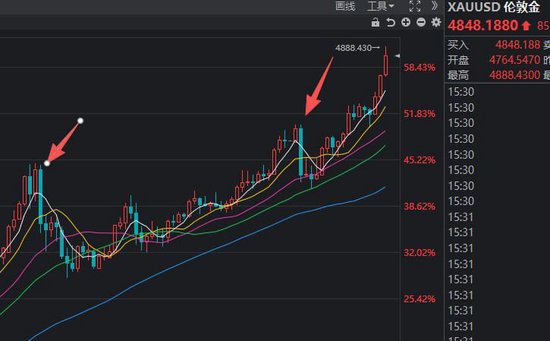
Core Viewpoint - Gold has regained market attention, with prices reaching new highs and structural deposits linked to gold becoming popular investment choices [1][12]. Group 1: Gold Price Trends - As of January 22, 2026, COMEX gold prices reached $4,827 per ounce, marking an increase of over 11% within the first 22 days of the year [1][12]. - Multiple institutions remain optimistic about the medium to long-term outlook for gold prices, with predictions suggesting a potential increase of 10%-35% by 2026 [19][20]. Group 2: Structural Deposits - Numerous listed companies, including Guozi Software and Fudan Zhangjiang, have announced their subscription to gold-linked structural deposits, reflecting rising interest from individual investors as well [2][13]. - Several banks, such as Bank of Communications and China Merchants Bank, have launched structural deposits linked to gold, with some products experiencing high demand and limited availability [2][13]. Group 3: Yield Conditions - The overall yield levels of gold-linked structural deposits are not particularly high, with most products offering annualized returns not exceeding 2% [3][14]. - For example, a product from Bank of Communications offers a yield range of 0.5%-3.2%, contingent on gold price movements during the observation period [3][14]. Group 4: Investment Considerations - Investors are advised to carefully evaluate the conditions for achieving the highest yields, as many products have specific requirements that may be challenging to meet [4][18]. - The safety of principal is a key advantage of structural deposits compared to non-principal protected structured financial products, with a significant percentage of the latter experiencing early termination [19].

李明老师解构交易的底层逻辑!怎么样在交易中稳定持续的获利
Sou Hu Cai Jing· 2026-01-20 10:05
Core Insights - The article discusses the historical context of the 2008 financial crisis and draws parallels to current financial challenges in the U.S. market, emphasizing the need for enhanced awareness to seize investment opportunities [3][8]. Group 1: Historical Context of the 2008 Financial Crisis - The 2008 financial crisis was a global financial storm rooted in a complex interplay of factors, primarily driven by a housing bubble and uncontrolled financial innovation [3]. - Low interest rates post-2000 led to a significant housing bubble in the U.S., creating a widespread illusion that housing prices would only rise [3]. - The proliferation of high-risk subprime mortgages, particularly adjustable-rate mortgages, contributed to widespread defaults as borrowers faced rising payments [4]. - Financial derivatives, such as mortgage-backed securities (MBS) and collateralized debt obligations (CDOs), were misrated by agencies, leading to a false sense of security among global investors [5]. - A lack of effective regulation in the financial sector allowed for excessive risk-taking, with various stakeholders prioritizing short-term profits over long-term stability [6]. Group 2: Crisis Trigger and Transmission - The Federal Reserve's interest rate hikes from 2004 to 2006 led to a wave of defaults among subprime borrowers, initiating a downward spiral in housing prices [7]. - The resulting "death spiral" of falling home prices and increasing defaults caused significant losses for financial institutions, leading to a freeze in interbank lending and a broader financial panic [7]. - The bankruptcy of Lehman Brothers in September 2008 marked a critical point, triggering widespread fear and a global economic downturn [7]. Group 3: Current Financial Landscape - The current U.S. financial system faces structural issues, including a fiscal crisis characterized by unsustainable debt levels and a weakening dollar [8][12]. - The federal debt has surpassed $36 trillion, with annual deficits exceeding $1 trillion, raising concerns about the long-term sustainability of U.S. fiscal policy [12]. - The recent "Tax and Spending Act" is projected to increase debt by $3.4 trillion over the next decade, exacerbating existing fiscal challenges [12]. - The dollar's status as a global reserve currency is threatened by rising debt levels and policy missteps, leading to a potential loss of confidence in U.S. financial assets [12][17]. Group 4: Market Risks and Opportunities - The U.S. stock market is heavily concentrated in a few technology stocks, raising concerns about potential valuation bubbles [13]. - Economic recession risks are heightened by policy uncertainties, with predictions of significant downturns if current trends continue [13]. - The article suggests that gold may present a viable investment opportunity amidst these challenges, with expectations of a market surge by the end of the year [16].
多家银行推出“黄金+存款”产品 投资者可以上车吗
Jing Ji Ri Bao· 2026-01-16 07:23
Core Viewpoint - The article discusses the emergence and characteristics of "gold + deposit" products, which are structured deposits linked to gold prices, gaining attention in the market due to fluctuations in international gold prices [1]. Group 1: Product Attributes - "Gold + deposit" products are fundamentally structured deposits, ensuring principal protection under China's deposit insurance system, distinguishing them from structured wealth management products that do not guarantee principal or interest [2]. - These structured deposits are classified as floating-rate deposits, differing from traditional deposits, as they are linked to derivatives such as exchange rates, indices, stocks, and gold to pursue higher returns [2]. Group 2: Return Levels - Structured deposits typically offer two or three tiers of expected maturity interest rates, providing significant elasticity in returns. For instance, a specific gold-linked deposit has a minimum return rate of 1.65%, a middle rate of 2.17%, and a maximum rate of 2.37%, contingent on gold price fluctuations within a defined range [3]. Group 3: Investor Considerations - Investors should carefully evaluate their investment needs and risk preferences before purchasing structured deposits, considering factors such as deposit term and minimum investment amount, as terms generally range within one year, with some as short as seven days [4]. - The underlying assets linked to these deposits should be assessed for recent price trends and investment risks, as they significantly influence the final returns for investors [4]. - Understanding the return rules is crucial, as the difference between minimum and maximum returns can be substantial, necessitating a clear grasp of the conditions that trigger the highest returns [4]. Group 4: Financial Institutions' Role - Financial institutions must respect investors' rights to information and choice when selling structured deposit products, providing professional support to avoid misleading investors [5]. - There is a growing demand for online channels to address investor inquiries, highlighting the need for financial institutions to enhance their service capabilities and training for frontline staff to bridge the information gap between financial products and investors [5].
聚丙烯月均价期货的交易品种是什么
Jin Tou Wang· 2026-01-14 09:35
Core Viewpoint - The article discusses the introduction of polypropylene monthly average price futures on the Dalian Commodity Exchange, highlighting its innovative features and benefits for market participants [2] Group 1: Contract Details - The trading variety of the polypropylene monthly average price futures is explicitly stated as "polypropylene" [2] - The contract is designed to settle based on the arithmetic average of all trading day settlement prices in the month prior to the delivery period, rather than a single closing price [2] - The contract employs a cash settlement mechanism, where the exchange directly pays the profit and loss difference based on the monthly average price at expiration, eliminating the need for physical delivery [2] Group 2: Benefits and Parameters - This innovative design smooths out the impact of daily price volatility, aligning more closely with the commercial practice of "monthly average" settlements in spot trading [2] - The contract parameters include a trading unit of 5 tons per lot, a quotation unit in RMB per ton, a minimum price fluctuation of 1 RMB per ton, and a price limit of 4% based on the previous trading day's settlement price [2] - The introduction of this futures contract is expected to lower storage and logistics costs while improving capital efficiency, thereby attracting more financial institutions and investors [2]