风险因子下调

Search documents
强势吸金!规模TOP6的A500ETF本月资金净流入额超972亿元
Ge Long Hui A P P· 2025-12-29 06:59
Core Insights - The CSI A500 Index has become a major attraction for capital inflow, with a total net inflow of 96.065 billion yuan in December alone, driven primarily by institutional investors [1][5]. Group 1: Fund Inflows - The top six A500 ETFs accounted for nearly all of the net inflow in December, with significant contributions from A500 ETF Southern (24.825 billion yuan), A500 ETF Huatai-PB (21.061 billion yuan), and A500 ETF Fund (18.196 billion yuan) [1][3]. - The total net inflow for the top six A500 ETFs reached over 97.2 billion yuan, highlighting a concentration of capital in larger funds [1][3]. Group 2: Regulatory Changes - In December, regulatory adjustments reduced the risk factors for insurance companies' stock investments, effectively lowering capital costs and facilitating greater market participation from insurance funds [5]. - The adjustments specifically targeted core assets, including stocks in the CSI 300 Index and the CSI Dividend Low Volatility 100 Index, which are expected to release approximately 290 billion yuan in capital for potential market investment [5]. Group 3: Market Dynamics - The recent inflow into A500 ETFs is influenced by a seasonal "calendar effect," where historical patterns show increased inflows near quarter-end [6]. - The CSI A500 Index is favored for its balanced industry allocation and selection of leading companies, making it an attractive option for year-end investment strategies [6].


从资本占用到长期持有:调整风险因子或为红利低波打开显著增量空间?
Sou Hu Cai Jing· 2025-12-22 03:27
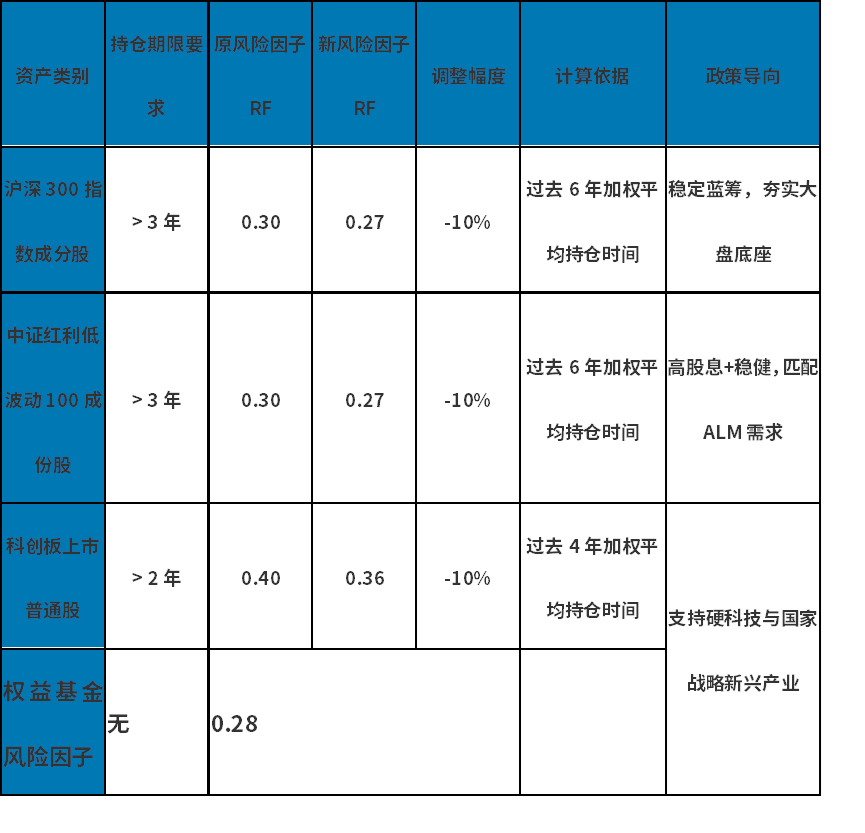
Core Viewpoint - The recent regulatory change to lower the risk factor for insurance companies investing in the stock market is expected to increase the available capital for investments, particularly benefiting dividend-paying and low-volatility assets [1][4]. Group 1: Understanding the Risk Factor Adjustment - The risk factor is a key constraint for insurance companies, determining the minimum capital they must hold against their investments. A lower risk factor means less capital is required for the same investment, thus improving capital efficiency [2][3]. - The new regulation reduces the risk factor from 0.30 to 0.27, a 10% decrease, which directly lowers the capital cost for equity investments [4]. Group 2: Implications for Dividend and Low-Volatility Assets - The inclusion of the CSI Dividend Low Volatility 100 index in the favorable risk factor category indicates a clear policy direction to encourage investment in stable, high-dividend assets [5]. - Insurance companies, facing challenges in traditional fixed-income returns, are likely to seek out high-quality assets with stable cash flows, making dividend-paying stocks more attractive [5]. Group 3: Comparison with Previous Adjustments - The current macroeconomic environment is more favorable compared to the previous risk factor adjustment in 2023, which occurred during a period of aggressive interest rate hikes by the Federal Reserve. This time, the anticipated easing of rates and clearer policy direction may enhance the effectiveness of the new regulation [6]. Group 4: Summary of Potential Market Impact - The adjustment in the risk factor is expected to release significant incremental capital, directing investments towards high-quality, long-term assets like dividend-paying stocks. Monitoring insurance capital allocation may provide valuable insights for investors in a volatile market [8].
瑞众人寿再入手青岛啤酒H股,解码险资“南下”投资新逻辑
Nan Fang Du Shi Bao· 2025-12-16 06:01
Core Insights - Insurance capital is actively entering the market, with a notable investment by Ruizhong Life in Qingdao Beer, coinciding with a regulatory adjustment that lowers investment risk factors for insurance funds [2][3] - The trend of insurance capital acquiring shares reflects a significant shift in investment logic within the industry, driven by policy incentives and pressure on liability-side returns [2][5] Group 1: Investment Activities - Ruizhong Life invested 10.64 million HKD to acquire 200,000 shares of Qingdao Beer, increasing its stake to 5% [3] - This marks the third time in 2025 that Ruizhong Life has made a significant investment in H-shares, focusing on high-dividend, undervalued core assets [3][4] - The total market value of Ruizhong Life's holdings in Qingdao Beer is approximately 1.571 billion CNY, indicating a long-term investment strategy [3] Group 2: Regulatory Environment - The National Financial Regulatory Administration has been adjusting risk factors for insurance company investments, which has facilitated increased equity asset allocations [7][8] - As of December 5, 2023, the risk factor for certain stocks was lowered, allowing for a potential influx of approximately 108.6 billion CNY into the market if insurance funds fully reallocate to these stocks [7][8] - The adjustments are seen as a means to encourage long-term holding behaviors among insurance capital, particularly in high-quality stocks and innovative enterprises [8] Group 3: Market Trends - There has been a significant increase in insurance capital's share acquisitions, with 38 instances recorded in 2025, the highest since 2016 [5][9] - H-shares have become the preferred investment target for insurance capital, with over 80% of acquisitions in 2025 being H-shares, attributed to their valuation advantages and higher dividend yields [5][6] - The shift in investment focus includes a growing interest in technology and pharmaceutical sectors, indicating a diversification of investment strategies beyond traditional high-dividend sectors [6][9]


险资年内举牌38次创近十年最高 股票配置3.6万亿助市场稳定运行
Chang Jiang Shang Bao· 2025-12-14 23:47
Core Viewpoint - The insurance funds are significantly increasing their market participation under regulatory encouragement for long-term investment, with a notable impact on market stability [2][8]. Group 1: Insurance Fund Activities - On December 5, 2025, Ruizhong Life Insurance purchased 200,000 shares of Qingdao Beer H-shares for 10.64 million HKD, raising its total holdings to 32.76 million shares, which is 5% of the total H-share capital [3][4]. - This marks the third time in 2025 that Ruizhong Life has made a significant investment in listed companies, contributing to a total of 38 instances of insurance capital raising stakes in listed companies this year, the highest in nearly a decade [2][9]. Group 2: Regulatory Environment - The National Financial Regulatory Administration has lowered risk factors for insurance companies' related business, aiming to guide long-term capital into the market and support stable capital market operations [8][9]. - As of September 2025, the total investment balance of the insurance industry reached 37.5 trillion CNY, with stock allocations amounting to 3.6 trillion CNY, a year-on-year increase of 55.1%, representing 9.67% of total investments [9]. Group 3: Market Implications - The adjustment of long-term investment stock risk factors indicates a relaxation of regulatory constraints on insurance capital's equity asset allocation, responding to market expectations for long-term capital entry [9]. - The surge in insurance capital's market activities, including Ruizhong Life's recent actions, reflects a broader trend of increased institutional investment in the capital market, which is crucial for the stability and high-quality development of the real economy [9].

风险因子下调 释放更多保险资金投资股市
Zhong Guo Jing Ji Wang· 2025-12-10 02:04
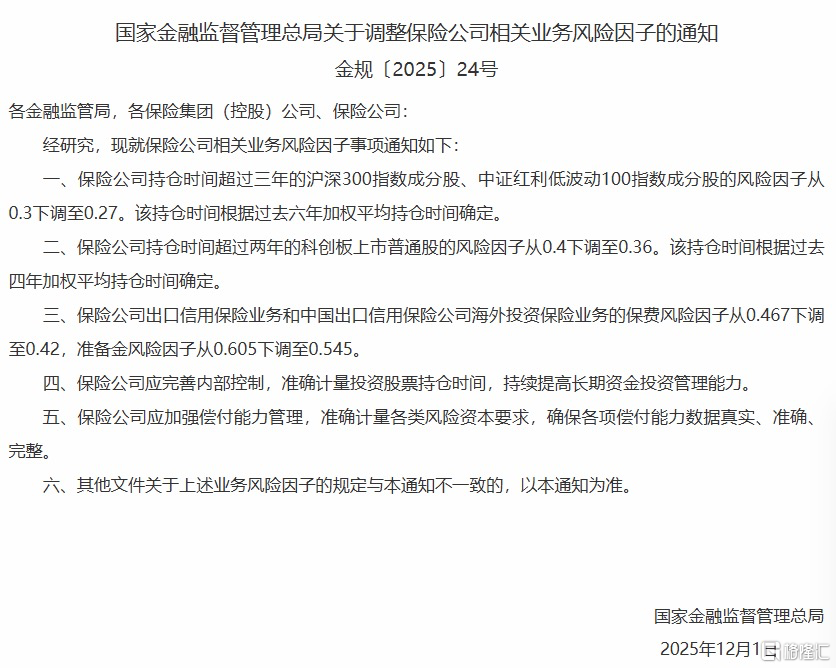
Core Viewpoint - The recent notification from the Financial Regulatory Bureau aims to adjust the risk factors for insurance companies' investment in stocks, enhancing the efficiency of capital usage and supporting the real economy [1][2]. Group 1: Adjustments to Risk Factors - The risk factor for stocks held by insurance companies for over three years in the CSI 300 and the CSI Low Volatility 100 Index has been reduced from 0.3 to 0.27 [1]. - The risk factor for stocks in the Sci-Tech Innovation Board held for over two years has been lowered from 0.4 to 0.36 [1]. - The calculation of holding periods for these stocks is based on weighted averages over the past six years for the former and four years for the latter [1]. Group 2: Impact on Capital and Investment - Lowering the risk factors will directly reduce the capital required for equity assets, allowing insurance companies to allocate more funds to stock market investments [2]. - This adjustment, combined with previous policy changes to increase the equity investment ratio limit, is expected to lead to greater investment in high-growth sectors, thereby fostering patient capital and supporting technological innovation [2]. Group 3: Other Risk Factor Adjustments - The risk factors for export credit insurance and overseas investment insurance by the China Export & Credit Insurance Corporation have also been reduced, with premium risk factors decreasing from 0.467 to 0.42 and reserve risk factors from 0.605 to 0.545 [2]. - These changes are intended to encourage insurance companies to provide more support to foreign trade enterprises and effectively serve national strategies [2]. Group 4: Internal Control and Management - The notification emphasizes the need for insurance companies to enhance internal controls, accurately measure stock holding periods, and continuously improve long-term capital investment management capabilities [3]. - It also stresses the importance of strengthening solvency management and ensuring that all solvency data is accurate, complete, and truthful [3].
大金融突然爆发!原因找到了
Ge Long Hui· 2025-12-08 07:45
Core Viewpoint - The sudden surge in the financial sector of the A-share market is attributed to a policy announcement from the National Financial Regulatory Administration, which indicates a significant influx of capital from insurance funds [1][2]. Group 1: Policy Changes - On December 5, the National Financial Regulatory Administration announced a reduction in risk factors for insurance companies related to specific indices, including the CSI 300 and the ChiNext, by 10% [2][4]. - The risk factor for CSI 300 stocks held for more than three years was reduced from 0.3 to 0.27, and for ChiNext stocks held for more than two years, it was reduced from 0.4 to 0.36 [2][5]. - This adjustment is a continuation of previous efforts to encourage insurance companies to increase their equity investments, following a similar reduction in September 2023 [7][8]. Group 2: Impact on Capital Allocation - The reduction in risk factors allows insurance companies to allocate less capital to cover potential risks, thereby increasing their capital efficiency for equity investments [5][6]. - If the released capital is fully allocated to CSI 300 stocks, it could result in an additional 108.6 billion yuan entering the stock market [6]. - The policy aims to improve the solvency ratio of the insurance industry by approximately 1 percentage point if the capital is not reinvested in stocks [6]. Group 3: Long-term Investment Encouragement - The policy changes are designed to promote long-term investments by insurance companies, with specific holding periods established to further incentivize this approach [7][8]. - The regulatory framework has been adjusted to facilitate the entry of long-term funds into the market, reflecting a broader strategy to address the challenges posed by a low-interest-rate environment [9][10]. Group 4: Market Trends - Insurance companies have been increasingly shifting their asset allocation towards equity investments, with a notable decrease in bond allocations [9][10]. - As of the third quarter of 2025, the total investment scale of insurance companies exceeded 37 trillion yuan, with a rising proportion of investments in stocks and securities [9].
风险因子下调或可释放千亿入市资金,红利低波ETF天弘(159549)上周持续“吸金”累超1.1亿元居同标的第一
2 1 Shi Ji Jing Ji Bao Dao· 2025-12-08 02:09
Core Viewpoint - The adjustment of risk factors for insurance companies' investments in certain indices is expected to release significant capital into the market, potentially enhancing the performance of low-volatility dividend stocks [1][2]. Group 1: Market Performance - On December 8, major indices opened higher, with the CSI Low Volatility 100 Index rising by 0.06% [1]. - Among the constituent stocks, Fujian Expressway increased by over 2%, with other stocks like Central South Media, Yili, Solar Energy, and Guizhou Tire also showing gains [1]. - The Tianhong Low Volatility ETF (159549) experienced a net inflow of over 110 million yuan last week, ranking first among similar funds [1]. Group 2: Regulatory Changes - On December 5, the Financial Regulatory Authority announced a reduction in risk factors for insurance companies holding stocks from the CSI 300 and CSI Low Volatility 100 indices for over three years, from 0.3 to 0.27 [1][2]. - This adjustment is based on the weighted average holding period over the past six years [1][2]. Group 3: Capital Market Implications - According to estimates, the reduction in risk factors could release approximately 100 billion yuan into the market, with a static release of at least 32.6 billion yuan in capital if insurance funds increase their allocation to stocks [2]. - If this capital is fully allocated to CSI 300 stocks, it could correspond to an influx of 108.6 billion yuan into the stock market [2]. - The adjustment is expected to strengthen the trend of long-term capital entering the market, benefiting patient capital growth [2].

风险因子下调释放“千亿级别”权益加仓空间!申万宏源:保险开门红升温,高股息行情正在提前抢跑
Hua Er Jie Jian Wen· 2025-12-08 00:19
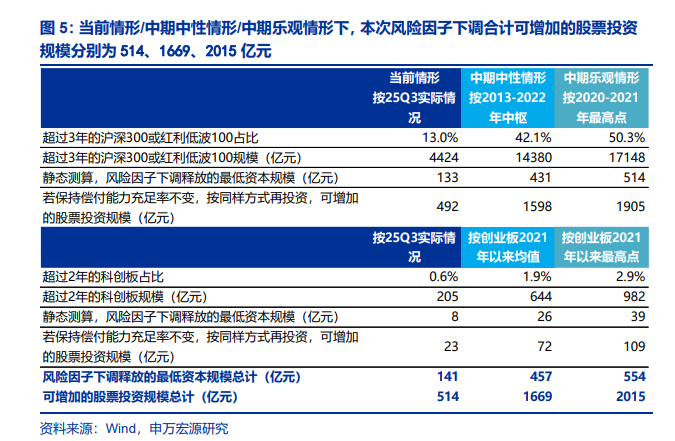
Core Viewpoint - A new regulatory policy aimed at insurance funds is expected to inject significant capital into the A-share market, potentially releasing hundreds of billions in incremental funds and stimulating market activity [1][9]. Group 1: Regulatory Changes - The National Financial Regulatory Administration announced a reduction in risk factors for insurance companies holding certain equity assets long-term, effective December 5, 2025 [1][10]. - The risk factor for stocks held over three years in the CSI 300 and the China Securities Low Volatility 100 Index has been lowered from 0.3 to 0.27, while for stocks held over two years in the Sci-Tech Innovation Board, it has been reduced from 0.4 to 0.36 [10]. Group 2: Capital Release Estimates - The policy is projected to release a minimum capital scale of approximately 457 billion yuan under a neutral scenario, with potential stock investment increases of about 1,669 billion yuan if the solvency ratio remains unchanged [2][3]. - In an optimistic scenario, the potential increase in stock investment could reach 2,015 billion yuan [2][3]. Group 3: Long-term Implications - The true potential for insurance funds entering the market lies in the systemic increase of their overall equity allocation ratio, which could represent a trillion-level space [5][7]. - As of Q3 2025, insurance companies' investment in stocks and funds exceeds 15%, indicating significant room for growth towards the regulatory cap of 30% [5][6]. Group 4: Market Impact - The timing of this policy is crucial, as it may catalyze the "spring market" amid a lack of clear industrial catalysts, with supply-demand dynamics becoming a primary market concern [9]. - The policy is expected to enhance the appeal of high-dividend assets, which may become a key focus for insurance capital as their investment appetite increases [9].

金融监管总局再放大招 引导险企助力资本市场发展
Mei Ri Jing Ji Xin Wen· 2025-12-07 13:26
Core Viewpoint - The Financial Regulatory Administration has announced a reduction in risk factors for insurance companies' related businesses to enhance their capital efficiency and support the real economy [1][2]. Group 1: Adjustments to Risk Factors - The notification primarily focuses on two areas: adjusting risk factors for investments in stocks and for export credit insurance businesses, encouraging insurance companies to support foreign trade enterprises [2][3]. - The risk factor for stocks held for over three years in the CSI 300 index has been reduced from 0.3 to 0.27, while for stocks held over two years in the STAR Market, it has been lowered from 0.4 to 0.36 [2][3]. - The risk factor for export credit insurance premiums has been decreased from 0.467 to 0.42, and the reserve risk factor from 0.605 to 0.545 [2]. Group 2: Implications for Insurance Companies - The reduction in risk factors is intended to guide insurance funds into the equity market as long-term capital, thereby alleviating the solvency pressure on insurance companies [3][4]. - Insurance companies are expected to enhance their internal controls and accurately measure investment holding periods to improve long-term capital management capabilities [3][4]. - Following the announcement, insurance stocks saw significant gains, with China Pacific Insurance rising by 6.85% and Ping An Insurance by 5.88% [3]. Group 3: Historical Context and Future Outlook - This is not the first time the Financial Regulatory Administration has lowered risk factors; previous adjustments were made in September 2023 and May 2023 to encourage insurance companies to support the capital market [5][6]. - The adjustments are seen as a means to optimize capital allocation, allowing insurance companies to invest more in quality assets and enhance overall operational efficiency [6][7]. - The policy changes are expected to facilitate greater investment in strategic industries and high-tech enterprises, thereby promoting innovation and economic development [7].



险资股票投资风险因子调降10%落地
第一财经· 2025-12-05 13:46
Core Viewpoint - The recent policy adjustment by the National Financial Regulatory Administration aims to lower the risk factors for insurance companies' equity investments, encouraging increased market participation and potentially releasing significant capital into the stock market [3][4]. Summary by Sections Policy Adjustment - The risk factor for insurance companies holding stocks from the CSI 300 Index and the CSI Low Volatility 100 Index for over three years has been reduced from 0.3 to 0.27, while the risk factor for stocks listed on the Sci-Tech Innovation Board held for over two years has been lowered from 0.4 to 0.36, both representing a 10% decrease [5][6]. Impact on Market Capital - According to estimates, if insurance companies fully allocate the released minimum capital to the CSI 300 stocks, it could result in an influx of approximately 108.6 billion yuan into the stock market [7]. The total balance of insurance capital invested in stocks reached 3.62 trillion yuan by the end of the third quarter, with a significant portion expected to be allocated to the aforementioned indices [12]. Long-term Investment Strategy - The policy encourages insurance companies to adopt a long-term investment approach, promoting the concept of "patient capital" and supporting technological innovation [6][8]. The adjustment is part of a broader strategy to enhance the insurance sector's investment capabilities and improve solvency ratios [7]. Historical Context - This is not the first adjustment; a previous reduction in risk factors occurred in September 2023, indicating a trend towards more favorable conditions for insurance equity investments [7][10]. Overall Market Trends - The combination of policy support and favorable market conditions has led to a substantial increase in insurance capital allocated to equities, with a reported increase of 1.19 trillion yuan in stock balances compared to the previous year [12]. The overall investment environment remains attractive for insurance funds, driven by low interest rates and a shift towards high-quality economic development [12].