
AI算力扩张

Search documents
最火芯片研究机构! SemiAnalysis创始人:算力瓶颈从CoWoS转移到EUV,存储吃掉30%资本开支
华尔街见闻· 2026-03-16 10:18
Core Insights - The core argument of the article is that the bottlenecks in AI computing power expansion are constantly shifting, with the semiconductor manufacturing segment becoming the primary constraint as other infrastructure components like data centers and power supply expand [2][5][6]. Group 1: Bottlenecks in AI Computing Power - The bottlenecks in the AI supply chain have changed almost every year, with previous limitations being CoWoS packaging, power supply, and data centers [4][5]. - As these issues are addressed, new bottlenecks emerge, indicating that the demand for AI is growing faster than the supply chain can expand [5][6]. - Currently, the core limitation is returning to semiconductor manufacturing, specifically in logic chip capacity, high-bandwidth memory (HBM), and wafer fabrication capabilities [6][8]. Group 2: Future Constraints - If AI computing power continues to grow rapidly, future bottlenecks may shift further downstream to semiconductor equipment capacity, particularly focusing on extreme ultraviolet (EUV) lithography machines produced by ASML [9][10]. - The current global production of EUV machines is about 70 units per year, with potential increases to 80 units, but even with aggressive expansion, it is unlikely to exceed 100 units by the end of the decade [11][12]. Group 3: Impact on Consumer Electronics - A significant shortage of memory chips is expected to be a core trading theme in the next couple of years, with predictions that about 30% of capital expenditures from tech giants will flow into memory chips by 2026 [17]. - The demand for high-bandwidth memory (HBM) will lead to a reduction in consumer electronics memory production, potentially increasing costs for devices like smartphones [18][19]. - The global smartphone shipment volume, originally projected at 1.4 billion units annually, may drop to 800 million this year and could halve to 500-600 million next year due to rising memory costs [20]. Group 4: Power Supply Considerations - The article argues that power supply will not be the ultimate constraint for AI computing, and alternative energy solutions can be implemented to support data centers [22][23]. - The concept of space-based data centers is dismissed as economically unfeasible due to high failure rates of chips and expensive communication costs [24].



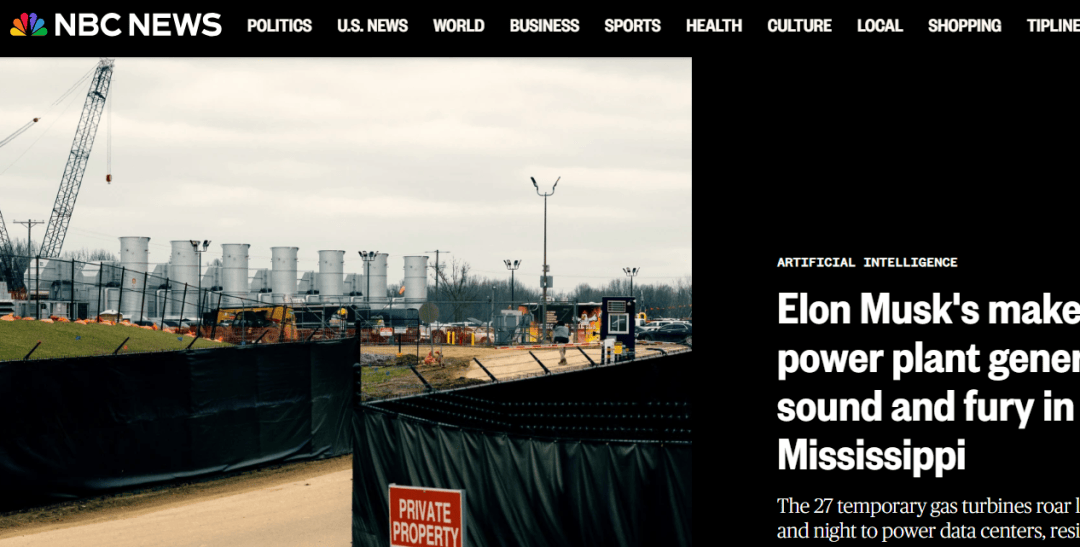
马斯克 xAI电站吵得居民彻夜难眠,700万隔音墙跟没装一样
Sou Hu Cai Jing· 2026-02-27 08:41
Core Insights - The construction of an AI power station by xAI, a company owned by Elon Musk, in Southaven, Mississippi, has led to significant resident protests due to continuous noise pollution, highlighting the conflict between AI computational expansion and community well-being [1][3] Group 1: Project Details - xAI has repurposed an idle power plant and installed 27 temporary gas turbines to supply power to its AI data center, resulting in noise levels comparable to those of an airport runway, causing long-term disturbances for local residents [3] - The company plans to invest over $20 billion and has applied to install 41 permanent turbines, which would represent the largest private investment in the state’s history, promising tax revenue and job creation [3] Group 2: Community Response - Local residents have reported minimal effectiveness from a $7 million sound barrier constructed by the city to mitigate noise [3] - Environmental organizations and the NAACP have accused xAI of operating turbines without proper legal permits, emitting harmful pollutants like formaldehyde, and treating vulnerable communities as "environmental sacrifice zones," with plans to file a lawsuit under the Clean Air Act [3] Group 3: Regulatory Issues - Although the state environmental department has not required permits for the temporary equipment, new federal EPA regulations indicate that such devices should have undergone approval [3] - Public hearings have shown no support for the project from the community, and protests are ongoing, with permanent power station permits expected to be approved as early as next month [3]
摩根大通预警2026年铝市缺口23万吨,铜铝价格中枢或将大幅上移
Jin Rong Jie· 2026-02-23 11:09
Group 1 - The core viewpoint of the report is that the global aluminum market is expected to face a supply gap of approximately 230,000 tons by 2026, with an average price forecast of $3,200 per ton in the second quarter of 2026, and continued support for aluminum prices in the second half of the year [1] - The report also predicts a similar tightening in the copper market, estimating a supply gap of 130,000 tons by 2026, with price forecasts of $13,500 per ton in the second quarter and $13,000 per ton in the third quarter [1] - The demand structure for industrial metals like copper and aluminum is undergoing significant changes, driven by accelerated data center construction, upgrades in electrical infrastructure, and the expansion of the renewable energy sector, moving away from traditional real estate cycle dependency [1] Group 2 - On the supply side, the expansion of global electrolytic aluminum capacity is constrained by factors such as energy costs and environmental policies, leading to a slower pace of new capacity release [1] - Additionally, some resource-rich countries are tightening supply elasticity by increasing resource taxes and setting export quotas, further impacting the supply side [1] - These structural changes on both the supply and demand sides provide a strong foundation for long-term support of aluminum prices [1]

散户买走九成份额:有色金属ETF为何成为开年爆款?
市值风云· 2026-02-13 10:13
Core Viewpoint - The article highlights the significant interest and participation of retail investors in the non-ferrous metals sector, particularly through newly launched ETFs, driven by the sector's profitability and market dynamics [3][7][11]. Group 1: Retail Investor Participation - Retail investors have shown remarkable enthusiasm, with many new non-ferrous metal-themed ETFs being predominantly held by individual investors. For instance, the industrial non-ferrous ETF from Penghua has a staggering 99.68% of its holdings by retail investors [5]. - The largest non-ferrous metal ETF, Tianhong, raised a total of 1.074 billion yuan, with retail investors holding 97% of the shares [6]. Group 2: Market Performance - As of February 12, the non-ferrous metal index has recorded a year-to-date increase of 21%, despite some volatility in early February [8]. - The non-ferrous metals sector experienced a 28.27% increase from January 1 to January 31, followed by a slight decline of 3.08% from February 1 to February 12, resulting in an overall gain of 21.34% for the period [9]. Group 3: Institutional Response - Public fund institutions are accelerating their product offerings in response to the high demand from retail investors, with several new ETFs being launched to capture market interest [11]. - Major institutions like CITIC Securities and CICC remain optimistic about the future performance of commodities and resource stocks, viewing recent market fluctuations as technical adjustments rather than fundamental reversals [14].

化工板块低开高走,指数涨超2%,关注化工行业ETF易方达(516570)等产品投资机会
Mei Ri Jing Ji Xin Wen· 2026-02-11 03:09
Group 1 - The core viewpoint of the article highlights the positive performance of the chemical sector, with the China Petroleum and Chemical Industry Index rising by 2.5%, driven by significant gains in stocks such as Tongkun Co., New Fengming, Hengli Petrochemical, and Rongsheng Petrochemical [1] - The polyester fiber industry is experiencing a widening price gap between upstream and downstream, with increased support from upstream costs boosting market sentiment and leading to rising prices for PX, MEG, and PTA [1] - Analysts predict that the polyester filament industry may see a concentrated resumption of work and inventory replenishment after the Spring Festival, making the traditional price increase window in March and April noteworthy [1] Group 2 - The China Petroleum and Chemical Industry Index includes major chemical leaders, with approximately 60% in basic chemicals and 30% in petroleum and petrochemicals, focusing on sub-industries with clear supply and demand improvements [1] - The recent performance of the chemical sector ETF, E Fund (516570), has attracted around 1.5 billion yuan in investments over the past month, benefiting from a low management fee rate of 0.15% per year [2]
稀土价格持续上行,盛和资源强势涨停!有色ETF华宝(159876)劲涨2%,机构:资源股中期有望重拾升势!
Xin Lang Cai Jing· 2026-02-09 11:45
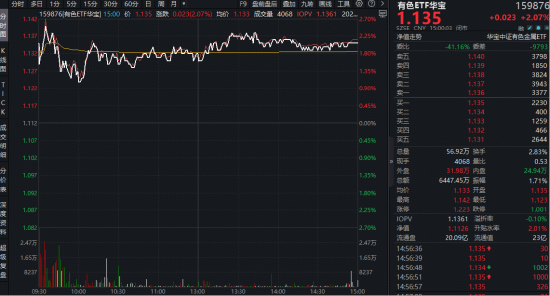
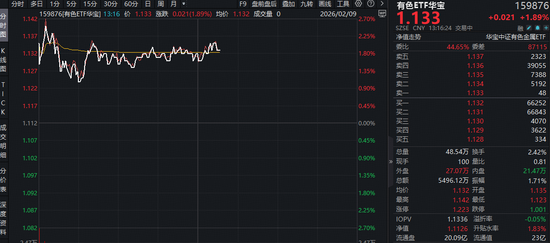
Group 1 - The core viewpoint of the article highlights the positive market sentiment driven by spot gold returning to $5,000, leading to significant activity in the non-ferrous metals sector, particularly the Huabao ETF (159876), which saw a price increase of 2.07% on February 9 [1][7] - The Huabao ETF includes leading companies in the non-ferrous metals industry, with notable stocks such as Shenghe Resources and Hunan Silver reaching their daily price limits, while silver and rare earth stocks also experienced substantial gains [1][7] - The article emphasizes the ongoing bullish trend in the rare earth market, with prices for praseodymium and neodymium rising significantly, indicating a tightening supply and increasing demand in emerging sectors [10] Group 2 - The People's Bank of China has increased its gold reserves for 15 consecutive months, with the latest figures showing reserves of 7.419 million ounces as of January 2026, which is expected to support gold prices [10] - The article discusses the structural demand for commodities driven by AI computing expansion and energy transition, suggesting that the market for related resource stocks is likely to continue its upward trajectory after a short-term adjustment [10] - The Huabao ETF and its linked funds provide comprehensive coverage of various metals, including copper, aluminum, gold, rare earths, and lithium, making it an efficient tool for investors looking to gain exposure to the non-ferrous metals sector [10]

美联储降息信号出现,现货黄金重返5000美元!有色ETF(159876)盘中拉升2.5%!机构:资源股有望重拾升势!
Xin Lang Cai Jing· 2026-02-09 05:40
Core Insights - The article highlights the significant increase in gold holdings by the People's Bank of China for 15 consecutive months, alongside spot gold prices returning to $5,000 per ounce, which has led to heightened activity in the non-ferrous metals sector, particularly the Huabao ETF [1][9]. Group 1: Market Performance - The Huabao ETF (159876) has seen a price increase of over 2.5% during the day, currently up by 1.89% [1][9]. - Key stocks in the non-ferrous metals sector, such as Shenghe Resources and Hunan Silver, have surged over 9%, while Silver Nonferrous has risen by more than 6% [5][11]. Group 2: Economic Indicators - The U.S. labor market shows signs of cooling, with job vacancies dropping to 6.542 million, the lowest since September 2020, significantly below the expected 7.25 million [2][12]. - The previous month's job vacancy data was revised down from 7.146 million to 6.928 million, indicating a continued weakening in labor demand [2][12]. Group 3: Federal Reserve Insights - Mary Daly, President of the San Francisco Federal Reserve, suggests that the Fed may need to implement one or two more rate cuts to address the weak labor market conditions [3][13]. - Current inflation is eroding wage income for American workers, and new job opportunities are scarce [3][13]. Group 4: Commodity Market Outlook - According to Zhongjin Company, the rigid demand driven by AI computing expansion and energy transition, along with structural supply-demand gaps for certain commodities, indicates that the structural market for bulk commodities may not have ended [3][13]. - The article suggests that after a short-term adjustment, resource stocks are expected to regain upward momentum [3][13]. Group 5: ETF Overview - The Huabao ETF and its linked funds cover a wide range of sectors including copper, aluminum, gold, rare earths, and lithium, allowing for better exposure to various market cycles [4][13]. - The ETF serves as an efficient tool for investors looking to gain exposure to the non-ferrous metals sector [4][13].
大宗商品2026年行情未结束,能源化工估值见底,资源股有望重拾升势
Sou Hu Cai Jing· 2026-02-09 05:27
Group 1 - The core viewpoint of the report is that commodities are a diversified asset for global capital allocation, with current valuations in energy and chemicals potentially at the lower end of the range, despite increased short-term volatility [1] - The report suggests that the structural demand for commodities driven by AI computing expansion and energy transition remains unchanged, indicating that the structural market for commodities may not be over [1] - The report anticipates that resource stocks will not end, and after a short-term adjustment, they are expected to regain upward momentum in the medium term [1] Group 2 - The report highlights a differentiated outlook for the commodity market in 2025, with precious and industrial metals expected to strengthen significantly due to AI computing expansion, rising electricity infrastructure demand, and geopolitical risks, positively impacting the A-share non-ferrous metal sector [1] - In contrast, energy and agricultural products are expected to perform weakly, with non-ferrous metals and some chemical products continuing to rise into early 2026 [1] - The report reviews the past 20 years of commodity cycles and their linkage with A-shares, noting that previous commodity rallies were typically driven by supply-demand mismatches and monetary environment resonance, with global economic recovery boosting demand while supply remained inflexible due to previous underinvestment [2]
中金:大宗商品的结构行情可能尚未结束
Xin Hua Cai Jing· 2026-02-09 02:21
Group 1 - The core viewpoint of the article emphasizes that commodities are benefiting from global capital diversification, with valuations in energy and chemicals potentially at a bottom range despite increased short-term volatility [1] - The report suggests that the structural demand driven by AI computational expansion and energy transition remains unchanged, indicating that the structural commodity market may not have ended [1] - The strategy team at CICC believes that Kevin Warsh's decisions may face multiple constraints, making significant balance sheet reduction unlikely in the short term, and the Federal Reserve may not turn as hawkish as the market fears [1] Group 2 - Following a release of short-term emotions and a noticeable decrease in trading congestion, the resource stock market is not over, and after a short-term adjustment, there is potential for a mid-term recovery [1]
中金:相关资源股行情并未结束,历经短期调整后中期有望重拾升势
Xin Lang Cai Jing· 2026-02-09 00:44
Core Viewpoint - Commodities are benefiting from global capital diversification, with current valuations in energy and chemicals potentially at the lower end of the range, despite increased short-term volatility [1] Group 1: Market Dynamics - The rigid demand driven by AI computing expansion and energy transition remains unchanged, along with structural supply-demand gaps for certain commodities [1] - The structural market trend for commodities may not be over yet [1] Group 2: Federal Reserve Insights - The decision-making of Kevin Warsh, upon taking office, may face multiple constraints, making significant balance sheet reduction unlikely in the short term [1] - The Federal Reserve may not adopt a fully hawkish stance as the market fears [1] Group 3: Investment Outlook - As short-term sentiment normalizes and trading congestion decreases, the market for related resource stocks is not over yet [1] - After a short-term adjustment, there is potential for a mid-term recovery in commodity prices [1]