生成式AI

Search documents
SenseAI 荐读|2026年 A16Z GenAI 应用 Top 100
深思SenseAI· 2026-03-12 10:48
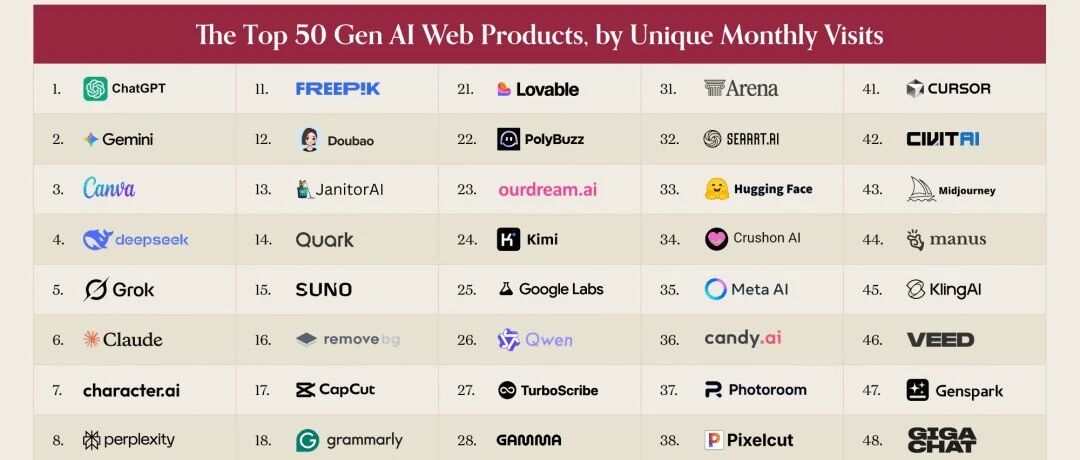
Core Insights - The latest A16Z Top 100 Generative AI Consumer Applications report reveals three significant structural shifts in the AI landscape, moving beyond mere rankings [1][3]. Group 1: Platform Evolution - ChatGPT and Claude have evolved from a model competition to two distinct platform species, with products like OpenClaw and Manus gaining real user traction [2][3]. - The AI battleground is shifting from browsers and standalone apps to native desktop tools, operating systems, and even hardware layers [3][66]. Group 2: Market Dynamics - The boundary between "AI-native" companies and traditional software players has blurred, with products like CapCut and Canva integrating AI as core experiences [6][8]. - ChatGPT remains the largest consumer AI product, with a significant lead over competitors like Gemini, boasting a weekly active user increase of 500 million to reach 900 million [8][15]. Group 3: User Engagement and Retention - ChatGPT's web traffic is 2.7 times that of Gemini, and its mobile monthly active users are 2.5 times higher, indicating strong user retention [8][15]. - The competitive landscape is intensifying, with Gemini and Claude experiencing rapid growth in paid subscriptions, although they still lag behind ChatGPT [15][19]. Group 4: Geographic Fragmentation - The AI market is fracturing into three distinct ecosystems, with Western tools primarily used in the U.S., India, Brazil, the U.K., and Indonesia, while facing restrictions in China and Russia [33][37]. - DeepSeek is notable for its cross-border appeal, with significant user bases in China, Russia, and the U.S., highlighting a shift in market dynamics [38]. Group 5: Creative Tools Transformation - The creative tools landscape is evolving, with traditional image generation tools losing dominance to video, music, and voice products [41][46]. - The rise of integrated AI capabilities in existing platforms, such as Google Workspace and Microsoft Office, is reshaping user engagement with creative tools [72][73]. Group 6: Emergence of Agentic AI - The trend towards Agentic AI is gaining momentum, with platforms like OpenClaw and Manus allowing users to delegate tasks to AI, marking a shift in user interaction [56][64]. - These platforms are competing with general-purpose AI assistants, as they offer more integrated and task-oriented experiences [65]. Group 7: AI Integration into Browsers and Desktop Tools - AI is increasingly embedded into browsers and desktop applications, with products like OpenAI's Atlas and Claude in Chrome enhancing user experiences [66][67]. - The growth of native AI tools among developers is notable, with applications like Claude Code achieving significant revenue milestones [71][72].


一年一度最值得关注的AI榜单来啦!申报即日启动
量子位· 2026-03-12 09:37
Core Insights - The article discusses the evolution of generative AI in China, highlighting its transition from a "new technology" to an essential tool for businesses, impacting content production, R&D efficiency, marketing methods, team collaboration, and decision-making processes [1] - The upcoming 2026 China AIGC Industry Summit will recognize outstanding generative AI companies and products based on their performance and feedback over the past year, with results to be announced in May 2026 [1][2] Selection Criteria for AIGC Companies - Companies must be based in China or have their main business operations in China [7] - The primary business should focus on generative AI or have widely applied AI in its core operations [7] - Companies should have demonstrated outstanding performance in technology/products and commercialization over the past year [7] Selection Criteria for AIGC Products - Products must be based on generative AI capabilities [13] - Products should have mature technology, be market-released, and possess a certain user scale [13] - Significant technological innovations or functional iterations should have occurred in the past year, influencing industry applications [13] Evaluation Dimensions for AIGC Companies - **Technical Dimension**: Focus on the company's technical strength, R&D capabilities, and innovation, including technical achievements, R&D investment, and talent reserves [12] - **Product Dimension**: Emphasizes the innovation, market adaptability, and user experience of core products, including product innovation, user scale, and user experience [12] - **Market Dimension**: Evaluates the company's market performance and growth opportunities, including business models, market size, and revenue [12] - **Potential Dimension**: Assesses the core team's strength and brand potential, including team capabilities, financing progress, and brand influence [12] Evaluation Dimensions for AIGC Products - **Product Technical Strength**: Focus on the product's technological advancement, maturity, and efficiency, including technical architecture and outcomes [13] - **Product Innovation**: Emphasizes the uniqueness and innovation in functionality, experience, and application scenarios [13] - **Product Performance**: Evaluates user feedback and market performance, including user scale and retention rates [13] - **Product Potential**: Assesses future development and market expansion potential, including product ecosystem and strategic planning [13] Event Details - The registration for the evaluation starts immediately and ends on April 27, with results to be announced at the May summit [14] - The summit will focus on how to effectively utilize AI, inviting entrepreneurs, developers, and industry veterans to engage in discussions [17]

快手启动2026年春季校园招聘,超200类岗位开放,大模型相关岗位需求翻倍
Jin Rong Jie· 2026-03-12 07:10
Core Insights - Kuaishou has officially launched its 2026 spring campus recruitment, targeting both 2026 graduates and 2027 interns, with a focus on attracting high-potential talent, especially in technology innovation [1][2] Recruitment Overview - The spring recruitment offers over 200 job types across various fields including algorithms, engineering, product, operations, gaming, design, marketing, sales, strategic analysis, project management, and functional roles, with a particular emphasis on technical positions [1] - The demand for positions related to large models has doubled, reflecting Kuaishou's ongoing commitment to AI capability development and innovation [1] Fast-Track Programs - The Kuaishou Star-X internship program is aimed at top global technical talent, focusing on engineering and algorithm roles, and will have continuous recruitment throughout the year [2] - Participants in the Star-X program may receive competitive compensation and opportunities to tackle world-class technical challenges [2] Growth and Support - Kuaishou provides a comprehensive growth and support system for new hires, including a "3+1" training system, dedicated mentorship, housing subsidies, and various benefits [2] - Data indicates that 94.2% of new hires achieve a promotion within two years, with the fastest promotion occurring as early as 44 days after joining [2] Strategic Focus - Kuaishou aims to attract more exceptional talent to accelerate growth and unleash potential in a broader range of business scenarios driven by AI [3]

腾讯研究院AI速递 20260312
腾讯研究院· 2026-03-11 16:10
Group 1 - Google has released its first native multimodal embedding model, Gemini Embedding 2, which integrates text, images, audio, video, and PDFs into a unified vector space for cross-modal retrieval, eliminating information loss and engineering complexity associated with traditional multi-model approaches [1] - The model employs Russian nesting doll representation learning technology (MRL), reducing vector dimensions from 3072 to 768 with only a 0.18 point loss, balancing performance and cost [1] - Compared to competitors like OpenAI, Cohere, and Jina, Gemini Embedding 2 is currently the only commercial-grade embedding model covering five modalities, achieving state-of-the-art (SOTA) in multimodal capabilities [1] Group 2 - Meta has acquired the AI social platform Moltbook, which was launched only 40 days prior, and its founders will join Meta's Super Intelligence Lab (MSL) [2] - Moltbook gained attention for its "encrypted language" hoax posts, revealing critical flaws in identity verification and security on the platform [2] - Meta is interested in Moltbook's underlying capabilities for AI agents to be permanently online and autonomously discover and connect, planning to integrate it into its AI ecosystem after addressing security issues [2] Group 3 - Nvidia has signed a $60 billion computing power agreement with Thinking Machines Lab to deploy a next-generation Vera Rubin computing cluster with a scale of 1GW, including cash investment from Nvidia [3] - The company, founded by former OpenAI CTO Mira Murati, has a current valuation of $50 billion and recently appointed the founder of PyTorch as its new CTO after a previous departure [3] - By securing scarce computing power capacity, the company is building a second moat beyond talent competition to support cutting-edge model training and enterprise-level AI customization [3] Group 4 - Tencent has responded to security and cost concerns regarding OpenClaw, emphasizing that installation is free but model calls incur token fees, and has launched a series of security products and the SkillHub plugin ecosystem [4] - Tencent's lobster services are divided into two categories: deployment solutions around the open-source OpenClaw and the self-developed desktop AI agent WorkBuddy, which shares the Agent architecture with CodeBuddy [4] - Nearly 40,000 Tencent employees are already using OpenClaw internally, indicating a shift towards a new development model involving agents [4] Group 5 - Tencent Cloud has launched the SkillHub skill marketplace, which has over 13,000 lobster skills, supporting Chinese search and domestic node acceleration, and is compatible with various agent frameworks and environments [5] - More than 50 high-quality skills covering frequent scenarios such as office collaboration, development tools, and content creation have been selected, completing security scans and quality filtering [5] - Over 10 products, including Tencent Docs, QQ Browser, and Tencent Maps, have undergone skill transformation, allowing for one-click integration with OpenClaw [5] Group 6 - ZhiMi has launched its chip brand "Xinjichuan Yue," which includes a mobile chip (Chixiao 01) with a self-developed NPU architecture, a 2nm process autonomous driving chip with 2000 TOPS computing power, and the mass-produced Tianqiong series of general-purpose robot chips [7] - The company has announced plans for a space computing center, intending to deploy 2 million computing satellites to form a super constellation, with the first space computing box set to be verified in orbit soon [7] - A personal super AI computer with 1.5 PFLOPS has been introduced, utilizing a unified memory architecture capable of locally loading large models with billions of parameters and supporting multi-device networking [7] Group 7 - On the 10th anniversary of AlphaGo's victory over Lee Sedol, Demis Hassabis reflects on how the "37th move" initiated the modern AI era, showcasing AI's ability to surpass human experts and autonomously discover new strategies [8] - The reinforcement learning and search methods from AlphaGo have been extended to various scientific fields, including AlphaFold for protein structure prediction and AlphaProof for mathematical reasoning [8] - DeepMind believes that combining Gemini's world model, AlphaGo's search planning, and specialized AI tools is key to achieving artificial general intelligence (AGI) [8] Group 8 - The new version of LeRobot v0.5.0 integrates full-body control for the Unitree G1 humanoid robot and introduces six new strategy models, supporting LoRA fine-tuning [9] - Dataset processing has been significantly optimized, with streaming video encoding achieving zero-wait recording and image training speed improved by ten times, along with the launch of EnvHub for direct loading of simulation environments [9] - The codebase has been upgraded to Python 3.12+ and Transformers v5, with a new third-party strategy plugin system, and the paper has been accepted by ICLR 2026 [9] Group 9 - The author of "The Biography of Hassabis" reveals the contradictory personality of Demis Hassabis, who dislikes control yet is extremely competitive, and his clear aversion to the pursuit of power [10] - Hassabis attempted for three years to make DeepMind independent from Google but failed, and the book contains details that contradict Hassabis's own statements following the dismissal of co-founder Suleyman [10] - The author believes that AI safety faces the "Oppenheimer dilemma," where scientists can build technology but cannot control its use, ultimately requiring cooperation between the US and China to achieve safety [10] Group 10 - Jensen Huang outlines a five-layer industrial system for AI, consisting of energy, chips, infrastructure, models, and applications, where each successful application drives demand down to power generation [11] - He asserts that AI has crossed a critical threshold, with significant improvements in model inference and deployment capabilities, and open-source models like DeepSeek-R1 accelerating the growth of full-stack demand [11] - While thousands of billions have been invested globally, trillions in infrastructure remain to be built, marking it as the largest infrastructure project in human history [11]




一年一度最值得关注的AI榜单来啦!申报即日启动
量子位· 2026-03-11 05:35
Core Insights - The article discusses the transition of generative AI in China from a "new technology" to a "new tool" and now to a necessity for businesses, impacting various aspects such as content production, R&D efficiency, marketing methods, team collaboration, and decision-making processes [1] Group 1: Event Overview - The Fourth China AIGC Industry Summit will take place in May 2026, where Quantum Bit will announce the results of its evaluation of generative AI companies and products based on their performance and feedback over the past year [1][2] - The summit aims to invite millions of industry practitioners to witness the recognition of outstanding companies [2] Group 2: Evaluation Criteria for AIGC Companies - The evaluation will focus on companies that are either based in China or have their main business operations in China, and whose primary business involves generative AI or has widely applied AI in their operations [7] - Companies must have demonstrated outstanding performance in technology, products, or commercialization over the past year [7] Group 3: Evaluation Dimensions for AIGC Companies - The evaluation will consider several dimensions: 1. **Technical Dimension**: Assessing the company's technical strength, R&D capabilities, and innovation [12] 2. **Product Dimension**: Evaluating the innovation, market adaptability, and user experience of core products [12] 3. **Market Dimension**: Analyzing the company's market performance and growth opportunities [12] 4. **Potential Dimension**: Focusing on the core team's strength and brand potential [12] Group 4: Evaluation Criteria for AIGC Products - The evaluation will focus on products that are based on generative AI capabilities, have mature technology, and have been launched in the market with a certain user scale [13] - Products must have significant technological innovations or functional iterations in the past year that promote the application of AI technology and have a certain impact on the industry [13] Group 5: Evaluation Dimensions for AIGC Products - The evaluation will consider several dimensions for products: 1. **Product Technical Strength**: Assessing the advanced nature, maturity, and efficiency of the product [13] 2. **Product Innovation**: Evaluating the uniqueness and innovation in functionality, experience, and application scenarios [13] 3. **Product Performance**: Analyzing user feedback and market performance, including user scale and retention [13] 4. **Product Potential**: Focusing on future development and market expansion potential [13] Group 6: Registration Information - Registration for the evaluation is open now and will close on April 27, with the final results to be announced at the May summit [14] - Companies can register through specified contact methods, including WeChat and email [14]

创业板指半日涨1.74%
第一财经· 2026-03-11 03:47
Market Overview - The A-share market showed mixed performance with the Shanghai Composite Index up 0.05%, Shenzhen Component Index up 0.85%, and the ChiNext Index up 1.74% as of midday [3][10]. - The total trading volume of the Shanghai and Shenzhen markets exceeded 1 trillion yuan, a decrease of nearly 40 billion yuan compared to the previous day [6]. Sector Performance - The photovoltaic and lithium battery sectors experienced significant gains, with stocks like Tongwei Co., Zhengwei Electric, and Deye Holdings hitting the daily limit [7]. - The MicroLED concept stocks rebounded strongly, with companies like Wogang Optoelectronics hitting the daily limit and others like Huaxing Yuanchuang and Huacan Optoelectronics rising over 10% [5]. - The industrial mother machine sector opened high, with stocks like Huadong CNC hitting the daily limit and others like Hengjin Induction rising over 15% [9]. Notable Stocks - Contemporary Amperex Technology Co., Ltd. (CATL) saw its A-shares rise over 6%, returning above the 400 yuan mark, while its Hong Kong shares rose about 9% [5]. - Tongwei Co. opened high at 3.14% after announcing plans to acquire 100% equity of Lihua Qingneng [12]. Investment Themes - The market is currently focused on themes such as AI applications, cloud computing, and energy storage, while sectors like military industry, oil and gas, steel, and rare earths showed weakness [4][11]. - The demand for high-speed transmission in data centers is increasing due to the rise of generative AI, with MicroLED CPO solutions expected to significantly reduce overall energy consumption [5].


孙正义的杠杆周期:当软银暴跌,市场在害怕什么
美股研究社· 2026-03-10 10:42
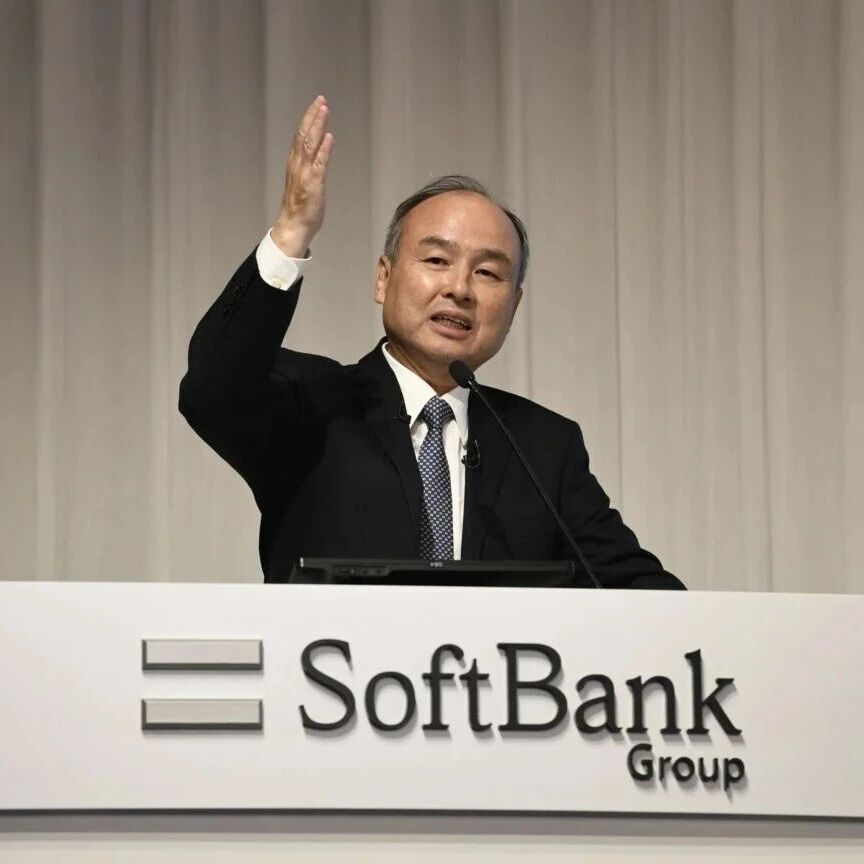
Core Viewpoint - SoftBank Group is viewed as a "magnifier" of market sentiment, where its stock price fluctuations signal broader trends in the technology sector, particularly during periods of high leverage and concentrated investments in technology narratives [1][3]. Group 1: SoftBank's Role in the Market - SoftBank is characterized as a unique entity in the global tech investment landscape, functioning more like a "technology-themed leveraged fund" rather than a traditional venture capital firm or a typical public company [5]. - The company's stock price is highly sensitive to market liquidity and investor sentiment, often experiencing greater volatility than the broader tech sector [7][8]. - SoftBank's stock movements often precede broader market shifts, acting as an early indicator of changing investor sentiment towards high-risk technology investments [8][10]. Group 2: Historical Context and Current Trends - In early 2021, SoftBank's stock began to decline even as the tech sector was experiencing a boom, foreshadowing the subsequent market downturn that occurred later that year [10]. - The current decline in SoftBank's stock is attributed to concerns over its significant investments in OpenAI, with the company having invested approximately $64.6 billion and committed to further funding [10][11]. - Similar to past trends, the market is now questioning the sustainability of the AI industry's profitability, which could lead to a broader reevaluation of tech valuations [11][14]. Group 3: Implications for the AI Sector - The focus of SoftBank's recent stock decline is on the capital narrative surrounding generative AI, with OpenAI representing a critical player in this space [13][14]. - As market enthusiasm shifts to a more rational perspective, doubts are emerging about whether AI companies can justify their high valuations amidst ongoing cash burn and substantial capital requirements [14][15]. - If the narrative surrounding AI falters, SoftBank could face significant pressure, potentially leading to a broader reassessment of the entire AI application sector's valuation framework [14][15]. Group 4: Future Outlook - The current situation suggests that the AI bull market may be entering its first real stress test, with investors increasingly demanding tangible profits and cash flows rather than just compelling narratives [15][16]. - SoftBank's stock fluctuations serve as a reminder that during periods of leveraged retreat, defensive strategies may be more prudent than aggressive investments [16].
一年一度最值得关注的AI榜单来啦!申报即日启动
量子位· 2026-03-10 08:00AI Processing
这两年,AI从"新技术"变成了"新工具",又从"新工具"慢慢变成企业必须面对的现实。它不只在改变内容生产,也在影响研发效率、营销方 式、团队协作,甚至决策流程。 中国生成式AI正在进入产业深水区。 组委会 发自 凹非寺 量子位|公众号 QbitAI 时值第四届中国AIGC产业峰会, 量子位将根据过去一年里生成式AI企业、产品的表现与反馈,结合对2026年技术与场景的观察与预判,评 选出: 将评选出拥有最创新、最前瞻或最有规模落地潜力的AI企业。 【参选条件】 2026年度值得关注的AIGC企业 2026年度值得关注的AIGC产品 1. 公司主体在中国或主营业务在中国; 2. 主营业务是生成式AI及相关,或已将AI广泛应用于其主营业务; 3. 近一年在技术/产品、商业化有出色表现的企业。 【评选维度】 量子位将结合对公司的深入调研及数十位行业知名专家的意见,评选结果将于2026年5月中国AIGC产业峰会上公布。 届时,量子位也将邀请数百万行业从业者,共同见证这些优秀企业的荣誉。 2026年度值得关注的AIGC企业 2026年度值得关注的AIGC产品 将评选出拥有最创新、最实用、最热门或最有应用潜力的AI产品。 ...

AI Technologies:《2026年全球人工智能状况与趋势》
欧米伽未来研究所2025· 2026-03-09 10:35
Core Insights - The report "State of AI 2026" by AI Technologies outlines significant advancements in AI technology over the past year and provides nine predictions for 2026, emphasizing the report's influence among global decision-makers and investors [3] Investment Trends - In 2025, global venture capital investment in AI is projected to reach approximately $200 billion, accounting for 50% of total VC investments, with 58% directed towards "super rounds" exceeding $500 million [4] - Major players like OpenAI, Scale AI, and Anthropic have secured substantial funding, indicating a "winner-takes-all" market dynamic [4] Infrastructure and Energy - The competition for computing power is intensifying, with tech giants expected to invest over $300 billion in data center expansion by 2025 [4] - Data centers are projected to consume about 10% of global energy by 2030, highlighting a mismatch in infrastructure capabilities [5] Hardware Landscape - NVIDIA maintains a dominant position in the hardware market, with projected revenues of around $130 billion in 2025, but faces increasing competition from AMD and local Chinese manufacturers [6] Model Development and Adoption - The AI model landscape is characterized by a dual dominance of the US and emerging players in China, with top closed-source models led by US firms and open-source models increasingly controlled by Chinese companies [7] - Despite high adoption rates of generative AI in enterprises, the success rate of AI projects in production remains low, with a failure rate of 88% to 95% for pilot projects [8] Consumer Market Dynamics - OpenAI leads the consumer market with 5.5 billion monthly visits, while the AI companion market has reached a size of $32 billion, growing at a CAGR of 30% [9][10] Security and Governance Challenges - Cybersecurity incidents have escalated, with DDoS attacks increasing by 30% and ransomware attacks by 32% in 2025 [11] - The global regulatory landscape is becoming increasingly fragmented, with the EU establishing comprehensive AI regulations while the US adopts a more relaxed approach [12] Geopolitical Context - The report highlights the ongoing technological rivalry between the US and China, particularly in areas like chip export controls and data sovereignty [13] Robotics and Scientific Advancements - The robotics market is expected to exceed $200 billion, with significant advancements in AI applications in scientific research and drug approval processes [14] Future Predictions - Key predictions for 2027 include a decline in NVIDIA's market share, increased investment in AI applications, and a significant rise in the robotics sector [15][16]

Gemini 账户 48 小时被盗刷 57 万,三人创业团队站在破产边缘
AI前线· 2026-03-09 10:06
Core Viewpoint - A Mexican startup faced a catastrophic financial loss of $82,314.44 in just 48 hours due to the theft of their Google Cloud API key, which is 457 times their normal monthly expenditure of $180, raising concerns about the platform's risk management and billing practices [4][5][12]. Group 1: Incident Overview - The startup, consisting of only three developers, experienced a significant spike in their Google Cloud bill due to unauthorized usage of the Gemini API, which they could not trace back to any specific error [3][4]. - The company took immediate remedial actions, including deleting the compromised key, disabling Gemini APIs, and enabling two-factor authentication [6][8]. - Despite these actions, Google maintained that under its "Shared Responsibility Model," the company is liable for the unauthorized charges, which could lead to bankruptcy for the startup [7][12]. Group 2: Systemic Issues - The incident highlighted a lack of basic protective measures within Google's billing system, such as automatic stops for usage spikes or spending caps, which could prevent catastrophic financial impacts [10][11]. - The developer raised questions about the absence of safeguards against anomalous usage patterns, emphasizing that the system should have triggered alerts or actions when usage exceeded historical norms [9][10]. - The situation reflects broader structural anxieties regarding the high costs associated with generative AI APIs compared to traditional web services, which can be devastating for small teams [12][32]. Group 3: Security and API Key Management - Security researcher Joe Leon pointed out that the API key system used by Google Cloud allows for significant vulnerabilities, as a single key can provide access to both public and sensitive endpoints [13][14]. - The default settings for new API keys are overly permissive, allowing access to sensitive APIs without adequate restrictions, which can lead to unauthorized usage and financial losses [24][28]. - The incident has sparked discussions in the tech community about the need for better risk management practices and clearer guidelines for developers regarding API key security [32][34].