移民政策

Search documents
特朗普政府施压 苹果下架追踪移民执法人员软件
Xin Hua She· 2025-10-03 07:47
Core Points - Apple has removed the ICEBlock app, which tracked the movements of U.S. Immigration and Customs Enforcement (ICE) personnel, from its App Store due to safety concerns [2] - The U.S. Department of Justice, led by Attorney General Pam Bondi, stated that the app posed a danger to ICE officers and could lead to violence against law enforcement actions [2] - Following the removal, Bondi warned the app's developers that they may face legal consequences as their actions are not protected under the U.S. Constitution [2] Industry Context - The removal of ICEBlock comes amid heightened tensions surrounding immigration enforcement under President Trump's administration, which has been characterized by aggressive policies and increased raids on undocumented immigrants [2] - The use of the app has been linked to incidents of violence against ICE personnel, including a shooting at an ICE facility in Dallas, Texas, where the shooter reportedly used the app to track officers [3] - The situation reflects a growing hostility towards immigration enforcement actions, leading to potential risks for law enforcement officials involved in these operations [3]


新加坡总人口增至611万人 创历史新高
Zhong Guo Xin Wen Wang· 2025-09-30 00:10
Core Insights - Singapore's total population has reached a historic high of 6.11 million as of June this year, marking a year-on-year increase of 1.2%, which is lower than the 2% growth rate of the previous year [1][1][1] Population Growth - The increase in Singapore's population is primarily attributed to the rise in the number of foreign workers, which has reached 1.91 million, reflecting a 2.7% growth compared to the same period last year [1][1][1] Aging Population - The report highlights an accelerated aging process, with the proportion of Singaporean citizens aged 65 and above rising from 13.1% in 2015 to 20.7% by 2025. Additionally, the number of citizens aged 80 and above has increased from 91,000 in 2015 to 145,000 this year, representing a 60% growth [1][1][1] Immigration Policy - Immigration is seen as a crucial factor in mitigating the impacts of aging and low birth rates on Singapore's population, with the government planning to maintain a moderate pace of immigration to prevent long-term population decline [1][1][1]
梦回1997?韩国押注美国,恐遭第二次金融危机
Hu Xiu· 2025-09-27 05:57
Group 1 - The potential for a financial crisis in South Korea reminiscent of the 1997 crisis if trade negotiations with the US do not proceed as required [1][23] - South Korean President Lee Jae-myung expressed concerns about US actions affecting Korean companies, particularly following the arrest of employees from Korean firms in Georgia [2][3] - The incident involving the arrest of Korean technical staff highlights the complexities of US immigration laws and the challenges faced by Korean companies operating in the US [4][6][11] Group 2 - The arrest of Korean workers was linked to their lack of valid work visas, reflecting the stringent immigration policies under the Trump administration [5][7] - Korean companies often utilize short-term visas for business trips due to the difficulties in obtaining long-term work visas, leading to legal vulnerabilities [6][8][11] - The incident has raised concerns about the stability of Korean companies' operations in the US, particularly in light of the significant investments being made [13][23] Group 3 - The establishment of a "super factory" by Hyundai and LG Energy in Georgia is a significant investment aimed at producing electric vehicles, but it also exposes the companies to regulatory risks [13][14][17] - The super factory concept integrates key production processes, which is a departure from traditional supply chain models, indicating a strategic shift for Korean automakers [17][18] - The reliance on US markets for growth is critical for Hyundai, which has historically focused on building relationships with Korean expatriates in the US [18][19] Group 4 - The current geopolitical climate and trade relations between South Korea and the US are under strain, with implications for Korean companies' operations and investments [28][29] - The financial commitments made by South Korean firms to the US market are substantial, raising concerns about potential economic repercussions if the US market faces instability [23][24] - The historical context of South Korea's financial crises and reliance on foreign investment underscores the risks associated with current economic strategies [23][26]
经济学家眼中全球经济增长所面临的最大不确定性是什么?
Jing Ji Guan Cha Wang· 2025-09-26 08:38
Group 1 - The global economic growth forecast has been cautiously optimistic, with the International Monetary Fund adjusting its growth prediction from an average tariff rate of 24% to 17% for the U.S., indicating the significant impact of U.S. tariff policies on global growth in 2025 and 2026 [2] - The uncertainty surrounding the U.S. tariff policies includes potential legal challenges and the possibility of additional tariffs on specific industries such as semiconductors and pharmaceuticals, which could significantly impact regions like Singapore and Taiwan if tariffs reach 25% [2] - The imposition of a 40% tariff on goods exported to the U.S. via Vietnam by former President Trump introduces further uncertainty for Chinese companies' international strategies [2] Group 2 - The unpredictability of U.S. policies, including immigration, tariffs, and monetary policy, poses significant risks to the economy, with potential inflation and stagnation concerns arising from labor shortages and rising domestic product prices [3] - The recent decision by the Federal Reserve to lower interest rates may reduce the attractiveness of U.S. dollar assets due to decreasing real yields, prompting investors to diversify their global asset allocations [3] - The potential for asset bubbles is a major concern for investors, although it is premature to declare that assets are fully inflated, as companies like Nvidia and Apple continue to show accelerating profit growth and substantial cash flow [4] Group 3 - Chinese technology companies have seen their valuations decrease as their profit growth has outpaced stock price increases, leading to lower valuations compared to earlier in the year [4] - The ongoing transition between old and new technologies is expected to create new investment expectations, with a high probability of asset bubble formation in a liquidity-rich environment [4] - Investors are encouraged to seize current investment opportunities amidst these dynamics [4]

美签证新政无异于“搬起石头砸了自己的脚” 美国经济将受到哪些冲击?
Yang Shi Wang· 2025-09-26 06:08
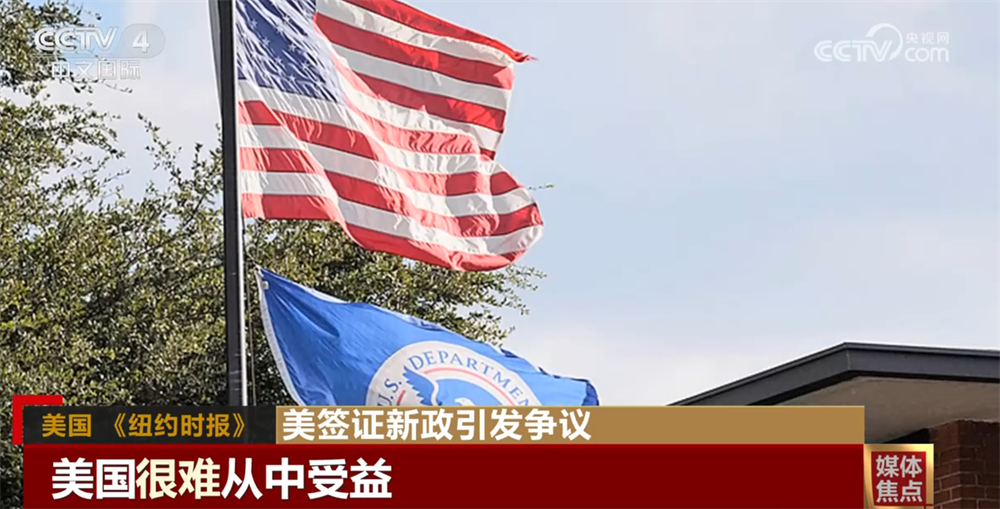
Core Viewpoint - The Trump administration's significant increase in H-1B visa fees from several thousand dollars to $100,000 is expected to have substantial impacts on U.S. technology companies and the broader economy [1][3]. Group 1: Economic Impact - The increase in H-1B visa fees is justified by the government as a response to systemic abuse of the visa program, which has led to the displacement of American workers and harmed the economy and national security [3]. - Small and medium-sized enterprises in the U.S. will face a sharp rise in costs, exacerbating their financial burdens [3]. - The policy may lead to a shift of certain jobs overseas, slow down innovation, and limit the ability to attract global high-end talent [5][9]. Group 2: Talent Acquisition and Innovation - The H-1B visa is crucial for U.S. tech companies to hire foreign talent, and the new policy could hinder the ability to attract top talent, ultimately weakening U.S. innovation and economic growth [5][7]. - Major tech companies may absorb some of the increased costs but will still face risks related to delays in hiring key talent [5]. - The policy change is likely to push capable university graduates out of the U.S. to other countries, affecting the talent pool available to American companies [9]. Group 3: Global Talent Flow - The policy change has drawn global attention, with countries like Canada, India, and Germany monitoring the situation closely and potentially adjusting their own immigration policies to attract talent that may be excluded from the U.S. [7]. - Canada plans to enhance its "Global Skills Strategy" to attract technology talent that may be turned away by U.S. policies [7].
‘I would beg the president’: Jamie Dimon, one of Wall Street’s top H-1B visa users, predicts ‘pushback’ because big employers need top expertise
Yahoo Finance· 2025-09-24 16:49
Core Viewpoint - JPMorgan Chase CEO Jamie Dimon expresses concerns over President Trump's new $100,000 fee for H-1B visas, emphasizing the potential negative impact on U.S. companies that rely on skilled foreign workers [1][2][3] Group 1: Immigration Policy Impact - Dimon supports merit-based immigration but anticipates pushback from U.S. companies dependent on non-U.S. expertise due to the new visa fee [2] - JPMorgan is a significant sponsor of H-1B visas, with 1,990 certified filings for fiscal 2024, indicating the bank's reliance on foreign talent [2] - The new fee could lead to a reduction of up to 5,500 work authorizations per month, based on projections from JPMorgan economists [4] Group 2: Labor Market Concerns - Analysts at JPMorgan predict that the $100,000 fee will impact 65,000 of the 141,000 approved petitions for new employment requiring consular processing [4] - Dimon highlights the importance of maintaining the U.S. as an attractive destination for global talent, referencing the nation's immigrant roots as a core strength [4]

经济与物价担忧加剧,特朗普支持率走低
Jin Shi Shu Ju· 2025-09-24 09:34
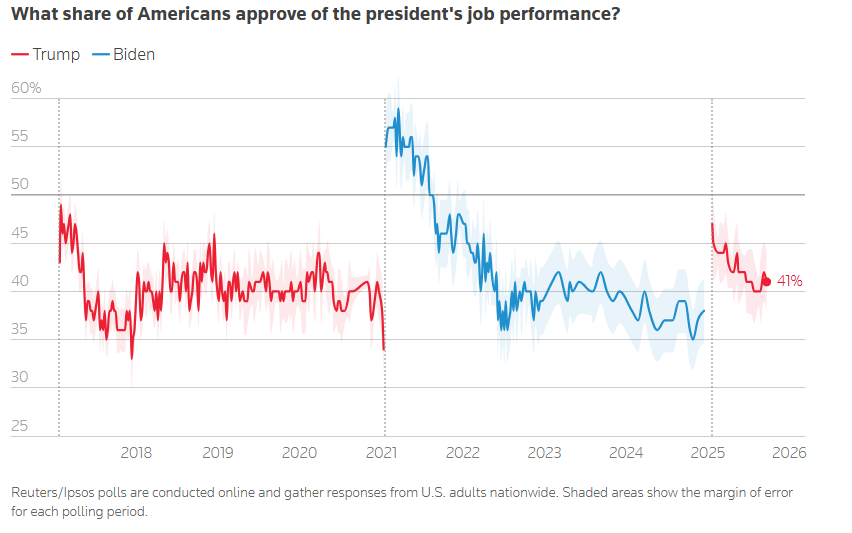
Group 1 - Recent Reuters/Ipsos poll indicates a slight decline in President Trump's approval rating, with 41% of respondents approving his performance, down from 42% in early September [1] - Approximately 54% of respondents believe the U.S. economy is "off track," an increase from 53% in August and 52% in July [3] - Only 35% of respondents approve of Trump's economic management, and 28% approve of his handling of cost-of-living issues, both slightly lower than previous polls [3] Group 2 - In August, U.S. job growth significantly slowed, with the unemployment rate rising to a near four-year high of 4.3%, while inflation accelerated [7] - Political extremism is viewed as the biggest issue facing the nation, with 28% of respondents identifying it as the primary concern, compared to 16% for the economy [8] - When asked which party has a better plan to address extremism, 30% chose the Republican Party, while 26% favored the Democratic Party, with others either unsure or believing both parties are inadequate [8] Group 3 - Despite economic concerns affecting Trump's approval, the Republican Party has a higher approval rating (34%) for economic policy management compared to the Democratic Party (24%) [9] - Trump's immigration policy remains relatively popular, with approximately 42% of respondents approving it, marking the highest support rate for any single issue in the Reuters/Ipsos poll [9]
【环球财经】旅游业持续下滑 美国“娱乐之都”乐不起来了
Xin Hua She· 2025-09-24 08:46
Core Insights - Las Vegas is experiencing a significant decline in tourism, with visitor numbers dropping for seven consecutive months, indicating a broader economic downturn [1][3][4] - The decrease in international tourists, particularly from Canada and Mexico, is attributed to various factors including trade policies and rising costs [3][4] Visitor Trends - Visitor numbers in Las Vegas fell by 11.3% in June and 12% in July compared to the previous year, with hotel occupancy rates declining by 6.5% and 7.6% respectively [1] - International tourist numbers decreased by 13% in June, with shorter stays reported by visitors [2] Economic Impact - Local businesses reliant on tourism are facing severe challenges, with one transportation service reporting a 60% drop in business [2] - The Las Vegas tourism downturn is seen as a signal of potential national economic trends, reflecting broader issues affecting the U.S. economy [3] Government and Policy Factors - Concerns are rising regarding the impact of U.S. government policies, including trade wars and immigration restrictions, on international tourism [3] - Increased visa fees and stricter entry regulations are contributing to the decline in international visitors [3] Local Responses - In response to the decline in visitors, hotels are offering promotions such as free parking and room upgrades to attract guests [2] - The mayor of Las Vegas has publicly called for the return of Canadian tourists, acknowledging the economic pressure from the drop in international visitors [4]
美联储古尔斯比:移民政策导致劳动力供给状况波动不定。
Sou Hu Cai Jing· 2025-09-23 12:53
Group 1 - The core viewpoint is that immigration policies have led to fluctuations in labor supply conditions [1] Group 2 - The Federal Reserve's Goolsbee highlights the impact of immigration on labor market dynamics [1]
美元走弱+融资环境转好,美联储降息正无声拉低赴美移民“门槛”!
Sou Hu Cai Jing· 2025-09-23 05:52
Group 1 - The Federal Reserve's interest rate cuts are expected to lower the total costs for immigration and education in the U.S., benefiting families paying in RMB due to a stronger RMB against a weaker USD [2][4] - The employment and entrepreneurial environment is anticipated to become more favorable as lower interest rates reduce corporate financing costs, encouraging business expansion and job creation [2][4] - Investment immigration projects, particularly EB-5, are likely to benefit significantly from lower financing costs, enhancing project feasibility and expected returns for investors [4][5] Group 2 - Continuous monetary easing by the Federal Reserve presents an opportune moment for closely monitoring and selecting quality EB-5 projects [5] - Potential risks associated with interest rate cuts include inflation that may erode purchasing power, exchange rate volatility, and immigration process delays due to regulatory policies [6] - Recommendations include monitoring exchange rate trends, selecting stable EB-5 projects, and assessing financial leverage for entrepreneurial immigration [8]