
通胀对冲

Search documents
刚刚!黄金 大跳水!
Zhong Guo Ji Jin Bao· 2025-09-30 13:43
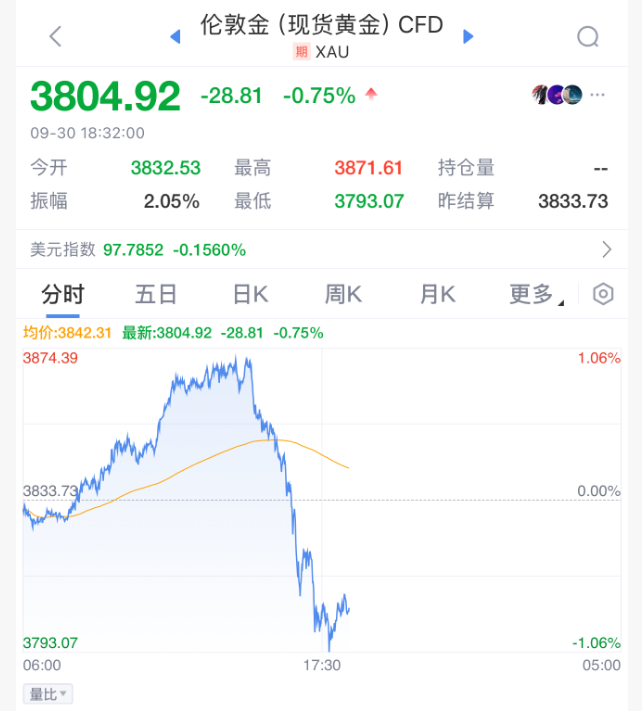
Core Viewpoint - The recent sharp decline in gold prices follows a significant increase, driven by concerns over a potential U.S. government shutdown and profit-taking by traders after a month of gains [1][5]. Group 1: Gold Market Dynamics - On September 30, after the A-share market closed, spot gold prices experienced a significant drop, initially rising over 1% to reach a new high of $3,871 per ounce before falling approximately 0.8% to around $3,800 per ounce [1]. - The gold market has seen a cumulative increase of about 45% this year, potentially marking the largest annual gain since 1979 [5]. - Concerns regarding the U.S. government shutdown and its impact on economic data releases have heightened gold's appeal as a safe-haven asset [5]. Group 2: Influencing Factors - Saxo Bank's commodity strategist Ole Hansen noted that profit-taking at the end of the month and potential actions by Chinese traders to reduce positions ahead of the October holiday contributed to the price drop [5]. - Central bank demand for gold and the Federal Reserve's potential return to interest rate cuts have provided support for gold prices [5]. - UBS forecasts a bullish outlook for the gold market, predicting prices could rise to $4,200 per ounce by mid-2026, driven by factors such as a weaker dollar, significant central bank purchases, and increased ETF investments [5].

黄金现货价格突破3800美元/盎司 机构称中长期仍有上涨空间
Zhong Guo Zheng Quan Bao· 2025-09-29 22:20
Core Viewpoint - The gold market is experiencing a significant upward trend, with spot gold prices reaching a historical high of $3,819.81 per ounce, driven by factors such as potential interest rate cuts by the Federal Reserve and increased demand from gold ETFs [1][2][4]. Group 1: Market Performance - On September 29, spot gold prices rose over 1%, breaking the $3,800 per ounce mark, while spot silver prices increased by 2%, reaching $47.174 per ounce, also a historical high [2]. - The A-share market saw a strong performance in the precious metals sector, with several gold-related stocks, such as Zhaojin Mining and Xiaocheng Technology, rising over 6% [2]. Group 2: Investment Drivers - Financial investment participants, including gold ETF investors and global central banks, are identified as the main sources of the current upward trend in gold prices [3]. - In September, global gold ETF holdings surged, with a notable increase of nearly 27 tons in a single day, marking the fastest growth in three years [3]. Group 3: Future Price Predictions - UBS Wealth Management predicts that gold prices could reach $3,900 per ounce by mid-2026, supported by a favorable macroeconomic narrative for precious metals [4]. - Analysts from Dongwu Securities believe that the downward trend in real interest rates and the initiation of a rate-cutting cycle by the Federal Reserve will provide substantial upward potential for gold prices [4]. Group 4: Supporting Factors - Three main factors are expected to support the upward trend in gold prices: 1. Increased demand for safe-haven assets due to economic uncertainties and geopolitical risks [4]. 2. Continued central bank purchases of gold, driven by diversification of reserves and reduced reliance on the US dollar [4]. 3. Inflation expectations, which, if they materialize, could enhance gold's value as an inflation hedge [5]. Group 5: Regional Insights - In China, despite a recent decline in gold investment demand due to a rising stock market, expectations are that ETF holdings will recover as gold prices continue to rise [5]. - The Hong Kong government's plan to expand gold reserves and establish a central clearing system for gold is anticipated to provide additional support for gold prices [5].


百利好丨国际金价持续攀升,多重因素共筑价格新底座
Sou Hu Cai Jing· 2025-09-25 08:45
Core Viewpoint - The international gold market has shown strong performance, with prices continuously breaking historical highs, driven by various factors including monetary policy shifts, central bank purchases, and geopolitical uncertainties [1][3][4][5][6] Group 1: Price Movements - On September 23, COMEX gold futures closed at $3,796.9 per ounce, with a daily increase of 0.58%, reaching an intraday high of $3,824.60, marking a historical peak [1] - Year-to-date, international spot gold prices have risen approximately 43% from around $2,625 per ounce, while domestic market prices have increased about 38% [1] Group 2: Monetary Policy Influence - The recent rise in gold prices is directly influenced by the Federal Reserve's shift in monetary policy, which included a 25 basis point reduction in the federal funds rate target range to 4.00%-4.25% on September 18 [3] - Market expectations indicate a 75.4% probability of cumulative rate cuts totaling 75 basis points by the Federal Reserve in 2025, reinforcing support for gold prices [3] Group 3: Central Bank Purchases - Global official institutions have been consistently increasing their gold reserves, with central banks net adding 166 tons of gold in the second quarter of 2025, continuing a trend of steady accumulation [4] - A survey by the World Gold Council indicates that 95% of over 90 central banks plan to increase their gold reserves in the next 12 months, reflecting long-term recognition of gold's value [4] Group 4: Geopolitical and Economic Factors - The current complex global geopolitical landscape, with ongoing tensions in various regions, has heightened market uncertainty and increased investor focus on asset safety [5] - Gold's traditional role as a safe-haven asset has been further activated, making it a significant option for capital allocation in uncertain times [5] Group 5: Inflation and Investment Value - The structural volatility of global inflation has highlighted gold's value as a hedge against inflation, with U.S. inflation data rebounding to 2.9% in August, the second-highest this year [6] - The uncertain economic data and policy paths have attracted more medium- to long-term capital inflows into gold, emphasizing its property preservation characteristics [6]

黄金价格一路上涨,为何?
Sou Hu Cai Jing· 2025-09-25 02:56
Core Viewpoint - Recent international gold prices have reached new highs, driven by multiple factors including changes in Federal Reserve policy, global central bank gold purchases, and geopolitical risks [2][4][8]. Group 1: Gold Price Trends - On September 23, COMEX gold futures rose by 0.58% to $3,796.9 per ounce, with an intraday high of $3,824.60, marking a historical peak [2]. - Since the beginning of the year, international spot gold prices have increased by nearly 43%, while domestic gold prices have risen approximately 38% [2]. Group 2: Federal Reserve Policy Impact - The Federal Reserve's decision to lower the federal funds rate by 25 basis points to a range of 4.00% to 4.25% is seen as a direct catalyst for the recent rise in gold prices [4]. - Market expectations indicate a 75.4% probability that the Federal Reserve will implement a total of 75 basis points in rate cuts by the end of 2025 [4]. Group 3: Central Bank Gold Purchases - Global central banks have consistently increased their gold holdings, with annual purchases exceeding 1,000 tons for three consecutive years, accounting for about 20% of global gold demand [6]. - The World Gold Council reported that 95% of surveyed central banks plan to increase their gold reserves in the next 12 months [6]. Group 4: Geopolitical Risks - Ongoing geopolitical tensions, such as the Russia-Ukraine conflict and Middle Eastern tensions, have heightened market risk aversion, leading to increased investment in gold as a safe haven [8][9]. - The U.S. defense budget has surpassed $1 trillion, raising concerns about an arms race and escalating geopolitical tensions, further enhancing gold's appeal as a defensive asset [9]. Group 5: Inflation Hedge - Current global inflation pressures highlight gold's strategic value as an important inflation hedge, with U.S. inflation rebounding to 2.9% in August [10]. - Historical data indicates that gold tends to perform well in environments where inflation exceeds 3%, reinforcing its attractiveness as a protective asset [10]. Group 6: Supply and Demand Dynamics - The supply of gold is expected to grow at a stable, single-digit rate, while investment demand is rapidly increasing, contrasting with declining jewelry consumption [12][14]. - In the first half of 2025, global gold ETFs saw a net inflow of 397 tons, the highest for the same period since 2020, indicating a significant shift towards investment demand [12][14].

多位华尔街交易员揭秘:“欧美资本是本轮金价新高的最大多头”
Jing Ji Guan Cha Wang· 2025-09-24 06:18
Core Viewpoint - The recent surge in gold prices, reaching a record high of $3824.6 per ounce, is primarily driven by European and American capital, with significant contributions from hedge funds and investment institutions in these regions [1][3]. Group 1: Gold Price Trends - Since August 20, gold prices have increased by 1.3% in the Asia-Pacific trading session, 1.8% in Europe, and 7.7% in the U.S., indicating that the majority of the price increase is attributed to U.S. trading [1]. - From August to September, U.S. and European investors increased their holdings in gold ETFs by 37.1 tons and 20.8 tons, respectively, while Asian investors reduced their holdings by 4.8 tons [1]. Group 2: Institutional Investment Behavior - Hedge funds and asset management firms in Wall Street have significantly increased their net long positions in COMEX gold futures options, rising from 14.1758 million ounces to 16.0489 million ounces between August 16 and September 16 [1]. - Major investment banks like Goldman Sachs and Morgan Stanley are advocating for a portfolio strategy that includes a 20% allocation to gold, viewing it as a robust hedge against inflation [3]. Group 3: Market Dynamics and Strategies - There is a notable increase in the net buying of COMEX gold options, particularly those with strike prices between $3900 and $4000 per ounce, favored by quantitative investment firms [4]. - Many large asset management firms are increasing their investments in gold ETFs as part of their core strategy to hedge against potential market risks [4]. - Wealthy family offices in the U.S. are raising their gold allocation from 15% to between 20% and 25%, further boosting demand for gold investments [4]. Group 4: Asian Market Response - In contrast to the bullish sentiment in the West, Asian capital appears to be retreating from gold investments, as indicated by a decline in the total long-short ratio of Shanghai gold futures from a yearly high of 3.58 to 2.67 [2][6]. - Factors such as the strong performance of the A-share market and the appreciation of the RMB against the USD have reduced domestic demand for gold [7]. - Domestic gold industry players are increasing hedging operations, leading to a rise in short positions in the futures market, which has dampened the momentum for gold price increases in China [8]. Group 5: Future Outlook - The divergence in investment behavior between U.S. and Asian capital could influence future gold price movements, with potential for prices to reach $4000 per ounce if Asian investors re-enter the market [9].
ETF Inflows Surge Into Gold and Bitcoin in September | US Crypto News
Yahoo Finance· 2025-09-23 14:30
Group 1 - The core viewpoint of the articles indicates that gold is currently outperforming Bitcoin in terms of ETF inflows, with gold nearing its strongest yearly gain while Bitcoin's momentum has cooled [2][4]. - On a 30-day rolling basis, inflows into gold funds are significantly surpassing those into Bitcoin ETFs, reflecting a shift in investor preference towards hard assets [2][4]. - The Federal Reserve's indication of potential rate cuts is contributing to the rising demand for both gold and Bitcoin, with experts suggesting that this trend may continue [2][3]. Group 2 - Deutsche Bank forecasts that Bitcoin could join gold on central bank balance sheets by 2030, highlighting a potential long-term integration of Bitcoin into traditional financial systems [3]. - Despite the positive outlook for gold, some analysts express caution regarding Bitcoin's future, suggesting that gold's recent performance may signal challenges for Bitcoin holders [5]. - A contrasting perspective from crypto analysts suggests that even if gold's value were to increase significantly relative to Bitcoin, it would still remain down 99.96% against Bitcoin over the long term [6].
Not Just Gold: Silver, Platinum and Other Precious Metals Are All Stealing Bitcoin’s Thunder in 2025
Yahoo Finance· 2025-09-23 12:07
Group 1: Precious Metals Performance - Gold has surged by 44% to a record price of $3,784 per ounce, while silver has gained 53% to $44.32 per troy ounce, platinum has increased by 60% to $1,452, and palladium has risen by 33% to $1,207 [1][2] - Precious metals are viewed as safe havens and inflation hedges amid a deteriorating fiscal outlook for advanced economies and geopolitical tensions [2] Group 2: Central Bank Activity - Central banks have been diversifying into gold, holding approximately 36,000 metric tons, which has provided significant support for gold and its counterparts [3] - The buying spree by central banks began after the coronavirus crisis and intensified following Russia's invasion of Ukraine, with over 1,000 metric tons added annually, more than double the average of the previous decade [4] Group 3: Bitcoin Comparison - Bitcoin has only risen slightly over 20% to $113,000, failing to keep pace with precious metals, and has not been adopted by central banks as a reserve asset [2][5] - The gains of Bitcoin may be limited due to continued liquidations from old wallets above $110,000, which have offset ETF inflows [5]
研究人员:未来几个月的黄金需求料将继续得到有力支撑
Sou Hu Cai Jing· 2025-09-22 08:22
Core Viewpoint - Gold prices have surged to new record highs due to concerns that the Federal Reserve may begin to ease monetary policy while the U.S. economy remains resilient [1] Group 1: Demand for Gold - Future demand for gold appears to be strongly supported in the coming months [1] - Gold is recognized as the oldest inflation hedge globally, which is expected to enhance its appeal as the Federal Reserve seems poised to initiate a new round of monetary easing [1]
这一地发现金矿,有望新增金金属资源量超5吨!国际金价又涨了,分析师预测......
Sou Hu Cai Jing· 2025-09-20 05:43
Group 1 - Jiangsu Province's natural resources department is conducting a gold mine survey project in the Lunshan area, which is part of the 2024 geological exploration funding project [1] - Out of six completed drill holes, four have encountered industrial or low-grade gold ore bodies, with thicknesses ranging from 3 to 5 meters and the highest grade reaching 7 grams per ton [1] - The survey is expected to add over 5 tons of gold metal resources and identify a medium-sized mineral site in the region [1] Group 2 - International gold prices have fluctuated significantly, with a recent drop due to profit-taking after the Federal Reserve's 25 basis point rate cut, but prices rebounded to above $3700 per ounce [3] - The latest surge in gold prices began on August 20, driven by factors such as expectations of Fed rate cuts, a weaker dollar, increased global central bank gold purchases, and heightened geopolitical uncertainties [5] - Goldman Sachs predicts that gold could reach $4000 per ounce within the next 12 months, citing a long-term trend of global investors seeking diversification [5]
46% Use Crypto to Hedge Inflation, 63% for Passive Income — What This Means for Investors
Yahoo Finance· 2025-09-19 08:52
Core Insights - A significant increase in users entering crypto for inflation protection, rising from 29% to 46% globally [3][8] - Latin America shows strong community-driven adoption, with 63% of new users seeking passive income [4][8] - Wealth distribution is shifting, with a decline in high-net-worth wallets in East Asia and a rise in mid-tier wallets [5][6][8] Regional Trends - East Asia sees inflation protection as a primary motivation, with 52% of users citing this reason, up from previous figures [3] - The Middle East also experiences a notable increase, with users citing inflation protection rising from 27% to 45% [3] - South Asia emerges as a trading hub, with 52% of user activity in spot trading and 53% motivated by financial independence [4] Asset Preferences - Public chain tokens are the most widely held assets, with over 65% of users globally including them in their portfolios [5] - Stablecoin usage remains steady at 50%, indicating a balance between hedging against volatility and seeking yield [5] - Mid-tier wallets ($5k–$20k) are increasing, suggesting broader participation in the crypto market [6] Future Outlook - MEXC forecasts continued growth in users entering crypto for wealth protection and an increase in structured trading strategies [6] - Core holdings like public chain assets are expected to remain dominant despite the short-term interest in memecoins and AI tokens [6] Market Penetration - Over 50 million Americans now own crypto, reflecting its shift into the financial mainstream, with 21% of US adults participating [7]