
高端化转型

Search documents
华帝2025年中报:高端战略与创新研发双轮驱动,产品结构优化显成效
Zhong Jin Zai Xian· 2025-09-01 07:39
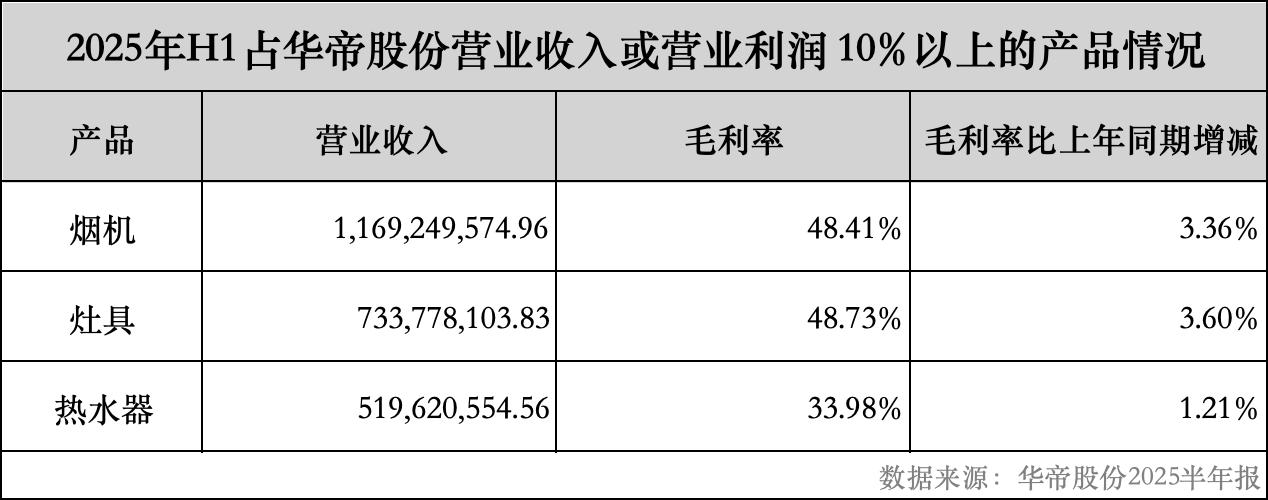
Core Insights - In the first half of 2025, the company reported a revenue of 2.8 billion yuan and a net profit of 272 million yuan, with a basic earnings per share of 0.33 yuan [1] - The company's gross margin increased to 43.54%, up by 2.86% year-on-year, demonstrating significant operational resilience amid industry challenges [1] - The company achieved operational efficiency and quality improvements through product structure optimization, lean operations, and supply chain enhancements [1] Product Performance - The core product categories of the company, including range hoods, stoves, and water heaters, saw gross margin increases of 3.36%, 3.60%, and 1.21% respectively [2] - Revenue from stoves grew by 2% year-on-year, increasing its share of total revenue to 26.21% [1][2] - Emerging growth products such as steam ovens and water purifiers achieved year-on-year growth of 2.69% and 3.25%, indicating successful product diversification and market expansion [2] Research and Innovation - The company invested 116 million yuan in R&D, accounting for 4.14% of its revenue, focusing on core areas and achieving breakthroughs in key technologies [3] - As of June 30, the company added 472 new patents, bringing its total to 4,690, positioning it among the industry leaders [3] Channel Development - The company enhanced its channel structure, achieving a gross margin of 45.89% in offline channels, a significant increase of 6.83% year-on-year [5] - New retail channel gross margin rose to 41.51%, driven by initiatives such as retail transformation and local life platform expansion [5] - The company's high-end transformation and lean management strategies are expected to drive high-quality growth, benefiting from the accelerating consumer upgrade trend in the kitchen appliance industry [5]


上半年利润暴增近七成,绿源集团控股(2451.HK)厚积薄发
Zhong Jin Zai Xian· 2025-08-28 05:17
Core Insights - The company reported a revenue of 3.096 billion yuan for the first half of 2025, representing a year-on-year growth of 22.2%, and a net profit of 110 million yuan, up 66.9% year-on-year [1] - The gross margin reached 13.6%, an increase of 1.6 percentage points compared to the previous year, showcasing the company's strong fundamentals in a complex electric bicycle market [1] Group 1: Technological Advancements - The company emphasizes a technology-driven approach, continuously investing in R&D to maintain its leading position in "liquid-cooled motors" [2] - A digital battery management system was introduced to address battery durability issues, ensuring safety and longevity, with a reputation for lasting "10 years" [2] - The braking system features high-strength ceramic brake pads, enhancing durability by five times compared to standard drum brakes, achieving upgrades in both safety and longevity [2] Group 2: Diverse Business Model - The company offers a comprehensive product line, having launched over 21 new models by June 30, 2025, including industry-leading products like K50 and MS95 [3] - It has established over 14,000 offline retail stores and innovated its marketing strategy by launching online stores on major e-commerce platforms, successfully driving nearly 300,000 electric two-wheelers to stores in the past year [3] - The company was recognized as one of "China's 500 Most Valuable Brands" by the World Brand Lab, indicating strong brand value [3] Group 3: High-End Brand Development - The launch of the LYVA brand targets urban middle-class consumers seeking high-quality, tech-driven electric bicycles, entering the high-end market segment [4] - LYVA features an "AI mid-mounted motor + intelligent riding algorithm," enabling real-time interaction based on road conditions and user status, transitioning from "functional travel" to "smart companion" [4] Group 4: Comprehensive Service Ecosystem - The company focuses on a "full-scenario light travel solution," integrating hardware, software, and services to meet diverse user needs [5] - It has established a "3-kilometer service circle" with 14,000 smart stores nationwide, offering rental, on-site maintenance, and battery swapping services, creating a closed-loop business model [5] - This transition from product sales to ecosystem services positions the company as a comprehensive solution provider in the light travel sector [5] Group 5: Market Positioning and Growth Potential - The new national standard for electric bicycles will be implemented on September 1, 2025, which may lead to the exit of many smaller, less compliant companies, benefiting leading firms with strong compliance and brand influence [6] - The company is positioned for accelerated growth through technological innovation, high-end brand development, and comprehensive service offerings, aiming to redefine the standards in the light travel industry [6]
岚图单飞!央企新能源转型,成败在此一举?
电动车公社· 2025-08-27 16:05
Group 1 - The article discusses the rapid consolidation of automotive brands, including state-owned enterprises like Dongfeng Group [1][2] - Dongfeng Group announced that Lantu Motors will go public in Hong Kong through an introduction listing, while Dongfeng Motor Group Co., Ltd. will complete its privatization and delisting [3][9] - This move is likened to "changing birds in a cage," allowing Lantu to soar while setting the stage for significant changes in Dongfeng's passenger vehicle business [6][8] Group 2 - The privatization does not involve the entire Dongfeng Group, as Dongfeng Motor Group Co., Ltd. remains a non-listed parent company of various subsidiaries [10][11] - The process involves a "share distribution + absorption merger" approach to transition from Dongfeng shares to Lantu shares for investors [15][12] - Shareholders will receive Lantu shares valued at HKD 4.17 per share and a cash compensation of HKD 6.68 per share, making it a favorable deal given Dongfeng's stock price [20][21] Group 3 - Dongfeng Group's decision to delist is driven by the lack of necessity for Dongfeng shares in the capital market, as it has not engaged in capital raising since its listing [24][26] - Despite a revenue exceeding RMB 100 billion, Dongfeng's market perception is hindered by its complex structure and low price-to-book ratio [30][26] - The need for reform and restructuring within Dongfeng's various brands is highlighted as a reason for the privatization and delisting [35][24] Group 4 - Lantu Motors has been profitable since Q4 2024 and has seen consistent sales growth, making it a prime candidate for public listing [36][39] - Lantu is positioned as a high-end electric vehicle brand, requiring the public listing to further its development and financing [39][40] - The article emphasizes Lantu's independence and resource allocation within Dongfeng, showcasing its potential for growth in the competitive market [43][46] Group 5 - The automotive market is characterized by intense competition, with various players undergoing significant changes, including the rise of new brands and the decline of others [55][56] - Dongfeng Group, as a major state-owned enterprise, faces pressure to adapt and innovate in the face of market challenges [58][59] - The future of Lantu Motors and Dongfeng Group is uncertain, with both entities needing to navigate their respective paths in a rapidly evolving industry [60][61]

男人最爱的迪卡侬,失宠了
投中网· 2025-08-27 03:21
Core Viewpoint - Decathlon's recent price increases have led to a significant decline in consumer visits, prompting speculation about the potential sale of its Chinese operations, with estimates valuing the stake at approximately €1-1.5 billion (around ¥10 billion) [5][8][18]. Group 1: Price Increases and Consumer Behavior - Decathlon's products have seen substantial price hikes, such as a 20L backpack rising from ¥49.9 to ¥89.9 and a fleece jacket jumping from ¥249 to ¥499, leading to decreased consumer interest [8][9]. - The company's pricing strategy has been influenced by rising supply chain costs, including increased raw material prices and labor costs, which have pressured profit margins [9][10]. - The shift in consumer behavior is not solely due to price increases but also the emergence of competitive alternatives in the market, which have captured market share from Decathlon [9][10][12]. Group 2: Competitive Landscape - Domestic and international brands have increasingly encroached on Decathlon's market share, with alternatives like Taobao white-label products and brands such as Anta and Li Ning offering competitive pricing and appealing designs [10][11]. - The rise of mid-range and premium brands has further complicated Decathlon's position, as competitors like Lululemon and Camel have introduced products that resonate with urban consumers [11][12]. - The competitive pressure has forced Decathlon to consider a shift towards higher-end products as a strategy to recover profitability [12][18]. Group 3: Internal Challenges and Management Issues - Decathlon's long-standing low-margin business model has resulted in a net profit margin of only 5-6%, significantly lower than competitors like Nike and Adidas [9][12]. - Internal management practices, including a centralized decision-making structure, have led to inefficiencies and employee dissatisfaction, contributing to talent attrition [15][16]. - The company's reliance on a low-cost workforce has become unsustainable, with rising salaries in manufacturing impacting overall profitability [9][15]. Group 4: Potential Buyers and Future Directions - Speculation about the sale of Decathlon's Chinese operations has identified potential buyers, including JD.com and Anta Sports, with JD.com seen as a strong candidate due to its supply chain capabilities [18][19]. - The acquisition could allow Decathlon to leverage JD.com's logistics and data-driven approach to optimize inventory and enhance market presence [19][20]. - The future direction of Decathlon hinges on balancing its traditional low-cost model with the need for higher-end offerings, while maintaining its core identity as a provider of accessible sports goods [21].



男人最爱的迪卡侬,失宠了
36氪· 2025-08-26 14:23
Core Viewpoint - Decathlon is facing a significant decline in consumer interest in China, attributed to rising prices and increased competition from both domestic and international brands [3][10][11]. Group 1: Decline in Consumer Interest - Decathlon's affordable products, such as a 19.9 yuan quick-dry T-shirt and a 49.9 yuan backpack, have seen a noticeable price increase, leading to a decrease in customer visits [3][7]. - The company is rumored to be considering selling approximately 30% of its Chinese subsidiary, with an estimated valuation between 10 billion to 15 billion euros (approximately 100 billion yuan) [3][4]. - The increase in prices is linked to rising supply chain costs, including raw material prices and labor costs, which have pressured Decathlon's low-cost business model [7][8]. Group 2: Competitive Landscape - The market has seen a surge in alternative brands, with consumers shifting to cheaper options from platforms like Pinduoduo and Douyin, as well as domestic brands like Anta and Li Ning [10][11]. - Decathlon's pricing strategy has led to a loss of its core customer base, as competitors offer similar products at lower prices or with more appealing designs [10][11]. - The company has struggled to maintain its low-price, high-experience model due to increased operational costs in urban areas [7][8]. Group 3: Internal Management Issues - Decathlon's internal management has been criticized for being overly centralized, leading to inefficiencies and a lack of responsiveness to market changes [17][18]. - Employee dissatisfaction due to low wages compared to competitors has contributed to talent attrition, impacting the company's operational effectiveness [14][15]. - The company's long-standing reliance on a low-margin business model has limited its ability to offer competitive salaries, further exacerbating employee turnover [15][19]. Group 4: Potential Buyers and Future Strategies - Potential buyers for Decathlon's Chinese operations include JD.com, Anta Sports, and international private equity firms like Blackstone and Carlyle, with JD.com seen as the frontrunner due to its supply chain capabilities [21][22]. - Anta Sports could leverage its existing brand portfolio to enhance Decathlon's market position, but there are concerns about whether it would maintain Decathlon's low-cost positioning [23][25]. - The future direction of Decathlon hinges on whether it can balance its high-end transformation with its original value proposition of affordability and accessibility [25][26].

鞍钢股份总经理张红军、副总经理邓强同日辞任,2024年公司亏71亿总经理年薪近百万
Xin Lang Zheng Quan· 2025-08-26 06:10
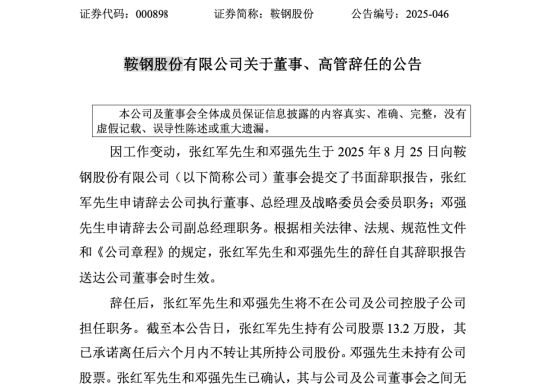
Core Viewpoint - The resignation of key executives at Ansteel Co., Ltd. raises concerns about the company's governance and strategic execution amid ongoing challenges in its structural transformation and performance pressure [2][9]. Executive Changes - Ansteel announced significant personnel changes, with Executive Director and General Manager Zhang Hongjun and Vice General Manager Deng Qiang resigning [1][2]. - Zhang Hongjun held 132,000 shares in the company and committed not to transfer them within six months post-resignation, while Deng Qiang did not hold any shares [2]. Financial Performance - Ansteel's 2024 financial report indicates a revenue of 1,051.01 billion RMB, a decline of 9.06% year-on-year, and a total profit loss of 7.035 billion RMB, down 70.38% [5]. - The net profit attributable to shareholders was a loss of 7.122 billion RMB, representing a 118.8% decline compared to the previous year [5]. - Despite advancements in high-end products and green manufacturing, the company faces pressure from steel prices, rising raw material costs, and weak demand [5]. Management Background - Zhang Hongjun has a long history within the Ansteel system, contributing to key projects but overseeing a period of declining performance [3][4]. - Deng Qiang's career has been diverse, with experience across various subsidiaries, but his short tenure at Ansteel suggests ongoing challenges in strategic alignment [6][9]. Strategic Implications - The resignations may signal a shift in Ansteel's governance structure and strategic direction, highlighting the need for improved management and market strategies [9]. - The company is at a critical juncture, facing dual challenges of high-end transformation and profitability recovery, which will influence its competitive positioning in the next industry cycle [9].

上海石化上半年净利润暴跌1755% 高端转型阵痛加剧
Xi Niu Cai Jing· 2025-08-25 13:22
Core Viewpoint - Shanghai Petrochemical reported a significant decline in performance for the first half of 2025, with revenue dropping by 9.21% year-on-year and a net loss of 4.62 billion yuan, marking a staggering 1755% decrease compared to the previous year [2][3] Financial Performance - Revenue for the first half of 2025 was 39.52 billion yuan, down from 43.53 billion yuan in the same period last year, representing a decrease of 9.21% [3] - The total profit (loss) for the period was -595.62 million yuan, a decline of 1688.52% year-on-year [3] - The net loss attributable to shareholders was -462.13 million yuan, a drop of 1755.66% compared to the previous year [3] - The net cash flow from operating activities was 778.94 million yuan, an increase of 127.78% year-on-year [4] - The net assets attributable to shareholders were 24.31 billion yuan, down 2.94% from the end of the previous year [3] Business Segment Performance - The refining segment generated revenue of 26.86 billion yuan, a decrease of 12.96% year-on-year, primarily due to a 6.72% drop in sales volume and a decline in average selling prices [4] - The chemical products segment reported revenue of 8.54 billion yuan, down 3.41% year-on-year, influenced by market conditions [4] - The petrochemical trading segment achieved revenue of 3.86 billion yuan, an increase of 22.65% year-on-year, driven by increased production and sales of petroleum coke and liquefied gas [4] Production and Operational Insights - Total production of main products was 5.58 million tons, a decrease of 4.35% year-on-year [4] - Crude oil processing amounted to 6.32 million tons, down 4.93% year-on-year [4] - Finished oil production decreased by 6.81%, with diesel and aviation kerosene down by 13.56% and 8.62% respectively [4] Strategic Initiatives and Future Outlook - The company is addressing aging equipment issues and has achieved a 98.8% completion rate in rectifying old facilities, with plans for full completion within the year [5] - Shanghai Petrochemical is focusing on high-end, intelligent, and green development, initiating its "14th Five-Year" planning [5] - The company is accelerating the construction of ongoing projects and enhancing product development, particularly in high-value-added products [5] - The market outlook remains challenging, with a weak demand scenario and increased penetration of new energy vehicles impacting the existing market [5][6] - The company aims to optimize operations and drive innovation while ensuring safety and environmental compliance in the second half of the year [5][6]


男人最爱的迪卡侬,失宠了
首席商业评论· 2025-08-25 04:05
Core Viewpoint - Decathlon's decline in China is attributed to rising prices, increased competition, and internal management issues, leading to a significant drop in consumer visits and sales [5][10][17]. Price Increase Impact - Decathlon's price hikes have led to a decrease in consumer interest, with products like a 20L backpack increasing from 49.9 yuan to 89.9 yuan, and a jacket from 199 yuan to 599 yuan [6][7]. - The company's net profit margin has been low, around 5% to 6%, compared to over 10% for competitors like Nike and Adidas, with revenue growth plummeting from 21.3% to 1.15% [8][10]. Competitive Landscape - Increased competition from both domestic and international brands has eroded Decathlon's market share, with alternatives like low-cost brands on e-commerce platforms attracting former Decathlon customers [10][11]. - Brands like Anta and Li Ning are aggressively targeting the same consumer base, offering competitive pricing and stylish designs [10][11]. Internal Management Issues - Decathlon's internal management style, characterized by low salaries and a lack of career advancement opportunities, has contributed to employee turnover and dissatisfaction [13][14]. - The company's centralized decision-making process has led to inefficiencies and a lack of responsiveness to market changes [16][17]. Potential Buyers for Decathlon China - There are ongoing discussions about the potential sale of Decathlon's China business, with major interest from JD.com, Anta Sports, and international private equity firms [19][20]. - JD.com is seen as a strong candidate due to its supply chain capabilities and data-driven approach, which could help Decathlon optimize its operations [19][20]. Future Directions - Decathlon faces a critical juncture, needing to balance its high-end transformation with its original value proposition of affordability and accessibility [23][24]. - The company must decide whether to continue pursuing a high-end strategy or return to its roots of providing affordable sports products for all consumers [24].
水羊股份(300740):二季度归母净利同比增长24% 高端化转型成效显著
Xin Lang Cai Jing· 2025-08-25 00:43
Core Viewpoint - The company demonstrated accelerated growth in Q2 2025, with revenue reaching 2.5 billion, a year-over-year increase of 9.02%, and net profit attributable to shareholders at 123 million, up 16.54% year-over-year [1] Financial Performance - In Q2 2025, the company achieved revenue of 1.414 billion, reflecting a year-over-year growth of 12.16%, and net profit of 81 million, which is a 23.76% increase year-over-year [1] - The company's gross margin and net margin for Q2 2025 were 65.27% and 5.77%, respectively, showing improvements of 3.67 and 0.48 percentage points year-over-year [2] Business Segments - The self-owned brand segment generated revenue of 1.039 billion in H1 2025, accounting for 41.55% of total revenue, with a gross margin of 76.83%, up 5.7 percentage points year-over-year [1] - The company is focusing on high-end brands such as Ifidan, Perheqiao, and Revive, with Revive contributing significantly to revenue growth after its acquisition [1] - The agency operation business is returning to normal development, focusing on leading brands like Dabao and Mistick, which has stabilized overall profit margins [2] Product Categories - In H1 2025, the water, milk, and cream category generated revenue of 1.997 billion, a year-over-year increase of 11.70%, while the mask category achieved revenue of 423 million, up 17.96% year-over-year [2] Sales Channels - The company primarily utilizes online e-commerce channels, with revenue from Taobao platforms at 595 million, a year-over-year increase of 3.63%, and from Douyin platforms at 998 million, up 16.11% year-over-year [2] Cost Structure - In Q2 2025, the sales, management, and R&D expense ratios were 48.47%, 4.80%, and 1.62%, respectively, reflecting increases of 1.20, 0.90, and 0.52 percentage points year-over-year [2]
江苏新增17家符合环保装备制造业规范条件企业
Xin Hua Ri Bao· 2025-08-24 23:12
Core Insights - Jiangsu Province has the highest number of newly approved enterprises in the environmental protection equipment manufacturing industry, with 17 companies passing the review, accounting for 25.8% of the national total [1] - A total of 90 enterprises from Jiangsu are included in the 2025 version of the list, representing 21.6% of the nationwide total [1] - The Ministry of Industry and Information Technology (MIIT) aims to guide enterprises towards technological innovation, quality control, and safety production capabilities, promoting a transition to green, digital, intelligent, and high-end development [1] Summary by Category Environmental Protection Equipment - The 2025 version of the list includes 416 enterprises, with 66 newly approved and 350 re-evaluated [1] - The newly approved companies include 5 in air pollution control, 10 in wastewater treatment, and 2 in environmental monitoring instruments [1] Industry Development - The list aims to replace the 2024 version and is published after local recommendations, expert evaluations, and public announcements [1] - The initiative is part of a broader strategy to promote high-quality development in the environmental protection sector [1]
