ETF投资

Search documents
巴西IBOVESPA指数ETF今日合计成交额3.17亿元,环比增加310.25%
Zheng Quan Shi Bao Wang· 2025-11-27 09:57
Core Insights - The trading volume of Brazil's IBOVESPA index ETFs reached 317 million yuan today, an increase of 239 million yuan compared to the previous trading day, representing a growth rate of 310.25% [1] Trading Performance - The E Fund Itaú Brazil IBOVESPA ETF (QDII) (520870) had a trading volume of 193 million yuan today, up by 152 million yuan from the previous day, with a growth rate of 376.51% [1] - The Huaxia Bradesco Brazil IBOVESPA ETF (QDII) (159100) recorded a trading volume of 124 million yuan, an increase of 86.9865 million yuan from the previous day, with a growth rate of 237.13% [1] Market Movement - As of market close, ETFs tracking the Brazil IBOVESPA index averaged an increase of 2.91%, with notable performers including the E Fund Itaú Brazil IBOVESPA ETF (QDII) (520870) rising by 3.17% and the Huaxia Bradesco Brazil IBOVESPA ETF (QDII) (159100) increasing by 2.64% [1]
《来!聊聊ETF》第10期:基金管理人如何管理ETF产品
申万宏源证券上海北京西路营业部· 2025-11-27 02:53
女育之日的,在互世方对历史,何小汉贝尔松,了得 成对投资者的任何投资建议。投资者不应以该等信 息取代其独立判断或仅依据该等信息做出投资决 策。申万宏源力求本栏目的信息准确可靠,但对这 些信息的准确性或完整性不作保证,亦不对因使用 该等信息而引发或可能引发的损失承担任何责任。 本栏目内容如有变动,恕不另行通知。最终解释权 归申万宏源证券有限公司所有。 编者按:为帮助投资者系统了解 ETF、掌握ETF投资方法,深交所推出"来!聊聊ETF"系 列动画短视频,希望用浅显易懂的语言传递投资知识。今天是第10期,一起看看基金管理人如 何管理ETF产品吧! ...


超400亿资金加仓港股科技类ETF
21世纪经济报道· 2025-11-27 02:01
Core Viewpoint - The Hong Kong technology sector has experienced a correction after reaching a yearly high in early October, with significant ETF inflows indicating investor confidence in the long-term value of technology companies despite short-term volatility [1][4][5]. Group 1: Market Performance - The Hong Kong technology indices, including the CSI Hong Kong Stock Connect Technology Index and the Hang Seng Technology Index, have seen declines exceeding 7% in the past month [1][4]. - Major technology stocks like Alibaba and SMIC have faced price drops of 6.24% and 15.06% respectively over the same period [4]. - The Hang Seng Technology Index's price-to-earnings ratio (PE-TTM) stands at 22.5 times, which is at the 27th percentile over the past decade, indicating a relatively low valuation [6][9]. Group 2: ETF Inflows - Despite the market correction, technology-focused ETFs in Hong Kong have seen a net inflow of 439 billion yuan in the past month, with 13 Hang Seng Technology ETFs attracting over 240 billion yuan [1][5]. - Specific ETFs such as Huatai-PB Hang Seng Technology ETF and Huaxia Hang Seng Technology Index ETF have recorded net inflows of 57.72 billion yuan and 54.47 billion yuan respectively [5][6]. Group 3: Investor Sentiment and Future Outlook - Investors remain optimistic about the long-term growth potential of leading technology companies like Tencent, Alibaba, and Xiaomi, which are seen as having strong technological foundations and market positions [6][9]. - The market is currently influenced by external factors such as the U.S. Federal Reserve's hawkish stance, which has raised concerns about liquidity and market valuations [4][5]. - Analysts suggest that if short-term pressures on the Hong Kong market are alleviated, there is potential for continued upward momentum driven by institutional investments [8][9]. Group 4: AI Bubble Concerns - Concerns regarding an "AI bubble" have emerged, but some analysts argue that the current fluctuations do not diminish the underlying investment value of AI technologies [5][10]. - The potential of AI technologies is still seen as significant, with leading companies that can integrate AI into diverse business scenarios likely to benefit the most [11].

《来!聊聊ETF》第9期:ETF的交易成本怎么计算
申万宏源证券上海北京西路营业部· 2025-11-26 03:24
女育之日的,在互世方对历史,何小汉贝尔松,了得 成对投资者的任何投资建议。投资者不应以该等信 息取代其独立判断或仅依据该等信息做出投资决 策。申万宏源力求本栏目的信息准确可靠,但对这 些信息的准确性或完整性不作保证,亦不对因使用 该等信息而引发或可能引发的损失承担任何责任。 本栏目内容如有变动,恕不另行通知。最终解释权 归申万宏源证券有限公司所有。 编者按:为帮助投资者系统了解 ETF、掌握ETF投资方法,深交所推出"来!聊聊ETF"系 列动画短视频,希望用浅显易懂的语言传递投资知识。今天是第9期,一起看看ETF的交易成 本怎么计算吧! ...

游戏ETF领涨;超700亿元资金借ETF逆市加仓丨ETF晚报
2 1 Shi Ji Jing Ji Bao Dao· 2025-11-25 11:08
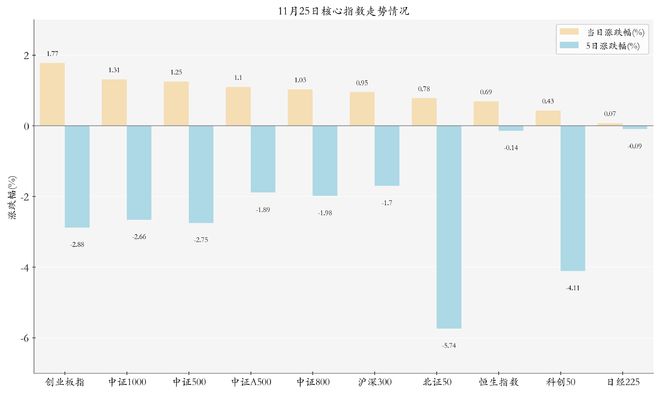
ETF Industry News - The three major indices collectively rose, with the Shanghai Composite Index increasing by 0.87%, the Shenzhen Component Index by 1.53%, and the ChiNext Index by 1.77. Multiple gaming sector ETFs saw gains exceeding 4% [1] - Over 70 billion yuan flowed into ETFs during a market downturn, with a net inflow of 701.21 billion yuan into stock and cross-border ETFs, indicating that many investors are taking advantage of the market correction to buy at lower prices [2] Market Overview - On November 25, the three major indices all rose, with the Shanghai Composite Index closing at 3870.02 points, the Shenzhen Component Index at 12777.31 points, and the ChiNext Index at 2980.93 points. The highest intraday points were 3882.03, 12882.81, and 3027.83 respectively [3] - In terms of sector performance, telecommunications, media, and non-ferrous metals led the day with gains of 3.54%, 2.85%, and 2.42% respectively, while defense, transportation, and oil & gas sectors lagged behind [5] ETF Market Performance - The overall performance of ETFs showed that commodity ETFs had the best average gain of 1.44%, while bond ETFs had the worst average performance at -0.04% [7] - The top-performing ETFs included the 5G ETF (159994.SZ) with a gain of 4.28%, followed by gaming ETFs (516010.SH and 159869.SZ) with gains of 4.14% and 4.11% respectively [10][11] Trading Volume - The top three ETFs by trading volume were the ChiNext ETF (159915.SZ) with a trading volume of 6.486 billion yuan, the A500 ETF (512050.SH) at 5.733 billion yuan, and the A500 ETF Huatai-PB (563360.SH) at 4.607 billion yuan [13][14]
上海金ETF(159830)年内累计“吸金”超13亿居深市同标的首位,美国银行:黄金价格2026年或将达到5000美元
2 1 Shi Ji Jing Ji Bao Dao· 2025-11-25 02:21
Group 1 - The A-share market opened higher on November 25, with the CSI A500 index rising over 1% [1] - Among the constituent stocks, Huadian Co. hit the daily limit, while Giant Network, Fangda Carbon, Feilihua, and Kying Network saw significant gains [2] - The CSI A500 ETF Tianhong (159360) recorded a trading volume exceeding 20 million yuan and experienced a net subscription of 6 million units during the day, indicating active trading [2] Group 2 - The CSI A500 ETF Tianhong has seen a net inflow of over 21 million yuan over the past four days, reflecting strong investor interest [2] - The Shanghai Gold ETF (159830) rose by 1.69%, marking its second consecutive day of gains, with a year-to-date net inflow of 1.351 billion yuan, the highest among similar products in the Shenzhen market [2] - The management fee for the Shanghai Gold ETF is 0.25%, and the fund custody fee is 0.05%, both lower than the average for similar products, and it supports T+0 trading [3] Group 3 - Bank of America predicts that gold prices could reach $5,000 per ounce by 2026, driven by ongoing factors behind the recent surge in gold prices [3] - Central banks have been significant buyers of gold in recent years, although some may reduce their gold holdings temporarily as their allocations exceed targets [3] - Overall, there is still potential for an increase in the proportion of gold in global central bank reserves [3]

主动管理的价值发现与被动策略的配置升维
Yin He Zheng Quan· 2025-11-24 05:08
Group 1 - The report highlights that active equity funds are expected to experience a value reassessment due to favorable market conditions and policy support, despite previous underperformance [4][6][10] - The active equity funds have shown significant excess returns in a structural bull market, particularly those focused on advanced manufacturing themes [4][5][6] - The report suggests a "core + satellite" investment strategy to capitalize on the current market environment, emphasizing the importance of thematic investments in state-owned enterprises, technology, and consumption sectors [4][5][6] Group 2 - The ETF market has seen a substantial breakthrough in both quantity and scale, with the total ETF size surpassing 1 trillion yuan, indicating a shift towards high-quality development [4][5][10] - The report notes that the growth of passive products is driven by policy support, technological advancements, and increased demand, particularly in the non-ferrous metals and TMT sectors [4][5][10] - The report anticipates a continued trend of strong performance in popular sectors, with a focus on technology and financial real estate, as well as the potential for expansion in niche ETFs [4][5][10] Group 3 - The report outlines a multi-dimensional ETF quantitative allocation strategy that leverages macro timing, momentum, and advanced modeling techniques to capture diverse returns [4][5][10] - It emphasizes the importance of asset allocation to achieve stable risk-adjusted returns, particularly in a "slow bull" market [4][5][10] - The report suggests that the focus should be on sectors with strong momentum and lower crowding, especially in technology, to capture excess returns [4][5][10]
Why These 2 ETFs Could Redefine Retirement Income in 2026
Yahoo Finance· 2025-11-22 16:57
Core Insights - Retirement planning is rapidly evolving due to concerns over Social Security shortfalls and rising healthcare costs, necessitating immediate attention to income potential for those nearing retirement [2] - Traditional retirement strategies focusing on bonds, stocks, drawdowns, and cash reserves are becoming outdated, as cash loses purchasing power and bonds offer lower yields [4][5] Investment Strategies - The new approach to retirement income blends income generation with long-term market participation, utilizing ETFs that provide structured monthly payments while allowing for portfolio growth [6] - The JPMorgan Equity Premium Income ETF (JEPI) is highlighted for its reliability, focusing on high-quality US stocks and enhancing monthly income through options, yielding 8.38% with a year-to-date return of 5.83% in 2025 [7][8] - The Vanguard Total Stock Market ETF (VTI) offers a lower yield of 1.16% but has delivered a total return of 15.26% in 2025, indicating a potential for growth despite lower immediate income [8]
指数化投资生态持续优化
Shang Hai Zheng Quan Bao· 2025-11-21 18:43
Group 1 - The market has seen a rapid increase in the number of ETFs, with 32 China Securities A500 ETFs established, and the scale of Huatai-PB China Securities A500 ETF reaching 25.697 billion yuan as of November 20, while some ETFs have scales below 10 million yuan [1] - The regulatory body encourages fund managers to develop ETF products based on market conditions and investor needs, advising against following trends and mass applications that could lead to poor fundraising and unstable operations [1] - The China Securities Regulatory Commission (CSRC) will implement measures such as batch registration and guiding reasonable initial scale settings to ensure orderly fundraising and listing of ETFs, preventing adverse market impacts [1] Group 2 - The rapid growth of ETF products has led to issues with similar names and low recognition, complicating investor decision-making [2] - The Shanghai Stock Exchange and Shenzhen Stock Exchange have issued guidelines for ETF naming conventions to enhance product identification, requiring names to include core investment elements and fund manager abbreviations by March 31, 2026 [2] - Industry participants have begun to respond, with several fund managers, including Dacheng Fund, changing ETF names to align with the new guidelines, improving product recognition [2] Group 3 - The standardization of ETF naming proposed by the exchanges aims to resolve investor identification challenges and promote industry standardization and regulation [3] - The company has already incorporated fund manager names into nearly 70 of its ETFs, enhancing product recognition and aiding investors in making informed decisions [3]
私募现身年内上市190只ETF前十大持有人 私募大买ETF有争议?
Sou Hu Cai Jing· 2025-11-21 03:43
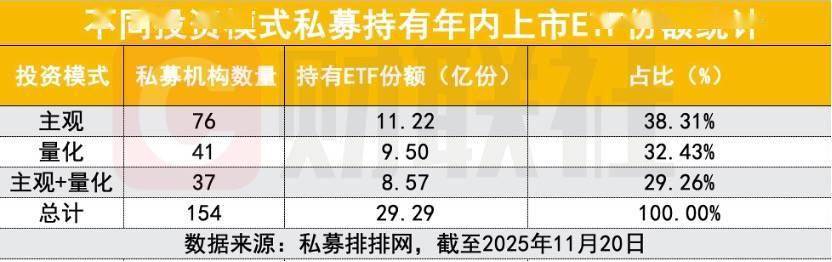
Core Insights - Private equity firms are becoming significant holders of ETFs, with 154 firms entering the top ten holders of 190 newly listed ETFs this year, holding a total of 2.929 billion shares [1][2][11] Group 1: Private Equity Participation - Subjective private equity firms are the main subscribers of ETFs, with 76 firms holding 1.122 billion shares, accounting for 38.31% of the total [2][3] - Quantitative private equity firms follow, with 41 firms holding 0.950 billion shares, representing 32.43% of the total [2][3] - Mixed subjective and quantitative private equity firms are less common, with 37 firms holding 0.857 billion shares, making up 29.26% of the total [2][3] Group 2: Size of Private Equity Firms - Small and medium-sized private equity firms show a stronger preference for ETFs, with 79 small firms holding 1.155 billion shares (39.43%) and 49 medium firms holding 1.154 billion shares (39.40%) [3][4] - In contrast, large private equity firms (26 firms) hold only 0.620 billion shares, accounting for 21.17% of the total [3][4] Group 3: ETF Characteristics and Appeal - ETFs are valued for risk diversification, operational efficiency, cost advantages, strategy flexibility, and liquidity management, making them attractive to private equity firms [5][6] - The total number of ETFs issued this year reached 322, with a total issuance of 244.644 billion shares, marking a year-on-year increase of 79.89% in quantity and 91.83% in volume [6] Group 4: Focus on Sci-Tech Board ETFs - Private equity firms are particularly interested in Sci-Tech Board ETFs, with 48 firms entering the top ten holders of these ETFs, holding a total of 0.820 billion shares [1][6] - Among the ETFs with significant holdings by private equity, those related to the Sci-Tech Board constitute a notable portion, with 4 out of 12 ETFs holding at least 50 million shares [6] Group 5: Controversies Surrounding ETF Investments - There are debates regarding the implications of private equity firms heavily investing in ETFs, with some questioning whether this reflects a lack of research capability [10] - Some private equity firms engage in arbitrage strategies, participating in ETF launches while hedging risks through related index futures [10]