AI应用

Search documents
资金6日狂揽20亿元!创业板人工智能ETF(159363)规模突破60亿元再创新高!配置思路有哪些?
Xin Lang Cai Jing· 2026-01-20 01:20
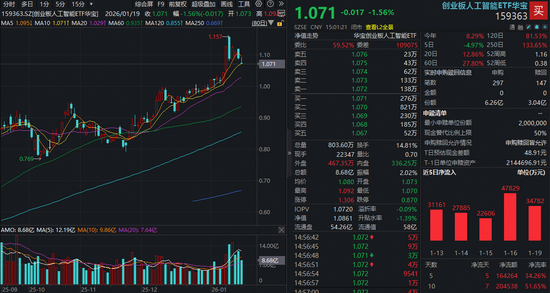
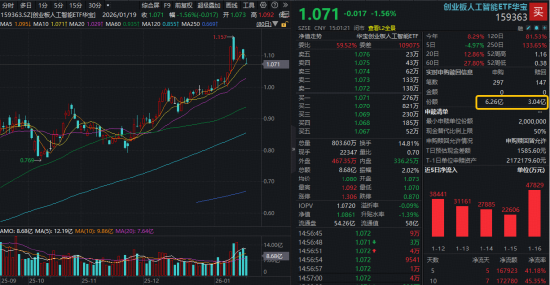
Market Overview - The ChiNext AI sector experienced fluctuations and corrections, with funds continuing to buy on dips. Most constituent stocks declined, with notable gainers including Hangyu Micro up over 6% and BlueFocus up over 3%. Conversely, Ruijie Networks led the decline, falling over 10% [1][8]. - The ChiNext AI ETF (159363) saw a slight decline of 1.56%, retreating to the 10-day moving average, with a trading volume of 868 million yuan. After a significant inflow of nearly 1.7 billion yuan in the previous week, the fund recorded a net inflow of 347 million yuan over six consecutive days, totaling over 2 billion yuan [1][8]. Fund Performance - The ChiNext AI ETF managed by Huabao reached a new high in scale, totaling 6.164 billion yuan as of January 19, with an average daily trading volume of nearly 800 million yuan over the past six months, leading among the eight ETFs tracking the ChiNext AI index [4][12]. - The fund manager indicated that short-term corrections do not alter the strong performance expectations for the A-share market in the first half of the year, suggesting that performance stocks in the optical module sector may become a focal point for market consolidation during this period [5][10]. Sector Insights - From a funding allocation perspective, the optical module sector is expected to attract attention due to positive earnings forecasts. The market is anticipated to undergo structural adjustments as companies begin to disclose their annual reports, with performance becoming a key driver of market dynamics [3][10]. - The AI application sector has emerged as a leading theme for 2026, with a year-to-date increase of 19%, making it the top performer in the A-share market. The ongoing trend of AI applications accelerating towards commercialization is expected to continue, supported by China's advantages in application deployment and user scale [11][13]. Investment Strategy - The ChiNext AI ETF is strategically positioned with approximately 60% of its portfolio in computing power (primarily optical modules) and about 40% in AI applications, reflecting a balanced approach to both sectors [13].


超300份预告折射产业冷暖,业绩驱动取代概念博弈成市场主线
第一财经· 2026-01-19 12:59
2026.01. 19 本文字数:3133,阅读时长大约5分钟 作者 | 第一财经 魏中原 景气度较差的地产行业,相关上市公司业绩也普遍承压。华夏幸福(600340.SH)预计去年归母净利润亏损160亿元至240亿元;绿地控股 (600606.SH)预亏160亿元至190亿元。就业绩亏损的原因,上述两家企业均表示市场有效需求不足、社会预期偏弱,房地产业的结转规模、基建产 业的营收规模同比均有较大幅度下降。 A股市场已有超过350家公司发布2025年度业绩预告,一幅清晰的产业景气度"分野图"就此展开。 业绩预告数据显示,在全球科技浪潮与商品周期驱动下, 半导体、有色金属 行业业绩耀眼,龙头公司普遍实现高增长;而曾备受瞩目的 光伏 产业则因 产能过剩、价格内卷深陷亏损,多家龙头预亏合计超300亿元。更为引人深思的是, 商业航天、AI应用 等此前遭资金热捧的赛道,多数公司业绩预告 亏损,凸显概念炒作后基本面与估值的严重脱节。 综观已披露的业绩预告,A股市场正在经历一场从"预期叙事"到"报表验证"的切换,市场资金正基于业绩真实成色进行博弈与调仓,业绩确定性已成为 当前市场的核心锚点。 半导体业绩实现高增长,光伏龙头陷 ...

商业航天突传重磅!军工ETF(512810)上探2.8%!资金博弈业绩主线?创业板人工智能ETF单日获净申购超3亿份
Xin Lang Cai Jing· 2026-01-19 11:31
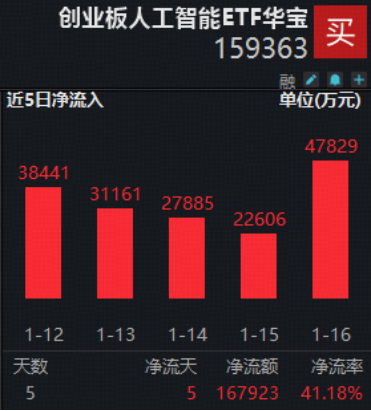
Group 1 - A-shares showed mixed performance on January 19, with the Shanghai Composite Index performing strongly while the ChiNext Index experienced a pullback, and total trading volume in Shanghai, Shenzhen, and Beijing reached 2.73 trillion yuan, a significant decrease of 324.3 billion yuan from the previous trading day [1][23] - The commercial aerospace sector received significant news with the successful validation of crewed spacecraft landing buffer technology, leading to a rise in the General Aviation ETF Huabao (159231) by 2.2% [1][10] - The chemical sector is entering an upward cycle as large-scale chemical products are at a dual turning point of capacity and inventory, with the Chemical ETF (516020) surging by 3.06%, reaching its highest closing price since August 2022 [1][5][30] Group 2 - The AI sector continues to attract substantial investment, with the ChiNext AI ETF Huabao (159363) seeing a net subscription of 322 million units on January 19, following a total of 1.679 billion yuan in net inflows over the previous five days [2][24] - The focus on the domestic AI industry chain is evident, as the Science and Technology Innovation AI ETF Huabao (589520) also experienced net inflows totaling 156 million yuan over the same period [2][24] Group 3 - The National Bureau of Statistics reported that China's GDP for 2025 is projected to be 14,018.79 billion yuan, with a year-on-year growth of 5%, marking the successful completion of the "14th Five-Year Plan" [4][26] - Analysts suggest that the market's risk appetite may improve following the release of macroeconomic data, with potential incremental policies expected to be introduced [4][26] - The chemical sector has shown strong performance since 2025, with the Chemical ETF (516020) index rising by 52.03%, significantly outperforming major A-share indices [5][29] Group 4 - The price of refrigerants has surged, with R507 and R404 reaching 46,000-49,000 yuan/ton and 43,000-45,000 yuan/ton respectively, reflecting increased overseas demand and tightened domestic supply [8][30] - The chemical industry is expected to experience a recovery in profitability and valuation in 2026, driven by supply-demand rebalancing and new production capabilities in AI computing and advanced manufacturing [8][30] Group 5 - The commercial aerospace sector is experiencing a rebound, supported by strong policy backing and improving industry trends, with significant investments in satellite technology and related fields [14][15] - The profitability of leading companies in the commercial aerospace index has shown improvement, with expected growth in earnings for 2026 [15]


港股AI倒车接人?阿里跌逾3%,近12亿资金涌入高“含BA量”港股互联网ETF(513770)
Xin Lang Cai Jing· 2026-01-19 11:25
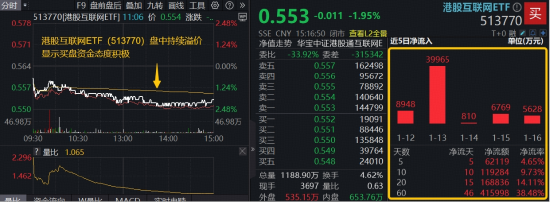
Core Viewpoint - The Hong Kong stock market is experiencing a downturn, with major internet stocks like Alibaba and Kuaishou seeing significant declines, while there is a notable inflow of capital into the Hong Kong Internet ETF, indicating investor interest in AI-related assets [1][9]. Group 1: Market Performance - As of January 19, the Hang Seng Index and the Hang Seng Tech Index both fell over 1%, with Alibaba-W down more than 3% and Kuaishou-W down over 2% [1][9]. - The Hong Kong Internet ETF (513770) saw a price drop of 1.95%, marking three consecutive days of decline and falling below the 10-day moving average [1][9]. - Despite the downturn, the Hong Kong Internet ETF has attracted a net inflow of 1.193 billion yuan over the past 10 days, indicating strong buying interest [1][9]. Group 2: AI and Technology Sector Outlook - The acceleration of AI applications is expected to benefit the technology sector in the medium to long term, with 2026 anticipated to be a pivotal year for AI commercialization [3][11]. - Alibaba's recent integration of its Qianwen App with its ecosystem, allowing AI-driven shopping functionalities, is seen as a significant advancement in the AI narrative for the Hong Kong internet sector [3][11]. - Analysts predict that leading companies in the AI space may experience both valuation and performance recovery as the commercialization path for AI becomes clearer [3][11]. Group 3: Valuation and Investment Opportunities - The current valuation of Hong Kong AI stocks is at a historical low, with the Hong Kong Internet Index's latest P/E ratio at 26.17, significantly lower than that of the ChiNext Index (43.05) and the Nasdaq 100 (36.23) [3][12]. - The top ten holdings in the Hong Kong Internet ETF include major players like Alibaba (14.71% weight), Tencent (14.64%), and Xiaomi (12.29%), collectively accounting for nearly 77% of the ETF [5][14]. - The fund size of the Hong Kong Internet ETF reached a record high of 14.637 billion yuan, with an average daily trading volume exceeding 600 million yuan since 2025, indicating strong liquidity [6][14].
坚定加仓!创业板人工智能ETF(159363)缩量退守10日线,资金单日扫货超3亿份!博弈年报行情?
Xin Lang Cai Jing· 2026-01-19 11:25
Market Overview - The ChiNext AI sector experienced fluctuations with a slight pullback, while funds continued to buy on dips. Most constituent stocks declined, with notable gainers including Hangyu Micro rising over 6% and BlueFocus up over 3%. Conversely, Ruijie Networks led the decline with a drop of over 10% [1][7] - The popular ETF tracking the ChiNext AI sector (159363) saw a decrease of 1.56%, retreating to the 10-day moving average, with a trading volume of 868 million yuan. After a significant net inflow of nearly 1.7 billion yuan over the past week, the fund recorded a net subscription of 322 million units today, indicating continued accumulation [1][7] Investment Strategy - According to Industrial Securities, the focus on performance expectations in the second half of January during the earnings disclosure period suggests a structural adjustment in the market. As market sentiment returns to rationality, earnings will become a key factor driving market movements, with previous hot sectors facing performance validation [3][9] - The technology sector, particularly in upstream computing hardware (communications, semiconductors), has seen upward revisions in profit forecasts since November last year, indicating a potentially positive fundamental support. The communications industry has underperformed in the AI hardware sector since the beginning of the year, suggesting it may attract funds focused on fundamentals during the earnings disclosure period [3][10] Future Outlook - CITIC Securities anticipates that 2026 will be a pivotal year for AI applications, as major cloud service providers (CSPs) have invested heavily in capital expenditures for over three years. The development of AI applications will continue to drive the growth of computing power and model training iterations [4][10] - The ChiNext AI ETF (159363) is positioned to benefit directly from the commercialization of AI technology, with approximately 60% of its portfolio allocated to computing power (primarily optical modules) and 40% to AI applications, representing both core computing and true AI application sectors [4][10]
股价9天翻一倍!301171 澄清不涉GEO业务 明天复牌!
Zheng Quan Shi Bao Wang· 2026-01-19 11:15
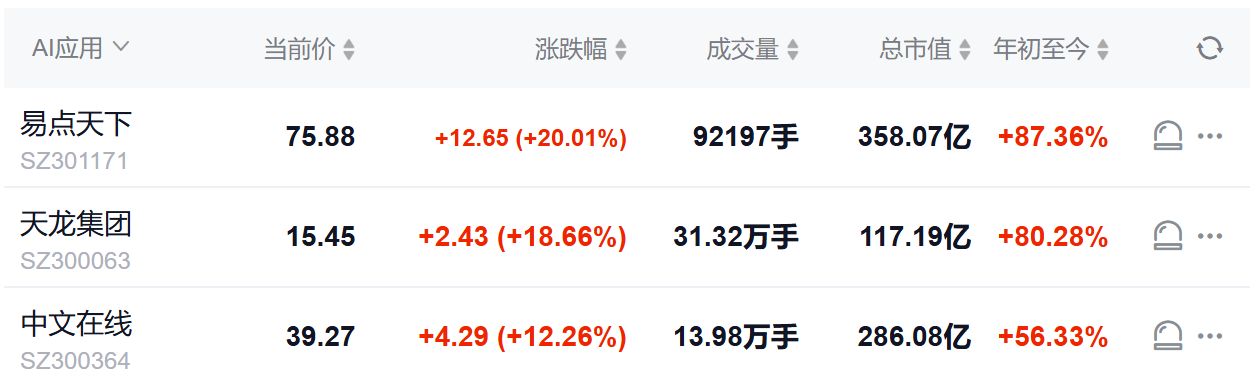
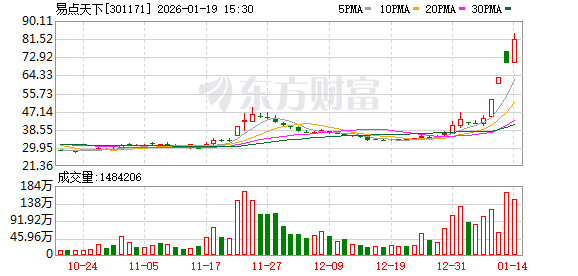
Core Viewpoint - The stock of Yidian Tianxia (301171) has experienced a significant increase of over 100% in just nine trading days, leading to a suspension of trading for further investigation [2][4]. Group 1: Stock Performance and Trading Suspension - Yidian Tianxia announced that from December 31, 2025, to January 14, 2026, its stock price increased by 121.34%, prompting concerns about abnormal trading fluctuations [7]. - The company will conduct a suspension of trading to investigate the reasons behind the stock price volatility, which has been classified as severe [7]. Group 2: Business Operations and Financial Performance - Yidian Tianxia confirmed that its business does not involve GEO operations and has not generated related revenue; its main services include overseas integrated marketing, digital marketing, and AI-driven digital services [6]. - For the first three quarters of 2025, the company reported a revenue of 2.717 billion yuan, representing a year-on-year growth of 54.94%, and a net profit attributable to shareholders of 204 million yuan, up 4.41% year-on-year [6]. - In Q3 2025, the company achieved a revenue of 980 million yuan, reflecting a year-on-year increase of 46.80% [6]. Group 3: Market Sentiment and AI Application - The recent surge in the AI application sector has led the market to categorize Yidian Tianxia as a popular AI application stock, alongside companies like Zhongwen Online and Tianlong Group [7]. - The market's interest in Yidian Tianxia is attributed to its use of large models and algorithms to enhance programmatic advertising and AIGC creative content generation, thereby improving cost efficiency for overseas marketing [7].
涨停复盘:今日全市场共103只股涨停,连板股总数11只,机器人概念五洲新春、日盈电子涨停!
Sou Hu Cai Jing· 2026-01-19 11:10
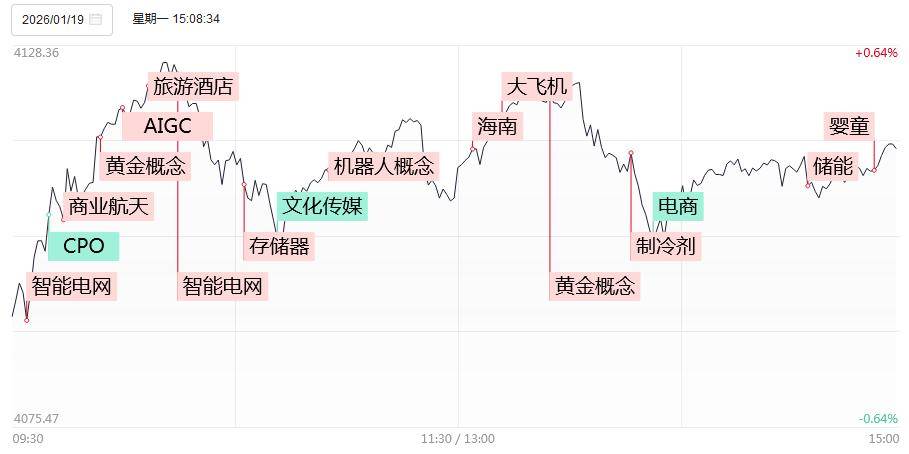
Market Overview - On January 19, the three major indices showed mixed results, with the Shanghai Composite Index performing strongly while the ChiNext Index experienced a pullback [1] - The total trading volume in the Shanghai and Shenzhen markets was 2.71 trillion yuan, a decrease of 317.9 billion yuan compared to the previous trading day [1] - Over 3,500 stocks in the market rose, with 103 stocks hitting the daily limit [1] Sector Performance - The electric grid equipment sector saw significant gains, with over ten constituent stocks hitting the daily limit, including Baobian Electric and China West Electric [1] - The robotics sector experienced fluctuations but ultimately rose, with stocks like Wuzhou New Spring and Riyi Electronics hitting the daily limit [1] - The precious metals sector also performed well, with Sichuan Gold and Zhaojin Gold reaching the daily limit [1] - The tourism and hotel sector strengthened, with stocks such as Dalian Shengya and Jiuhua Tourism hitting the daily limit [1] - The commercial aerospace sector was active, with stocks like Jiuding New Materials and Yuexiu Capital hitting the daily limit, and Chaojie Co. rising over 15% [1] Stock Highlights - A total of 87 stocks hit the daily limit across the market (excluding ST and delisted stocks), with 11 stocks on consecutive limit-up days [1] - Notable stocks included: - Jiamei Packaging, which had 15 limit-up days in 22 days due to a change in actual controller [1] - Victory Energy, also with 15 limit-up days in 22 days [1] - Fenglong Co., with 14 consecutive limit-up days [1] - Youbang Ceiling, with 9 limit-up days in 13 days [1] - Xinhua Department Store, which had 4 limit-up days due to a share transfer [1] - Sanbian Technology in the smart grid sector, with 4 limit-up days in 5 days [1] Related Industry News 1) The State Grid Corporation's fixed asset investment is expected to reach 4 trillion yuan during the 14th Five-Year Plan, representing a 40% increase compared to the previous plan [11] 2) The establishment of a working group for commercial community service robots marks a new phase in standardization efforts in China's robotics sector [11] 3) Huatai Securities reports that the profitability of bulk chemicals is at a ten-year low, indicating a potential upward trend as the industry approaches a dual inflection point in capacity and inventory cycles [11]

新“易中天”来袭,AI的投资方向变了?
虎嗅APP· 2026-01-19 11:07
Core Viewpoint - The article discusses the evolving landscape of AI applications in the stock market, highlighting the emergence of new investment opportunities and the volatility associated with AI-related stocks. Group 1: AI Application Market Dynamics - In 2025, companies representing AI computing power saw significant stock price increases, with gains of 424.03%, 396.38%, and 213.72%, leading to the creation of the "Yizhongtian" investment group [2] - In 2026, a new "Yizhongtian" group emerged, focusing on AI applications, with stocks like Yidian Tianxia, Zhongwen Online, and Tianlong Group experiencing a 20% surge [3][4] - Despite initial optimism, many AI application companies began to issue risk warnings, leading to a decline in stock prices [5] Group 2: Progress and Challenges in AI Applications - The current phase of AI application is seen as a significant technological transformation, with potential opportunities, but it still faces challenges in implementation [7] - AI applications are reshaping consumer decision-making, with 40% to 55% of consumers in key industries relying on AI for purchase decisions [10] - The deployment of AI agents is progressing, but challenges such as the "hallucination" problem and internal organizational adjustments remain [11] Group 3: Market Sentiment vs. Performance - The global GEO market is projected to reach $24 billion in 2026, with expectations of $100 billion by 2030, indicating strong growth potential [13] - Despite the hype around AI applications, many companies have not yet demonstrated substantial revenue from their AI initiatives, leading to concerns about market sentiment driving valuations rather than actual performance [14] - Investors are advised to focus on genuine AI application companies rather than those merely riding the wave of market sentiment [15] Group 4: Competitive Landscape and Future Outlook - Major internet companies like Alibaba and Tencent are leading the charge in AI applications, leveraging their existing user bases and data [16] - The article suggests that once revenue from AI applications materializes, companies like Alibaba may undergo significant valuation adjustments [19] - Historical trends indicate that as AI application revenue increases, companies could see substantial stock price appreciation, similar to the transition from traditional software to cloud computing [20][21]



轻工制造及纺服服饰行业周报:361度Q4流水稳健增长,关注李宁边际改善
ZHONGTAI SECURITIES· 2026-01-19 10:45
Investment Rating - The industry investment rating is "Overweight (Maintain)" [3] Core Views - The report highlights that 361 Degrees has shown steady growth in revenue, while Li Ning's revenue decline has narrowed, with profit margins exceeding expectations. The company has opened 33 new stores, bringing the total to 126, which is above initial expectations for the year [5][6] - The report suggests focusing on leading home textile brands such as Water Star Home Textile and Luolai Home Textile, as well as sports brands like Anta Sports, Li Ning, 361 Degrees, and Bosideng, which are expected to benefit from major sporting events in 2026 [5][6] - The report also emphasizes the potential of AI applications in consumer products, particularly in the context of AI smart glasses and 3D printing, indicating a significant growth opportunity in these areas [6] Summary by Sections Market Overview - The light industry index decreased by 1.11%, ranking 20th among 28 Shenwan industries, while the textile and apparel index decreased by 0.55%, ranking 15th [10] - The report notes that the revenue growth for 361 Degrees' main brand and children's clothing is approximately 10%, with e-commerce revenue growing at a high double-digit rate [5][6] Key Company Performance - 361 Degrees reported a healthy revenue increase, while Li Ning's retail revenue saw a slight decline in the low single digits across various channels [5][6] - The report recommends monitoring companies with strong growth potential, including those in the AI and consumer goods sectors, as well as established brands in textiles and home goods [6] Industry Trends - The report indicates a recovery in the paper industry, with prices for certain types of paper expected to rebound after recent declines. It suggests focusing on companies with high wood pulp procurement costs and those with integrated advantages in cultural paper production [6][41] - The furniture manufacturing sector is experiencing a decline, with a reported 9.1% decrease in revenue year-on-year, and a significant number of companies facing losses [66][69]

新“易中天”来袭,AI的投资方向变了?
Hu Xiu· 2026-01-19 09:51
Group 1 - The core viewpoint of the article highlights the volatility and speculative nature of AI application stocks, particularly the "new Yizhongtian" combination, which has seen significant price fluctuations in early 2026 [1][12] - AI applications are perceived to be in a transformative phase comparable to the internet, with substantial opportunities, but they still face challenges in achieving practical implementation [2][6] - The market sentiment is driving the valuation of AI application companies, with many lacking solid performance metrics to support their stock prices [12][13] Group 2 - The AI application sector is entering a phase of diverse development, with significant capital inflow, indicating a high level of market interest [8] - The global GEO market is projected to reach $24 billion in 2026 and potentially $100 billion by 2030, reflecting the growing importance of AI in consumer decision-making [10] - Major internet companies like Alibaba and Tencent are leading the charge in AI applications, leveraging their existing ecosystems to capture market share [17][18] Group 3 - The article discusses the competitive landscape, noting that smaller firms struggle to compete against large tech companies that dominate user engagement and data resources [16][17] - There is a focus on the potential for revenue generation from AI applications, with companies expected to undergo valuation reassessments once they start reporting income from these initiatives [22][23] - Historical data suggests that as companies transition to AI-driven revenue models, their market valuations may significantly increase, similar to trends observed during the shift to cloud computing [23][24]