黄金投资

Search documents
涨势暂歇静待非农 黄金回落4450美元关口获支撑
Jin Tou Wang· 2026-01-08 03:01
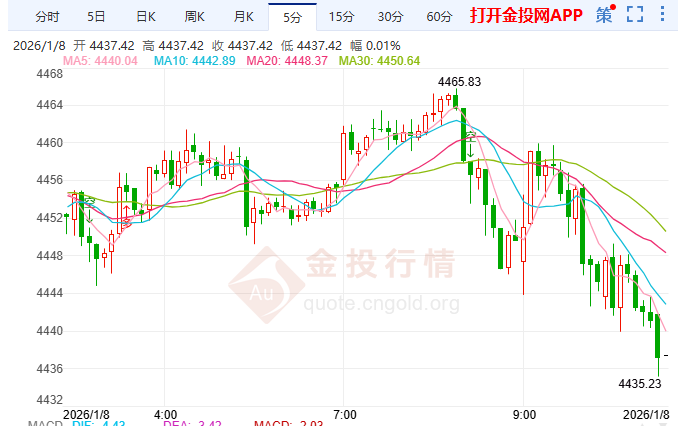
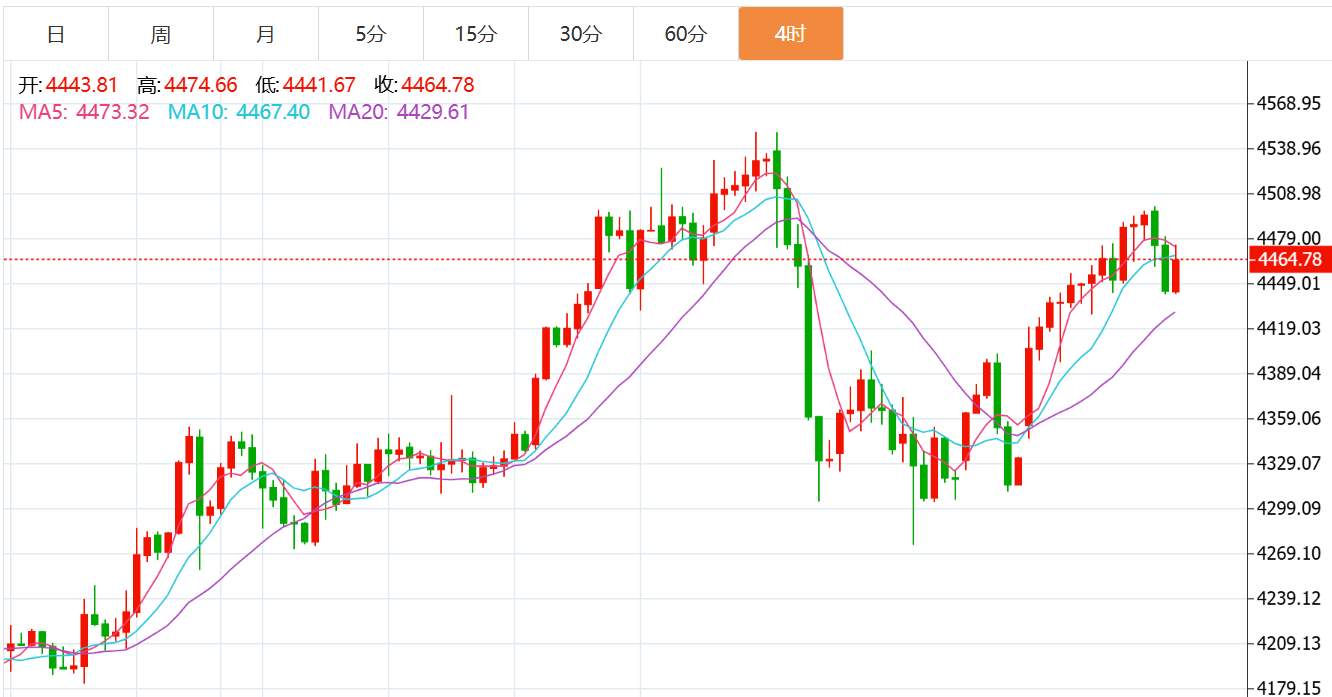
美国将于周四公布当周初请失业金人数,周五发布的12月非农就业报告则是市场关注的焦点。市场预期 12月新增就业约6万人,失业率或小幅降至4.5%。这些数据将为评估美国经济韧性及美联储未来利率路 径提供重要依据。 若就业数据不及预期,可能强化市场对美联储年内降息的预期,进而压低实际利率,降低持有无息资产 黄金的机会成本,对金价构成支撑;反之,若数据表现强劲,金价短期或继续承压整理。 摘要今日周四(1月8日)亚市时段,黄金小幅回落至4450美元附近,此前因地缘避险情绪推动快速拉升并 刷新阶段性高位,短线涨幅较大引发部分交易者获利了结,上涨动能暂缓。当前市场对地缘局势的担忧 有所降温,风险偏好边际修复,黄金避险买盘暂时减弱。 今日周四(1月8日)亚市时段,黄金小幅回落至4450美元附近,此前因地缘避险情绪推动快速拉升并刷新 阶段性高位,短线涨幅较大引发部分交易者获利了结,上涨动能暂缓。当前市场对地缘局势的担忧有所 降温,风险偏好边际修复,黄金避险买盘暂时减弱。 【基本面解析】 与此同时,市场逐渐进入观望模式,静待本周美国一系列关键宏观数据集中公布。当前金价回落更多是 前期大幅上涨后的正常获利回吐,而非趋势性反转。 黄 ...

央行连续14个月增持黄金,黄金股票ETF基金(159322)涨近1%
Xin Lang Cai Jing· 2026-01-08 02:11
Group 1 - The core viewpoint of the news is that China's gold reserves have increased for the 14th consecutive month, reaching 7,415 million ounces (approximately 2,306.323 tons) as of the end of December, with a month-on-month increase of 30,000 ounces (approximately 0.93 tons) [1] - The China Securities Index for gold industry stocks (931238) rose by 0.73%, with significant increases in individual stocks such as WanGuo Gold Group (03939) up 4.20% and ZhaoJin Mining (01818) up 2.97% [1] - An analysis by Anliang Futures indicates a paradigm shift in the gold market driven by global macroeconomic changes, highlighting the importance of sovereign credit risk premium, diversification of reserve assets, and improvements in microstructure as key support for gold prices [1] Group 2 - The China Securities Index for gold industry stocks (931238) includes 50 large-cap companies involved in gold mining, smelting, and sales, reflecting the overall performance of gold industry stocks in mainland China and Hong Kong [2] - As of December 31, 2025, the top ten weighted stocks in the index accounted for 63.58% of the total index weight, with companies like Zijin Mining (601899) and Shandong Gold (600547) being the largest contributors [2]

一个月涨超9% 谁在背后疯狂买入黄金?
Zhong Guo Jing Ying Bao· 2026-01-08 02:00
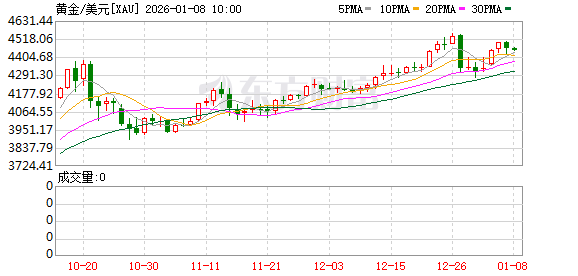
Core Viewpoint - The recent surge in gold prices is primarily driven by speculative funds, with expectations of a shift in Federal Reserve policy leading to lower real interest rates, thus reducing the holding costs of gold [3][4]. Group 1: Market Dynamics - As of January 7, 2026, the London spot gold price opened at $4,494.59 per ounce, with a monthly increase exceeding 9% [2]. - The relationship between gold prices and real interest rates is notably negative, with current economic indicators suggesting a weakening labor market and declining consumer confidence, which heightens expectations for Federal Reserve rate cuts [3]. - The lack of significant changes in fundamental factors indicates that the recent volatility in gold prices is largely driven by speculative trading rather than institutional investment [3][4]. Group 2: Central Bank Demand - Global central bank demand for gold remains robust, with a net purchase of 45 tons in November 2025, bringing total purchases for the year to 297 tons, primarily driven by emerging market central banks [4]. - The ongoing accumulation of gold reserves by central banks reflects a strategic shift away from reliance on a single reserve currency, enhancing gold's status as a "currency substitute" [4]. Group 3: Silver Market Influence - The silver market has experienced significant upward pressure, contributing to the rise in gold prices, with a notable shortage in silver delivery stocks since October 2025 [4][5]. - Increased speculative trading in the silver market may spill over into the gold market, further driving up gold prices in the short term [5]. Group 4: Future Outlook - Morgan Stanley maintains a bullish outlook for gold, projecting prices could reach $5,000 per ounce in 2026, supported by strong demand from central banks and investors [6]. - The anticipated demand for gold in 2026 is expected to average 585 tons per quarter, with central bank purchases projected at 755 tons, indicating a sustained interest in gold despite potential price corrections [6][7]. - The trajectory of gold prices will largely depend on the Federal Reserve's monetary policy, with a continued easing cycle likely to support gold investment demand [7].
央行连续14个月增持黄金,黄金基金ETF(518800)连续5日净流入超14亿元,规模超300亿元
Sou Hu Cai Jing· 2026-01-08 01:35
Group 1 - The People's Bank of China has increased its gold reserves for 14 consecutive months, with a total of 7.415 million ounces as of the end of 2025, an increase of 30,000 ounces from the end of November last year [1] - Gold ETFs have seen a net inflow of over 1.4 billion yuan for five consecutive days, bringing the total scale to over 30 billion yuan [1] - Long-term outlook suggests a weakening of the US dollar's credibility, supporting the central bank's continued gold purchases and a bullish sentiment on gold prices [1] Group 2 - The current geopolitical tensions, a weak dollar, and loose liquidity conditions have initiated a trend of rising precious metal prices, despite recent volatility due to deleveraging [1] - The supply-demand balance and differentiated inventory structures are expected to provide price support for gold in the long term [1] - Investors are encouraged to consider direct investments in physical gold and tax-exempt gold ETFs (518800), as well as gold stock ETFs (517400) that cover the entire gold industry chain [1]
今日金价!1月7日最新黄金价格!各大金店、黄金回收价格查询
Sou Hu Cai Jing· 2026-01-08 01:21
Group 1: Retail Gold and Platinum Prices - The domestic gold jewelry market shows a significant price differentiation among brands, with leading brands like Chow Tai Fook, Chow Sang Sang, and others maintaining high gold prices around 1390 CNY per gram [1] - The overall market price range for gold is between 1158 CNY and 1390 CNY per gram, with specific stores like South Ping Sun Gold Store and Wu Han Ya Yi Gold Store quoting prices of 1209 CNY and 1389 CNY per gram respectively [1] - Platinum prices also exhibit notable differences, with retail prices ranging from 583 CNY to 920 CNY per gram, indicating a strong brand premium effect [1] Group 2: Precious Metal Recycling Market - The recycling market shows that the gold jewelry recycling price is 998 CNY per gram, while platinum is at 533 CNY per gram [2] - There is a significant discount between retail and recycling prices for platinum, with some brands experiencing a discount rate exceeding 20%, reflecting a depreciation of brand premium in the second-hand market [2] Group 3: Financial Institutions and Professional Institutions Gold Bar Prices - Bank gold bar prices range from 1019 CNY to 1062.5 CNY per gram, with the highest price from Pudong Development Bank [3] - The Shanghai Gold Exchange standard gold bar is priced at 1001.5 CNY per gram, aligning closely with market benchmarks [3] - Various professional institutions have different pricing for gold bars, with China Gold Investment Gold Bar priced at 1017 CNY per gram and other brands showing price variations based on brand value and craftsmanship [3] Group 4: Gold Market Trends - The technical outlook for gold indicates a weak short-term trend, with bearish K-line structures and MACD showing limited rebound strength [5] - Key support levels are identified at 4400 points, with a potential drop below this level leading to a clearer mid-term downtrend [5] - Short-term strategies suggest treating gold for value preservation through gradual accumulation, while short-term trading should respect market trends and avoid aggressive bottom-fishing strategies [6]
2026年首家 工行上调积存金业务风险承受能力等级
Mei Ri Shang Bao· 2026-01-07 23:08
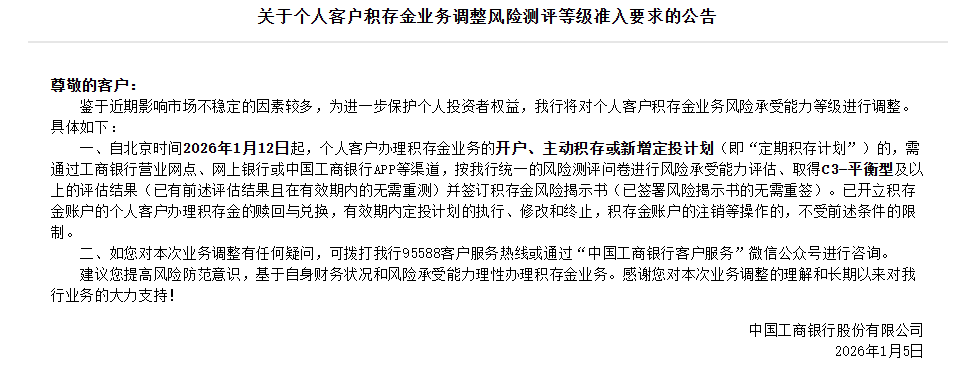
Group 1 - The core point of the article is that Industrial and Commercial Bank of China (ICBC) has announced an increase in the risk assessment level for personal customers' accumulation gold business, raising the threshold to C3-balanced type and above, marking it as the first state-owned bank to do so this year [1][2][3] - Starting from January 12, 2026, personal customers must achieve a C3-balanced type risk assessment result to engage in accumulation gold business, which includes account opening, active accumulation, or new investment plans [2][3] - The adjustment by ICBC is expected to have a demonstration effect, prompting more banks to follow suit in raising risk assessment levels for accumulation gold business, especially given the ongoing volatility in gold prices [3] Group 2 - Analysts remain optimistic about the potential for gold prices to rise, with forecasts suggesting an average price of $4,538 per ounce in 2026, and a possibility of reaching $5,000 in an optimistic scenario [4][5] - Several institutions, including UBS and Goldman Sachs, predict that gold prices will continue to perform well, with UBS forecasting a price of $5,000 per ounce by September 2026, and Goldman Sachs suggesting a rise to $4,900 by December 2026 [5]

贺博生:1.7黄金原油晚间行情涨跌趋势分析及最新独家多空操作建议
Sou Hu Cai Jing· 2026-01-07 16:06
Group 1: Market Overview - The current market sentiment suggests a cautious approach, emphasizing the need for strategic trading while being aware of market fluctuations [1] - The gold market is experiencing a pullback after reaching a psychological resistance level of $4500, attributed to profit-taking and improved risk appetite [2] - The geopolitical situation and expectations of interest rate cuts by the Federal Reserve provide significant support for gold prices [2] Group 2: Gold Analysis - Gold and silver have broken out of previous trading ranges, indicating a potential for new historical highs, although future price movements are expected to be volatile [4] - Key upcoming economic data, such as employment figures, could influence gold prices significantly, with a potential drop in unemployment rate increasing the likelihood of interest rate cuts [4] - Short-term trading strategies for gold suggest focusing on buying on dips while monitoring resistance at $4500 and support at $4450 [4] Group 3: Oil Analysis - Oil prices are under pressure due to potential increases in Venezuelan oil exports, with WTI crude oil experiencing a drop of over 1.6% [5] - The market is currently more focused on the medium to long-term supply-demand dynamics rather than short-term events [5] - Technical analysis indicates a downward trend for oil prices, with significant resistance levels identified at $58.0-$59.0 and support at $55.0-$54.0 [6]
李迅雷:央行将抛售还是增持黄金,先看一张图
Sou Hu Cai Jing· 2026-01-07 12:25
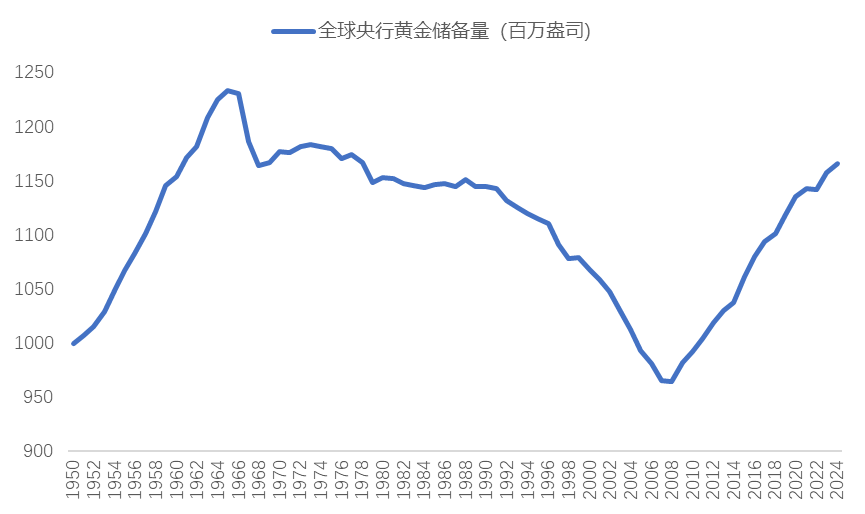
Core Viewpoint - The article emphasizes the increasing importance of gold as a hedge against inflation and geopolitical risks, highlighting its dual attributes of value preservation and risk aversion, particularly in the context of ongoing financial, trade, and technological conflicts among major nations [1]. Group 1: Gold Holdings and Central Banks - Global central banks held 12.25 billion ounces of gold in 1964, which decreased to 11.66 billion ounces by 2024, despite significant monetary expansion over the same period [3]. - The price of gold has increased nearly 75 times from $35 per ounce in 1964 to approximately $2639 per ounce in 2024, indicating a substantial rise in value despite the reduction in physical gold holdings [3]. - The total value of central bank gold reserves is projected to exceed $3 trillion by the end of 2024, yet this represents a low percentage of global broad money supply, increasing from 4.3% in 1964 to only 1.9% in 2024 [5]. Group 2: Monetary Expansion and Gold Value - The broad money supply (M2) grew from $0.98 trillion in 1964 to $156.67 trillion in 2024, a 159-fold increase, which outpaces the growth in gold prices [3]. - The ratio of broad money to GDP has risen significantly, from 53.4% in 1964 to 141.17% by the end of 2024, indicating a trend of monetary overexpansion [3]. Group 3: Central Bank Strategies - The share of foreign exchange reserves in total central bank reserves increased from 31% in 1960 to a peak of 90% between 2006 and 2008, before declining to 77% in 2024, reflecting a shift in reserve management strategies [7]. - The proportion of gold in central bank reserves was 59% in 1964, but this dropped to around 10% from 2000 to 2019, with a slight recovery to 17% by 2024, still below historical levels [7]. Group 4: Future Outlook and Recommendations - The article suggests that central banks should continue to increase their gold reserves in response to concerns over U.S. debt and the weakening dollar, which has prompted a shift towards gold accumulation since 2022 [10]. - For China, increasing gold reserves relative to U.S. and Japanese government bonds is recommended to enhance the international status of the Renminbi and optimize reserve structures [14].
央行将抛售还是增持黄金:我最想贴的一张图
李迅雷金融与投资· 2026-01-07 12:02
Core Viewpoint - The article emphasizes the increasing importance of gold as an investment due to its value preservation and hedging properties, driven by monetary expansion and geopolitical tensions [1][4]. Group 1: Gold Investment Attributes - Gold is valued for its two main attributes: value preservation against currency devaluation and as a hedge against unforeseen events, with the saying "in prosperous times, jewelry; in chaotic times, gold" highlighting its role [1]. - The preservation attribute is identified as the primary driver for the continuous rise in gold prices, while the hedging attribute is also significant due to ongoing financial, trade, and technological conflicts among major nations [1]. Group 2: Central Bank Gold Holdings - Global central banks held 12.25 billion ounces of gold in 1964, which decreased to 11.66 billion ounces by 2024, despite significant monetary expansion during the same period [4]. - The price of gold has increased dramatically, from $35 per ounce in 1964 to approximately $2,639 per ounce by the end of 2024, representing a nearly 75-fold increase [4]. - The broad money supply (M2) grew from $0.98 trillion in 1964 to $156.67 trillion in 2024, a growth of 159 times, indicating a much faster expansion compared to gold price increases [4]. Group 3: Gold Reserves and Monetary Policy - By the end of 2024, the market value of central bank gold reserves exceeded $3 trillion, but this still represents a low percentage of global broad money, increasing from 4.3% in 1964 to only 1.9% in 2024 [7][10]. - The share of foreign exchange reserves in total central bank reserves rose from 31% in 1960 to 90% in 2006-2008, then decreased to 77% by 2024, indicating a shift in reserve composition [10]. - The proportion of gold in central bank reserves was 59% in 1964, but it dropped to around 10% from 2000 to 2019, with a slight recovery to 17% by 2024, still below historical levels [10][11]. Group 4: Future Outlook and Recommendations - The article suggests that central banks should continue to increase their gold reserves in response to concerns over U.S. debt and the weakening dollar, which has led to a rise in gold prices since 2022 [13]. - It is noted that China's gold holdings are relatively low, projected to be around 0.74 billion ounces by the end of 2025, representing only 6.3% of global central bank holdings [15]. - The article concludes that to enhance the international status of the Renminbi and optimize reserve structures, China should reduce holdings in U.S. and Japanese government bonds while increasing gold reserves [16].
工商银行率先上调积存金风险等级至C3,黄金投资准入门槛趋严
Sou Hu Cai Jing· 2026-01-07 10:13
深圳商报·读创客户端首席记者 谢惠茜 工商银行近日发布的一则公告,引发市场广泛关注。公告显示,工商银行将于1月12日起对个人客户积存金业务风险承受能力等级进行调 整,成为今年以来首家调整该门槛的国有大行。 工行率先上调风险评测等级准入 工商银行发布的《关于个人客户积存金业务调整风险测评等级准入要求的公告》显示,"自2026年1月12日起,个人客户办理积存金业务的 开户、主动积存或新增定投计划(即'定期积存计划')的,需通过工商银行营业网点、网上银行或中国工商银行APP等渠道,按我行统一 的风险测评问卷进行风险承受能力评估、取得C3-平衡型及以上的评估结果(已有前述评估结果且在有效期内的无需重测)并签订积存金 风险揭示书(已签署风险揭示书的无需重签)。已开立积存金账户的个人客户办理积存金的赎回与兑换,有效期内定投计划的执行、修改 和终止,积存金账户的注销等操作的,不受前述条件的限制。" 这意味着,当前多家主流银行对积存金业务的风险评级都在中风险及以上,甚至有某国有大行银行要求最高风险等级才能进行相关投资。 后续或有更多银行跟进调整 "此次工商银行将积存金业务风险准入等级从C1保守型上调至C3平衡型,是一次基于市 ...