资产配置

Search documents
周期洗牌,存款缩水股市被套!中国经济回暖背后,普通人如何避坑
Sou Hu Cai Jing· 2025-11-16 12:38
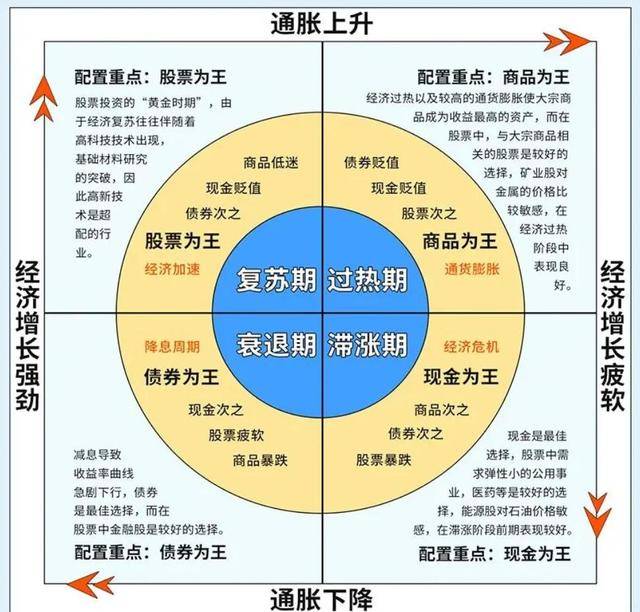
Group 1 - The article emphasizes that many individuals are struggling with their investments in 2025 due to a lack of understanding of market cycles, leading to poor financial decisions [1] - It highlights the contrasting economic conditions between China and the United States, with China experiencing economic stimulus and lower loan rates, while the U.S. faces stagnant orders and rising prices [3][5] - The article suggests that understanding economic cycles is crucial for making informed investment choices, as government policies shift between stimulating consumption and tightening fiscal measures [5][7] Group 2 - It advises that during economic recovery, investors should focus on sectors supported by government policies, such as green energy and infrastructure technology [7] - In times of market overheating, caution is advised against blindly chasing high prices, as this can lead to significant losses [7][8] - The article recommends a balanced investment strategy for ordinary families, combining low-risk assets like savings or bonds with a smaller portion allocated to high-growth sectors [10] Group 3 - The underlying principle for successful investing is to adapt to changing market conditions and avoid the temptation of quick profits [12] - Maintaining cash flow and understanding asset allocation are essential for long-term wealth growth, allowing investors to weather market fluctuations [12]

各国通胀有差异,为何我国经常发生通胀,而日本几乎不会?结果令人意外
Sou Hu Cai Jing· 2025-11-15 18:11
Core Insights - The inflation differences between China and Japan reflect the distinct stages of economic development and national conditions, making it difficult to determine absolute superiority [1] - Japan's long-term price stability is influenced by factors such as aging population and sluggish economic growth, while China's moderate inflation indicates economic vitality and potential [1] Inflation Rates - Over the past decade, China's average inflation rate was approximately 2.3%, while Japan's was only 0.8%, leading to a 25% increase in Chinese prices compared to an 8% increase in Japan [2] - Over a 30-year period, Japan's price levels have remained nearly unchanged since the early 1990s, with instances of deflation [2] Demographic Factors - Japan has the highest aging population globally, with over 29% aged 65 and above, resulting in low consumption demand and high savings rates [2] - In contrast, China's labor force aged 16-59 constitutes 61.2% of the total population, driving strong consumption demand [2] Economic Growth - Rapid economic growth typically correlates with higher inflation due to increased investment, employment, and consumer demand [3] - Japan has experienced low growth rates averaging around 0.7% from 2014 to 2024, leading to weak overall demand and limited inflationary pressure [3] - China has maintained high growth rates, with a projected GDP growth of approximately 5% in 2024, contributing to inflationary pressures [3] Monetary Policy - Japan's central bank has implemented ultra-loose monetary policies, including zero and negative interest rates, but these have not effectively stimulated inflation due to demographic and growth factors [4] - Japan's M2 money supply grew by only about 35% from 2014 to 2024, indicating low monetary expansion [4] - Conversely, China's M2 money supply increased by approximately 115% during the same period, suggesting greater inflationary pressure [5] Industrial Structure - Japan's highly industrialized and efficient economy allows for productivity gains that can offset cost increases, with manufacturing productivity rising by about 2.1% annually from 2020 to 2025 [5] - China's industrialization is still in progress, leading to more noticeable price increases [5] Housing Market - China's housing market has seen significant price increases over the past two decades, affecting overall consumer prices through direct and indirect channels [6] - Japan's real estate market has remained subdued since the bubble burst, contributing to stable price levels [6] Consumer Behavior - Japanese consumers are highly price-sensitive, which limits companies' ability to raise prices easily [8] - In contrast, Chinese consumers have developed higher inflation expectations, leading to anticipatory consumption that can drive prices up [10] Globalization and Government Regulation - Japan benefits from a global economic structure that allows for low-cost imports and high-value exports, influencing its inflation dynamics [10] - China faces greater pressure from international market fluctuations, impacting its inflation levels [10] - Both countries have different approaches to price monitoring and regulation, with Japan having a more established system [10] Social Welfare Systems - Japan's comprehensive social welfare system helps stabilize prices, while China's system is still developing, leading to higher price pressures in healthcare and education [11]
1004元抢黄金的傻眼!全仓亏11%资产配置才亏1.1%,13天教你做人
Sou Hu Cai Jing· 2025-11-15 13:36
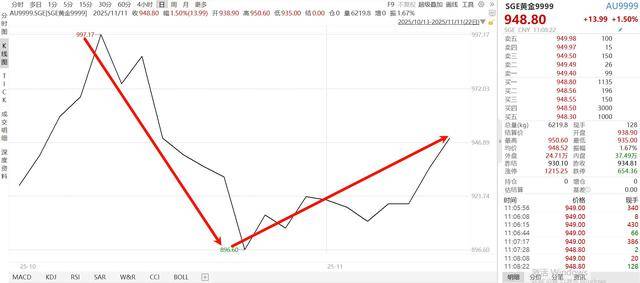
Core Insights - The recent volatility in gold prices, with a peak of 1004 CNY per gram followed by a drop to 894 CNY, highlights the risks of chasing market trends and the emotional toll on investors [1][3][10] - Many investors tend to invest all their capital in a single asset, leading to significant losses during downturns, as seen in the recent gold price fluctuations [3][5] - The importance of asset allocation is emphasized, suggesting that diversifying investments across different asset classes can mitigate risks and reduce emotional stress during market volatility [5][9] Investment Behavior - Investors often react to market news and peer performance, leading to impulsive buying at high prices and subsequent panic selling at lows [3][10] - The tendency to invest all funds in one asset class can amplify losses, as demonstrated by the 11% maximum loss on a 10,000 CNY investment in gold during the recent downturn [5][7] Asset Allocation Strategy - A recommended strategy is to allocate only a portion of total capital to gold (e.g., 10%), while diversifying the remainder into bonds and stocks to stabilize overall portfolio performance [5][9] - Historical data suggests that a balanced portfolio with 12% in stocks and 88% in bonds can effectively manage risk and reduce anxiety during market fluctuations [7][9] Long-term Perspective - Long-term asset allocation strategies are likely to yield better returns compared to short-term trading strategies, which can lead to inconsistent performance [7][10] - The psychological benefits of a stable investment portfolio, which allows for less daily monitoring and anxiety, are highlighted as a significant advantage of proper asset allocation [9][10]
做空AI的《大空头》原型关闭基金!抄大佬作业为什么赚不到钱?
雪球· 2025-11-15 13:00
以下文章来源于做配置的小雪 ,作者做配置的小雪 曾经幻想暴富,现实变成暴负,投资只能慢慢变富~ ↑点击上面图片 加雪球核心交流群 ↑ 风险提示:本文所提到的观点仅代表个人的意见,所涉及标的不作推荐,据此买卖,风险自负。 作者:做配置的小雪 最近,电影《大空头》的原型迈克尔·伯里(Michael Burry),因为公开质疑美股AI泡沫,再次成为市场焦点。 01 "我对资产价值的判断,已经长期与市场脱节" 最近几周,大空头先是披露了旗下Scion基金,分别持有英伟达和AI软件公司Palantir的看跌期权,并在社交媒体上炮火全开,强调市场正处于泡 沫状态。 11月10日,Scion基金显示已在SEC(美国证券交易委员会)注销。 11月13日,大空头在社交媒体上表示,"我对证券价值的评估现在与市场脱节,而且这种状况已经持续一段时间了",并预告"11月25日将有更好 的事情"。 在最近的帖子中,更是配上了电影《大空头》剧照,并配文:"往昔之我,今日之我。上次成功了,这次也终将成功"。 做配置的小雪 . 这不是大空头第一次关闭基金。 2008年,他就关闭了第一家对冲基金Scion Capital,随后在2013年,重新 ...

A股震荡上行,投资者如何应对波动
Sou Hu Cai Jing· 2025-11-15 09:56
Core Viewpoint - The A-share market is experiencing a volatile upward trend, with the Shanghai Composite Index breaking through the 4000-point mark and continuously reaching new highs amid fluctuations [2] Market Analysis - Investors are advised to optimize their strategies to cope with the current market characteristics [2] - Data shows that both the October CPI and PPI have rebounded year-on-year, indicating a continuous recovery in the economic fundamentals [2] - Most daily fluctuations in the market can self-correct, and excessive focus on short-term volatility may exacerbate anxiety [2] Investment Strategies - Long-term investors are recommended to adopt three strategies: 1. Implement regular investment plans to average costs through market volatility [2] 2. Allocate to hedging assets like gold to reduce correlation risks in the portfolio [2] 3. Increase the proportion of deposits and government bonds to build a solid investment foundation [2] - The working class can utilize automated investment tools to manage risks while seizing market opportunities [2] Market Sentiment - Market participants emphasize that fluctuations in equity assets are normal, and having clear long-term investment goals helps maintain investment discipline [2] - As the economic recovery solidifies, investors are encouraged to adopt a more composed attitude towards market fluctuations and achieve asset preservation and appreciation through scientific allocation [2]

全球赛重量组第九名、长期稳定盈利奖第五名顾明喆:黄金长期上涨逻辑明确,资产配置价值凸显
Qi Huo Ri Bao Wang· 2025-11-15 08:53
Group 1 - The global economy is currently in a phase of "prosperity, bubbles, and currency devaluation," with central banks having cut interest rates 312 times in the past 24 months, supporting the rise in gold prices [1] - There has been a significant increase in central bank gold purchases, with global gold reserves now exceeding those of U.S. Treasury bonds for the first time, driven by countries like China and Russia diversifying their foreign exchange reserves [1] Group 2 - From an allocation perspective, gold remains structurally underweighted, comprising only 0.5% of the asset management scale of U.S. bank private clients and 2.4% of institutional allocations, indicating substantial room for future price increases [3] - The bullish trend for gold has not yet terminated, with potential upward movements expected unless rare geopolitical events or central bank revaluation occur, such as a significant easing of global trade tensions or breakthroughs in Russia-Ukraine negotiations [3] - Historical patterns show that gold tends to rise before and after interest rate cuts, with a potential buying opportunity anticipated after the Federal Reserve's expected rate cut in December, supported by a normalizing volatility level [3]

金价突发大跳水!找跑腿小哥“代抢”金条,有人称省下近万元,律师紧急提醒→
Sou Hu Cai Jing· 2025-11-15 07:10
2025年11月1日实施的黄金税收新政,对非投资性黄金的税收抵扣规则进行了调整。这直接影响了深圳 水贝市场的黄金交易,导致成本上升和价格调整。有外地的消费者咨询发现,水贝市场内有少量料商可 以低于实时价出售黄金,随即联系跑腿小哥代抢省下了近万元,线下代购黄金这一现象也引发了市民的 热议。 近期,世界黄金协会发布2025年三季度《全球黄金需求趋势报告》显示,第三季度全球黄金需求总量 (包含场外交易)达1313吨,需求总金额达1460亿美元,创下单季度黄金需求的最高纪录。 作为当下市场关注度最高的资产之一,黄金起起落落的价格时刻牵动着投资者心弦,现在还是好的投资 时间点吗? 东方金诚研究发展部副总监瞿瑞表示,投资者需理性看待金价行情,警惕高位波动风险,避免盲目跟风 追涨,需结合自身风险承受能力、资产配置规模及投资周期,合理规划黄金资产占比。 投资者应优化资产配置的风险收益比,关注黄金投资的价格波动风险、流动性风险、机会成本风险等, 在对黄金价格客观分析的基础上力争获得稳健收益。瞿瑞表示,投资者应立足长期逻辑、明确投资目 标,以资产保值、对冲风险为核心,而非单纯追逐短期价差收益,规避盲目追高导致的投资风险。 新闻多 ...

中央汇金最新持仓曝光,单季度暴增2000亿元
21世纪经济报道· 2025-11-15 07:04
Core Insights - Central Huijin's latest investment activities indicate a significant increase in ETF holdings, with total holdings reaching approximately 1.53 trillion yuan, marking a 19% increase from the previous quarter [1][3][11] - The investment strategy focuses on maintaining a stable position in core broad-based ETFs, particularly in major indices like CSI 300 and SSE 50, reflecting a commitment to market stability [3][13] - Adjustments in specific asset management plans suggest a responsive approach to market trends, with notable actions such as the complete liquidation of a high-dividend ETF [6][7] Investment Holdings Overview - As of September 30, Central Huijin's total ETF holdings increased from 1.29 trillion yuan to approximately 1.53 trillion yuan, a rise of about 2.4 billion yuan [3][11] - The number of ETFs with holdings exceeding 20% reached 28, with a total market value of 1.48 trillion yuan, reflecting a quarterly increase of 233.2 billion yuan [1][7] - The main contributors to the growth in holdings were the core broad-based ETFs, with significant increases in net asset values due to a recovering stock market [6][11] Specific ETF Performance - Fourteen broad-based ETFs saw substantial increases in market value, while only one sector ETF experienced a decline [4] - Central Huijin Investment maintained a stable number of holdings in 15 ETFs, with a total market value of approximately 777.98 billion yuan, reflecting a 19.23% increase [3][6] - Central Huijin Asset also held 12 ETFs, with a total market value of about 697.56 billion yuan, marking an 18.26% increase [6] Strategic Adjustments - The asset management plans under Huaxia and E Fund made strategic adjustments, including the complete liquidation of a high-dividend ETF and a reduction in automotive sector ETF holdings [6][7] - Analysts suggest these adjustments are aimed at aligning with market trends and sector performance expectations [7] Long-term Investment Philosophy - Central Huijin's investment approach emphasizes long-term stability and diversification, focusing on broad-based ETFs to support market stability [13] - The organization is viewed as a "national team" in the capital market, reinforcing investor confidence through its substantial and stable holdings [13][14]

帮主郑重定制:普通人低利率中长线配置清单(好懂好操作)
Sou Hu Cai Jing· 2025-11-15 04:12
Core Insights - The article emphasizes the importance of maintaining a "safety cushion" of 6-12 months of living expenses before making any investments [1] - It provides tailored investment strategies based on different levels of available funds, focusing on long-term holdings (3-5 years) [3][4] Investment Strategies - For small funds (up to 100,000): 70% in broad-based index funds, 20% in high-dividend ETFs, and 10% as flexible capital for market dips [3] - For medium funds (100,000 to 500,000): 50% in broad-based index funds, 20% in industry-themed funds, 20% in government or high-grade credit bond funds, and 10% as flexible capital [3] - For large funds (over 500,000): 40% in broad-based index funds, 20% in selected industry-themed funds, 20% in government and high-grade credit bond funds, 10% in gold ETFs, and 10% as flexible capital [3] Risk Management - The article advises against putting all funds into one investment and emphasizes the importance of not chasing market trends [4] - It highlights the need for patience in long-term investments, warning against selling too early [4]
Druckenmiller Opens Position In Amazon, Closes Microsoft — Here's More Of Duquesne's Biggest Q3 Moves
Benzinga· 2025-11-14 21:59
Core Insights - Duquesne Family Office, led by Stanley Druckenmiller, filed its third-quarter 13F, showcasing a dynamic and actively managed portfolio that emphasizes agile asset allocation [1][2] - The filing reflects Druckenmiller's ongoing pursuit of growth and value, with a notable increase in new positions while exiting others, consistent with the firm's nimble investment strategy [2] Holdings Summary - New significant positions include Amazon.com Inc. (437,070 shares), Cleveland-Cliffs Inc. (2,715,035 shares), Alphabet, Inc. (102,200 shares), Meta Platforms Inc. (76,100 shares), and StubHub Holdings, Inc. (4,259,516 shares) [5] - The firm closed several positions, including Microsoft Corp. (sold 200,930 shares), Eli Lilly & Co (sold 100,675 shares), Viking Therapeutics Inc. (sold 549,295 shares), Applovin Corp. (sold 76,100 shares), and Joby Aviation Inc. (sold 31,489 shares) [5] - As of September 30, 2025, the firm's top five holdings were Natera Inc. (13%), Insmed Inc. (8.6%), Teva Pharmaceutical Industries Ltd. (8.3%), Taiwan Semiconductor Manufacturing Company Ltd. (5.3%), and Woodward Inc. (3.9%) [5] Investment Strategy - Duquesne's aggressive repositioning in the third quarter reinforces its reputation for nimble action and readiness to capture growth opportunities, particularly in the healthcare and technology sectors [2]