
产业升级

Search documents
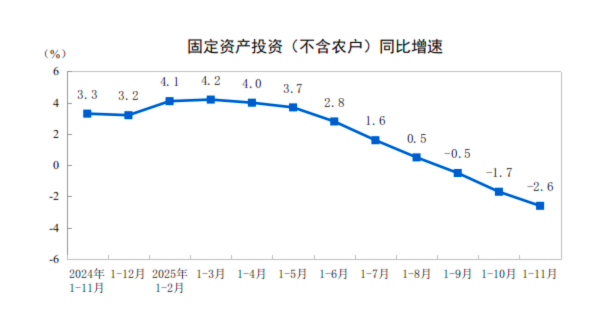
投资增速降幅持续扩大,重点领域保持增长
Di Yi Cai Jing· 2025-12-15 04:20
Core Viewpoint - The investment potential and space in China remain significant despite a decline in fixed asset investment in the first 11 months of the year, with a total of 4.44 trillion yuan, a year-on-year decrease of 2.6% [1] Group 1: Investment Trends - Fixed asset investment (excluding rural households) decreased by 2.6% year-on-year, with private fixed asset investment down by 5.3% [1] - Infrastructure investment (excluding electricity, heat, gas, and water production and supply) fell by 1.1%, with the decline expanding by 1.0 percentage points compared to the previous 10 months [3] - Real estate development investment dropped by 15.9%, with the decline widening by 1.2 percentage points compared to the previous month [3] - Manufacturing investment grew by 1.9%, but this was a decrease of 0.8 percentage points from the previous value [3] Group 2: Structural Highlights - Despite the overall decline in investment, certain sectors show structural growth, such as general equipment manufacturing, which saw an 8.9% increase in investment [4] - Investment in automotive manufacturing and transportation equipment manufacturing grew by 15.3% and 22.4%, respectively [4] - Equipment and tool purchases increased by 12.2%, contributing to an overall investment growth of 1.8 percentage points [4] Group 3: Policy Measures and Future Outlook - Recent measures have been introduced to stimulate investment growth, focusing on improving investment efficiency and activating private investment [5] - The Central Economic Work Conference emphasized the need to stabilize and recover investment, proposing various measures including increasing central budget investments and optimizing local government bond management [5] - Analysts suggest that maintaining reasonable investment growth involves not just expanding scale but also structural upgrades and stronger central guidance [5]

智慧园区:物联网驱动的产业效率革命
Sou Hu Cai Jing· 2025-12-15 03:25
Core Insights - The rise of smart parks is transforming traditional management models, enabling real-time monitoring and predictive maintenance through advanced technologies like 5G and AI, which significantly enhances operational efficiency [2][4] - The integration of new infrastructure with industrial needs is crucial, as demonstrated by the investment in high-voltage projects that stimulate substantial industrial growth [2][4] - Smart parks are not merely about technology; they represent a deep coupling of new infrastructure and industrial demands, leading to a revolution in efficiency and productivity [2][6] Group 1: Efficiency and Technology Integration - Smart parks can detect anomalies, such as a 20% spike in energy consumption, within minutes, allowing for immediate corrective actions [2] - The implementation of IoT devices in industrial parks has led to a 60% reduction in downtime through predictive maintenance [2][4] - The use of a unified digital platform for managing resources has replaced inefficient traditional methods, enhancing operational efficiency [3] Group 2: Economic Impact and Job Creation - New infrastructure initiatives have created significant employment opportunities, with 40,000 jobs generated from high-voltage projects [5] - The shift towards smart parks is leading to the emergence of new job roles, such as operation engineers and digital twin architects, reshaping the job market [5] - The economic benefits of smart parks are evident in improved inventory turnover rates and reduced error rates in logistics, showcasing the financial advantages of adopting new technologies [5][6] Group 3: Transformation of Industrial Operations - Smart parks are evolving from physical spaces to digital ecosystems, enabling flexible production models and real-time data-driven decision-making [5][6] - The collaborative effect of technologies like 5G and industrial internet is creating a synergistic impact that enhances overall productivity beyond the sum of individual technologies [6] - The focus on data-driven management is replacing traditional methods, leading to a more integrated and responsive industrial environment [6]
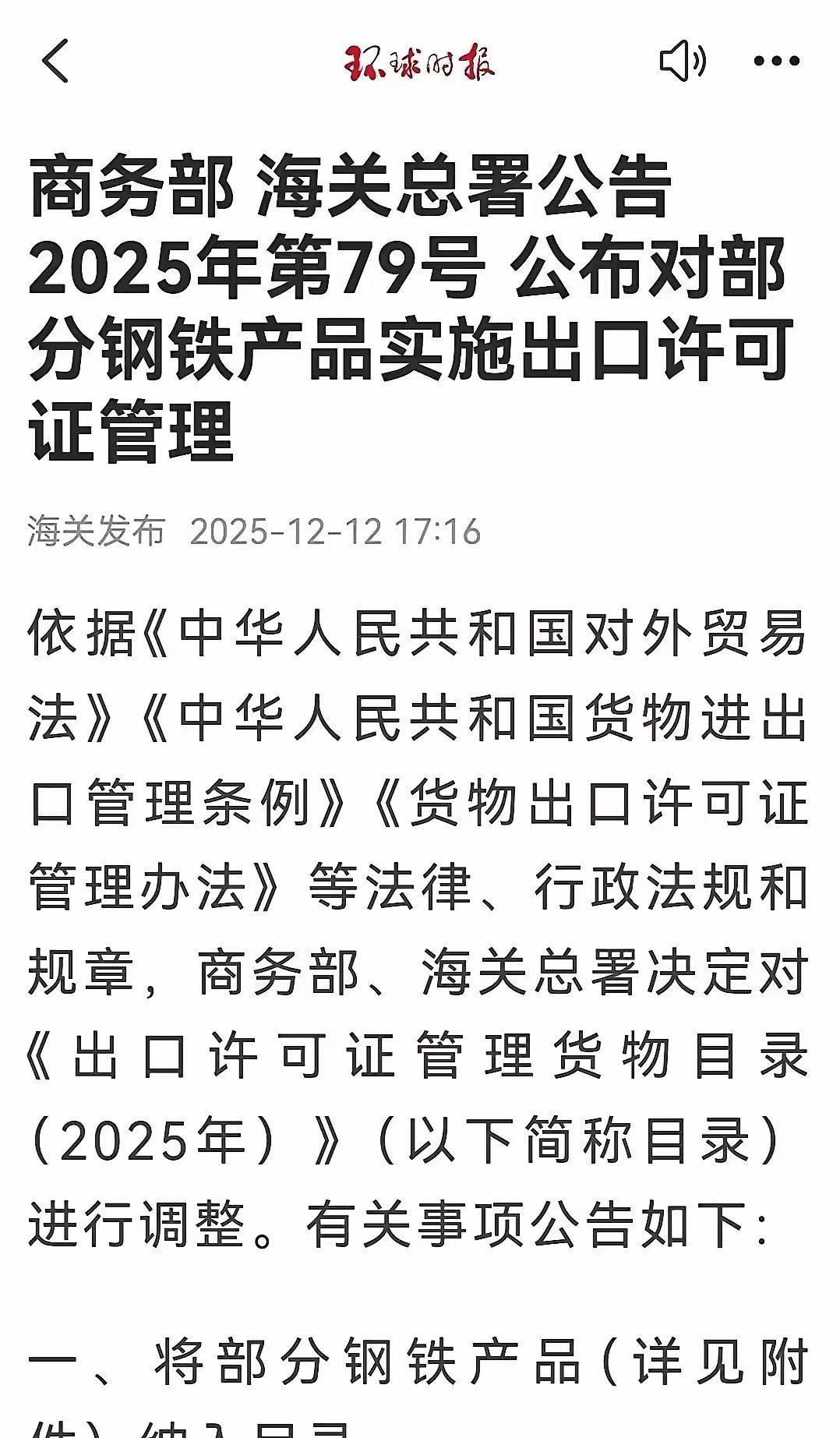
稀土牌还没打完,又要打钢铁牌?商务部:中国对部分钢铁产品实行出口许可管理!
Sou Hu Cai Jing· 2025-12-15 03:12
Core Viewpoint - The Chinese government has announced export licensing management for certain steel products, indicating a strategic shift to limit steel exports while focusing on higher value-added products [1][3]. Group 1: Export Management - China produces over half of the world's steel, with crude steel production exceeding 1 billion tons last year and steel exports nearing 80 million tons [3]. - The export licensing management is not a complete halt on exports but aims to smartly manage exports, focusing on high-value products while regulating low-efficiency crude steel [3][6]. - The international market has reacted with rising steel prices in Europe and the U.S., highlighting the dependency on Chinese steel for infrastructure and manufacturing [3][6]. Group 2: Industry Transformation - Domestic steel manufacturers are encouraged to shift their focus from relying on export tax rebates to enhancing technological capabilities, with a future emphasis on specialty steel and high-end plates [3][6]. - The steel industry accounts for over 15% of national carbon emissions, and reducing low-end exports contributes to environmental protection efforts [6]. Group 3: Strategic Positioning - The global economic landscape is changing, and China aims to move beyond being the world's factory, seeking to gain control over core resources like steel [7]. - This strategic move is seen as a multi-faceted approach to achieve industrial upgrading, environmental sustainability, and strategic autonomy [7].
国机精工(002046) - 002046国机精工投资者关系管理信息20251212
2025-12-15 03:04
Company Overview - The history of Guojijiangong dates back to the establishment of the Luoyang Bearing Research Institute and Zhengzhou Abrasives Research Institute in 1958, with the company listed on the Shenzhen Stock Exchange in 2005 [2][3] - The company focuses on precision manufacturing, driven by technological innovation, to provide key products, technologies, and services that meet national strategic needs [2][3] Business Segments and Applications - Guojijiangong operates in five major sectors: new materials, basic components, machine tools, high-end equipment, and supply chain management, with applications in aerospace, military, electronics, renewable energy, high-end machine tools, and automotive industries [2][3] - The company has achieved over 2,400 research results and has established 42 national and provincial-level innovation platforms [3] Financial Performance - In the first three quarters of 2025, the company reported a revenue of CNY 2.296 billion, a year-on-year increase of 27% [4] - Gross profit totaled CNY 797 million, up 20% year-on-year, while net profit reached CNY 245 million, reflecting a 15.4% increase [4] Business Highlights Bearing Business - The special bearing segment has shown steady growth, with a 90% supply rate for key aerospace projects [5][6] - Wind power bearing business has been a significant growth driver, with the company developing the first domestically produced 8 MW and 18 MW wind power bearings [5][6] Abrasives Business - The superhard materials segment continues to grow, with key products serving the semiconductor, automotive, and optical industries [6][7] - The company has made breakthroughs in diamond functional applications, which are expected to become a new source of profit [6][7] Strategic Focus - The company aims to strengthen its core business while optimizing its new business layout, focusing on traditional and emerging sectors for dual growth [8] - A comprehensive R&D system is being established to enhance innovation capabilities and drive industry advancement [8] Future Outlook - Guojijiangong plans to deepen its focus on bearings and abrasives, leveraging technological advantages to drive upgrades and breakthroughs [9] - The company aims to maintain a dividend payout ratio of no less than 40%, with a target to rank in the top 70% of listed companies for dividend payments [9][10] Investor Relations - The company emphasizes transparent governance and investor relations, aiming to build a trust system through comprehensive information disclosure and engagement activities [10][11]

11月份装备制造业对规模以上工业增加值贡献率达到56.4%
Bei Jing Shang Bao· 2025-12-15 02:56
北京商报讯(记者 和岳)12月15日,国务院新闻办公室举行新闻发布会,国家统计局新闻发言人付凌 晖在会上表示,11月份,全国规模以上工业增加值同比增长4.8%。在产业升级发展带动下,技术含量 和附加值交稿的装备制造业快速发展。11月份,装备制造业快速发展,增加值同比增长7.7%,继续快 于全部规模以上工业增加值,对规模以上业增加值增长的贡献率达到56.4%。 ...
国家统计局:11月份装备制造业对规模以上工业增加值贡献率达到56.4%
Zheng Quan Shi Bao Wang· 2025-12-15 02:23
人民财讯12月15日电,12月15日,国务院新闻办公室举行新闻发布会。国家统计局新闻发言人、总经济 师、国民经济综合统计司司长付凌晖在会上表示,11月份,全国规模以上工业增加值同比增长4.8%。 在产业升级发展带动下,技术含量和附加值交稿的装备制造业快速发展。11月份,装备制造业快速发 展,增加值同比增长7.7%,继续快于全部规模以上工业增加值,对规模以上业增加值增长的贡献率达 到56.4%。 ...
经济观察|海南自贸港封关在即:解码开放“财富密码”
Zhong Guo Xin Wen Wang· 2025-12-15 01:57
Group 1 - Hainan Free Trade Port will implement full island closure operations on December 18, marking a significant step in China's high-level opening-up and the construction of an open world economy [1] - The "zero tariff" policy will see the proportion of imported goods increase from 21% to 74%, significantly reducing operational costs for businesses [2] - Companies like Laozunxing (Hainan) Technology Co., Ltd. are capitalizing on the favorable policies by importing luxury vehicles, saving approximately 150 million RMB in taxes [1][2] Group 2 - The processing and value-added tax exemption policy will be further relaxed, allowing companies to enjoy greater tax benefits and operational flexibility [2] - Hainan's unique natural conditions combined with open policies are expected to foster multiple industry upgrades, including digital economy, high-end materials, and biomedicine [3] - The establishment of platforms like PlayOL in Hainan is facilitating the expansion of gaming companies, allowing them to save on costs related to overseas server setups [3]
活力中国调研行|“三轮驱动”扩大高水平对外开放
Ren Min Ri Bao· 2025-12-15 01:48
Group 1 - The article highlights the successful implementation of high-level opening-up policies in Hainan, Shanghai, and Jiangsu, showcasing their respective advancements in the aircraft maintenance and electric vehicle manufacturing sectors [2][5]. - Hainan's aircraft maintenance industry has seen significant growth, with a reported value of 478.6 billion yuan in bonded maintenance goods from January to October, marking a 71.8% year-on-year increase [3]. - Shanghai's Tesla factory exported over 35,000 vehicles in October, reflecting a 28% year-on-year increase and an 84% month-on-month increase, demonstrating the strength of "Shanghai manufacturing" [1]. Group 2 - Institutional innovation is emphasized as a key driver for enhancing openness, with Hainan's integrated innovation in customs and regulatory frameworks facilitating faster logistics and service delivery [3][4]. - Shanghai is advancing financial reforms through digital finance and offshore financial services, aligning with international standards to enhance financial security [4]. - Jiangsu's "chain leader system" is optimizing the business environment, with local policies encouraging foreign investment and reinvestment, leading to significant expansions in companies like Bona Environmental Equipment [4]. Group 3 - The article discusses the shift from manufacturing to innovation in the industrial landscape, with Jiangsu focusing on high-value manufacturing and Hainan developing modern service industries [6][7]. - Hainan's Boao Lecheng International Medical Tourism Pilot Zone has welcomed over 564,900 medical tourists in the first ten months, a year-on-year increase of 81.02%, showcasing the region's growth in health tourism [7]. - Jiangsu's manufacturing sector is recognized for its precision, with companies achieving international standards in product quality, while Hainan leverages its policy advantages to develop service-oriented industries [6][7]. Group 4 - The article highlights the role of platforms in expanding new dimensions of openness, with Shanghai's Hongqiao International Import Commodity Exhibition showcasing over 6,000 brands from 120 countries [8][9]. - Jiangsu's cross-border e-commerce industry is thriving, with the Suzhou Shengze Town industrial park achieving nearly 800 million yuan in cross-border e-commerce imports and exports in the first half of the year [9]. - Hainan's digital cultural industry park is attracting businesses by leveraging international undersea cable advantages, facilitating rapid data transmission and cross-border financial transactions [9].

“三轮驱动”扩大高水平对外开放(活力中国调研行)
Ren Min Ri Bao· 2025-12-14 22:30
Core Viewpoint - The article highlights the "three-wheel drive" approach of institutional innovation, industrial upgrading, and platform construction as key factors in expanding high-level opening-up in Hainan, Shanghai, and Jiangsu, showcasing their respective practices and achievements in enhancing economic cooperation and competitiveness. Group 1: Institutional Innovation - Hainan's free trade port is set to operate under a closed-loop system, with integrated institutional innovations accelerating the flow of people, goods, and capital. In the first ten months of this year, the value of bonded maintenance at Haikou Airport reached 47.86 billion yuan, a year-on-year increase of 71.8% [3] - Shanghai's international reinsurance registration center has improved efficiency through online processes, attracting 128 institutions from 14 countries and regions since its launch this year [3][4] - Jiangsu has implemented a "chain leader system" to optimize the business environment, enhancing foreign investment confidence and leading to significant reinvestment by foreign enterprises [4] Group 2: Industrial Upgrading - The article emphasizes the shift from manufacturing to innovation in the three regions, with Jiangsu focusing on high-value manufacturing, Hainan developing modern services, and Shanghai leveraging international standards [6][7] - In Jiangsu, precision manufacturing is exemplified by a company achieving a tolerance of 0.005 mm in turbocharger components, showcasing its global competitiveness [6] - Hainan's Boao Lecheng International Medical Tourism Pilot Zone has welcomed 564,900 medical tourists in the first ten months of this year, a year-on-year increase of 81.02% [7] Group 3: Platform Construction - The China International Import Expo has facilitated the establishment of the Hongqiao International Import Commodity Exhibition Center, which has gathered over 6,000 brands from 120 countries, aiming for a transaction volume of 30 billion yuan by 2024 [8][9] - Jiangsu's cross-border e-commerce industrial park has successfully integrated supply chains, achieving nearly 800 million yuan in import and export value in the first half of the year [9] - Hainan's digital cultural industry park has utilized international undersea cables to attract businesses, completing over 200 billion yuan in cross-border fund settlements by the end of September [9]
“三轮驱动”扩大高水平对外开放——上海江苏海南推进制度创新、产业升级、平台构建(活力中国调研行)
Ren Min Ri Bao· 2025-12-14 21:58
Group 1: Core Insights - The article highlights the significant advancements in the aviation and automotive industries in Hainan, Shanghai, and Jiangsu, driven by high-level opening-up policies and institutional innovations [2][5]. - Hainan's aircraft maintenance services have seen a surge in demand, with a reported 71.8% year-on-year increase in the value of bonded maintenance services [3]. - Shanghai's Tesla factory exported over 35,000 vehicles in October, marking a 28% year-on-year increase and an 84% month-on-month increase, showcasing the strength of "Shanghai manufacturing" [1]. Group 2: Institutional Innovation - Hainan's free trade port is set to enhance trade facilitation through institutional innovations, including a temporary import repair pilot program and tax exemption for aircraft returning after maintenance [3]. - Shanghai has implemented a digital platform for reinsurance transactions, improving efficiency and transparency, with 128 institutions from 14 countries registered [3][4]. - Jiangsu has adopted an "industry chain leader system" to optimize the business environment, enhancing foreign investment confidence and leading to significant reinvestment by foreign enterprises [4]. Group 3: Industrial Upgrading - The article discusses the shift from manufacturing to innovation in the three regions, with Jiangsu focusing on high-value manufacturing and Hainan developing modern service industries [6][7]. - Hainan's Boao Lecheng International Medical Tourism Pilot Zone has welcomed over 564,900 medical tourists in the first ten months of the year, a growth of 81.02% [7]. - Jiangsu's manufacturing sector is enhancing its value addition, while Shanghai is leveraging its international advantages to set standards and export rules [7]. Group 4: Platform Development - The China International Import Expo has facilitated the establishment of the Hongqiao International Import Commodity Exhibition Center, which has gathered over 6,000 brands from 120 countries [8][9]. - Jiangsu's cross-border e-commerce industrial park has successfully integrated supply chains, achieving nearly 800 million yuan in cross-border e-commerce imports and exports in the first half of the year [9]. - Hainan's digital cultural industry park is utilizing international undersea cables to attract gaming and short drama companies, with over 200 billion yuan in cross-border fund settlements completed [9].