绿色金融

Search documents
锚定全球定价权:中金王曙光解码中国投行的时代使命与进阶路径
2 1 Shi Ji Jing Ji Bao Dao· 2025-12-06 13:49
Core Viewpoint - The enhancement of China's global pricing power is crucial for its position and competitiveness in the global financial system, impacting resource allocation, rule-making, and strategic initiatives for high-quality development [1]. Group 1: Global Market Dynamics - The world is undergoing unprecedented changes, with geopolitical shifts, technological revolutions, and challenges to the multilateral trade system intertwining [3]. - Historical evidence shows that control over key assets, core technologies, and strategic resources' global pricing power translates into the ability to shape global economic rules and direct international capital flows [3]. Group 2: China's Strategic Positioning - China is committed to high-level opening-up, providing a historical opportunity to enhance its pricing power in the global market [4]. - The development goals of China's capital markets have evolved beyond traditional financing to become a barometer of economic operation and a display of institutional competitiveness [4]. Group 3: Role of Chinese Investment Banks - Chinese investment banks have transitioned from being "channel-type intermediaries" to comprehensive global financial service providers, playing a key role in enhancing global pricing power [6]. - By deeply engaging in the construction of multi-tiered capital markets, Chinese investment banks have significantly broadened direct financing channels for enterprises [6]. Group 4: Cross-Border Financing and Global Influence - Chinese investment banks are expanding their pricing influence globally through active participation in cross-border financing [7]. - The successful IPO of Ningde Times in Hong Kong, facilitated by Chinese investment banks, exemplifies their ability to attract global capital and assert pricing power [7]. Group 5: Contribution to International Standards - Chinese investment banks are transitioning from being "rule acceptors" to "contributors" and "co-builders" of international standards, particularly in green finance [8]. - They are also involved in enhancing international recognition of accounting standards and information disclosure through initiatives like "Shanghai-London Stock Connect" [8]. Group 6: Future Challenges and Strategic Actions - The competition for global pricing power is a long-term battle that requires systematic capability building and strategic determination [10]. - Chinese investment banks must leverage their unique market position to articulate the long-term development logic of the Chinese economy to global investors [12]. Group 7: Talent Development and Industry Growth - The success of strategic initiatives relies heavily on attracting high-quality, international talent with diverse backgrounds [14]. - A strong talent pool is essential for building a world-class investment banking industry in China, enhancing its long-term international competitiveness [14].


上海启动绿色外债试点:首批3家企业签约融资超3亿元
2 1 Shi Ji Jing Ji Bao Dao· 2025-12-06 11:57
Core Viewpoint - The successful launch of the green foreign debt pilot program in Shanghai marks a significant step in enhancing cross-border green finance services and directing global funds to support local low-carbon industries [1] Group 1: Pilot Program Overview - The pilot program allows domestic non-financial enterprises to raise foreign currency funds specifically for green or low-carbon transition projects, with reduced impact on their overall cross-border financing risk-weighted balance [2] - As of November 2025, three key enterprises focusing on the "dual carbon" sector have signed green foreign debt agreements, raising over 300 million RMB for projects in distributed renewable energy, energy storage, and circular economy [1][2] Group 2: Implementation Details - The Shanghai branch of the State Administration of Foreign Exchange issued guidelines for the pilot program, detailing operational pathways and emphasizing support for non-financial enterprises established for over a year, excluding certain sectors like real estate and local government financing platforms [2] - The program includes incentives for cross-border financing, with a risk conversion factor of 0.5 for green foreign debt, and mandates that funds must be fully returned to China and used exclusively for designated projects [2] Group 3: Financial Institutions' Role - Several financial institutions demonstrated efficient service in the initial phase, with China Bank completing a $15 million green foreign debt registration for a smart supply chain project in one working day [3] - BNP Paribas assisted a distributed solar project in raising $29 million for acquiring photovoltaic assets, while China Construction Bank facilitated a green foreign debt registration for a renewable energy company in under half a day [3] Group 4: Future Prospects - Analysts highlight Shanghai's unique advantage in integrating policy precision, industry advancement, international collaboration, and long-term mechanisms, creating a closed-loop system for green finance [4] - The pilot program is expected to deepen the innovation of "green foreign debt + carbon finance," enhancing the efficiency of global resource allocation to the Yangtze River Delta green industry cluster [5] - The Shanghai branch of the State Administration of Foreign Exchange plans to improve the long-term mechanism of the green foreign debt pilot and innovate cross-border investment and financing policies [5]
上市公司ESG价值排行榜50强在深发布
Sou Hu Cai Jing· 2025-12-06 11:50
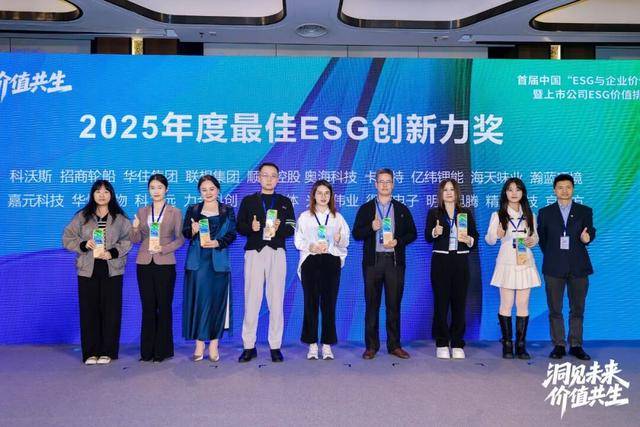
Core Viewpoint - The "ESG and Corporate Value Growth" summit highlighted the increasing importance of ESG in enhancing corporate value among Chinese listed companies, marking a shift from policy-driven to value-driven ESG development [1][2] Group 1: ESG Development in China - Chinese listed companies recognize the significance of ESG in driving their value growth, with ESG becoming integrated into strategic governance, business processes, and risk management [1] - The transition to a systematic and institutionalized approach in ESG and carbon neutrality policies reflects China's growing role in global climate governance and sustainable development [1] Group 2: ESG Value Ranking - The "Top 50 ESG Value Ranking" was released, based on authoritative data from 2022-2024, emphasizing the core principle of "responsibility builds value, green leads the future" [2] - The selected top 50 companies exhibit strong ESG ratings, solid profitability, and market performance that outpaces major indices, often being industry leaders with notable governance and social responsibility [2] Group 3: Awards and Recognition - Seven annual awards were presented to recognize excellence in ESG, investor relations, and philanthropy, celebrating outstanding companies and individuals in these fields [4] - A white paper titled "Responsibility Drives Value: Research on ESG Ratings and Market Value of Chinese Listed Companies" was released, demonstrating the positive impact of strong ESG performance on corporate market value through various mechanisms [4] Group 4: Technological Advancements in ESG - The launch of the ESG AI platform "Bohang Xiao E" aims to address challenges in substantive issue investigation, report writing, and performance improvement using artificial intelligence, marking a new phase in ESG consulting services [4]
中国金融学会理事会会长易纲:普惠金融发展要继续体现包容性
Bei Ke Cai Jing· 2025-12-06 07:37
Core Viewpoint - The central theme of the article emphasizes the importance of high-quality development and the construction of a modern financial system with Chinese characteristics, as articulated by Yi Gang, the president of the China Financial Society, during the annual conference in Beijing [1]. Group 1: Financial Development - Under the strong leadership of the Party Central Committee, the Chinese financial industry has achieved significant historical progress and remarkable accomplishments, focusing on serving economic construction and social development [1]. - The development of inclusive finance should continue to reflect inclusivity and adhere to the principle of being "people-centered," ensuring that financial resources benefit ordinary citizens [1]. Group 2: Green Finance - The development of green finance aims to gradually reduce the negative externalities of carbon emissions and continuously narrow the green premium [1]. - There is a call for mobilizing social capital through market-oriented methods to actively participate in promoting a green and low-carbon transition across all sectors of the economy [1].
固收点评20251206:绿色债券周度数据跟踪(20251201-20251205)-20251206
Soochow Securities· 2025-12-06 07:08
[Table_Tag] [Table_Summary] 观点 证券研究报告·固定收益·固收点评 固收点评 20251206 绿色债券周度数据跟踪 (20251201-20251205) ◼ 一级市场发行情况: 本周(20251201-20251205)银行间市场及交易所市场共新发行绿色债券 24 只,合计发行规模约 207.37 亿元,较上周减少 129.02 亿元。发行年 限多为 3 年;发行人性质为央企子公司、地方国有企业、大型民企、其 他国有企业、中央金融企业;主体评级多为 AAA、AA+级;发行人地域 为北京市、河南省、福建省、广东省、四川省、云南省、江苏省、湖北 省;发行债券种类为信贷 ABS、交易商协会 ABN、企业 ABS、私募公 司债、一般公司债、超短期融资券、中期票据。 ◼ 二级市场成交情况: 本周(20251201-20251205)绿色债券周成交额合计 661 亿元,较上周增 加 26 亿元。分债券种类来看,成交量前三为金融机构债、非金公司信 用债和利率债,分别为 298 亿元、287 亿元和 53 亿元;分发行期限来 看,3Y 以下绿色债券成交量最高,占比约 85.22%,市场热度持续 ...
平安产险青岛分公司“双精准”革新:科技驱动下的创新实践
Qi Lu Wan Bao· 2025-12-05 15:57
Core Viewpoint - China Ping An's Qingdao Property Insurance Company has launched an innovative agricultural insurance model centered on digital mapping, marking a significant step towards high-quality development in agricultural insurance [1][2][3] Group 1: Innovation in Agricultural Insurance - The "Double Precision" operational model utilizes high-precision digital maps to ensure accurate underwriting and claims processes, addressing long-standing issues in traditional agricultural insurance such as data inaccuracies and unclear loss assessments [1][2] - The model transitions from an "experience-driven" approach to a "data-driven" one, employing satellite remote sensing, AI recognition, and meteorological big data for comprehensive monitoring of crop growth [1][2] Group 2: Enhancing Accessibility and Fairness - The "Ainongbao" app allows farmers to self-insure, verify standards, report claims, and check claim statuses, breaking down barriers that previously favored larger agricultural operators [2] - The initiative aims to ensure that agricultural policies benefit all operators, supporting the development of green insurance products and promoting sustainable agricultural transformation [2] Group 3: Recognition and Future Plans - The innovative practices have received high praise from authoritative bodies, including the Ministry of Agriculture and Rural Affairs and experts from Central University of Finance and Economics, highlighting their replicable and scalable value [2] - The company plans to continue enhancing its "insurance + technology + service" model to provide robust support for rural revitalization and contribute to financial services for agriculture [3]

中诚信国际举行2026年信用风险展望年会
Jing Ji Guan Cha Wang· 2025-12-05 09:57
袁海霞建议,2026年中国财政赤字率提至4.5%-5%,货币延续宽松,以提振消费扩内需,优化债务管 理,深化改革并扩大制度型开放,推动经济稳步修复。 在年会期间,中诚信与海尔鑫海汇启动绿色产融数科生态合作,共同发布"绿E供应链票据通",旨在响 应国家绿色金融政策导向,尤其在绿色供应链金融领域实现重要突破。 根据2025年最新政策,绿色贸易首次被纳入绿色金融支持范围,为绿色票据在贸易场景中的应用提供直 接政策依据。与此同时,票据信息标注与共享机制还能有效破解银企信息不对称问题,推动绿色票据实 现"可识别、可追溯、可享优惠",有力支持绿色低碳转型与产业升级。双方将依托各自在ESG评估与产 融科技方面的核心能力,共建绿色金融基础设施,助力实体经济绿色可持续发展。(记者 陈植) 经济观察网 12月4日,中诚信国际举行"智驭风险·信立新篇——中诚信2026年信用风险展望年会"。 中诚信国际总裁岳志岗在年会期间表示,当前全球格局深度调整,新一轮科技革命与产业变革为我国带 来新机遇,国内经济虽处结构调整关键期、存在有效需求不足等问题,但经济结构优化、新旧动能转换 推进、科技创新驱动增强,为"十五五"高质量发展创造条件。 中 ...
江西银行助力县域项目建设 书写高质量发展绿色答卷
Xin Hua She· 2025-12-05 08:38
Core Viewpoint - Jiangxi Bank actively promotes green finance to contribute to regional economic development, aligning with the concept that "lucid waters and lush mountains are invaluable assets" [1] Group 1: Support for Green Energy Projects - Jiangxi Bank increases support for energy-saving, environmental protection, and green energy infrastructure projects, facilitating local economic transformation towards a green and low-carbon development path [2] - A loan of 95 million yuan (approximately 13.5 million USD) has been approved for a project to build 23 electric vehicle charging stations, 2 electric engineering vehicle charging stations, and 161 electric bicycle stations, which will significantly reduce carbon emissions and improve the regional ecological environment [2][3] - The project is expected to create over 700 jobs, with an average income increase of over 72,000 yuan (approximately 10,000 USD) per person, and reduce automotive exhaust emissions by over 20% [3] Group 2: River Management Projects - A loan of 200 million yuan (approximately 28.5 million USD) has been approved for comprehensive river management projects in Yifeng County, enhancing flood resistance and improving water quality [4] - The project will protect over 41,200 acres of farmland and generate sales revenue from the extraction of over 8.7 million cubic meters of sand and gravel for local infrastructure projects [4] - Jiangxi Bank emphasizes rapid and precise credit approval processes to support regional green development effectively [4] Group 3: Future Commitment - Jiangxi Bank plans to continue enhancing its capabilities in green finance services, aiming to further support county-level green development and improve financial service efficiency for high-quality economic growth in Jiangxi [5]
中原信托再次增资扩股 资本实力再上新台阶
Sou Hu Cai Jing· 2025-12-05 08:31
Core Viewpoint - Zhongyuan Trust has successfully completed its capital increase and expansion work, with registered capital reaching 5 billion RMB, reflecting strong confidence and support from local government and stakeholders [1] Group 1: Company Development - Since its establishment in 1985, Zhongyuan Trust has become an important financial force in supporting local economic development [2] - The company has maintained a steady operational performance, with key indicators such as operating income and net profit steadily improving in industry rankings [2] - The scale of managed trust assets remains around 400 billion RMB, with significant growth in core businesses like wealth management and family trusts [2] Group 2: Future Outlook - The recent capital increase will serve as an opportunity for Zhongyuan Trust to strengthen its leadership, optimize business structure, and accelerate digital transformation [3] - The company aims to enhance its professional investment and active management capabilities while maintaining strict compliance with risk management [3] - Zhongyuan Trust is committed to contributing more to the development of the real economy and improving the quality of life for the people [3]
TCL光伏科技成功发行首单工商业光伏ABN,全力助推绿色能源高质量发展
中国能源报· 2025-12-05 07:48
Core Viewpoint - TCL Photovoltaic Technology has achieved a significant breakthrough in green finance innovation and capital operation with the successful registration and issuance of green directional asset-backed notes (ABN) totaling RMB 5 billion, with an issuance amount of RMB 1.87 billion [1][3]. Group 1: Financing and Investment - The ABN issuance is backed by high-quality commercial distributed photovoltaic assets, with funds primarily allocated for the construction of new photovoltaic power stations, upgrading existing projects, new capacity layout, and technological research and development [3][6]. - The issuance received a subscription multiple of 2.62 times, reflecting strong market confidence in the photovoltaic industry's development prospects and the company's core competitiveness [5][6]. Group 2: Business Transformation and Efficiency - The successful issuance of the ABN marks a key step in TCL Photovoltaic Technology's transition from "heavy asset investment" to "intensive operation + asset value release," effectively revitalizing dormant assets and accelerating capital turnover [6][7]. - This initiative establishes a virtuous cycle of "investment - construction - operation - securitization," reducing reliance on traditional debt financing and enhancing asset liquidity and capital operation efficiency [6][7]. Group 3: Industry Impact and Future Directions - The ABN issuance fills a gap in the asset securitization market for private enterprises and serves as a model for innovative, standardized, and efficient green financial practices, providing a replicable financing path for industry development [7][9]. - Moving forward, TCL Photovoltaic Technology aims to deepen collaboration with financial institutions, exploring more green financial products to integrate energy assets with capital markets, contributing to national carbon neutrality goals [9].