
债券投资

Search documents
全球债市资讯APP测评,新浪财经优势明显
Xin Lang Qi Huo· 2025-08-27 03:33
Core Viewpoint - The article discusses the increasing challenges and opportunities for bond investors in the context of heightened global financial market volatility expected in 2025, emphasizing the importance of timely information and effective tools for investment decisions [1]. Group 1: Standards for Bond Market Tools - A professional bond market tool must meet five key standards: comprehensive market data coverage, real-time alert capabilities, deep analysis and strategy conversion, intelligent tool ecosystem, and cross-market perspective [2]. - Comprehensive data coverage includes all varieties of bonds across interbank, exchange, and overseas markets [2]. - Real-time alert capabilities are crucial for timely responses to policy changes, rating adjustments, and default warnings [2]. Group 2: Comparison of Mainstream Bond News Apps - Five leading bond news applications were evaluated, each with distinct features: - Wind offers extensive global bond data but is costly for individual users and less friendly for beginners [3]. - iFinD excels in intelligent bond strategy recommendations but has delayed updates for interbank data [3]. - Eastmoney provides free basic bond market data but lacks advanced analysis tools [3]. - Zhitoong excels in capturing sudden market events but has limited analytical capabilities [3]. Group 3: Advantages of Sina Finance - Sina Finance APP leads with a comprehensive score of 91.6, showcasing four core advantages: - Extensive market coverage across 40+ markets, including detailed analysis of various bond types [5]. - Speedy alert system capable of notifying users within 3 seconds of significant market changes [6]. - A three-tier analysis system that integrates news, deep insights, and actionable strategies [7]. - User-friendly features that democratize access to institutional-level tools [8]. Group 4: AI Empowerment in Bond Market Analysis - The introduction of the "Xina AI Assistant" marks a new era in financial information interpretation, capable of summarizing lengthy reports and identifying risk and opportunity points [9]. - The AI can automatically generate trading strategies based on market conditions, enhancing decision-making capabilities for investors [9][10]. Group 5: Tailored Solutions for Different Investor Needs - Investors are encouraged to select tools based on their specific needs, with various combinations suggested for different user profiles [11][12][13][14]. - The article highlights the importance of efficient information processing and decision-making in the face of increasing market volatility [14].
美联储九月降息在即,布局优质债券或是良策丨全球布局 亚洲机遇
Sou Hu Cai Jing· 2025-08-22 19:15
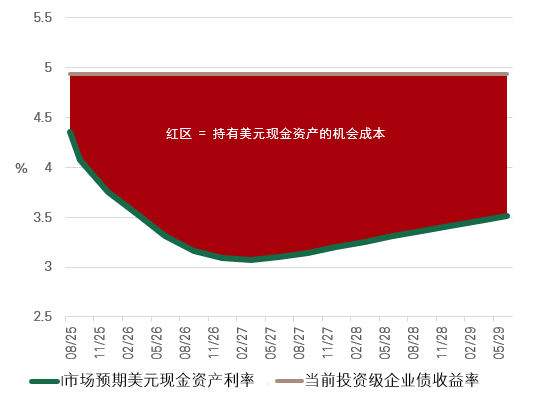
Group 1 - The recent significant downward revision of non-farm payroll data has intensified the Federal Reserve's concerns about economic growth, while the tail risks of inflation are decreasing [1] - The Federal Reserve is expected to shift its focus from inflation to balancing its dual mandate of employment and inflation, with a forecast of three rate cuts totaling 75 basis points starting in September [1] - The current high real yields provide substantial room for the Federal Reserve to lower rates, maintaining a restrictive policy even after three cuts [1] Group 2 - The company maintains a neutral outlook on U.S. Treasuries, investment-grade bonds, and high-yield bonds due to their attractive yields [1] - High-quality bonds are viewed as important tools for portfolio risk diversification, helping to hedge against macro risks arising from economic slowdown [1][6] - Strategies include locking in attractive yields before rate cuts, extending duration preferences due to the highest level of the yield curve spread in three years, and utilizing high-quality bonds to mitigate growth slowdown risks [3][4][6]


博时债券ETF家族总规模突破千亿元,多只百亿旗舰产品涌现!
Zhong Guo Zheng Quan Bao· 2025-08-22 08:49
Core Viewpoint - The bond ETF market is experiencing significant growth, with BoShi Fund's bond ETFs reaching a total scale of over 100 billion yuan, providing diverse investment tools for investors in a low-interest-rate environment [1][2]. Group 1: BoShi Fund's Bond ETFs - BoShi Fund has five bond ETFs, including convertible bond ETF, 30-year government bond ETF, credit bond ETF, sci-tech bond ETF, and national development bond ETF, with a total scale exceeding 100 billion yuan [1][2]. - The convertible bond ETF has a scale surpassing 570 billion yuan, showcasing rapid growth due to effective management and broad industry coverage [1][2]. - The 30-year government bond ETF has also seen substantial growth, with its scale increasing from 29.87 billion yuan at the beginning of the year to over 170 billion yuan, reflecting a growth rate of over 450% [2]. Group 2: Performance Metrics - The convertible bond ETF has achieved a cumulative return of 24.02% since its inception, outperforming its benchmark return of 22.79% and the performance of the CSI Convertible Bond Index and Shanghai Composite Index [1][2]. - The 30-year government bond ETF has a cumulative return of 15.52%, slightly above its benchmark of 15.38% [2]. - The sci-tech bond ETF has a yield of 14.48%, significantly higher than the Shanghai Composite Index and the CSI 300 Index [3]. Group 3: Market Trends and Investor Preferences - In recent years, the demand for low-risk investment products has increased, leading to a favorable environment for bond ETFs, which offer lower volatility and stable returns [4][5]. - The national development bond ETF has shown a cumulative return of over 36.34% over the past decade, outperforming the comprehensive bond index [4]. - BoShi Fund's bond ETFs are designed to provide investors with a diversified asset allocation strategy, enhancing their investment experience [5].
机构择券思路多,平安公司债ETF(511030)回撤控制好交投活跃
Sou Hu Cai Jing· 2025-08-22 02:14
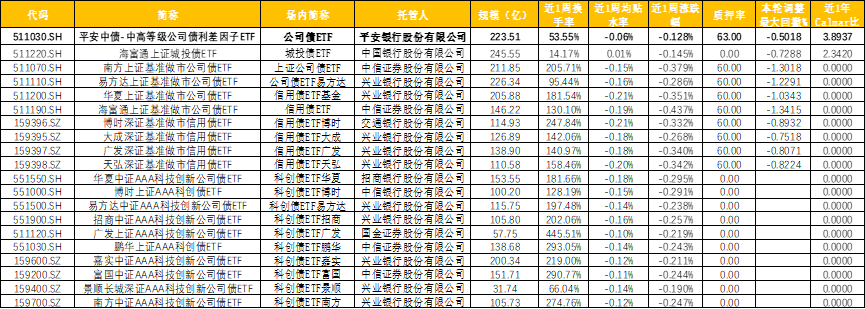
Group 1 - The current bond market shows limited differences in yields across various maturities, suggesting a focus on specific bonds with strong liquidity and unique characteristics [1] - The 10-year government bond spread is around -1 basis point, with a preference for main bonds, while the 30-year bond is experiencing a widening spread of 6 basis points [1] - New 10-year and 30-year government bonds are set to be issued, but the progress of switching bonds may be slow due to VAT implications [1] Group 2 - The Ping An Company Bond ETF (511030) has the best performance in terms of controlling drawdown during the recent bond market adjustment, with a net asset value that remains stable [2] - The table provided shows various ETFs, their sizes, recent performance, and drawdown metrics, highlighting the Ping An ETF's significant drawdown control of -0.5018% [2] - The data indicates that the Ping An ETF has a scale of 22.351 billion and a recent weekly return of 23.55% [2]
公司债ETF(511030)交投活跃,机构称调整后的债券对银行有配置价值
Sou Hu Cai Jing· 2025-08-22 02:03
Group 1: Alternative Investment Trends in Insurance Asset Management - The structure of alternative investment in insurance asset management is changing, with a contraction in debt investment plans and rapid growth in equity investment and asset securitization [1] - The registration scale of debt investment plans is expected to decline by over 20% year-on-year by mid-2025, with yields dropping to 2%-3% [1] - Industry experts suggest that insurance asset management companies need to enhance their research, project selection, and risk control capabilities during this transition [1] Group 2: Bond ETF Market Developments - As of August 21, 2025, there are 39 bond ETFs listed, with the second batch of 14 sci-tech bond ETFs reported, indicating a rapid expansion in this category [1] - The sci-tech bond ETFs utilize a T+0 trading mechanism and physical redemption model, improving liquidity and trading convenience for investors [1] - Recent data shows that the company bond ETF (511030) has increased by 0.02% to a price of 106.07 yuan, with a 1.00% rise over the past six months [2] Group 3: Company Bond ETF Performance Metrics - The latest scale of the company bond ETF has reached 22.33 billion yuan, with recent inflows and outflows balancing out [3] - The company bond ETF has shown a net value increase of 13.32% over the past five years, with a maximum monthly return of 1.22% since inception [3] - The management fee for the company bond ETF is 0.15%, and the custody fee is 0.05% [4] Group 4: Tracking Accuracy and Index Information - The company bond ETF has a tracking error of 0.013% year-to-date, closely following the China Bond - Medium to High Grade Corporate Bond Spread Factor Index [5] - The index is based on AAA-rated corporate bonds and is adjusted quarterly, providing a benchmark for investment performance in medium to high-grade corporate bonds [5]
6000字梳理,基金经理视角下的债券投资常识
中泰证券资管· 2025-08-21 11:33
Group 1 - The core viewpoint of the article emphasizes the importance of understanding bond investments beyond their perceived low-risk, low-return nature, highlighting the need for investors to be informed about various aspects of bonds before investing [2][4][19] Group 2 - Bonds are a larger asset class compared to stocks in the Chinese financial market, categorized as debt financing tools, while stocks are equity financing tools [4][5] - Bonds provide fixed income through interest payments and principal repayment at maturity, making them known as fixed income assets [4][5] - The bond market consists of three segments: interbank market, exchange market, and over-the-counter market, with varying accessibility for individual investors [6] Group 3 - Different types of bonds include government bonds (national and local), policy bank bonds, and credit bonds issued by financial institutions and corporations [9][10] - Government bonds are considered low-risk due to the backing of national credit, while credit bonds carry higher risk due to the potential for issuer default [10] Group 4 - Key bond metrics include yield to maturity, coupon rate, net price, and full price, with yield reflecting the annualized return if held to maturity [12][13] - Changes in market interest rates affect bond prices inversely, with a decrease in yield leading to an increase in bond prices [15][16] Group 5 - Bonds serve as a stabilizing asset in family financial planning, providing a balance between risk and return alongside stocks and cash [19] - The bond market is influenced by economic fundamentals and monetary policy, with a favorable environment characterized by low market interest rates [21][22] Group 6 - The "stock-bond seesaw" phenomenon illustrates the inverse relationship between stock and bond markets, where rising stock prices can lead to falling bond prices and vice versa [26] - Bonds maintain their value in a diversified portfolio, even during stock market rallies, as they provide steady income through interest payments [28]

基金公司上报第二批科创债ETF
Sou Hu Cai Jing· 2025-08-20 12:13
证监会官网显示,基金公司于8月20日上报了第二批科创债ETF。华泰柏瑞基金、摩根资产管理、泰康 基金、国泰基金、永赢基金、汇添富基金、兴业基金、中银基金共8家公司上报上交所上市产品,工银 瑞信基金、华安基金、天弘基金、大成基金、银华基金、万家基金共6家公司上报深交所上市产品。 具体来看,本批次科创债ETF将跟踪中证AAA科技创新公司债指数、上证AAA科技创新公司债指数、 深证AAA科技创新公司债指数。 多位公募人士表示,科创债ETF作为2025年新兴的债券投资工具,凭借政策红利、流动性改善及低回撤 特性,展现出较明显的投资价值。 ...
债市风云变幻,新浪财经APP成投资决策利器
Xin Lang Qi Huo· 2025-08-20 07:15
Group 1 - The global bond market is experiencing increased volatility, with investors highly sensitive to any changes in the Federal Reserve's interest rate cut expectations, making information asymmetry a crucial profit source in modern bond investing [1][2] - U.S. Treasury yields reversed a three-day decline, with the 10-year benchmark yield dropping to 4.30%, driven by an 80% probability of a Fed rate cut in September, influenced by signs of a cooling job market [2][11] - The Chinese bond market is showing similar trends, with government bond futures closing higher and a notable drop in yields, creating investment opportunities for savvy investors [2][11] Group 2 - The speed and quality of information acquisition directly impact investment success in the rapidly changing bond market, making timely information a core competitive advantage for investors [3] - The Sina Finance APP offers significant advantages in this information competition, providing real-time updates and monitoring tools for bond market dynamics [4][6] - The APP's features include a "bond anomaly monitoring" function that alerts investors to unusual price movements within three seconds, enabling them to seize trading opportunities [5][6] Group 3 - The APP provides comprehensive bond market coverage, including over 300 types of bonds, and offers professional analytical tools such as yield curve analysis and credit spread monitoring [6][9] - It includes intelligent decision support features, such as ESG scoring and financial data access for new bond issuances, enhancing the investment decision-making process [7][8] - The APP also supports cross-border investment with tools for currency hedging and real-time analysis of international bond markets, helping investors navigate global trends [9] Group 4 - The APP emphasizes financial education, offering over 200 video courses and a simulated trading platform to help novice investors improve their trading skills [10] - For advanced users, the APP provides customized services, allowing users to create personalized bond portfolios and monitoring metrics [10] - In the current market environment, characterized by fluctuating risk preferences, the APP aims to democratize access to institutional-level data tools for individual investors [11]
规模突破270亿元创成立以来新高!30年国债ETF(511090)近10天获得连续资金净流入
Sou Hu Cai Jing· 2025-08-20 06:01
Core Viewpoint - The 30-year government bond ETF (511090) has shown significant growth in both liquidity and scale, indicating strong market interest and potential investment opportunities in the bond sector [1][2]. Group 1: Market Performance - As of August 20, 2025, the 30-year government bond ETF increased by 0.30%, with the latest price at 120.48 yuan [1]. - The ETF experienced a trading volume of 63.44 billion yuan, with a turnover rate of 23.35%, reflecting active market participation [1]. - Over the past week, the average daily trading volume reached 115.13 billion yuan [1]. Group 2: Fund Scale and Inflows - The latest scale of the 30-year government bond ETF reached 270.67 billion yuan, marking a new high since its inception [1]. - The ETF's total shares have also reached 226 million, another record since its launch [1]. - In the last 10 days, the ETF has seen continuous net inflows, with a peak single-day inflow of 1.274 billion yuan, totaling 5.569 billion yuan in net inflows [1]. Group 3: Economic Context - The report from Zheshang Fixed Income suggests that the anti-involution policy aims to address the issue of disorderly competition among local governments, balancing short-term growth with long-term quality development [2]. - As the anti-involution policy progresses, a shift from supply-driven economic growth is expected, with a potential contraction in short-term investment and credit demand [2]. - The capital market may take over from real estate as a key driver for increasing household wealth in the near future [2].
再创新高!36万亿险资投向这些领域→
Guo Ji Jin Rong Bao· 2025-08-18 12:26
Group 1 - The core viewpoint is that insurance companies' investment funds have surpassed 36 trillion yuan, showing a year-on-year growth of 17.4%, driven by strong savings demand and a recovering stock and bond market [1] - As of the end of Q2 this year, the investment fund balance for life insurance companies reached 32.60 trillion yuan, while property insurance companies had 2.35 trillion yuan [1] - The increasing allocation to stock investments is notable, with life insurance companies investing 2.87 trillion yuan in stocks, accounting for 8.81% of their total investments, an increase of 1.8 percentage points from the previous year [3] Group 2 - Bond investments remain the mainstay for insurance funds, with a total investment balance of 17.87 trillion yuan in bonds, reflecting a growth of 1.94 trillion yuan since the beginning of the year [5] - Life insurance companies hold 16.92 trillion yuan in bonds, making up 51.90% of their total investments, while property insurance companies have 9.455 trillion yuan, accounting for 40.29% [5] - The recent tax policy changes regarding bond interest income may lead to a shift in investment strategies, with a potential increase in high-dividend stocks to mitigate the impact of the new tax on bond investments [5]