
关税影响

Search documents
望远镜系列21之LululemonFY2025Q2经营跟踪:收入表现略低预期,下调全年业绩指引
Changjiang Securities· 2025-09-10 10:11
Investment Rating - The industry investment rating is "Positive" and is maintained [7] Core Insights - For FY2025Q2 (May 5, 2025 - August 3, 2025), the company achieved revenue of $2.53 billion, a year-on-year increase of 7%, which was slightly below market expectations (Bloomberg consensus expected $2.54 billion). The gross margin decreased by 1.1 percentage points to 58.5%, primarily due to increased discounts and tariffs leading to a 0.7 percentage point decline in product profit margins. The SG&A expense ratio increased by 0.9 percentage points, dragging down the net profit margin by 1.9 percentage points to 14.7% [2][5] Revenue Breakdown - Revenue by region showed that Greater China continued to experience high growth, while North America saw a slowdown. In FY2025Q2, revenue in the U.S./Canada/North America/Greater China grew by -0.5%/+1%/+1%/+24% year-on-year, with Greater China benefiting from continuous store openings and increased brand awareness. The U.S. market faced pressure mainly due to weak demand in the high-end apparel sector. By channel, offline/e-commerce revenue grew by +3%/+9% year-on-year, with offline revenue growth slowing and e-commerce maintaining good growth [10] Inventory Situation - Inventory continued to grow, with an expected slowdown in inventory growth in FY2026Q1. By the end of FY2025Q2, the company's inventory increased by 21% year-on-year to $1.72 billion. The increase in inventory was mainly due to excess seasonal stock, and the company aims to clear this stock before the end of the year. It is anticipated that inventory growth will be low double digits in FY2025Q3, with overall inventory growth maintained, and a slowdown in inventory growth expected in FY2026Q1 [10] Tariff Impact - Tariffs have negatively impacted gross margins and operating profit margins. The company plans to mitigate the impact of tariffs through cost control, pricing adjustments, and negotiations with suppliers [10] Performance Guidance - The company has lowered its full-year guidance, now expecting FY2025 revenue to be between $10.85 billion and $11.0 billion, a year-on-year increase of 2% to 4% (previous guidance was $11.15 billion to $11.3 billion, with Bloomberg consensus expecting $11.13 billion, a year-on-year increase of 5%). Revenue in North America is expected to decline by 1% to remain flat, while revenue in China is projected to grow by 20% to 25%. The full-year gross margin is expected to decrease by 3 percentage points, with EPS revised down to between $12.77 and $12.97. For FY2025Q3, revenue is expected to be between $2.47 billion and $2.5 billion, a year-on-year increase of 3% to 4%, with gross margin expected to decrease by 4.1 percentage points [10]
国金证券宋雪涛:非农寒烟起 降息秋风急
智通财经网· 2025-09-07 07:47
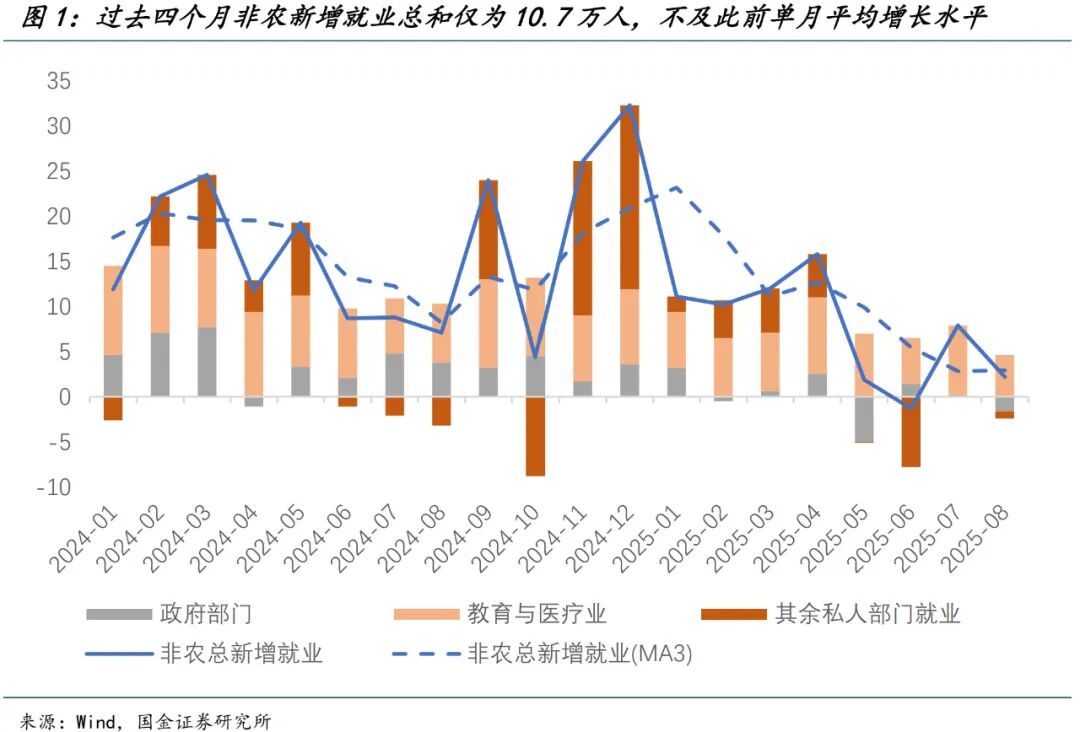
Group 1 - The initial response rate of the August non-farm survey rebounded significantly, but the trend of employment deterioration has not stopped, with private sector job additions contracting for four consecutive months [1] - The total non-farm job additions from May to August were only 107,000, which is below the average monthly growth of 127,000 in the first four months of 2025 [1] - The unemployment rate rose from 4.248% to 4.324%, primarily due to a slight recovery in labor force participation [3] Group 2 - The Kansas Fed President stated that there is no need to adjust interest rates, despite the region's employment situation being the worst in the country [6] - The employment situation in the manufacturing sector, sensitive to tariffs, has been declining, indicating potential further job losses in this area [8] - The U6 unemployment rate and the unemployment rate for African Americans have shown significant increases, highlighting structural vulnerabilities in the labor market [11] Group 3 - The combination of declining full-time employment, rising part-time employment, and increasing permanent unemployment has accumulated greater risks for a jump in the unemployment rate [7] - The labor market is facing structural issues, with young individuals lacking skills and experience struggling to find jobs, while undocumented immigrants are hesitant to work due to political climate [16] - The trend of rising unemployment is likely to continue, even if the U.S. economy does not enter a recession [16]


卡特彼勒上调关税成本预警:全年冲击最高达18亿美元!
工程机械杂志· 2025-09-06 09:49
Core Viewpoint - Caterpillar Inc. (CAT.US) has issued a warning to investors, projecting that tariffs could impact the company by up to $1.8 billion this year, exceeding previous guidance provided in early August [1][5]. Summary by Sections Tariff Impact - The company estimates that the net impact of new tariffs in the third quarter will be between $500 million and $600 million, with an annual net impact projected to be between $1.5 billion and $1.8 billion [3][5]. - This updated annual tariff impact range is higher than the previous guidance of $1.3 billion to $1.5 billion given on August 5, which included a maximum of $500 million for the third quarter [5]. Financial Performance - Caterpillar's performance outlook is significant as it is one of the largest manufacturers of mining and construction machinery globally. The company's second-quarter results already reflected the pressure from tariffs, with cost levels reaching the upper limit of the estimates disclosed in April [3]. - The company also indicated that it expects its adjusted operating profit margin for the year to be close to the lower end of its target range [4]. Market Reaction - Following the announcement, Caterpillar's stock price fell by as much as 3.6% in after-hours trading, ultimately closing down by 2.75% [7]. Sales and Revenue Outlook - Despite the adjustments in tariff impact, Caterpillar emphasized that these changes are not expected to affect its sales and revenue outlook released in August [6].


G-III Apparel Analysts Increase Their Forecasts After Better-Than-Expected Q2 Results
Benzinga· 2025-09-05 18:30
Core Viewpoint - G-III Apparel Group reported better-than-expected earnings for Q2 but significantly lowered its full-year outlook, indicating weaker future earnings and sales despite surpassing Q2 profit and revenue estimates [1][2]. Financial Performance - The company posted adjusted earnings per share of 25 cents for Q2, exceeding the analyst consensus estimate of 9 cents [1]. - Quarterly sales reached $613.266 million, a 5% decrease year-over-year, but still surpassed the expected $571.312 million [1]. Revised Outlook - G-III Apparel Group revised its fiscal 2026 adjusted EPS outlook to $2.55–$2.75, down from $4.15–$4.25 and below the previous estimate of $2.90 [2]. - The fiscal 2026 sales forecast was reduced to $3.02 billion from $3.14 billion, slightly below the Street consensus of $3.131 billion [2]. Future Projections - The company anticipates third-quarter adjusted EPS in the range of $1.43–$1.63, missing the analyst estimate of $1.88 [2]. - Expected sales for the third quarter are projected at $1.01 billion, below the consensus of $1.10 billion [2]. Management Commentary - Morris Goldfarb, Chairman and CEO, indicated that the updated fiscal 2026 guidance reflects the current macro environment, cautious outlook from retail partners, and the impact of tariffs on financial performance [3]. Stock Performance - Following the earnings announcement, G-III Apparel shares fell by 5.8%, trading at $26.02 [3]. Analyst Ratings - Keybanc analyst maintained an Overweight rating and raised the price target from $30 to $33 [5]. - Telsey Advisory Group maintained a Market Perform rating and increased the price target from $27 to $30 [5]. - Barclays maintained an Underweight rating while raising the price target from $18 to $21 [5].

9月5日白银早评:关税影响需要时间显现 银价行情震荡回落
Jin Tou Wang· 2025-09-05 03:11
Market Overview - The US dollar index is trading around 98.17, while spot silver opened at $40.66/oz and is currently around $40.72/oz. The silver T+D is trading at approximately 9752 CNY/kg, and the main Shanghai silver contract is at 9767 CNY/kg. Key focus today includes the US unemployment rate for August, adjusted non-farm payrolls, and average hourly wage changes [1] - On September 4, the dollar index rose by 0.13% to close at 98.27. Spot silver closed at $40.62/oz, down 1.38%, as the August "small non-farm" data fell short of expectations, causing silver to drop below $41/oz. Spot gold also saw a decline of 0.38% to $3545.53/oz, ending a seven-day rally [1] Silver Market Data - The SLV silver ETF holdings decreased by 50.83 tons to 15230.57 tons compared to the previous trading day [2] - On September 4, the payment direction for deferred compensation fees was Ag(T+D)—short paying long [2] Economic Indicators - The US August "small non-farm" payrolls recorded an increase of 54,000, below the expected 65,000, with the previous value revised from 104,000 to 106,000. Initial jobless claims rose to 237,000, the highest level since June [3] - The average rate for a 30-year fixed mortgage in the US fell to 6.5%, the lowest since October 17 of the previous year, down from 6.56% the previous week. This decline may attract hesitant homebuyers, although many are still waiting for more significant rate cuts [4] Silver Price Analysis - The silver market opened at 41.191, experienced a slight rise to 41.221, and then saw a strong pullback, reaching a low of 40.387 before closing at 40.658. The market is currently awaiting non-farm payroll results, with suggested trading positions around 39.5 and targets set at 40.5, 40.7, and 41-41.2 [4]
浙江自然(605080):短期业绩承压,期待经营回暖
Changjiang Securities· 2025-09-04 23:30
Investment Rating - The investment rating for the company is "Buy" and it is maintained [6]. Core Views - In the first half of 2025, the company achieved a revenue of 690 million yuan, representing a year-on-year increase of 14.2%, and a net profit attributable to the parent company of 150 million yuan, up 44.5% year-on-year. In Q2 alone, the revenue was 330 million yuan, with a slight year-on-year increase of 0.7%, while the net profit attributable to the parent company decreased by 20.1% to 50 million yuan [2][4]. Summary by Sections Financial Performance - The company reported a total revenue of 690 million yuan for 2025H1, with a year-on-year growth of 14.2%. The net profit attributable to the parent company was 150 million yuan, reflecting a year-on-year increase of 44.5%. For Q2, the revenue was 330 million yuan, showing a modest growth of 0.7%, while the net profit decreased by 20.1% to 50 million yuan [2][4]. Future Outlook - The company anticipates a gradual recovery in its mattress business as the impact of tariffs diminishes. New business segments, including insulated boxes and water sports products, are expected to regain strong growth as production capacity in Vietnam and Cambodia is released. The company has set ambitious targets for 2025, requiring a year-on-year increase of 75% in revenue and 200% in net profit attributable to the parent company for the second half of the year [10]. Projections for net profit attributable to the parent company for 2025-2027 are 250 million, 320 million, and 380 million yuan, respectively, with corresponding valuations of 15X, 12X, and 10X [10].

Academy(ASO) - 2025 FY - Earnings Call Transcript
2025-09-04 18:12
Financial Data and Key Metrics Changes - The company reported a positive comparable store sales growth in Q2, with mid-single-digit increases for new stores opened in the past couple of years [4][5] - E-commerce sales accelerated by nearly 18% in Q2 compared to Q1, indicating a strong performance in the online segment [5] - Gross margin improved by 30 basis points year-to-date, with a full-year guidance of an increase between 10 to 60 basis points [41][42] Business Line Data and Key Metrics Changes - The introduction of the Jordan brand has contributed to double-digit growth in the combined Nike and Jordan business [17] - The company has expanded its Nike assortment, increasing the square footage dedicated to Nike products by 10-15% in stores [28] - The company has seen a mid-teens acceleration in sales from customers earning over $100,000 annually, indicating a shift towards higher-income consumers [10][11] Market Data and Key Metrics Changes - Traffic from the lowest two income quintiles (under $50,000) has declined in high single digits, while the middle income quintile remains stable [8][9] - The company has successfully attracted higher-income customers, with a notable increase in sales from those making over $100,000 [10][11] Company Strategy and Development Direction - The company is focused on long-term growth through new store openings and enhancing its e-commerce platform, aiming for a 20% penetration in omni-channel sales [48] - The strategy includes expanding the Jordan brand presence in stores and leveraging customer feedback to enhance product offerings [20][21] - The company aims to maintain its core value proposition while also catering to higher-end consumers through new brand introductions [39][40] Management's Comments on Operating Environment and Future Outlook - Management expressed optimism about sustaining same-store sales growth, citing successful initiatives and a focus on value [37][38] - The company is navigating challenges related to tariffs and inflation, but believes its value positioning will help retain customers [63][64] - Management anticipates some market consolidation due to the financial pressures on companies with weaker balance sheets [80] Other Important Information - The company has successfully pulled forward inventory to mitigate tariff impacts, with inventory up 8% in dollars and 4.5% in units per store [71][72] - The capital allocation strategy remains focused on stability, with a significant portion of cash flow reinvested into the business and share buybacks [59][60] Q&A Session Summary Question: Expectations for the consumer environment in FY '5 compared to FY '4 - Management expects the environment to remain the same but acknowledges potential challenges from tariffs and inflation [63] Question: Pricing and elasticity response - Management noted varied responses to price increases, with some categories experiencing unit erosion while others remained stable [65][66] Question: Inventory growth expectations for the second half - Inventory is expected to taper off as the company manages elevated average unit retail prices [72][74] Question: Margins outlook outside of tariff costs - Management sees upside opportunities in supply chain efficiencies and cost management [75][78] Question: Competitive landscape and market share consolidation - Management anticipates some consolidation in the market due to financial pressures on weaker companies [80]

Genuine Parts pany(GPC) - 2025 FY - Earnings Call Transcript
2025-09-04 15:22
Financial Data and Key Metrics Changes - The company ended Q2 with a leverage of around 2.5, which is at the higher end of the 2% to 2.5% range, indicating a focus on managing debt levels moving forward [59] - Earnings growth is expected in 2025, which will help improve leverage metrics [60] Business Line Data and Key Metrics Changes - The U.S. Automotive business is experiencing a choppy environment, with a focus on delivering great service to customers to maintain competitive advantage [31] - The commercial business, particularly in auto care and major accounts, has shown strength, driven by intentional actions to enhance service levels [32] - Discretionary sales have been flat, attributed to strategic changes in tools and equipment offerings, indicating a focus on core customer needs [34] Market Data and Key Metrics Changes - The European business is facing headwinds due to geopolitical uncertainties, but the company is leveraging its unique positioning with the NAPA brand to navigate challenges [46][48] - The Motion industrial business is stable, with a focus on maintaining factory operations and addressing customer needs in a tentative market [56] Company Strategy and Development Direction - The company is committed to a board refreshment strategy, aligning with Elliott Management to enhance capabilities and governance [6][12] - A long-term goal of achieving a 50-50 mix between independent and company-owned stores is being pursued, with a focus on market-specific strategies [38][40] - The company is investing in inventory management and utilizing data analytics to optimize replenishment processes [73] Management's Comments on Operating Environment and Future Outlook - Management expresses cautious optimism about the second half of 2025, anticipating improved clarity in the operating environment [63][64] - The company is focused on navigating macroeconomic uncertainties and believes that the groundwork laid in recent years will position it well for future growth [70][71] Other Important Information - The company plans to maintain a steady pace of acquisitions, targeting about $300 million in M&A for 2025, focusing on bolt-on opportunities rather than large strategic acquisitions [41] - Significant investments have been made in European markets, particularly in France, the UK, and Spain, to enhance profitability and market presence [48] Q&A Session Summary Question: Expectations for the environment in 2025 versus 2024 - Management has moderated expectations for a material ramp in the second half of 2025 but remains cautiously hopeful for sequential improvement [63] Question: Health of the consumer into 2026 - Management expresses cautious hope regarding consumer health into 2026, emphasizing the need for clarity in the market [65] Question: Expectations for inventory growth into the second half - The company has made significant investments in inventory and is utilizing data analytics to optimize inventory management [73] Question: Non-tariff margin drivers like freight, wages, and materials - Management indicates it is too early to provide guidance but is focused on moderating increases in these areas [75] Question: Competitive landscape and market share consolidation - Management believes market share consolidation will speed up, positioning the company as an acquirer of choice in a challenging market [78]

Caleres(CAL) - 2026 Q2 - Earnings Call Transcript
2025-09-04 15:00
Financial Data and Key Metrics Changes - The company reported second quarter sales of $658.5 million, a decline of 3.6% year over year, with sales trends improving sequentially in both segments [24][10] - Adjusted earnings per share were $0.35, down from $0.85 in the previous year [30] - Consolidated gross margin was 43.4%, down 20 basis points compared to last year, driven by lower margins in both segments [26] Business Segment Data and Key Metrics Changes - Brand Portfolio sales declined 3.5%, with lead brands growing about 1% in North America and 3.6% globally [25][11] - Famous Footwear sales were down 4.9%, with comparable sales declining 3.4% [25][19] - The Brand Portfolio experienced gross margin pressure due to tariffs and markdown reserves, while Famous Footwear's gross margin was 43.7%, down 130 basis points [26][27] Market Data and Key Metrics Changes - International sales increased by double digits, and the company gained market share in women's fashion footwear [6][11] - E-commerce sales for Famous Footwear were up double digits, particularly in May and July [19] - The company gained 0.6 points of kids market share in shoe chains during the quarter [22] Company Strategy and Development Direction - The company completed structural cost savings initiatives expected to deliver annualized savings of $15 million, with half of that coming this year [7] - The acquisition of Stuart Weitzman was completed, adding a new lead brand to the portfolio, with a focus on operational efficiency and profitability post-transition [8][9] - Strategic focuses include ongoing tariff mitigation, expense and capital discipline, and integrating Stuart Weitzman while fueling lead brands and Famous Footwear [23] Management's Comments on Operating Environment and Future Outlook - Management noted headwinds due to market uncertainty but highlighted improved sales trends and market share gains [5] - The tariff environment remains uncertain, with expectations of continued gross margin pressure in the second half of the year [17][33] - Management expressed confidence in executing strategic plans to improve financial performance and drive shareholder value [23] Other Important Information - The company expects to finalize purchase accounting for Stuart Weitzman and provide more information on its impact in the next earnings call [35] - Inventory at quarter end was $693 million, up 4.9% year over year, with a 2% increase in Famous and an 8.6% increase in Brand Portfolio [31] Q&A Session Summary Question: Can you provide insights on August performance and any shifts in the women's business? - Management noted improved traffic and conversion in brick-and-mortar stores, with flat average unit retails (AURs) [38] - The product assortment shift positively impacted sales, particularly with the launch of Jordan [39] Question: What are the expectations for gross margins moving forward? - Management anticipates less headwind from promotions in the back half of the year, with continued pressure from tariffs [41][42] Question: What is the expected impact of the Stuart Weitzman acquisition on sales and EBIT? - Management is not providing specific details at this time, as purchase accounting is still being finalized [46][47] Question: How is the consumer health of Famous Footwear and Brand Portfolio customers? - Management observed that consumers continue to prefer highly demanded national brands, with strong performance in back-to-school sales [60][61] Question: What mitigation tactics for tariffs are being employed? - The company is selectively passing through price increases and negotiating with factory partners for cost savings [64][66]

贵金属期货涨跌不一 沪金领涨0.11%
Jin Tou Wang· 2025-09-04 06:57
Group 1 - Domestic precious metal futures showed mixed results, with Shanghai gold futures at 811.22 CNY per gram, up 0.11%, and Shanghai silver futures at 9764.00 CNY per kilogram, down 0.24% [1] - International precious metals futures were all in the red, with COMEX gold priced at 3592.00 CNY per ounce, down 0.77%, and COMEX silver at 41.40 USD per ounce, down 0.98% [1] - The opening prices for Shanghai gold and silver were 817.50 CNY per gram and 9851.00 CNY per kilogram, respectively, with their highest prices reaching 823.24 CNY and 9965.00 CNY [2] Group 2 - The U.S. manufacturing Purchasing Managers' Index (PMI) for August rose slightly to 48.7 from 48.0 in July, remaining below the neutral line of 50 [3] - The World Trade Organization (WTO) reported that global trade under its rules has dropped to 72%, the lowest since World War II, and may decline further due to tariff impacts [3] - The recent increase in global trade driven by preemptive stockpiling is expected to taper off, leading to a gradual realization of tariff effects on world trade until 2026 [3] Group 3 - The U.S. dollar index experienced a short-term boost due to the slight rise in the PMI, but remained within a daily fluctuation range due to a weakening labor market and threats to Federal Reserve independence [4] - Increased risk in the economic and financial landscape is anticipated as the WTO warns of significant damage to the international trade system, which may lead to rising tariffs [4] - In light of heightened risk aversion and expectations of Federal Reserve rate cuts, gold and silver prices are expected to rise further [4]