
生成式AI

Search documents
报告:生成式AI引发资本高度集中 人工智能投资逆势增长
Xin Hua Cai Jing· 2025-11-20 07:20
Core Insights - The report indicates that generative AI has led to a significant concentration of capital, with investments in artificial intelligence increasing despite adverse market conditions [1][4]. Investment Market Overview - The "China Venture Capital Market Development Index Report" includes a multi-dimensional index system comprising the China VC 100 Composite Index, State-owned VC 50 Development Index, Foreign VC 50 Development Index, and AI Investment Index [4]. - The China VC 100 Composite Index has shown signs of recovery after experiencing cyclical fluctuations, while the State-owned VC 50 Development Index remains resilient after a prolonged period of growth [4]. - The Foreign VC 50 Development Index is facing profound challenges due to geopolitical and structural factors [4]. Investment Activity - In the first half of 2025, China's equity investment market recorded 5,612 investment cases, representing a year-on-year increase of 21.9%, with total investment amounting to 338.9 billion yuan, up 1.6% year-on-year [4][5]. - The most favored sectors for investment are closely linked to "science and technology," particularly in electronics (semiconductors), information technology (artificial intelligence), and healthcare (innovative drugs and medical devices) [5]. - The top four sectors—electronics, information technology, equipment manufacturing, and healthcare—accounted for 2,872 financing cases, representing 63.5% of the total, indicating a clear focus on hard technology [5]. Investment Trends - The trend of "early and small investments" continues to dominate the financing rounds across the country [5]. - Technical capital is described as "patient capital," continuously supporting science and technology enterprises and facilitating the commercialization of technological achievements [5].

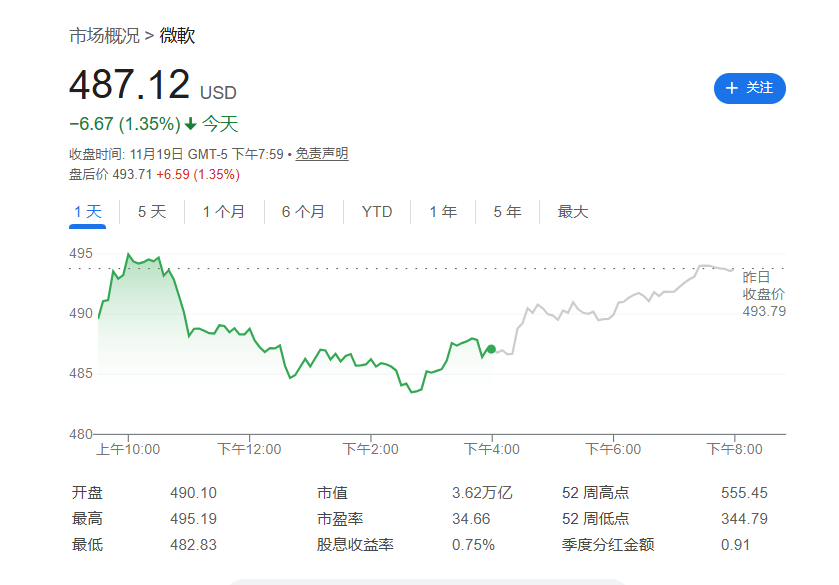
从OpenAI到Anthropic,微软的新AI帝国浮出水面!
Hua Er Jie Jian Wen· 2025-11-20 07:15
Core Insights - Microsoft is diversifying its AI strategy by deepening collaboration with Anthropic, a major competitor of OpenAI, moving away from a singular focus on OpenAI [1][2][3] Investment and Financial Implications - Microsoft and NVIDIA are investing $50 billion and $100 billion respectively in Anthropic, which will purchase $300 billion worth of Azure cloud capacity [1] - Morgan Stanley highlights that Microsoft's stock is undervalued, trading at about 25 times the estimated earnings per share for fiscal 2027, compared to 30 times for large software peers, reaffirming an "Overweight" rating with a target price of $650, indicating over 30% potential upside [4] - HSBC maintains a "Buy" rating with a target price of $667, emphasizing Microsoft's strong data, infrastructure, and AI capabilities to manage a complex ecosystem [6] Market Dynamics and Competitive Landscape - The AI market is evolving towards a "frenemy" model, where companies like Microsoft and Anthropic collaborate while also competing, reducing reliance on OpenAI and enhancing Azure's position as a multi-AI model platform [6][7] - Microsoft CEO Satya Nadella stated that the partnership with Anthropic will not alter the core relationship with OpenAI, indicating a balanced approach to partnerships in the AI space [7] Concerns and Risks - Despite positive evaluations from major banks, there are concerns about an "AI bubble," with 45% of fund managers viewing it as a significant risk, as the investment model may not generate sufficient revenue to justify high expenditures [8] - Following the announcement of the partnership, shares of Microsoft and NVIDIA fell nearly 3%, reflecting market apprehension regarding the sustainability of the AI investment model [8]

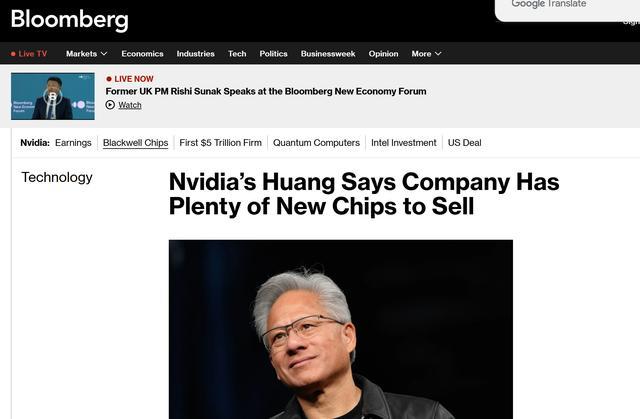
黄仁勋回应 Blackwell 芯片“售罄”:销量亮眼且备货充足,可满足市场需求
Huan Qiu Wang Zi Xun· 2025-11-20 04:25
Core Insights - Nvidia's CEO Jensen Huang reported strong market demand for the new Blackwell chips, with a well-prepared supply chain to meet the ongoing growth in demand [1][3] - Huang clarified that the term "sold out" regarding the Blackwell product line means that existing chips are fully utilized by customers, not a supply interruption, indicating ample availability for sales [3] - Nvidia's optimistic outlook includes expectations for new chip and system sales to exceed the previously set long-term target of $500 billion, driven by continuous performance upgrades [3] - The upcoming Vera Rubin product line is in the planning phase and is projected to generate approximately $35 billion in revenue, contributing to the company's long-term growth [3]

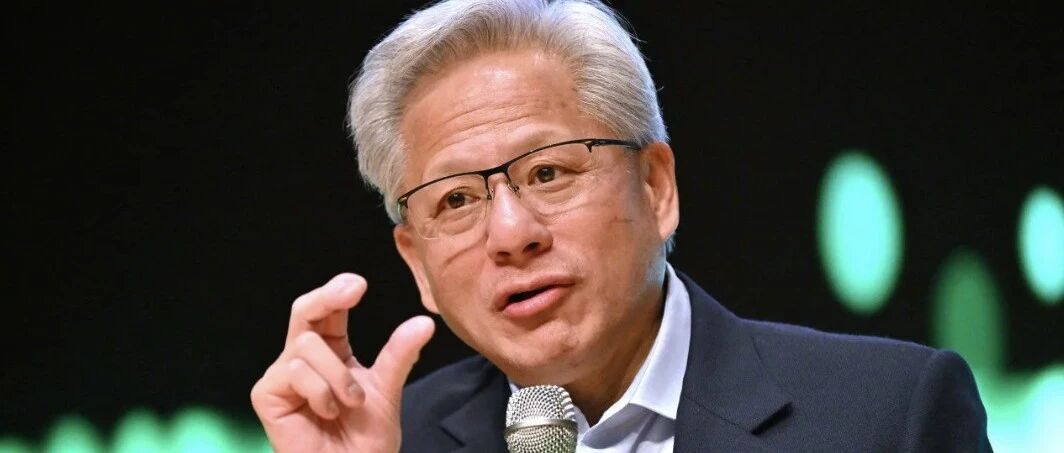
昨晚,马斯克对话黄仁勋,“吵起来了”
Sou Hu Cai Jing· 2025-11-20 02:52
Group 1 - Elon Musk predicts that money will become irrelevant in a future where advanced AI and robots create unprecedented material abundance, suggesting that work will become a choice rather than a necessity [5][6][21] - Jensen Huang offers a more cautious perspective, stating that while AI will change the nature of work, it will not eliminate the need for work, and people may become busier as AI enhances productivity and creativity [7][21] - The dialogue between Musk and Huang reflects contrasting views on the future of work and the economy in the context of AI advancements, highlighting optimism versus caution [20][22] Group 2 - The U.S.-Saudi Investment Forum showcased significant collaboration between Saudi Arabia and AI companies, including plans for large-scale data centers, indicating a strategic move towards establishing a robust AI infrastructure in the region [9][10][12] - HUMAIN, a Saudi AI company, plans to build multiple super data centers in collaboration with Musk's xAI, with a projected capacity of 1.9 gigawatts by 2030, positioning Saudi Arabia as a key player in the global AI landscape [8][9][10] - The emergence of "AI factories" in the Middle East signifies a shift in the role of data centers from mere storage to active production of AI models and content, driven by the demand for generative AI capabilities [11][12] Group 3 - Huang identifies three key factors driving the current AI boom: the need for processing vast amounts of data, the rise of generative AI replacing traditional recommendation systems, and the emergence of autonomous intelligent agents [14][15] - The AI infrastructure development in Saudi Arabia is supported by both local and international players, including partnerships with Chinese companies like Huawei and Alibaba, which are contributing to the digital transformation of the region [17][19] - The geopolitical landscape poses challenges for AI collaboration between China and Saudi Arabia, particularly concerning U.S. restrictions on technology exports, which may impact the pace and nature of technological partnerships [18][19]

重塑现金管理的四大趋势:对公银行业务未来展望
EY· 2025-11-20 02:47
Investment Rating - The report does not explicitly state an investment rating for the industry Core Insights - The future of corporate banking cash management is being reshaped by four major trends, emphasizing the need for customized solutions and data-driven services to enhance client relationships and operational efficiency [5][11] - There is a significant increase in demand for strong liquidity and cash management strategies due to complex geopolitical factors and fluctuating economic conditions [5][9] - The transition from transactional products to strategic, data-driven services is accelerating, requiring advanced knowledge and integrated data flows [5][10] Summary by Sections Cash Management Trends - The report identifies four key trends reshaping cash management, focusing on automation, data-driven services, customized solutions, and blockchain technology [7][11] - Companies are increasingly recognizing the potential of automated digital solutions and richer data sets to enhance their cash management capabilities [5][10] Strategic Cash Management - CFOs and treasury executives are under pressure to transform operations and establish new collaborative models, maximizing internal liquidity and reducing reliance on external financing [9][11] - There is a growing expectation for banks to provide actionable insights and industry-specific knowledge to meet client needs [9][11] Data-Driven Services - The report highlights the importance of integrating multi-source data to provide timely, actionable recommendations tailored to client operations and industry standards [31][32] - Clients are interested in AI-driven solutions that offer predictive insights and access to external data sets [33][36] Industry-Specific Solutions - There is a strong demand for customized cash management services that cater to the unique characteristics of different industries, with a significant portion of CFOs expressing the importance of industry-specific knowledge [43][45] - Banks are encouraged to develop vertical solutions that simplify core functions and adapt to industry-specific cash flow cycles and payment patterns [49][54] Digital Assets and Blockchain - The rise of digital assets, including stablecoins and tokenized funds, presents new opportunities and challenges for cash management solutions [56][61] - Banks are expected to leverage blockchain technology to enhance transaction efficiency and expand their service offerings to digital-native clients [62][63]
黄仁勋反击“AI泡沫论”!我们看到的和AI泡沫截然相反,公司订单能见度达5000亿美元,Rubin明年下半年推出(电话会全文)
美股IPO· 2025-11-20 02:41
Core Viewpoint - Nvidia's CEO Jensen Huang aims to counter the AI bubble narrative, asserting that the AI technology revolution is not only ongoing but expanding into broader fields [1][3][4]. Group 1: AI Technology Revolution - Huang emphasizes that the current landscape is characterized by three fundamental platform transformations: the shift from CPU to GPU accelerated computing, the transition from traditional machine learning to generative AI, and the rise of agentic AI [6][12][15]. - The company has a revenue visibility of $500 billion from its next-generation chip platforms, Blackwell and Rubin, with demand continuing to exceed expectations [7][16]. - Nvidia's Q3 revenue reached a record $57 billion, a 62% year-over-year increase, driven by strong demand in the data center segment [28][29]. Group 2: Market Confidence and Performance Guidance - Nvidia provided a strong Q4 revenue guidance of $65 billion, significantly above market expectations, despite not assuming any revenue from Chinese data center computing [8][23]. - The management's firm stance and optimistic guidance serve to restore investor confidence in the long-term growth potential of AI [4][8]. Group 3: Strategic Partnerships and New Clients - Nvidia announced a deep technical partnership with AI model company Anthropic, marking its first adoption of Nvidia's architecture with an initial compute commitment of up to 1 gigawatt [9][21]. - The company is also assisting OpenAI in building at least 10 gigawatts of AI data centers, indicating a significant scale-up in computational capacity [24][38]. Group 4: Supply Chain and Production Challenges - Nvidia acknowledges supply chain constraints, particularly in packaging and energy, as major challenges to growth, but asserts that these issues are manageable [11][17][19]. - The company is actively working to enhance supply chain resilience through partnerships and local manufacturing initiatives [41]. Group 5: Financial Performance and Future Outlook - Nvidia's data center revenue reached a record $51 billion in Q3, reflecting a 66% year-over-year growth, with GPU utilization at saturation levels [16][29]. - The company anticipates continued strong demand for its products, driven by the ongoing transition to accelerated computing and generative AI [30][64].
谷歌Gemini 3模型获市场认可,Alphabet股价一度大涨超6%创新高
硬AI· 2025-11-20 01:53
Group 1 - The core viewpoint of the article highlights that Google's latest AI model, Gemini 3, is a significant advancement that positions the company competitively against rivals like OpenAI and Anthropic [2][3][7] - Gemini 3 is an upgrade from Gemini 2.5, launched approximately eight months prior, and is designed to provide higher quality answers to complex questions with minimal prompting [3][4] - Initial tests and benchmark scores indicate that Gemini 3 has substantially advanced frontier technology, exceeding expectations in certain areas [4] Group 2 - Analysts from D.A. Davidson and Bank of America note that Gemini 3 represents a positive step in narrowing the perceived performance gap between Google's AI models and those of its competitors [2][7] - Since the launch of ChatGPT by OpenAI in 2022, Google has faced pressure to catch up in the generative AI space [8] - Despite increasing competition, early evaluation results for Gemini 3 are positive, and indicators suggest that Google is successfully directing users to its AI interfaces, alleviating concerns about potential impacts on its search business [9] Group 3 - Alphabet's stock price saw a significant increase, with a rise of over 55% year-to-date, partly driven by investor optimism regarding its AI product line and competitive enhancements [10] - The stock also benefited from Berkshire Hathaway's recent investment in Alphabet, marking one of the largest tech stock investments by the group in recent years [10]


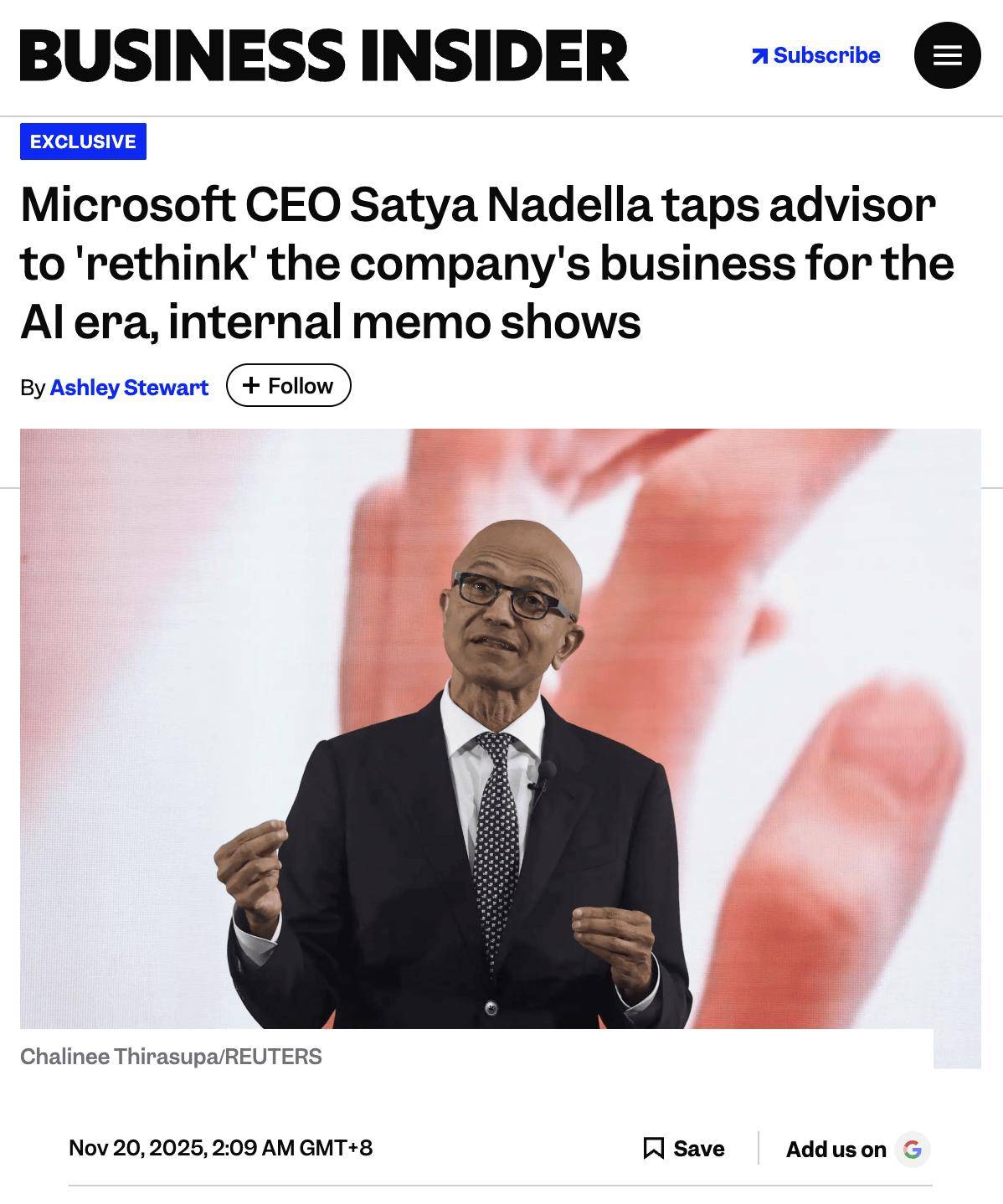
微软CEO纳德拉拟彻底重塑公司商业模式,并任命“AI经济学顾问”
Sou Hu Cai Jing· 2025-11-20 01:48
Core Insights - Microsoft CEO Satya Nadella believes that the era of generative AI necessitates a complete transformation of the company's business model, prompting him to enlist Rolf Harms, a key executive from the cloud business transformation 15 years ago [1][4] Group 1: Leadership and Strategy - Rolf Harms has been appointed as an AI economics advisor to assist in advancing Microsoft's large-scale transformation plan [4] - Nadella emphasized the need for Microsoft to rapidly reassess the economic logic of the AI era, similar to the past cloud business transformation [5] Group 2: Historical Context and Comparisons - The current situation in the AI industry mirrors the early days of cloud computing, where significant investments in data centers raised questions about return on investment and customer adoption [5][6] - Harms' 2010 white paper on cloud computing economics was pivotal in reshaping Microsoft's approach to its business model, demonstrating cost savings through large-scale cloud services [5][6] Group 3: Future Directions - Harms' responsibilities will expand beyond AI infrastructure to provide insights on how existing business categories will transform and how new business categories will emerge under Microsoft's new strategy [6]
黄仁勋回击AI泡沫论,GPU全卖光,Q3净赚2200亿
3 6 Ke· 2025-11-20 01:12
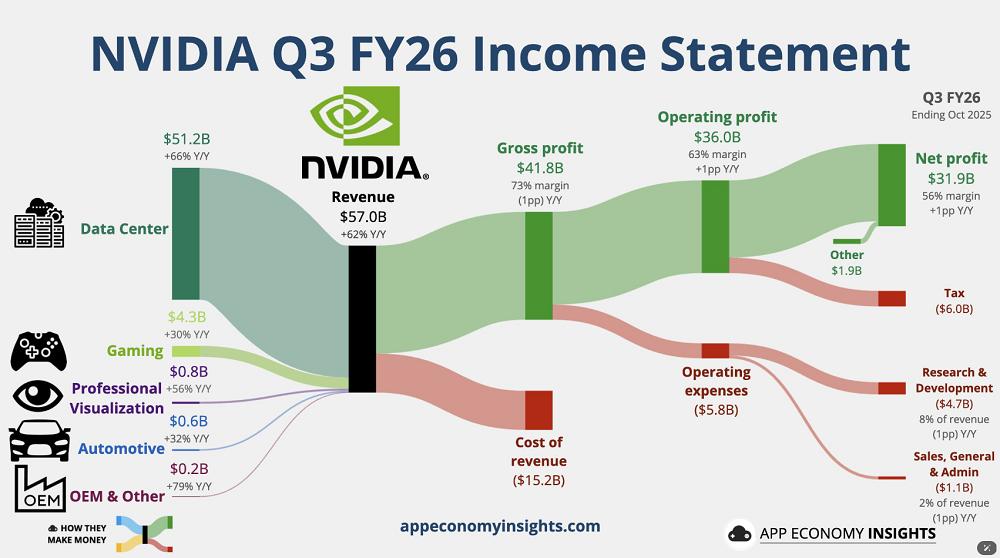
Core Viewpoint - Nvidia's Q3 FY26 financial results exceeded Wall Street expectations, showcasing significant growth in revenue and net profit driven by strong demand for AI infrastructure and GPU sales [1][2]. Financial Performance - Nvidia reported revenue of $57.006 billion, a year-over-year increase of 62% and a quarter-over-quarter increase of 22% [1][9]. - Non-GAAP net income reached $31.767 billion, reflecting a 59% year-over-year growth and a 23% quarter-over-quarter increase [9]. - The company achieved a non-GAAP gross margin of 73.6%, up 0.9 percentage points from the previous quarter but down 1.4 percentage points year-over-year [8][9]. Revenue Breakdown - The data center segment generated $51.215 billion, a 66% increase year-over-year and a 25% increase quarter-over-quarter [7][9]. - The compute segment contributed $43.028 billion, with a 56% year-over-year growth and a 27% quarter-over-quarter increase [7][9]. - Networking revenue surged by 162% year-over-year, reaching $8.187 billion [7][9]. - Gaming and professional visualization segments also saw growth, with gaming revenue at $4.265 billion (30% year-over-year) and professional visualization at $760 million (56% year-over-year) [7][9]. Market Dynamics - Nvidia's CEO highlighted three major platform transitions: the shift from CPU to GPU computing, the rise of generative AI applications, and the emergence of Agentic AI [1][10]. - The demand for AI infrastructure is outpacing Nvidia's expectations, with major cloud service providers experiencing sold-out capacities [2][10]. - Nvidia's partnership with Anthropic, involving a combined investment of $15 billion, underscores the company's strategic positioning in the AI market [12]. Future Outlook - Nvidia anticipates revenue of $65 billion for Q4 FY26, with a projected non-GAAP gross margin of 75% [9][14]. - The company expects to benefit from increased capital expenditures in the AI infrastructure sector, with top cloud providers' spending projected to reach $600 billion, up $200 billion from earlier estimates [14].
英伟达电话会:黄仁勋反击“我们看到的和AI泡沫截然相反”,公司订单能见度达5000亿美元,Rubin明年下半年推出
Hua Er Jie Jian Wen· 2025-11-20 01:08
Core Viewpoint - NVIDIA's CEO Jensen Huang strongly refuted the "AI bubble" narrative, asserting that the company is at the center of three fundamental technological transformations that are driving sustained growth in AI technology [1][2][3]. Group 1: AI Transformations - The world is experiencing three major platform transformations: the shift from CPU to GPU accelerated computing, the transition from traditional machine learning to generative AI, and the rise of agentic AI [3][4][32]. - Huang emphasized that these transformations are foundational and necessary for future infrastructure growth, with NVIDIA's architecture capable of supporting all three transitions [4][35]. Group 2: Financial Performance and Guidance - NVIDIA reported a record revenue of $57 billion for Q3, a 62% year-over-year increase, with data center revenue reaching $51 billion, up 66% [15][28]. - The company provided a strong Q4 revenue guidance of $65 billion, significantly above market expectations, even without assuming any revenue from data center computing in China [11][28]. Group 3: Demand and Supply Dynamics - NVIDIA's CFO Colette Kress revealed a revenue visibility of $500 billion for the Blackwell and Rubin platforms from now until the end of 2026, indicating robust demand [5][9]. - The company acknowledged supply chain challenges, particularly in power and packaging, but emphasized that these issues are manageable [6][8]. Group 4: Strategic Partnerships and New Clients - NVIDIA announced a strategic partnership with AI model company Anthropic, marking its first adoption of NVIDIA's architecture with an initial compute commitment of up to 1 gigawatt [9][25]. - The company is also collaborating with OpenAI to build and deploy at least 10 gigawatts of AI data centers, indicating a significant scale-up in computational capabilities [11][24]. Group 5: Market Position and Competitive Edge - NVIDIA's unique architecture allows it to run all major AI models, positioning it as a leader in the AI infrastructure market [9][12]. - The company is focused on expanding its CUDA ecosystem through strategic investments in key AI companies, which are intended to deepen technical collaborations rather than merely boost short-term demand [10][25].