人民币国际化

Search documents
重磅会议,多家全球资管巨头齐发声!
Zhong Guo Ji Jin Bao· 2025-11-10 13:53
Core Insights - Global asset management executives express increased interest in the Chinese market, highlighting Hong Kong's role as a vital bridge between mainland China and global markets [1][5][6] Group 1: Emerging Market Trends - There is a sustained increase in global investor interest in emerging markets, with many strategies focusing on China [2][4] - Three key reasons for this trend include profitability and valuation advantages, structural growth opportunities in sectors like AI and clean energy, and the diversification value of emerging markets [4] Group 2: Hong Kong's Strategic Role - Hong Kong's role in connecting global capital with China's asset markets is more critical than ever due to ongoing capital market openings and the internationalization of the RMB [6][8] - The city serves as a primary channel for global capital to participate in China's growth story, with trends such as Chinese companies returning for secondary listings and the rise of dual-listed stocks [8][9] Group 3: Investment Products and Strategies - There is a growing demand among Chinese investors for diversified investment portfolios that include exposure to global markets [11][14] - The mutual recognition fund (MRF) program has seen significant growth, with a notable increase in assets under management for global multi-asset strategies [14] - The QDLP program is recognized as an important channel for investing in overseas alternative products, catering to professional investors with higher risk tolerance [15] Group 4: Market Dynamics and Investor Behavior - Investor confidence is recovering, leading to a renewed interest in complex alpha strategies such as private equity and asset-backed finance [25][26] - Private equity funds have become mainstream asset classes, with significant capital inflows driven by their active management and value creation capabilities [27][29] Group 5: Future Outlook - The ongoing evolution of cross-border financial mechanisms is expected to further enhance Hong Kong's status as a leading international financial center [16][20] - The European private equity market is seen as a historic investment opportunity due to current valuation discounts compared to the U.S. market [29]


中国连续12个月增持黄金
Sou Hu Cai Jing· 2025-11-10 12:03
Core Insights - The strategic function of China's foreign exchange reserves is shifting from traditional liquidity support to asset structure optimization and currency credit support amid global economic adjustments and geopolitical risks [2][5][8] Foreign Exchange Reserves - As of the end of October, China's foreign exchange reserves stood at $33,433 billion, remaining above $3.3 trillion for three consecutive months, marking the highest level since November 2015 [2] - The People's Bank of China (PBOC) has increased its gold reserves to 7.409 million ounces, marking the twelfth consecutive month of gold accumulation since November 2024 [2][4] Gold Reserves - The recent increase in gold reserves was approximately 3,000 ounces (about 1 ton), which is significantly lower than previous monthly purchases of 10 tons or more, attributed to high gold prices [3][4] - Currently, gold reserves account for only 8.0% of China's official international reserves, which is below the global average of 15% [4] U.S. Treasury Bonds - The PBOC is adopting a strategy of "continuously increasing gold reserves while moderately reducing U.S. Treasury holdings" to optimize reserve structure and enhance the credit foundation of the Renminbi [4][5] - The recent stability in foreign exchange reserves is attributed to a rise in the U.S. dollar index and a significant increase in global financial asset prices, which offset potential declines in reserves [4][7] Global Trends - Since 2022, global central bank gold purchases have surged, with net purchases reaching 1,089 tons in 2024, the highest on record, indicating a reassessment of the traditional dollar-dominated reserve system [6][8] - The ongoing geopolitical conflicts and the trend of financial sanctions have led to a systemic risk in over-concentration on a single sovereign bond, prompting a shift towards increasing gold allocations [5][6] Future Outlook - The PBOC's strategy of gradually increasing gold reserves while managing U.S. Treasury holdings is seen as a long-term approach to enhance financial security and support the internationalization of the Renminbi [7][8] - The expansion of the Renminbi's cross-border usage and the improvement of domestic currency settlement mechanisms will necessitate a more urgent and practical optimization of foreign reserve structures [8]

凌志软件披露收购凯美瑞德预案 为金融信创和人民币国际化战略凝聚中国力量
Zheng Quan Shi Bao Wang· 2025-11-10 10:17
Group 1 - Lingzhi Software announced the acquisition of 100% equity in Kaimiride (Suzhou) Information Technology Co., Ltd, marking a significant consolidation project in the domestic fintech sector [1] - The acquisition will be executed through a combination of share issuance and cash payment to 20 transaction parties, with trading resuming on November 11 [1] - This move aligns with the national policy wave for financial innovation and transformation, injecting strong momentum for high-quality development in the sector [1] Group 2 - The financial innovation strategy is a core support for national financial security, entering a rapid development phase driven by policy guidance and market demand [2] - The Chinese financial innovation market is projected to reach 1.2 trillion yuan by 2025, with a compound annual growth rate exceeding 35% for the financial innovation sector [2] - The construction of a self-controllable RMB cross-border payment system is emphasized as a key policy direction in the 14th Five-Year Plan [2] Group 3 - Kaimiride is a leading financial IT supplier in the domestic capital market, known for its "self-controllable + overseas compatible" capabilities [3] - The company has provided comprehensive solutions and services to over 100 domestic and foreign financial institutions, establishing benchmark projects for major banks [3] - Kaimiride has maintained a leading position in the market, ranking first in the banking capital trading system market for two consecutive years [3] Group 4 - The acquisition positions Kaimiride's self-controllable technology system as a key anchor for integration value [4] - Kaimiride's VIVA-TCM system has been recognized as a key recommended solution in the fintech sector, showcasing its core advantages in building a fully self-controllable technology system [4] - The collaboration is expected to enhance the technological strength and sustainable operational capacity of the listed company, supporting the safe and controllable development of the national financial system [4]

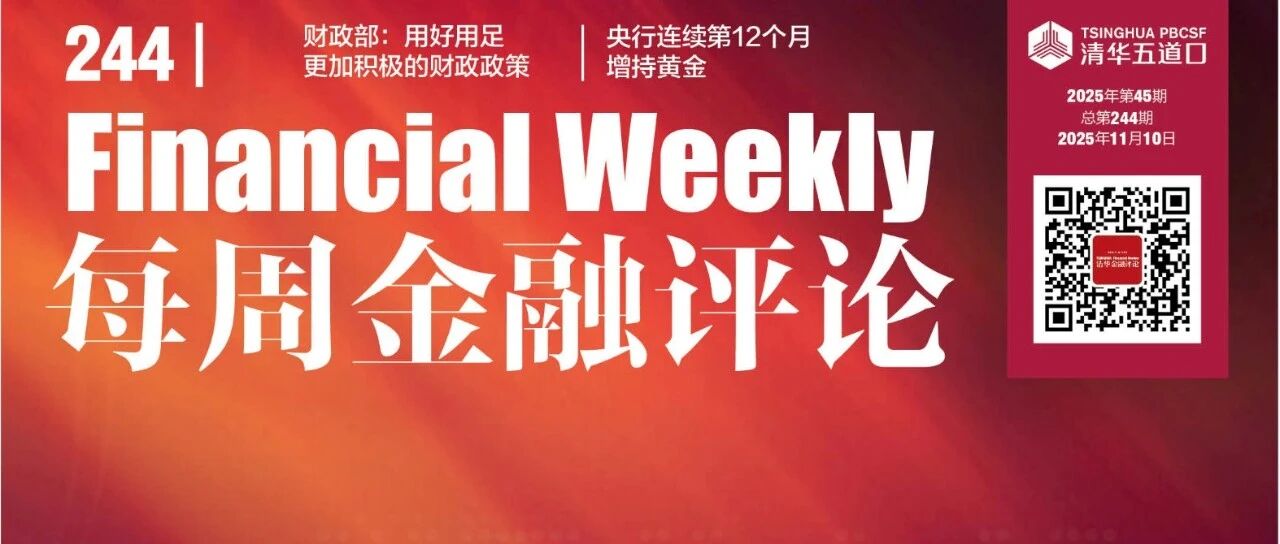
财政部:用好用足更加积极的财政政策;央行连续第12个月增持黄金|每周金融评论(2025.11.3-2025.11.9)
清华金融评论· 2025-11-10 10:06
si TSINGHUA Financial Review 清华金融评论 244 | | 央行连续第12个月 财政部:用好用足 更加积极的财政政策 Financial Weekly 每周金融评论 2025年11日10日 .. Financial Weekly 每周金融评论 | 目录 CONTENTS 国家外汇管理局数据显示,截至10月末中国官方黄金储备为7409万盎司,较上月末增加3万盎司,增幅降至2024年11月恢复增持 以来的最低水平。目前,中国央行已连续12个月增持黄金。 热点聚焦 FOCUS ◎ 央行连续第12个月增持黄金 重大会议 MEETINGS ◎ 何立峰:"十五五"规划建议为香港描绘了更加美好的未来 重大政策 POLICIES ◎ 证监会、财政部联合发布《 证券结算风险基金管理办法》 重大事件 EVENTS ◎ 财政部:用好用足更加积极的财政政策 ◎ 财政部在香港成功发行美元主权债券 重要数字 DATA ◎ 10月CPl同比转涨 PPI环比年内首次上涨 ◎ 2025年10日未、我国外汇储备和模为3.34.33亿美元 热点 聚焦 央行连续第12个月增持黄金 01 《清华金融评论》观察 我国央行连续 ...
基辛格:美元是我们的货币,却是你们的麻烦!
Sou Hu Cai Jing· 2025-11-10 08:48
Group 1 - The core argument emphasizes that the dominance of the US dollar is crucial for American power, with military strength serving to uphold this monetary hegemony [1][3]. - The high costs associated with maintaining the dollar's status are highlighted, including over a trillion dollars in military spending and extensive military bases worldwide [3]. - The article discusses China's attempts at internationalizing the renminbi, noting the challenges faced and the strategic pivot towards initiatives like the Belt and Road and currency swaps to enhance industrial tax collection [3][5]. Group 2 - The concept of currency swaps is presented as a method to disrupt the dollar's dominance, allowing countries to manage their debts more effectively without resorting to asset liquidation [5][7]. - The issuance of €4 billion in sovereign bonds in Luxembourg is framed as a signal to other nations that they can seek debt restructuring with China, while also indicating a loss of confidence in the dollar due to excessive issuance [7]. - The article suggests that China's control over rare earth resources and recent restrictions on silver exports serve as leverage against US dominance in high-end manufacturing, indicating a strategic shift towards securing commodity transactions in renminbi [7].

息周期与长线叙事交错,金属主升浪进行中
Guo Tai Jun An Qi Huo· 2025-11-10 08:47
Group 1: Gold Market Insights - The report indicates that after reaching a new high close to $4,400, gold prices have experienced a pullback, suggesting a short-term adjustment while maintaining a long-term bullish trend [6][10]. - Following the September FOMC meeting, the market's expectations for further interest rate cuts in 2026 did not significantly increase, which has led to a weakening in gold's pricing dynamics [9][14]. - The report highlights that the recent rise in gold prices is driven by multiple risk events, including the potential U.S. government shutdown and geopolitical tensions, but warns of the risk of profit-taking as these factors are priced in [28][33]. Group 2: Silver Market Dynamics - The silver market is experiencing significant tightness, with the 1-month leasing rate for silver soaring to nearly 40%, indicating a historically high demand for physical silver [75][79]. - There is a notable discrepancy in pricing between London and New York silver markets, with the London silver showing a significant premium over New York, marking a historical first for this inversion [79][80]. - The report suggests that despite the current tightness in the silver market, the underlying supply-demand dynamics remain unresolved, indicating potential for upward price elasticity in the future [70][72]. Group 3: Economic and Monetary Policy Outlook - The report projects a more optimistic economic outlook from the Federal Reserve, with upward revisions to GDP forecasts for 2025, 2026, and 2027, alongside a downward adjustment in unemployment rates for the same period [10][11]. - It notes that the Federal Reserve's recent decisions indicate a cautious approach to monetary policy, with expectations for interest rate cuts being moderated, particularly in the context of upcoming leadership changes within the Fed [50][53]. - The analysis emphasizes that the current economic environment is characterized by a mix of improving forward-looking indicators and weakening lagging indicators, suggesting a complex macroeconomic landscape [46][41]. Group 4: Long-term Gold Pricing Trends - Historical analysis indicates that the current gold price increase may have surpassed the halfway mark of its potential upward trajectory, with projections suggesting a target range of $5,293 to $5,838 per ounce when adjusted for inflation [66][67]. - The report highlights that the current gold price increase is less steep compared to historical averages, suggesting that the market may still have room for growth [66][67]. - It also discusses the ongoing central bank gold purchases, particularly in emerging markets, which could provide additional support for gold prices in the long term [57][58].
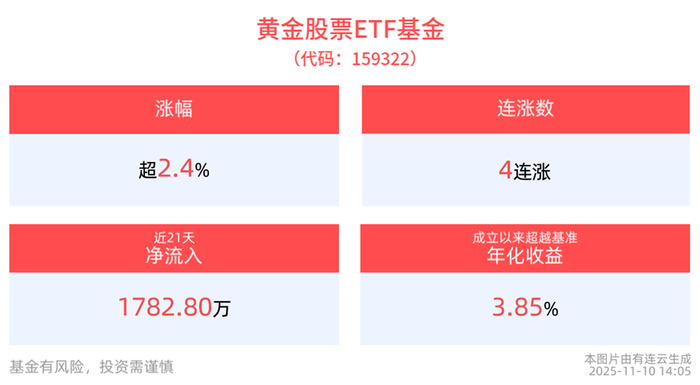
黄金股票ETF基金(159322)涨超2%已4连涨,兼具高景气与性价比品种!
Xin Lang Cai Jing· 2025-11-10 06:25
Group 1 - The core viewpoint of the articles highlights a significant increase in domestic gold ETF holdings, with a year-on-year growth of 164.03% in the first three quarters of 2025, reaching 79.015 tons [1] - As of September 2025, China's gold reserves amounted to 2303.52 tons, with the central bank increasing its gold holdings for 12 consecutive months, indicating a strategic focus on enhancing gold's proportion in foreign exchange reserves [1] - The Shanghai Gold Exchange is expected to gain international influence, potentially driving gold prices upward amid ongoing de-dollarization and the internationalization of the Renminbi [1] Group 2 - Despite recent price increases leading to a 2-3 month consolidation period for precious metals, the long-term de-dollarization process remains intact, and gold's strategic allocation value is still prominent [2] - The gold stock ETF fund has shown a strong performance, with a 36.00% increase in net value over the past six months and a 21.91% rise over the last three months [4][5] - The gold stock ETF fund has a Sharpe ratio of 1.74, ranking in the top 33% of comparable funds, indicating higher returns for the same level of risk [6] Group 3 - The top ten weighted stocks in the CSI Hong Kong and Shanghai Gold Industry Index account for 67.97% of the index, with Zijin Mining and Shandong Gold being the most significant contributors [6][7] - The gold stock ETF fund has a management fee of 0.50% and a custody fee of 0.10%, reflecting its cost structure [6]



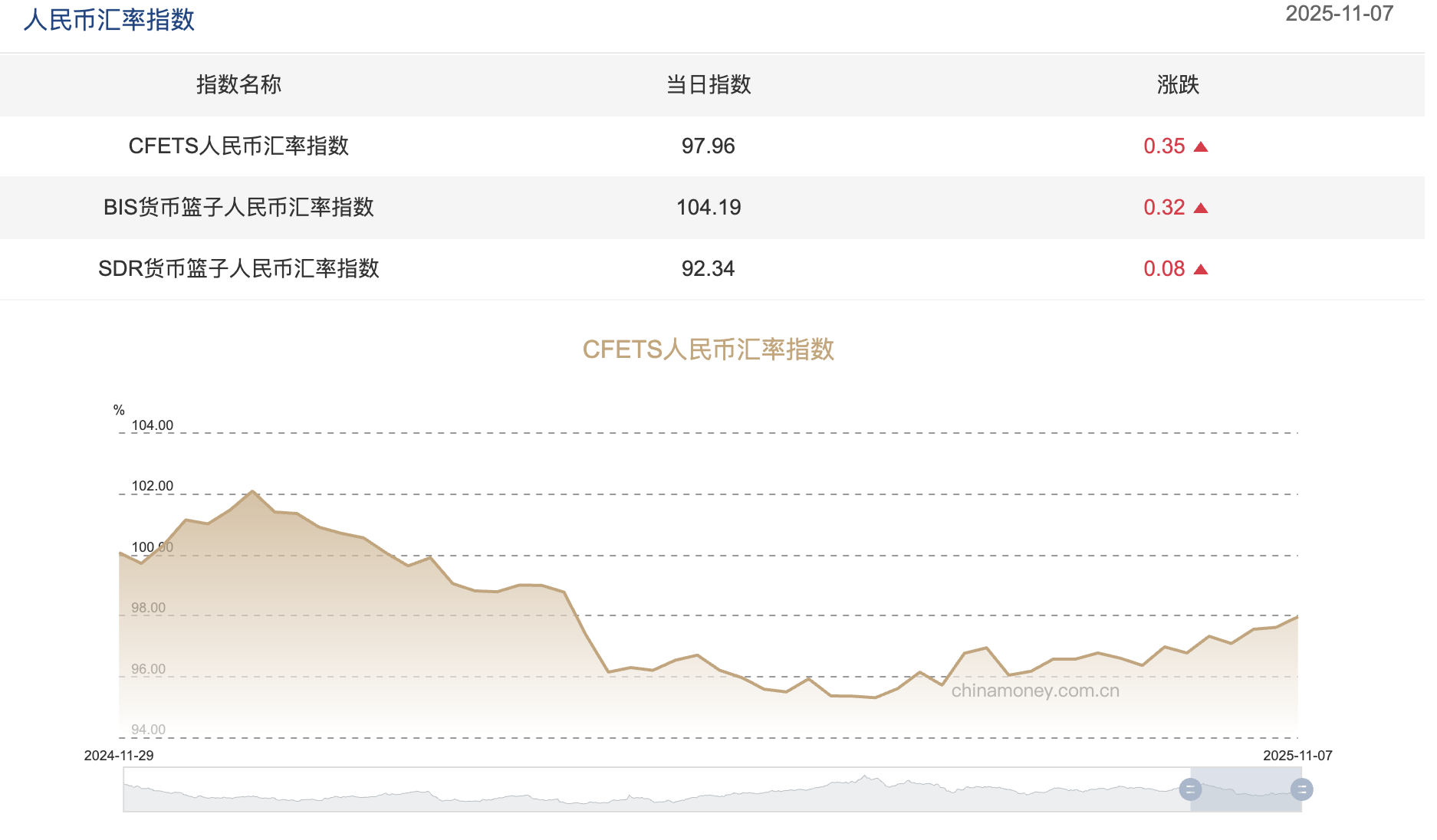
上周三大人民币汇率指数全线上行 市场对人民币升值预期继续升温
Xin Hua Cai Jing· 2025-11-10 05:32
Core Viewpoint - The Chinese yuan's exchange rate indices have shown significant increases, reaching new highs since April 2025, indicating a strengthening trend in the yuan against a basket of currencies [1][5]. Exchange Rate Indices - The CFETS yuan exchange rate index is reported at 97.96, up 0.35% week-on-week, marking a new high since April 2025 [1][2]. - The BIS currency basket yuan exchange rate index stands at 104.19, with a weekly increase of 0.32%, also a new high since April 2025 [1][2]. - The SDR currency basket yuan exchange rate index is at 92.34, reflecting a weekly rise of 0.08%, reaching a new high since April 2025 [1][2]. Market Dynamics - The US dollar index experienced fluctuations, ultimately declining by 0.18% to close at 99.54 points for the week [5]. - The onshore yuan against the US dollar closed at 7.1210, with a weekly increase of 10 basis points, while the offshore yuan closed at 7.1252, down 28 basis points [5]. - The yuan's central parity rate against the US dollar was set at 7.0836, up 31 basis points for the week [5]. Internal Factors - The yuan's central parity rate has reached a yearly high, with a strong performance against a basket of currencies, supporting the CFETS yuan exchange rate index near 98 [5]. - The increase in net settlement of foreign exchange is expected to continue, driven by policy guidance, contributing to the long-term appreciation of the yuan [5]. Economic Outlook - Upcoming economic data releases for October are anticipated to provide further insights into the yuan's performance [6]. - Analysts predict that 2025 may mark the beginning of a new appreciation cycle for the yuan, with expectations of the yuan potentially breaking the 7.0 mark against the US dollar by 2026 [6]. - The diversification of export structures and the internationalization of the yuan are expected to reduce the exchange rate risk associated with the US dollar [6][7].
最新!美元踢出人民币金属交易!全球金属定价权,今后就认美元?
Sou Hu Cai Jing· 2025-11-10 04:35
Core Viewpoint - The London Metal Exchange (LME) unexpectedly suspended all non-USD denominated metal options, including those in RMB, without prior notice or explanation, indicating a targeted approach towards the RMB market [1] Market Reaction - Following the announcement, the main aluminum and copper contracts on the Shanghai Futures Exchange hit the upper limit, while LME electronic trading saw a significant drop, with the price difference reaching $412 per ton, marking a historic occurrence in 38 years [3] - Traders noted that USD-denominated metals have become isolated, while RMB-denominated metals are gaining popularity, reflecting a shift in market dynamics [3] China's Position in Metal Trade - China contributes 70% of global rare earth oxides and 55% of electrolytic aluminum, with nearly half of copper consumption growth driven by China [3] - Major Middle Eastern steel manufacturers plan to reference Shanghai futures prices and settle long-term metal orders in RMB starting from Q4 2025, with Dubai also set to launch RMB-denominated metal futures in 2026 [3] Adoption of RMB in Global Trade - Major mining companies like BHP and Vale have begun accepting RMB for iron ore transactions, driven by the convenience and cost-effectiveness of using RMB in trade with China [5] - The cross-border RMB payment system has expanded to 32 countries, with bilateral currency swap agreements exceeding 4.5 trillion RMB, and RMB cross-border payment amounts reaching 35 trillion RMB in the first half of the year, a 14% year-on-year increase [5] LME's Weakness and Market Dynamics - LME's actions reveal its weaknesses, as actual trading has shifted to other markets, with contracts still being signed and settled despite the suspension [7] - The RMB's rise is attributed to its alignment with production, demand, and convenience, rather than an aggressive pursuit of dominance [7] Future Trends - The trend of using RMB for metal trade settlements is expected to grow, with more countries and companies likely to follow suit, indicating potential challenges for LME's traditional rules [8]

东方证券:料基本可确认金价左侧企稳 看好金价突破4500美元/盎司继续上冲
智通财经网· 2025-11-10 03:24
Core Viewpoint - The report from Dongfang Securities indicates that with the volatility of CBOE gold ETFs and the implied volatility of gold options returning to around 20%, gold prices are expected to stabilize. However, short-term fluctuations may occur due to weakened interest rate cut expectations and a stronger dollar. In the medium term, the total U.S. national debt may exceed $40 trillion, and overseas inflation is likely to rise, leading to a bullish outlook for gold prices, potentially breaking through $4,500 per ounce and aiming for $5,000 per ounce. The report suggests focusing on leading global copper and gold mining companies, particularly Zijin Mining (601899.SH), which is expected to see significant growth in its copper segment by 2026 [1]. Group 1: Central Bank Gold Reserves - As of October, the People's Bank of China has increased its gold reserves for the 12th consecutive month, adding 30,000 ounces to reach 74.09 million ounces. The value of gold assets, including gold deposits and swaps, is approximately $297.21 billion, reflecting a month-on-month increase of $13.92 billion [1]. - The monthly increase in gold reserves has slowed due to high gold prices, with October's addition being the smallest this year at 30,000 ounces, down from 40,000 ounces in September. However, the continuous increase indicates the importance of raising gold's proportion in foreign exchange reserves for the central bank [2]. Group 2: Gold's Proportion in Foreign Reserves - Gold now accounts for approximately 8.89% of the People's Bank of China's foreign exchange reserves, an increase of 0.5 percentage points from the previous month and a significant rise of 2.92 percentage points from the end of 2024. Despite this increase, China's gold reserve proportion remains lower than that of major countries, such as India's 15.17% and Thailand's 10.56%, indicating room for growth [3]. Group 3: Future Outlook - The central bank's strategy of increasing gold reserves aligns with the ongoing de-dollarization and the internationalization of the renminbi. The establishment of gold delivery warehouses in Saudi Arabia and designated warehouses in Hong Kong is expected to enhance the international influence of the renminbi through gold. The medium-term outlook for gold prices is supported by the continued deterioration of the dollar's credit and its weakening status as a universal currency in global metals [4].