资产配置

Search documents
裕丰昌控股发布中期业绩 收益约3848.2万港元 同比增长306.14%
Zhi Tong Cai Jing· 2025-11-11 12:08
Core Viewpoint - Yufengchang Holdings (08631) reported a significant increase in revenue for the six months ending September 30, 2025, with earnings reaching approximately HKD 38.482 million, representing a year-on-year growth of 306.14% [1] Financial Performance - The company recorded a loss attributable to shareholders of approximately HKD 3.457 million, which is a decrease of 27.78% compared to the previous year [1] - Basic loss per share was reported at HKD 0.0864 [1] Business Drivers - The increase in revenue is primarily attributed to heightened demand from the company's main logistics clients [1] Strategic Outlook - The company plans to maintain a robust financial policy, continuously optimize asset allocation, and strengthen cash flow management to ensure sufficient funding for business development [1] - There is a commitment to closely monitor macroeconomic conditions and industry trends, allowing for timely adjustments in operational strategies to enhance risk resilience and create sustainable long-term value for shareholders [1] - The board and management aim to drive high-quality business development through innovative thinking and a pragmatic approach [1]
裕丰昌控股(08631)发布中期业绩 收益约3848.2万港元 同比增长306.14%
智通财经网· 2025-11-11 12:05
Core Viewpoint - Yufengchang Holdings (08631) reported a significant increase in revenue for the six months ending September 30, 2025, with earnings reaching approximately HKD 38.482 million, representing a year-on-year growth of 306.14% [1] Financial Performance - The company recorded a loss attributable to shareholders of approximately HKD 3.457 million, which is a reduction of 27.78% compared to the previous year [1] - Basic loss per share was reported at HKD 0.0864 [1] Business Strategy - The increase in revenue is primarily attributed to heightened demand from the company's main logistics clients [1] - The company plans to maintain a robust financial policy, continuously optimize asset allocation, and strengthen cash flow management to ensure sufficient funding for business development [1] - The management will closely monitor macroeconomic conditions and industry trends to timely adjust operational strategies and enhance risk resilience, aiming to create sustainable long-term value for shareholders [1] - The board and management will lead all employees with innovative thinking and a pragmatic approach to drive high-quality business development [1]
每日报告精选-20251111
GUOTAI HAITONG SECURITIES· 2025-11-11 11:29
Market Overview - The average daily trading volume in the A-share market decreased to 2.0 trillion CNY, with the turnover rate declining, indicating reduced market activity[5] - The proportion of stocks rising increased to 54.77%, with the median weekly return for A-share stocks rising to 0.6%[5] Fund Flows - New issuance of equity funds decreased to 21.84 billion CNY, while foreign capital inflow accelerated, with a net inflow of 8.0 million USD as of November 5[6] - The net buying amount of financing decreased to 11.63 billion CNY, accounting for 10.8% of total trading volume[6] Sector Performance - Foreign capital primarily flowed into the electronics sector, with a net inflow of 63.2 million USD, while financing capital mainly flowed into the power equipment sector, with a net inflow of 68.3 billion CNY[7] - The healthcare equipment sector is expected to benefit from policy-driven market recovery, with significant growth in bidding volumes for new medical equipment[17][20] Economic Indicators - The average price of Brent crude oil was 68.17 USD per barrel in Q3 2025, reflecting a year-on-year decrease of 13.40%[44] - The construction sector showed signs of recovery, with new home transaction areas in major cities decreasing by 40.6% week-on-week, indicating ongoing challenges in the real estate market[33] Investment Recommendations - The company recommends an overweight position in A/H shares and industrial commodities, suggesting an equity allocation of 45% and a commodity allocation of 10%[9][10]





黄金的“双支柱”时代:降息潮中的避险逻辑与配置策略
Sou Hu Cai Jing· 2025-11-11 11:17
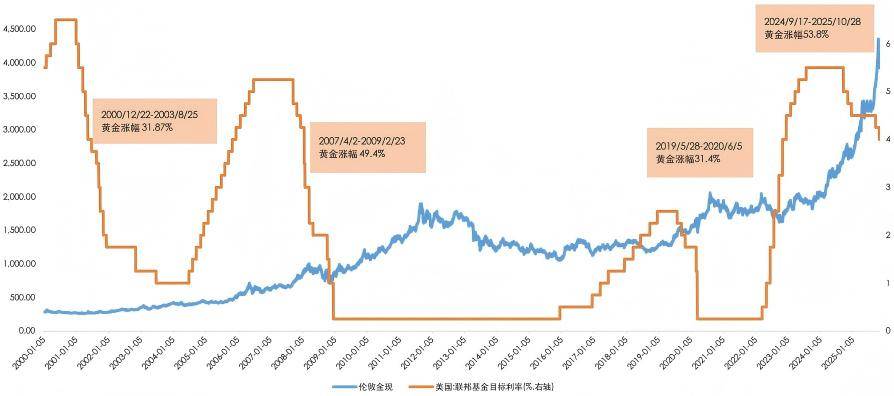
Core Viewpoint - The recent decline in tech stocks has led to a renewed interest in gold as a stable investment, with gold prices fluctuating around 4000 CNY per gram since late October, while tech giants reported disappointing earnings [1][2]. Group 1: Gold Demand and Market Dynamics - Global gold demand is projected to reach a record high of 1313 tons by Q3 2025, driven by both central bank purchases and increased retail investment [2]. - The appeal of gold is shifting from a traditional safe-haven asset to a structural asset allocation tool, benefiting from its low correlation with equity assets [2][6]. - Historical data shows that gold prices have significantly appreciated during previous Federal Reserve rate-cutting cycles, with increases of 31.9%, 49.4%, 31.4%, and a record 53.8% during the current cycle [2]. Group 2: Current Market Conditions - The gold market is currently experiencing a mix of bullish and bearish factors, with short-term pressures from improving international trade relations reducing gold's safe-haven appeal [5]. - The Federal Reserve's recent rate cut of 25 basis points to a target range of 3.75%-4.00% has lowered the holding costs for gold, providing a fundamental support for its price [6]. - Despite the rate cut, uncertainty remains regarding future Fed policies, with the probability of another rate cut in December dropping to 72.8% [6]. Group 3: Investment Strategy - The recent pullback in gold prices presents a potential buying opportunity for investors, who may consider dollar-cost averaging during price fluctuations [7]. - Long-term trends indicate that the current rate-cutting cycle and global central bank gold purchases may sustain upward price momentum for gold assets [7]. - Investors are encouraged to diversify their portfolios by including gold ETFs alongside equity investments to hedge against market uncertainties [7].

前10月全国法拍房成交额同比下降
Zheng Quan Shi Bao· 2025-11-11 07:21
Group 1 - The national judicial auction market for real estate has shown a "decline in both volume and price" in the first ten months of this year, with a total of 605,000 properties listed for auction, a year-on-year decrease of 5.7% [1] - The total number of auction sessions reached 1,058,000, with 138,000 properties successfully sold, reflecting a 2.4% year-on-year decline, and a clearance rate of 22.8% [1] - The total transaction amount for judicial auctions was 204.87 billion yuan, down 22.5% year-on-year, with an average transaction price of 4,668 yuan per square meter, a decrease of 12.3% [1] Group 2 - The luxury property auction segment remains a market hotspot, attracting significant attention compared to ordinary auction properties, with high-net-worth buyers particularly interested in scarce locations [2] - A notable transaction occurred in Shenzhen, where a villa sold for over 364 million yuan, setting a record for the highest price in judicial auctions, with a price per square meter reaching 570,000 yuan [2] - In Shanghai, a luxury property auction saw a final price of 42.25 million yuan, reflecting a 54.47% premium over the starting price, indicating strong competition among bidders [2] Group 3 - Buyers participating in luxury property auctions perceive better value compared to the secondary market, as they can acquire high-quality properties that are scarce in the traditional market [3] - Core luxury properties exhibit stronger resilience during market adjustments, reflecting the long-term confidence of high-net-worth individuals in scarce real estate [3] - The transparency of the auction mechanism and improved platform services may position this market as a leading indicator for asset allocation strategies [3]
【资产配置快评】2025年第50期:Riders on the Charts:每周大类资产配置图表精粹-20251111
Huachuang Securities· 2025-11-11 06:49
Group 1: Market Trends - The CDS prices of large tech companies are significantly lower than the overall level of high-yield bonds, with Oracle's 5-year CDS at 85.8 basis points compared to a basket of high-yield bonds at 332.8 basis points[4] - The impact of artificial intelligence on the labor market shows no significant substitution effect, as productivity has increased while labor hours have decreased, leading to a mild rebound in unemployment rates[6] - The U.S. labor market and the stock market have not shown sustained divergence, as using non-farm employment numbers aligns the labor market with stock performance[10] Group 2: Economic Indicators - The three-party repurchase market volume reached a new high of $1.19 trillion, alleviating dollar liquidity shocks despite short-term tightening[13] - Concerns over the U.S. government shutdown have not lowered the consensus forecast for U.S. economic growth in 2025, which stands at 1.9%, only 0.3% lower than at the beginning of the year[16] - The equity risk premium (ERP) for the CSI 300 index is at 4.3%, indicating significant room for valuation uplift compared to the historical average[18] Group 3: Financial Metrics - The forward arbitrage return for China's 10-year government bonds is 27 basis points, which is 57 basis points higher than the level in December 2016[21] - The 3-month USD/JPY basis swap is at -24.3 basis points, indicating increased offshore dollar financing pressure[24] - The copper-gold price ratio has dropped to 2.7, while the offshore RMB exchange rate has risen to 7.1, indicating a divergence in signals[26] - The total return ratio of domestic stocks to bonds is at 28.8, above the average level of the past 16 years, suggesting enhanced attractiveness of stock assets relative to fixed income[28]
今年前10月全国法拍房成交额同比下降 豪宅法拍仍受关注
Zheng Quan Shi Bao Wang· 2025-11-11 03:53
Group 1 - The national judicial auction market for real estate has shown a "decline in both volume and price" in the first ten months of this year, with a total of 605,000 properties listed for auction, a year-on-year decrease of 5.7% [1] - The total number of auction sessions reached 1,058,000, with 138,000 properties successfully sold, reflecting a 2.4% year-on-year decline, and a clearance rate of 22.8% [1] - The total transaction amount for judicial auctions was 204.87 billion yuan, down 22.5% year-on-year, with an average transaction price of 4,668 yuan per square meter, a decrease of 12.3% [1] Group 2 - The luxury property auction segment remains a market hotspot, attracting significant attention compared to ordinary auction properties, with high-net-worth buyers particularly interested in scarce locations [2] - A notable transaction occurred in Shenzhen, where a villa sold for over 364 million yuan, setting a record for the highest price in judicial auctions in China, reflecting a substantial appreciation in value over 14 years [2] - In Shanghai, a luxury property auction saw a final price of 42.25 million yuan, with a premium of 54.47% over the starting price, indicating strong competition among bidders [2] Group 3 - Buyers participating in luxury property auctions perceive better value compared to the secondary market, as they can acquire high-quality properties that are scarce in the traditional market [3] - Core luxury properties exhibit stronger resilience during market adjustments, reflecting the long-term confidence of high-net-worth individuals in scarce real estate [3] - The transparency of the auction mechanism and improved platform services may position this market as a leading indicator for asset allocation strategies [3]
光大证券晨会速递-20251111
EBSCN· 2025-11-11 01:41
Group 1: Macro Economic Outlook - The report highlights a shift in the global economic landscape, with the US expected to adjust interest rates at a slower pace initially, followed by a quicker pace later, while also emphasizing the fiscal expansion in Europe and Japan [1] - China's economic outlook suggests a strengthening of policies, accelerated construction of new productivity, and a gradual exit from a deflationary environment [1][2] - The geopolitical environment is characterized by a restructuring of international order, with the US and China seeking strategic stability amidst intense competition [1] Group 2: Asset Class Insights - The report indicates that the US dollar is expected to peak and then decline, while the A-share market is anticipated to maintain a slow bull trend [1][2] - Gold and copper are identified as having strategic value, with gold's macro narrative still relevant and copper expected to see price recovery [3][2] Group 3: Real Estate Market Analysis - As of November 9, 2025, new home transactions in 20 cities totaled 660,000 units, reflecting a decrease of 10.1% year-on-year, with significant declines noted in major cities like Beijing (-16%) and Shenzhen (-22%) [4] - In contrast, the second-hand housing market showed a positive trend, with transactions in 10 cities totaling 652,000 units, an increase of 5.3%, particularly in cities like Shanghai (+12%) and Shenzhen (+17%) [4]

又被马云说中了,持有大量现金的人或难入睡?3大理由很现实
Sou Hu Cai Jing· 2025-11-10 20:48
Core Insights - The article discusses the risks associated with holding large amounts of cash in the current economic environment, particularly due to inflation and opportunity costs [1][2][5] Group 1: Inflation Impact - Inflation acts as an invisible "tax" that erodes wealth, with the CPI rising by 2.6% in 2024 and 2.8% in Q1 2025, meaning that 100,000 yuan last year is only worth about 97,200 yuan this year [2] - Individuals like Wang, who have significant savings in low-interest bank accounts, are experiencing negative real interest rates, as their savings yield (2.2%) is lower than the inflation rate (2.8%) [2][3] Group 2: Opportunity Cost - Keeping funds idle in cash or low-yield savings means missing out on higher-return investment opportunities, with average returns on financial products at 3.5% and some stock funds exceeding 10% [2][3] - A case study of Zhang illustrates that a diversified investment strategy can yield significantly higher returns, with her assets growing from 500,000 yuan to approximately 680,000 yuan over five years [3] Group 3: Security Concerns - Holding cash poses risks such as theft, loss, or damage, with over 125,000 cash-related theft cases reported in 2024, involving over 2.5 billion yuan [4][6] - Personal anecdotes highlight the dangers of keeping cash at home, as natural disasters can lead to significant losses [4] Group 4: Recommendations for Wealth Management - The article suggests a diversified asset allocation strategy, recommending that individuals maintain 3-6 months of living expenses in cash, with the rest allocated to fixed income, equity, and other investments [8][12] - Increasing financial literacy is emphasized, as those with higher financial knowledge see an average asset growth rate 4.2 percentage points higher than those with lower financial literacy [9] - The importance of inflation-hedging tools is discussed, with options like index funds and inflation-protected bonds being recommended [11] - Regularly reviewing and adjusting financial plans is advised to ensure alignment with personal goals and market conditions [12]

现货黄金再上4000关口
Sou Hu Cai Jing· 2025-11-10 14:53
Core Insights - The current surge in spot gold prices reaching the $4000 mark is causing mixed sentiments among investors regarding entry points and potential missed opportunities [1] - Historical context shows that previous spikes in gold prices, such as the rise to $1900, led to panic selling after a subsequent correction, highlighting the importance of strategic investment rather than impulsive decisions [3] - Central banks globally, including China's, have been accumulating gold, reflecting concerns over the credibility of the US dollar and geopolitical instability, which enhances gold's appeal as a safe haven [3] Investment Strategy - The current price level of $4000 is considered high, and short-term volatility is expected; therefore, investors are advised against chasing prices and risking emotional trading [3] - A recommended strategy is to wait for a price correction to the $3800-$3900 range before gradually building positions, with an asset allocation of 5%-10% in gold [3] - The fundamental reasons supporting gold's price increase remain intact, indicating a positive long-term trend, but patience is emphasized as a key component of successful long-term investing [3]