
美元信用担忧

Search documents
江问樵:2.4黄金多头强势,晚间操作建议
Sou Hu Cai Jing· 2026-02-04 11:17
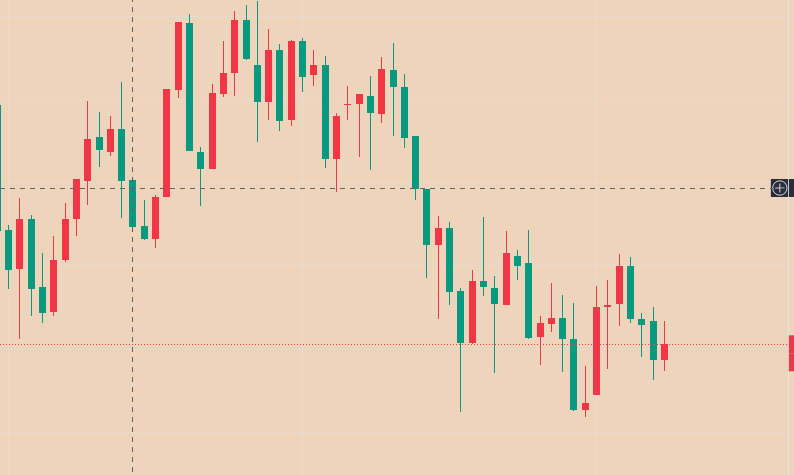
Core Viewpoint - Gold experienced a sharp decline followed by a strong rebound, with a daily increase of over 6%, returning to around 5050, which is a key pivot point and a previous area of concentrated trading [1] Technical Analysis - On the technical front, the daily MACD shows a bullish crossover at a low level, with expanding red bars, and the RSI has quickly rebounded from the oversold zone [1] - The 4-hour moving averages are in a bullish arrangement, and the Bollinger Bands are opening upwards [1] - Although some short-term indicators are overbought and may require a pullback, the rebound is accompanied by increased trading volume, indicating strong support around the 5050 level [1] Trading Strategy - A buy position near 5050 is aligned with the day's bullish-bearish dynamics, with a stop loss set at 20 points to 5030 to effectively mitigate short-term pullback and rebound failure risks [1] - The target is set towards 5200, which aligns with both short-term rebound momentum and medium-term bullish logic [1] Market Sentiment - The market sentiment has shifted from panic to cautious optimism, influenced by the cooling of hawkish Federal Reserve chair nominations and ongoing global central bank gold purchases, alongside geopolitical tensions in the Middle East and concerns over the dollar's credibility [1] - Institutions remain generally optimistic about gold's long-term outlook, with Deutsche Bank maintaining a year-end target of 6000 USD, identifying 5200 as a critical resistance level that, if broken, could confirm a transition from rebound to reversal [1]

未知机构:兴证策略近期涨价链的三条线索从我们跟踪的高频价格数据来看近-20260129
未知机构· 2026-01-29 02:10
Summary of Key Points from the Conference Call Industry Focus - The report focuses on the **materials and energy sectors**, specifically highlighting trends in **non-ferrous metals, oil, chemicals, and storage** industries [1]. Core Insights and Arguments 1. **Non-Ferrous Metals Price Increase**: Driven by geopolitical risk aversion and concerns over US dollar credit, prices for non-ferrous metals such as **silver and gold** have risen. This price increase is impacting the cost structure in the **semiconductor manufacturing and testing sectors**, particularly affecting **passive components and power devices** [1]. 2. **Oil Price Surge**: Supply-side disruptions combined with escalating geopolitical tensions have led to an increase in oil prices. This rise is being transmitted downstream, resulting in price hikes in the **chemical sector** and **consumer building materials** such as waterproofing and coatings [1]. 3. **AI-Driven Price Increases**: The strong demand for AI technologies is causing a price surge across various sectors, including **semiconductor manufacturing and testing, storage, CPUs, and cloud services** [1]. Other Important Insights - The report indicates a **deep transmission and linkage** of price increases throughout the supply chain, suggesting a systemic impact across multiple industries [1].
张瑜:回顾2025年全球投资十大主线
一瑜中的· 2026-01-04 15:38
Core Viewpoint - The article discusses the performance of global asset classes in 2025, highlighting significant trends and shifts in investment dynamics, particularly focusing on the impact of geopolitical events, monetary policy changes, and emerging market conditions. Group 1: Global Asset Performance - In 2025, global asset performance ranked as follows: global stocks (21.20%) > global bonds (8.17%) > RMB (4.44%) > 0% > commodities (-0.20%) > USD (-9.37%) [2] - Precious metals experienced a historic bull market, with gold and silver prices increasing by 64.58% and 147.95% respectively, driven by central bank purchases, geopolitical tensions, and concerns over USD credit [4][12] - The MSCI Emerging Markets index outperformed the MSCI Developed Markets index by 6.2 percentage points, indicating a favorable environment for emerging markets amid a weaker USD [6][50] Group 2: U.S. Market Dynamics - The U.S. stock market showed resilience, with the S&P 500 index rising over 16% in 2025, marking the third consecutive year of double-digit returns [6][48] - Concerns over an "AI technology bubble" led to significant volatility among major U.S. tech stocks, with a 27.37% drop in their price-to-earnings ratios early in the year [5][21] - Fund managers expressed expectations of rising interest rates and favored high-quality earnings, with 75% anticipating a steepening yield curve in the next 12 months [4][41] Group 3: Geopolitical and Economic Factors - The announcement of "reciprocal tariffs" by the Trump administration led to market volatility, with gold prices surging by 14.8% in two weeks, contributing to the decline of the "American exceptionalism" narrative [4][17] - Japan's stock index and long-term bond yields reached historical highs, with the Nikkei 225 index increasing by over 25% due to a combination of wage-inflation spirals and monetary policy normalization [7][53] - The oil market remained weak, with WTI crude oil prices fluctuating between $55 and $80 per barrel, reflecting cautious global demand and supply pressures [8][64] Group 4: Currency and Crypto Trends - The offshore RMB exchange rate fell below 7.0 against the USD, with a 9.4% decline in the USD index throughout the year, indicating a shift in market sentiment towards the RMB [8][66] - The "Genius Act" led to extreme volatility in the cryptocurrency market, with Bitcoin's price soaring from approximately $80,000 to $158,000 before experiencing a significant drop, ending the year down 6.5% [8][60]

现货黄金再上4000关口
Sou Hu Cai Jing· 2025-11-10 14:53
Core Insights - The current surge in spot gold prices reaching the $4000 mark is causing mixed sentiments among investors regarding entry points and potential missed opportunities [1] - Historical context shows that previous spikes in gold prices, such as the rise to $1900, led to panic selling after a subsequent correction, highlighting the importance of strategic investment rather than impulsive decisions [3] - Central banks globally, including China's, have been accumulating gold, reflecting concerns over the credibility of the US dollar and geopolitical instability, which enhances gold's appeal as a safe haven [3] Investment Strategy - The current price level of $4000 is considered high, and short-term volatility is expected; therefore, investors are advised against chasing prices and risking emotional trading [3] - A recommended strategy is to wait for a price correction to the $3800-$3900 range before gradually building positions, with an asset allocation of 5%-10% in gold [3] - The fundamental reasons supporting gold's price increase remain intact, indicating a positive long-term trend, but patience is emphasized as a key component of successful long-term investing [3]

多空拉锯考验关键支撑,宏观背景决定金价走势
Mei Ri Jing Ji Xin Wen· 2025-10-29 01:24
Core Viewpoint - Gold futures prices have rebounded after hitting a low, with COMEX gold futures maintaining around 3990 points, influenced by easing US-China trade negotiations and fluctuations in US Treasury yields, which have suppressed short-term safe-haven demand while supporting long-term value due to expectations of Federal Reserve easing [1] Market Performance - Gold ETF Huaxia (518850) declined by 3.5%, while gold stock ETF (159562) fell by 3.62% [1] - Gold prices are expected to fluctuate between 900-945 yuan per gram, and silver between 10,700-11,800 yuan per kilogram [1] Price Predictions - The London Bullion Market Association (LBMA) predicts gold prices will rise to $4,980 per ounce, silver to $59 per ounce, platinum to $1,816, and palladium to $1,709 within the next 12 months [1] Market Drivers - Current gold prices are driven by geopolitical tensions, uncertainty regarding US tariffs, and a "fear of missing out" sentiment [1] - Anlin Futures views the recent price correction as a healthy "technical correction" rather than a trend reversal, with a solid long-term macro backdrop supporting gold price increases [1] Central Bank Actions - The Federal Reserve's interest rate cut cycle has begun, with expectations of further cuts this week, and a continuous trend of global central banks purchasing gold provides a strong demand foundation for the market [1] - The global uncertainty environment, including concerns over US dollar credit and debt issues, has not fundamentally changed [1]
香港第一金:站在黄金十字路口,该如何布局?
Sou Hu Cai Jing· 2025-10-16 08:49
Group 1 - Gold prices have shown exceptional performance in 2025, with a cumulative increase of over 50% year-to-date, reaching new highs recently. This strong upward trend is driven by a combination of short-term risk aversion, medium-term monetary policy expectations, and deeper structural changes in the global monetary system [1] - The immediate factor driving gold prices is the expectation of interest rate cuts by the Federal Reserve, with markets anticipating a continuation of these cuts in Q4 2025. Additionally, ongoing geopolitical tensions, such as US-China trade disputes and the US government shutdown crisis, have heightened market risk aversion, leading to increased investment in gold [1] - A significant medium-term support for gold prices comes from the ongoing large-scale gold purchases by global central banks. As of September 2025, China's official gold reserves have increased for 11 consecutive months, and a survey by the World Gold Council indicates that 43% of central banks plan to continue increasing their gold holdings in the next 12 months [1] - The fundamental long-term driver of the current surge in gold prices is rooted in deep concerns about the credibility of the US dollar and structural changes occurring in the global monetary system. The share of the dollar as the primary reserve currency has fallen to around 55%, the lowest in nearly 15 years, reflecting a decline in global investors' trust in the dollar-centric monetary system [1] Group 2 - The overall trend for gold prices remains bullish, but caution is advised when operating at historical highs [2] - The primary strategy suggested is to focus on buying after price corrections, with key support levels identified around $4210-$4215. A stronger support level is noted at $4180-$4170, where a stabilization signal would present an ideal buying opportunity [3] - If gold prices can effectively break and hold above the $4245-$4250 range, there is potential for further upward movement towards $4260-$4265 and even the $4300 mark [3] - Risk management is crucial, with stop-loss recommendations set below $4200 for positions entered around $4210-$4215. If prices rise to the $4250-$4260 range and face resistance, a light short position may be considered, with a stop-loss above $4265 and a target around $4220-$4210 [3]
黄金、白银期货品种周报-20250714
Chang Cheng Qi Huo· 2025-07-14 07:35
1. Report Industry Investment Rating - There is no information provided regarding the report industry investment rating in the given content. 2. Report's Core View - The overall trend of Shanghai Gold futures is in an upward channel, currently possibly at the end of the trend. Shanghai Silver futures are in a sideways trend, also at the end of the trend. For both gold and silver, it is recommended to wait and see. The prices of gold and silver are influenced by multiple factors such as trade policies, the US dollar index, and industrial demand [7][30]. 3. Summary by Relevant Catalogs Gold Futures 3.1 Mid - term Market Analysis - Mid - term trend: The overall trend of Shanghai Gold futures is in an upward channel, currently possibly at the end of the trend [7]. - Trend judgment logic: US tariff policies have raised concerns about global economic recession and supply chain disruptions, increasing gold's safe - haven demand. Although the rising US dollar index suppresses gold prices, the strong demand for gold shows concerns about the US dollar's credit. The overall inflow of funds into gold ETFs is still strong, and central banks, especially the People's Bank of China, have continuously increased their gold holdings. The reduced expectation of a July interest rate cut and the increased expectation of a September cut also support gold prices [7]. - Mid - term strategy: It is recommended to wait and see [8]. 3.2 Variety Trading Strategy - Last week's strategy review: The short - term trend of the gold main contract 2510 was bearish, with support at 754 - 760 and resistance at 784 - 790 [11]. - This week's strategy suggestion: The gold main contract 2510 is expected to fluctuate. It is recommended to conduct grid trading in the range of 760 - 782 [12]. 3.3 Relevant Data - The report presents data on the price trends of Shanghai Gold and COMEX gold, SPDR gold ETF holdings, COMEX gold inventory, US 10 - year Treasury yields, the US dollar index, the US dollar against the offshore RMB, the gold - silver ratio, Shanghai Gold basis, and the gold's internal - external price difference [17][19][21]. Silver Futures 3.1 Mid - term Market Analysis - Mid - term trend: The overall trend of Shanghai Silver futures is sideways, currently at the end of the trend [30]. - Trend judgment logic: The increase in trade concerns last week boosted silver's safe - haven demand. The repair logic of the gold - silver ratio, the weakening US dollar index, and geopolitical tensions support silver from a financial perspective. The continuous growth of silver demand in the photovoltaic and electric vehicle industries strengthens its fundamentals. However, the industrial nature of silver may limit its price increase if the risk of global economic recession intensifies [30]. - Mid - term strategy: It is recommended to wait and see [31]. 3.2 Variety Trading Strategy - Last week's strategy review: The silver contract 2510 was expected to be strong, with support in the range of 8800 - 8900 [33]. - This week's strategy suggestion: The silver contract 2510 is expected to be strong, with support in the range of 8400 - 8500 and resistance at 8900 - 9000 [33]. 3.3 Relevant Data - The report shows data on the price trends of Shanghai Silver and COMEX silver, SLV silver ETF holdings, COMEX silver inventory, Shanghai Silver basis, and the silver's internal - external price difference [39][41][43].
美债“抛售潮”暂歇,什么信号
Zheng Quan Shi Bao· 2025-04-15 10:05
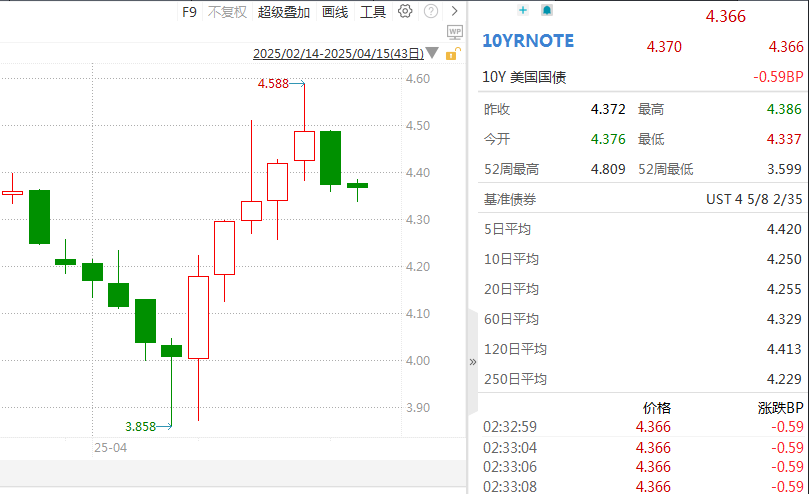
Core Viewpoint - The recent surge in U.S. Treasury yields, particularly the 10-year and 30-year bonds, reflects market concerns over economic recession, credit spreads, and liquidity tightening, rather than a broad-based sell-off of U.S. Treasuries [6][8] Group 1: Market Reactions - From April 4 to April 11, the 10-year Treasury yield rose from 3.858% to a peak of 4.588%, marking one of the largest weekly increases in years [2][6] - The 30-year Treasury yield also experienced significant volatility, climbing from 4.31% to over 5%, reaching a high of 5.018% on April 9 [4][6] - The U.S. Treasury futures prices fell nearly 3% during the same period, indicating a strong market reaction to rising yields [6] Group 2: Economic and Policy Implications - The recent sell-off in U.S. Treasuries is attributed to heightened recession fears, widening credit spreads, and tightening liquidity, rather than a systemic issue with dollar liquidity [6][8] - The "reciprocal tariffs" policy has led to global asset volatility, causing investors to withdraw from riskier assets, which has negatively impacted market liquidity [6][8] - Concerns over U.S. fiscal policy, including rising deficits and uncertainties surrounding tax policies, are contributing to a loss of confidence in U.S. sovereign credit and the traditional safe-haven status of Treasuries [7][8] Group 3: Shifts in Safe-Haven Preferences - The recent performance of gold and traditional safe-haven currencies like the yen and Swiss franc indicates a structural shift in market preferences away from U.S. Treasuries [7] - The volatility in the Treasury market suggests that its status as a safe haven is being challenged amid rising economic and geopolitical uncertainties [7]

中银证券全球首席经济学家管涛:美国经济“滞胀”风险增加 对美元信用深度担忧显现
news flash· 2025-04-14 03:01
Core Viewpoint - The risk of "stagflation" in the US economy is increasing, with deep concerns about the creditworthiness of the US dollar emerging due to aggressive tariff policies [1] Group 1: Economic Impact - The aggressive tariff policies under Trump's administration are disrupting the global situation, with the US economy and financial markets being the most affected [1] - The recent decline in US Treasury prices over five consecutive days has led to a cumulative increase of nearly 50 basis points in the 10-year Treasury yield, reaching 4.48%, marking the largest weekly increase since 2002 [1] Group 2: Market Reactions - The US dollar index has experienced a significant drop, with foreign institutions like Goldman Sachs shifting to a bearish outlook on the dollar's performance [1] Group 3: Comparative Analysis - In contrast, China's economic fundamentals, policy support, and valuation advantages are expected to continue driving the "revaluation of Chinese assets," reinforcing the narrative of "the East rising and the West declining" [1]

