AI芯片

Search documents
晶晨股份上周获融资净买入1642.31万元,居两市第454位
Sou Hu Cai Jing· 2025-08-03 23:37
8月4日,沪深两融数据显示,晶晨股份上周累计获融资净买入额1642.31万元,居两市第454位,上周融 资买入额3.19亿元,偿还额3.03亿元。 晶晨股份所属概念板块包括:半导体、上海板块、MSCI中国、沪股通、上证380、中证500、融资融 券、预盈预增、基金重仓、AI芯片、科创板做市股、半导体概念、超清视频、国产芯片、人工智能。 资金流方面,晶晨股份近5日主力资金流出1.27亿元,区间跌幅5.48%;近10日主力资金流出2.66亿元, 区间跌幅6.11%。 来源:金融界 通过天眼查大数据分析,晶晨半导体(上海)股份有限公司共对外投资了10家企业,参与招投标项目6 次,知识产权方面有商标信息24条,专利信息348条,此外企业还拥有行政许可16个。 天眼查商业履历信息显示,晶晨半导体(上海)股份有限公司,成立于2003年,位于上海市,是一家以从 事计算机、通信和其他电子设备制造业为主的企业。企业注册资本41832.6368万人民币,实缴资本6352 万人民币。公司法定代表人为JOHN ZHONG。 ...

德福科技吞下欧洲“技术吞金兽”!帮主郑重:1.74亿欧元买的是鲤鱼跃龙门门票?
Sou Hu Cai Jing· 2025-08-03 19:15
Core Viewpoint - The acquisition of Luxembourg Copper Foil by Defu Technology for €174 million is a strategic move that significantly enhances China's position in the copper foil market, particularly against Japanese competitors like Mitsui, which has dominated the industry for 30 years [1]. Group 1: Key Opportunities - **Technological Barrier**: The acquisition grants Defu access to critical technologies, specifically HVLP copper foil and DTH carrier copper foil, essential for AI chips, previously monopolized by Japan's Mitsui [3]. - **Profit Potential**: The processing fee for Luxembourg Copper Foil is €120 per kilogram, while Defu's own products are only €60. By leveraging lower domestic electricity costs, Defu aims to reduce operational costs by 20%, significantly boosting profit margins [4]. - **Client Portfolio**: Luxembourg Copper Foil has a prestigious client list, including major players like Nvidia and Doosan, positioning Defu to integrate Chinese copper foil into Nvidia's supply chain [5]. Group 2: Financial Considerations - **Profitability Concerns**: Despite a profit of €167,000 in Q1, Luxembourg Copper Foil reported a loss of €370,000 the previous year, raising questions about the sustainability of its operations and potential price adjustments post-acquisition [6]. - **Regulatory Approval**: The acquisition requires approval from both Chinese and European regulators, which could delay the process significantly, as seen in previous cases [7]. - **Competitive Response**: Mitsui holds 60% of the global removable copper foil market share and is likely to respond aggressively to Defu's acquisition, potentially escalating the technological competition [7]. Group 3: Strategic Recommendations - **Short-term Signals**: Investors should monitor the approval of the EU antitrust clearance and any announcements from Nvidia regarding the CoWoP technology, as these could trigger stock price movements [8]. - **Mid-term Financial Projections**: By 2026, Defu aims to achieve a sales target of 45,000 tons of high-end copper foil, potentially generating an additional €1.35 billion in net profit, doubling the projected profits for 2025 [9]. - **Long-term Market Share**: If CoWoP packaging technology penetration reaches 30% by 2027, Defu could capture 40% of the market, significantly increasing its market valuation [10].


我国成功发射巴基斯坦遥感卫星01星;Arm CEO:公司正在自研芯片丨智能制造日报
创业邦· 2025-08-01 03:24
Group 1 - The Russian National Space Corporation's president announced that the International Space Station will operate at least until 2028, with a possibility of extending to 2030 [1] - Media reports indicate that MediaTek's CEO expects the first batch of 2nm chips to begin trial production in September, with a projected revenue decline in Q3 due to earlier demand responses [2][1] - China successfully launched the Pakistan Remote Sensing Satellite 01 using the Kuaizhou-1A rocket, marking the 29th flight of this rocket [1] Group 2 - Arm's CEO revealed that the company is investing in developing its own chips, which has led to a disappointing forecast for the next fiscal quarter and an 8.65% drop in stock price [1]

芯片业务“生死存亡”,三星能否抓住特斯拉这根“救命稻草”?
Hua Er Jie Jian Wen· 2025-07-31 06:25
Core Viewpoint - Samsung Electronics is at a critical turning point in its chip business, with a $16.5 billion contract with Tesla for AI6 chip manufacturing seen as a potential lifeline for its struggling foundry operations [1][4]. Group 1: Business Challenges - Samsung's foundry business market share has plummeted from a leading position to just 7.7% in Q1 2023, significantly trailing TSMC's 67.6% [1]. - The company's second-quarter earnings report revealed a 55% year-on-year drop in operating profit to 4.7 trillion KRW, the lowest in six quarters, with the chip division's profit falling to 400 billion KRW from 6.5 trillion KRW a year earlier [2]. - Samsung's challenges stem from a lack of major clients, leading to delays in production at its flagship factory in Texas, contrasting sharply with TSMC's success in securing large clients like Apple and Nvidia for its Arizona facility [2][3]. Group 2: Opportunities from Tesla Contract - The eight-year contract with Tesla is viewed as a significant opportunity for Samsung's foundry business revival, as it will involve producing AI6 chips for Tesla's AI model training projects [4]. - Analysts believe that this contract could enhance confidence among other large tech companies in Samsung's technology, potentially attracting more AI clients [4]. - However, there are concerns regarding the long contract duration, as it provides Tesla with opportunities to exit if Samsung fails to execute effectively, raising questions about the contract's profitability for Samsung [4].

Wall Street predicts Nvidia and AMD price for next 12 months
Finbold· 2025-07-30 14:55
Group 1: Nvidia - Nvidia and AMD have seen stock rallies due to the U.S. easing chip export restrictions to China, allowing them to resume AI chip sales [1][2] - Nvidia can now sell its H20 GPUs after a sales halt in April, while AMD is set to restart shipments of its MI308 AI chips [2] - Nvidia's stock price has reached $177.44, with a year-to-date gain of 28.29% and a monthly gain of 12.31% [3] - Morgan Stanley raised Nvidia's price target to $200 from $170, citing strong demand for its Blackwell architecture [5] - The 12-month forecast for Nvidia's stock is $184.91, with bullish predictions reaching as high as $250, indicating potential gains exceeding 40% [6] Group 2: AMD - AMD has received a Moderate Buy rating from analysts, with a current stock price of $176.84, reflecting a year-to-date gain of 46.60% [7] - The average price target for AMD is $148.65, suggesting a 14.40% downside from current levels, despite recent gains [9] - The highest price predictions for AMD reach $210, while the lowest target is set at $110 [9]


AI芯片需求推动,联发科Q2营收1504亿新台币创新高,但汇率拖累净利润同比增长放缓至8.1% | 财报见闻
Hua Er Jie Jian Wen· 2025-07-30 12:11
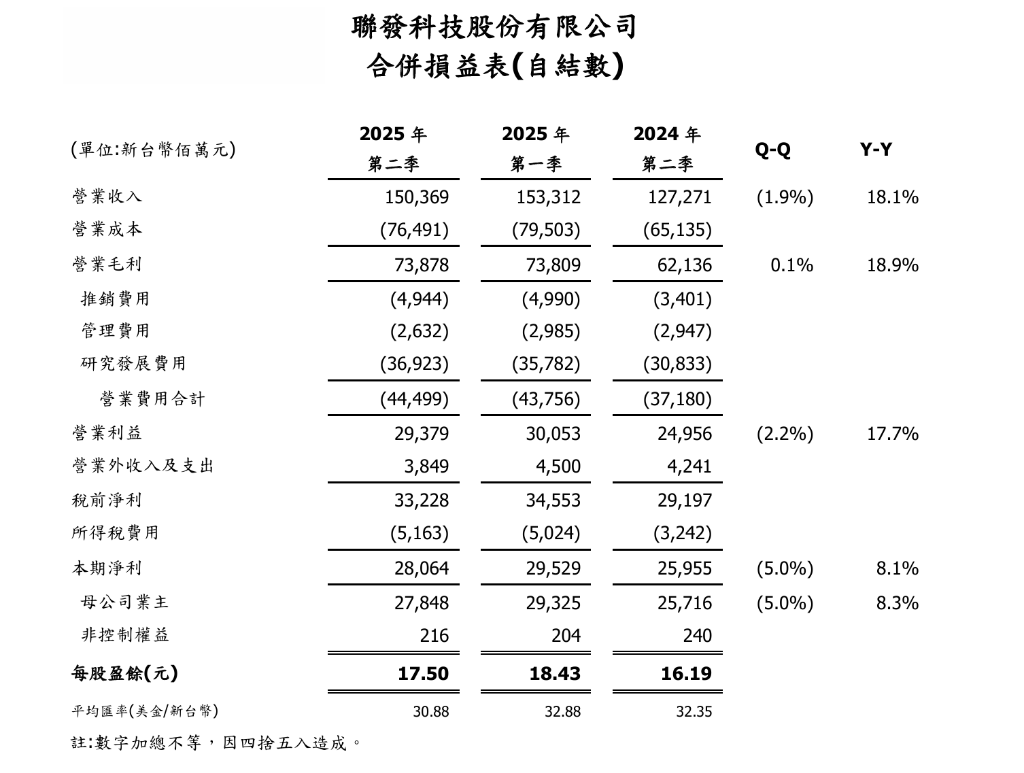
Core Insights - MediaTek's Q2 revenue reached NT$150.4 billion, marking an 18.1% year-over-year increase, driven by demand for edge AI chips and faster networking chips, while experiencing a 1.9% quarter-over-quarter decline due to unfavorable exchange rate factors [1][2][5] Financial Performance - Revenue for Q2 2025 was NT$150,369 million, down from NT$153,312 million in Q1 2025, but up from NT$127,271 million in Q2 2024 [1][5] - Gross profit was NT$73,878 million, with a gross margin of 49.1%, reflecting a 1% increase from the previous quarter [2][5] - Operating profit was NT$29,379 million, a decrease of 2.2% quarter-over-quarter but an increase of 17.7% year-over-year [1][5] - Net profit for the quarter was NT$28,064 million, down 5.0% from Q1 2025 but up 8.1% from Q2 2024, resulting in a net profit margin of 18.7% [2][5] Cost Structure - Research and development expenses totaled NT$36,923 million, accounting for 24.6% of revenue, with a year-over-year increase of 19.7% [2][3] - Selling expenses rose significantly by 45% to NT$4,944 million, increasing its share of revenue from 2.7% to 3.3% [3] Cash Flow and Working Capital - Operating cash flow improved significantly to NT$456 million, compared to NT$134 million in the previous quarter, indicating strong cash position [2] - Accounts receivable turnover days increased from 37 days in the previous quarter to 45 days, while inventory turnover days improved from 72 days to 66 days year-over-year [2] Strategic Partnerships - MediaTek is collaborating with NVIDIA to develop high-performance APU, aiming to enter the gaming laptop market, potentially disrupting AMD's dominance [4][6] - The new APU will integrate NVIDIA's latest GPU architecture and MediaTek's custom Arm architecture CPU cores, enhancing performance and energy efficiency [6]
台积电,靠封装赢麻了
半导体芯闻· 2025-07-30 10:54
Core Insights - The article discusses the projected demand for CoWoS wafers, predicting that global demand will reach 1 million pieces by 2026, with TSMC dominating the capacity allocation and Nvidia securing 60% of the CoWoS capacity [1][2]. Group 1: TSMC and CoWoS Technology - TSMC is expected to produce approximately 510,000 CoWoS wafers for Nvidia's next-generation Rubin architecture AI chips, which will account for about 60% of the global market demand [1]. - The CoWoS technology is crucial for enhancing signal transmission efficiency and chip density while reducing power consumption and heat dissipation, making it the standard packaging method for high-end AI chips [3]. Group 2: US Manufacturing Expansion - TSMC plans to build an advanced packaging facility in Arizona, which will include CoWoS, SoIC, and CoW technologies, with 60% of the capacity dedicated to Nvidia [2]. - The establishment of the US facility aims to strengthen the local supply chain, mitigate geopolitical risks, and address the increasing demand for advanced packaging technologies driven by AI and high-performance computing chips [2]. Group 3: Investment and Future Projections - Since Trump's second term, TSMC has announced a total investment plan of up to $100 billion, covering wafer fabs, R&D centers, and advanced packaging facilities [2]. - The anticipated output from Nvidia's chips could reach 5.4 million units by 2026, with 2.4 million units coming from the Rubin platform [1].

三星获特斯拉大订单推动韩股上涨 明日财报或有更多细节
news flash· 2025-07-30 03:32
金十数据7月30日讯,三星意外与特斯拉达成了价值165亿美元的芯片制造交易,为这家几乎被许多投资 者视为无足轻重的代工企业注入了新的活力。自消息公布以来,三星股价已上涨9%,使其7月份的涨幅 超过20%,并有望创下四年多来的最佳单月表现。韩国综合股价指数(KOSPI) 7月份涨幅的一半以上 来自三星,突显出投资者日益高涨的热情。三星预计在周四公布第二季度财报时,将提供有关特斯拉交 易的更多细节,以及今年下半年的前景。此前,该公司预计其初步营业利润下降56%,降幅大于预期。 此外,投资者也渴望了解三星能否从英伟达恢复向中国销售其H20 AI芯片中获益。 三星获特斯拉大订单推动韩股上涨 明日财报或有更多细节 ...
苏州强“芯”新政最高资助1亿
Su Zhou Ri Bao· 2025-07-29 22:35
Core Viewpoint - The article discusses the launch of measures by Suzhou to accelerate the development of the AI chip industry, emphasizing the importance of AI chips in high-performance computing and AI advancements, and outlining ten key areas for support and innovation from September 1, 2023, to December 31, 2027 [1][2][3][4] Group 1: Strengthening Core Enterprises - Suzhou aims to strengthen core enterprises in the AI chip sector, focusing on GPU, ASIC, FPGA, memory-compute integrated chips, silicon photonic chips, and network interconnection chips, with comprehensive support for key projects [1] - Financial incentives include up to 3 million yuan for manufacturing champions and 1 million yuan for "little giant" enterprises recognized for their specialization [1] Group 2: Building Innovation Platforms - The city plans to establish innovation platforms led by enterprises and supported by universities and research institutions, with operational funding of up to 2 million yuan [2] - Support will be provided for public technology service platforms for AI chip technology development and transformation, with rewards based on service effectiveness [2] Group 3: Attracting High-End Talent - Suzhou is focused on attracting top-tier talent in the AI chip field, offering project funding between 30 million to 100 million yuan and housing subsidies ranging from 300,000 to 1 million yuan [2] - The city will allocate around 100 special positions annually for AI talent, with funding and housing support for exceptional candidates [2] Group 4: Achieving Key Technology Breakthroughs - A list of key core technologies for AI chips will be compiled, with support of up to 10 million yuan for projects targeting chip architecture, process technology, and other critical areas [3] - Financial backing for independent engineering verification of chips includes up to 50% support for initial production costs, with higher support for advanced process nodes [3] Group 5: Promoting Industry Collaboration - The measures encourage collaboration between AI chip design and manufacturing enterprises, with rewards for production capacity support and recognition for significant semiconductor equipment [3] - The establishment of an AI chip industry ecosystem alliance is also planned to foster deep cooperation among enterprises [4]
AI创业公司集体交阶段性答卷,热闹之下的底色是“活下去”
Nan Fang Du Shi Bao· 2025-07-29 15:57
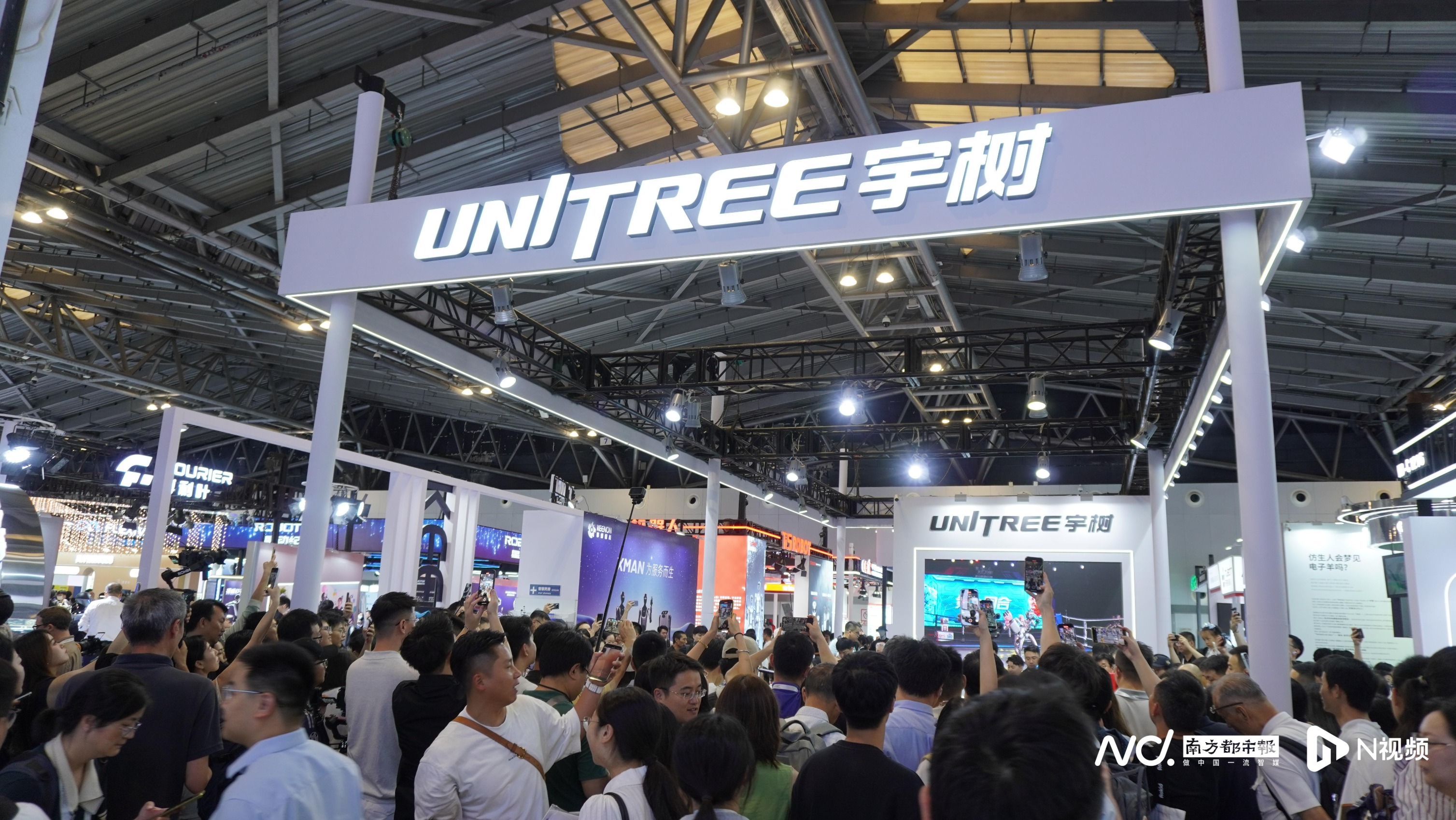
Group 1: Event Overview - The World Artificial Intelligence Conference (WAIC) 2025 is expected to attract 350,000 attendees, with significant interest in AI technologies, particularly humanoid robots [1] - Over 150 humanoid robots were showcased, dominating the event and attracting large crowds [1][3] - Companies from various sectors, including robotics, AI models, and industrial applications, are eager to participate in the growing field of embodied intelligence [1][3] Group 2: Market Dynamics - Startups in embodied intelligence are facing challenges in commercialization, with a need to demonstrate tangible value to justify high valuations [3][6] - The current high valuations in the embodied intelligence sector are seen as a bubble that needs to be addressed through actual business implementations [6][12] - Companies are exploring various commercial applications, such as logistics, entertainment, and service industries, to support their business models [7][10] Group 3: Technological Developments - Different approaches to embodied intelligence are emerging, including hardware-first, model-first, and integrated hardware-software strategies [7][11] - Companies like Yushutech are focusing on showcasing their hardware capabilities through live demonstrations, while others are developing advanced algorithms to enhance robot functionality [8][10] - The integration of AI models with hardware is crucial, as many companies are finding it necessary to develop their own hardware to ensure compatibility and performance [10][11] Group 4: AI Chip Market - Domestic AI chip companies are leveraging the demand for model inference to catch up with industry leaders like NVIDIA, focusing on cost-effective solutions [20][21] - The shift in demand from training to inference presents opportunities for domestic chip manufacturers to innovate and capture market share [20][22] - Collaborations between AI model developers and chip manufacturers are being formed to enhance compatibility and efficiency in the AI ecosystem [22][25]