
食品安全

Search documents
广东省江门市市场监督管理局关于2025年食品安全“你点我检,服务惠民生”食品安全监督抽检结果通告(2025年第二期)
Zhong Guo Zhi Liang Xin Wen Wang· 2025-05-21 08:48
Core Viewpoint - The Jiangmen Market Supervision Administration has conducted a food safety inspection campaign titled "You Order, We Inspect, Services Benefit People's Lives," revealing that out of 62 batches of food tested, 59 were compliant while 3 were found to have veterinary drug residues exceeding national safety standards [2]. Summary by Sections Food Safety Inspection Results - A total of 62 batches of food were inspected, with 59 passing and 3 failing the safety standards [2]. - The non-compliant products included: - Eggs from Bin Hua Restaurant in Taishan, which contained residues of doxycycline, florfenicol, and methoxyphenamine [2]. - Chicken from Shunli Seafood Restaurant in Taishan, which had sulfonamide and doxycycline residues [2]. - Eggs from Nanyan Restaurant in Kaiping, which also contained doxycycline residues [2]. Consumer Safety Tips - Consumers are advised to purchase food from reliable sources and retain shopping receipts [3]. - Important labels to check include production dates, expiration dates, producer names and addresses, ingredient lists, and food production license numbers [3]. - Consumers should avoid products without proper labeling, expired items, and those listed as non-compliant [3]. - When dining out, it is recommended to choose restaurants with complete licenses and hygiene standards, and to request invoices or receipts after meals [3]. Public Participation - The Jiangmen Market Supervision Administration encourages public participation in food safety supervision and reporting any food safety issues to designated complaint hotlines [3].

浙江省台州市市场监督管理局食品安全监督抽检信息通告(2025年第9期)
Zhong Guo Zhi Liang Xin Wen Wang· 2025-05-21 06:41
Summary of Key Points Core Viewpoint The recent food safety inspection conducted by the Taizhou Market Supervision Administration revealed that out of 312 food samples tested, 307 passed while 5 were found to be non-compliant with national food safety standards. The non-compliance primarily involved excessive food additives and pesticide residues. Group 1: Food Safety Inspection Results - A total of 312 food samples from 23 categories, including grain products, edible oils, and dairy products, were tested [3][4] - 307 samples were compliant, while 5 samples failed the inspection [3][4] - The non-compliant samples were related to excessive food additives and pesticide residues [3][4] Group 2: Specific Non-Compliant Products - Non-compliant products included: - Shrimp from a vendor in Wenling with sulfur dioxide residue exceeding the standard [3] - Green rice cakes from a vendor in Taizhou containing prohibited colorants [3] - Green rice cakes from a vendor in Sanmen with excessive sorbic acid [3] - Green rice cakes from another vendor in Linhai also with excessive sorbic acid [3] - Celery from a vendor in Wenling with pesticide residue exceeding the standard [4] Group 3: Regulatory Actions - The Taizhou Market Supervision Administration has mandated local market regulatory bodies to take immediate actions such as recalling and removing the non-compliant products from shelves [4] - Local authorities are required to report the rectification measures and results to the Taizhou Market Supervision Administration within three months [4]
浙江省绍兴市市场监督管理局食品安全监督抽检信息公告(2025年第2期)
Zhong Guo Zhi Liang Xin Wen Wang· 2025-05-20 09:11
Summary of Key Points Core Viewpoint - The recent food safety inspection in Shaoxing City revealed that out of 178 food samples tested, 169 passed while 9 were found to be non-compliant, primarily due to excessive food additives and pesticide residues [3][4]. Group 1: Inspection Results - A total of 178 food samples were tested across 19 categories including beverages, frozen foods, and dairy products [3]. - 169 samples were deemed compliant with national food safety standards, while 9 samples failed the inspection [3][4]. Group 2: Non-compliance Issues - The non-compliant samples were primarily related to two issues: 1. Exceeding limits for food additives 2. Excessive pesticide and veterinary drug residues [3][4]. - Specific instances of non-compliance included: - Chili from a vegetable store with a pesticide residue of 1.96 mg/kg, exceeding the limit of 1 mg/kg [5]. - Longan from multiple fruit stores with sulfur dioxide residue levels significantly above the permissible limit of 0.05 g/kg [5][6]. Group 3: Regulatory Actions - The Shaoxing Market Supervision Administration has mandated local regulatory bodies to take immediate action, including product recalls and risk control measures [4]. - Local authorities are required to report back on the handling of non-compliant products within three months [4].
贵州省黔南州市场监督管理局2025年“3·15”食品安全“你点我检服务惠民生”活动专项监督抽检结果公示(2025年总第3期)
Zhong Guo Zhi Liang Xin Wen Wang· 2025-05-20 08:58
Summary of Key Points Core Viewpoint The Guizhou Qiannan Market Supervision Administration has conducted a special food safety inspection as part of the "You Order, I Inspect" initiative for the 2025 "3.15" Food Safety Day, revealing that out of 100 food samples tested, 97 passed while 3 failed to meet safety standards. Group 1: Inspection Results - A total of 100 food samples were tested, with 97 passing and 3 failing [2][3] - The non-compliant items included marinated chicken feet and lemon yellow in cold noodles, which did not meet food safety requirements [2][3] - The inspection covered various food categories, including dairy products, edible oils, and school foods [2] Group 2: Specific Non-compliant Products - The first non-compliant product was marinated chicken feet from a vendor in Longli County, with a detected level of sunset yellow at 0.0102 g/kg, exceeding the permissible limit [2] - The second non-compliant product was cold noodles from a vendor in Dushan County, with a detected level of lemon yellow at 0.0193 g/kg, also exceeding safety standards [2] - The third non-compliant product was marinated chicken claws from a vendor in Fuquan City, with a detected level of sunset yellow at 0.0600 g/kg, surpassing the allowed limit [2] Group 3: Compliance and Public Health - The initiative aims to enhance public health and safety by ensuring food products meet regulatory standards [2][3] - The results of the inspections are publicly disclosed to promote transparency and consumer awareness [2][3] - The program reflects ongoing efforts by local authorities to monitor food safety and protect consumer interests [2][3]
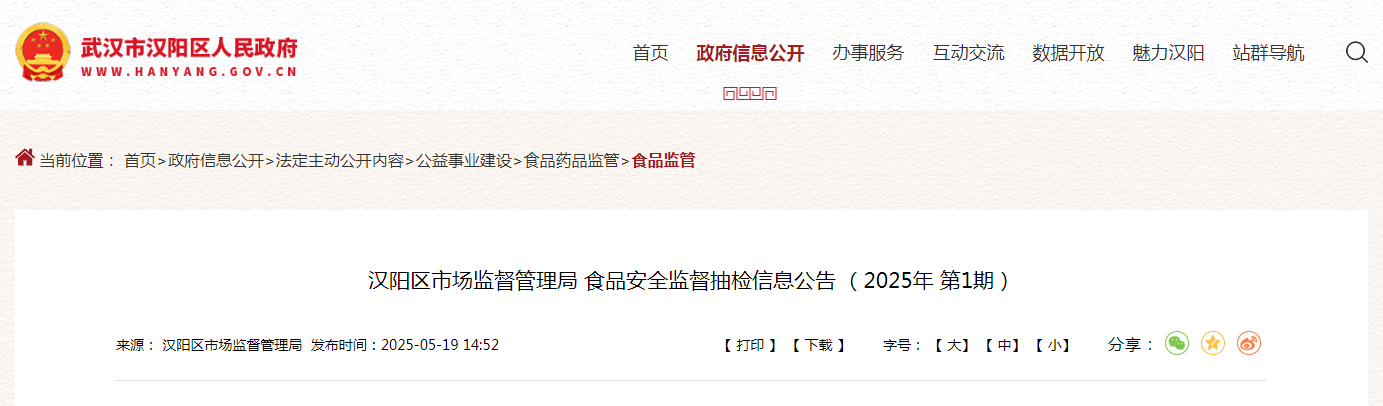
武汉市汉阳区市场监督管理局食品安全监督抽检信息公告(2025年第1期)
Zhong Guo Zhi Liang Xin Wen Wang· 2025-05-20 08:52
汉阳区市场监督管理局食品安全监督抽检信息公告(2025年第1期) 为切实保障广大人民群众的食品安全,根据《中华人民共和国食品安全法》的规定,汉阳区市场监督管理局组织检测机构对本辖区生产经营企业开展了食品 安全抽检,现将近期抽检信息进行公示如下: 一、总体情况。本次公布包括食用农产品110批次、酒类1批次、调味品20批次、粮食加工品21批次、淀粉及淀粉制品2批次、蔬菜制品8批次、糕点2批次、 食用油、油脂及其制品3批次、豆制品4批次、水产制品2批次、水果制品1批次、薯类和膨化食品2批次、方便食品2批次、炒货食品及坚果制品1批次、罐头1 批次、肉制品2批次、餐饮食品35批次共17类合计217批次。本次抽检196批次合格,21批次不合格。 | 监 | 督 | | | | | | | | | | | | | | | | | | | | | | | | --- | --- | --- | --- | --- | --- | --- | --- | --- | --- | --- | --- | --- | --- | --- | --- | --- | --- | --- | --- | --- | --- | --- ...
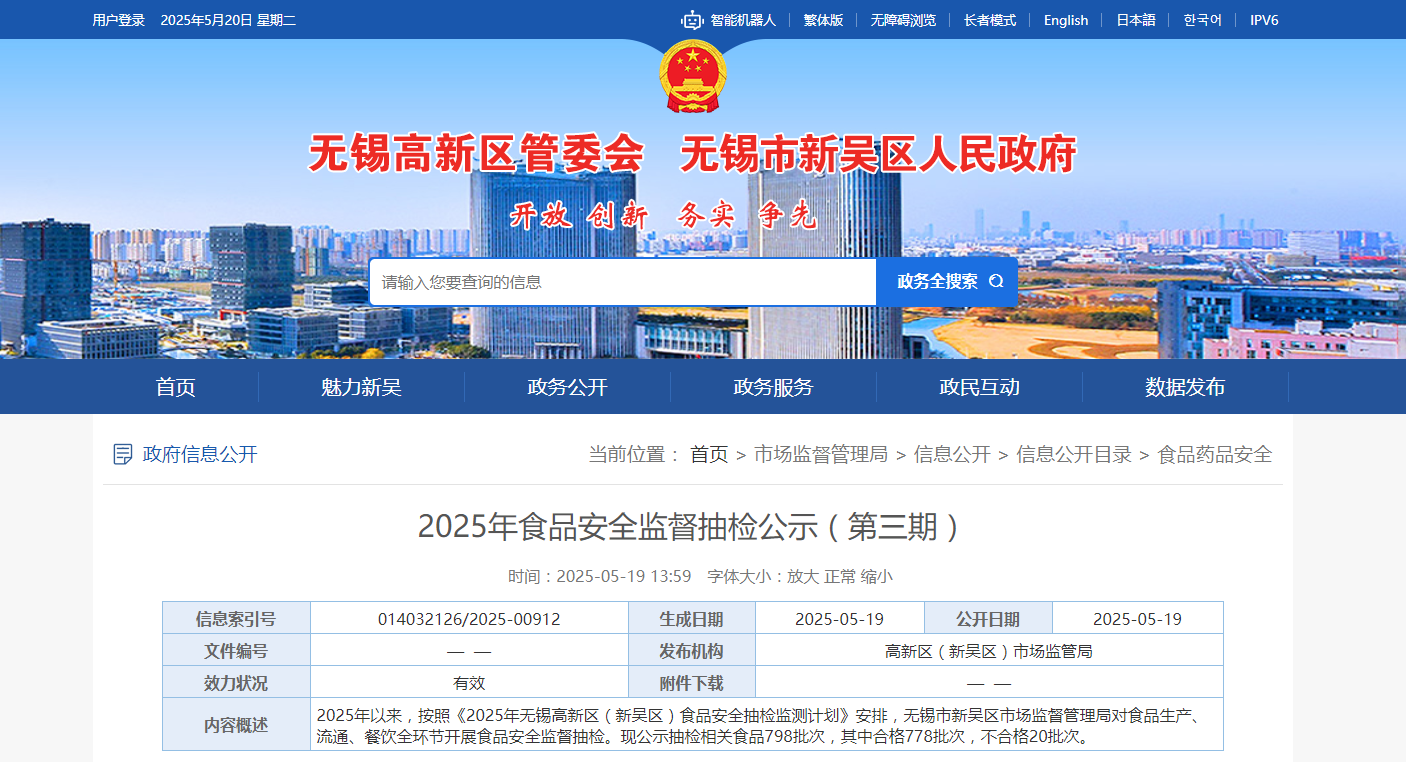
江苏省无锡市新吴区市场监督管理局发布2025年食品安全监督抽检公示(第三期)
Zhong Guo Zhi Liang Xin Wen Wang· 2025-05-20 07:57
Summary of Key Points Core Viewpoint - The Wuxi New District Market Supervision Administration has conducted food safety inspections in 2025, revealing that out of 798 food samples tested, 778 were qualified while 20 were found to be unqualified [3]. Group 1: Inspection Results - A total of 798 food samples were inspected in Wuxi New District [3]. - Out of these, 778 samples passed the safety standards, resulting in a pass rate of approximately 97.5% [3]. - 20 samples were deemed unqualified, indicating potential food safety issues that need to be addressed [3]. Group 2: Consumer Guidance - The Market Supervision Administration encourages consumers to report any food safety violations by calling the 12315 hotline [4].
浙江省湖州市市场监督管理局食品安全监督抽检信息通告(2025年第6期)
Zhong Guo Zhi Liang Xin Wen Wang· 2025-05-20 07:51
Core Viewpoint - The recent food safety inspection in Huzhou revealed that out of 280 food samples tested, 270 passed while 10 were found to be non-compliant with national food safety standards, highlighting ongoing concerns regarding food safety in the region [2][3]. Summary by Categories Food Safety Inspection Results - A total of 280 food samples across 20 categories were tested, with 270 passing and 10 failing the safety standards [2][3]. - The non-compliant products were linked to issues such as illegal use of food additives, pesticide and veterinary drug residues exceeding limits, and contamination [2][3]. Specific Non-Compliant Products - **Illegal Use of Food Additives**: - A specific case involved rice wine from Huzhou Yangjiabu Town, which contained cyanide levels exceeding the national safety standards [2]. - **Pesticide Residues**: - Several products were flagged for pesticide residue violations, including: - Old ginger from Changxing with a residue of 1.07 mg/kg for imidacloprid, exceeding the limit of 0.5 mg/kg [3]. - Small mangoes from Changxing with a residue of 0.12 mg/kg for thiamethoxam, above the permissible level of 0.05 mg/kg [3]. - **Contamination Issues**: - Dried longan from Changxing was found to have a sulfur dioxide residue of 0.132 g/kg, surpassing the limit of 0.05 g/kg [3]. Regulatory Actions - The Huzhou Market Supervision Administration has mandated local regulatory bodies to take immediate action, including product recalls and risk control measures for the non-compliant items [2][3].
浙江省市场监管局4月和5月食品安全监督抽检结果显示 豆制品不合格项目主要涉及食品添加剂超范围超限量使用
Zhong Guo Zhi Liang Xin Wen Wang· 2025-05-20 04:42
Core Viewpoint - The Zhejiang Provincial Market Supervision Administration has identified non-compliance issues in soy products primarily related to the excessive use of food additives, highlighting the need for stricter enforcement of food safety standards [1][2][3]. Group 1: Inspection Results - In April and May, the Zhejiang Provincial Market Supervision Administration conducted eight rounds of food safety inspections focused on soy products [1]. - Specific non-compliance cases included three batches of soy products failing to meet safety standards due to the presence of lemon yellow, a synthetic coloring agent [2]. - Other violations included the detection of benzoic acid and its sodium salt, as well as aluminum residue exceeding the national safety standards in various soy products [2][3]. Group 2: Regulatory Standards - The use of lemon yellow in dried vegetables and soy products is prohibited under the national food safety standards (GB 2760-2014) [3][4]. - Benzoic acid and its sodium salt are also banned in soy products, as their excessive consumption can lead to liver toxicity [4]. - The maximum allowable limit for aluminum residue in soy products is set at 100 mg/kg, according to the updated standards (GB 2760-2024) [5]. Group 3: Potential Causes of Non-compliance - The excessive use of lemon yellow may stem from manufacturers attempting to enhance product appearance and market value [4]. - The presence of benzoic acid could be due to efforts to extend shelf life or compensate for poor hygiene during production [4]. - Aluminum residue issues may arise from improper control of aluminum-containing additives or high aluminum content in raw materials [5].
消费舆警指数|食品安全问题频发、回应被指缺乏诚意,盒马何以保住口碑?
2 1 Shi Ji Jing Ji Bao Dao· 2025-05-19 23:45
Group 1 - The core issue revolves around the frequent food safety problems at Hema, with public relations responses lacking sincerity [2][6][7] - Hema has faced multiple instances of product quality failures, including non-compliance with national food safety standards for various items [3][6] - The company's response to these incidents has been criticized for being insufficient and not addressing consumer concerns adequately [7] Group 2 - Wahaha has confirmed its partnership with Jinmailang for bottled water production, which has raised questions due to quality issues [8][11] - The company quickly issued a statement acknowledging the partnership and emphasized that all products currently on the market meet quality standards [8][11] - Wahaha's response has been noted for its clarity and assertiveness, reflecting a strong brand image amidst ongoing scrutiny [11][12]

“预制菜早茶”你能接受吗?这项立法或值得期待
Nan Fang Nong Cun Bao· 2025-05-19 09:00
Core Viewpoint - The Guangzhou Municipal People's Congress has included the "Guangzhou Early Tea Heritage Protection Regulations" as a legislative preparatory project for 2025, aiming to gather public opinions through a survey on the preservation and modernization of early tea culture [2][4][41]. Group 1: Legislative Intent - The legislation aims to address the cultural significance of early tea and its associated practices, ensuring that traditional skills and cultural rituals are preserved in modern society [37][39][43]. - The survey includes questions about what aspects of early tea culture should be protected and how to support its development, reflecting a proactive approach to public engagement [35][36]. Group 2: Public Opinion on Pre-prepared Tea Dishes - The rise of pre-prepared tea dishes has sparked debate among consumers, with many expressing skepticism about their authenticity and quality compared to freshly made items [22][24][27]. - Some consumers support the idea of pre-prepared tea dishes for standardization and scalability, provided that clear labeling of preparation methods is implemented [29][30]. - Concerns have been raised about the potential loss of traditional culinary skills if pre-prepared options replace handmade dishes, highlighting the need for a balance between innovation and tradition [28][32]. Group 3: Food Safety Concerns - The core issue surrounding pre-prepared dishes is food safety rather than the concept of pre-prepared food itself, emphasizing the importance of transparency in ingredient sourcing and preparation processes [30][31][33]. - Experts suggest that the quality of food is determined by human practices rather than the method of preparation, indicating that proper standards can ensure safety in pre-prepared options [32][33].
