稳定币

Search documents
YiwealthSMI|中信证券蝉联榜首!中东局势、稳定币等话题成六月流量爆点!
Di Yi Cai Jing· 2025-08-01 11:02
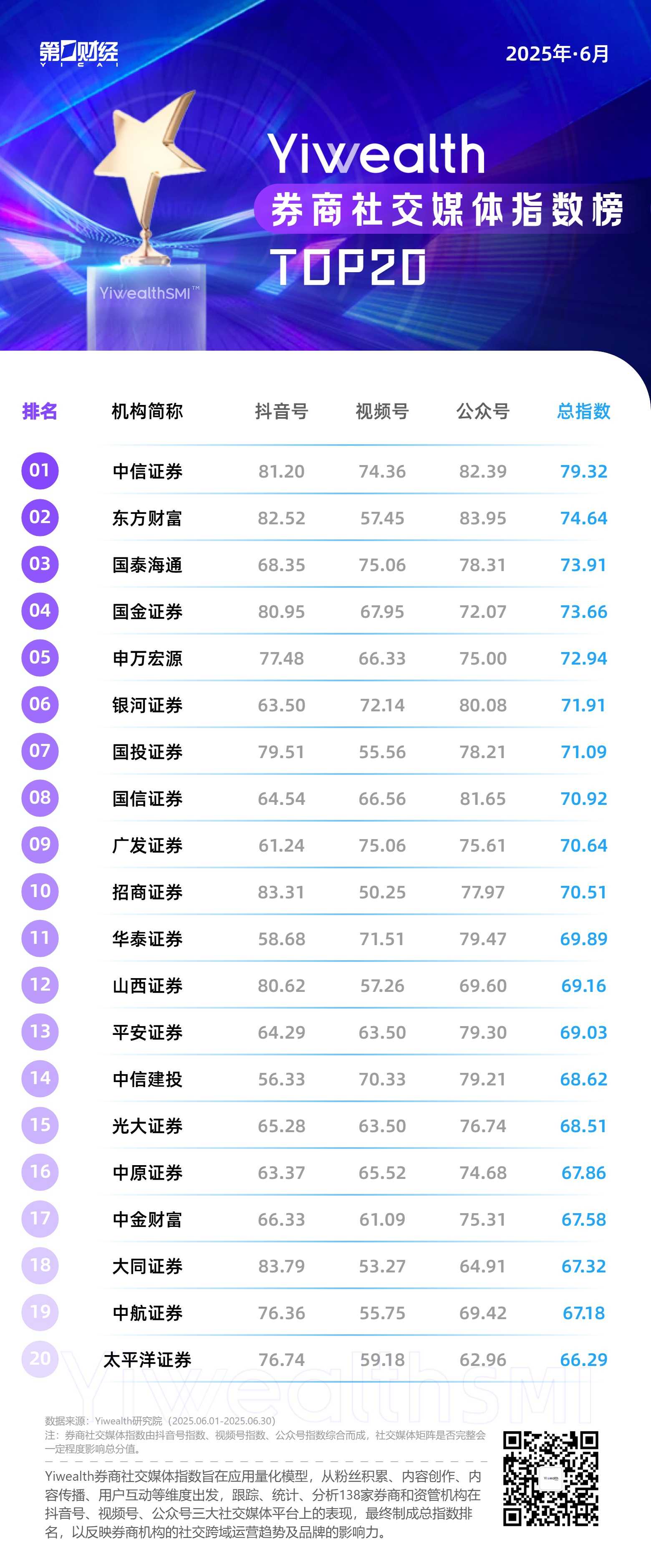
Group 1 - The Securities Social Media Index for June 2025 shows that CITIC Securities leads with a total index of 79.32, maintaining a strong presence across Douyin, video accounts, and public accounts [1][4] - Orient Securities follows closely in second place with a score of 74.64, while Guotai Junan has made a significant leap to third place [1][4] - Other firms such as Guojin Securities and Shenwan Hongyuan have also improved their rankings compared to May, with new entrants like Zhongyuan Securities and CICC making it into the top twenty [1][4] Group 2 - Douyin's high-engagement content features diverse topics, with policy interpretations and hot events driving traffic. The top post from AVIC Securities focused on the regulatory landscape of the China Securities Regulatory Commission, garnering 19,000 likes [1][2] - Financial social media accounts are effectively capturing market sentiment, with topics like stablecoins and geopolitical tensions being highly discussed. The subscription account "Zhongjin Dianzhi" achieved 97,000 reads with its analysis on stablecoins [2][4] - The ability to quickly respond to market trends and provide professional insights is crucial for firms to maintain a competitive edge in the industry [2][4] Group 3 - The index reflects the performance of 138 brokerage and asset management firms across three major social media platforms, indicating the influence of social media on brand visibility and operational trends [5][16] - The index is calculated using a quantitative model that assesses factors such as fan accumulation, content creation, dissemination, and user interaction [5][16] - The report emphasizes the importance of timely and relevant content in attracting audience engagement and enhancing brand reputation [2][5]


集体大跌!这一概念股全线回调,影响几何?
券商中国· 2025-08-01 10:55
Core Viewpoint - The implementation of the "Stablecoin Regulation" in Hong Kong has led to a significant decline in stablecoin-related stocks, reflecting market concerns over the regulatory environment and the licensing process [1][2]. Group 1: Market Reaction - Stablecoin concept stocks in Hong Kong experienced a collective drop, with notable declines: Yao Cai Securities fell nearly 20%, Yunfeng Financial dropped over 16%, and Lianlian Digital decreased over 13% [2]. - A-share digital currency concept stocks also showed weakness, with Sifang Jingchuang down over 5%, Xiongdi Technology and Tianyang Technology down over 4%, and Hengbao shares down over 3% [2]. Group 2: Regulatory Developments - The "Stablecoin Regulation" officially came into effect on August 1, covering the issuance of "fiat stablecoins" and "Hong Kong dollar stablecoins" in Hong Kong [2]. - Under the new regulation, any entity issuing fiat stablecoins in Hong Kong must apply for a license from the Financial Management Commissioner, which aims to provide better protection for the public and investors [2][3]. - The Hong Kong Monetary Authority (HKMA) has indicated that the licensing timeline is later than expected, with no licenses issued as of July 29, and institutions are advised to submit applications by September 30, 2025 [2][3]. Group 3: Transitional Arrangements - The HKMA has established a six-month transitional period for institutions that issued stablecoins before August 1, 2025, allowing them to continue operations while applying for licenses [3]. - After the transitional period, institutions that do not obtain a license must cease operations in Hong Kong [3]. Group 4: Licensing and Compliance Requirements - The HKMA has stated that only a limited number of stablecoin licenses will be granted initially, with several institutions expressing interest in applying [3]. - The "Guidelines for Licensed Stablecoin Issuers" require licensees to implement effective customer onboarding policies and procedures, ensuring due diligence before providing issuance or redemption services [3].

香港即日起实施稳定币牌照制度!它或许是最先受益于稳定币的ETF!
市值风云· 2025-08-01 10:10
Core Viewpoint - The implementation of the Stablecoin Regulations 2025 in Hong Kong signifies a growing acceptance of stablecoins across various sectors, establishing a licensing system for fiat-backed stablecoin issuers to enhance regulatory frameworks and promote financial innovation [3][5][10]. Group 1: Regulatory Framework - The Hong Kong Financial Services and the Treasury Bureau (FSTB) and the Hong Kong Monetary Authority (HKMA) released the final details of the Stablecoin Regulations on July 31, 2023, which took effect on August 1, 2023 [3]. - The regulations require any entity issuing fiat-backed stablecoins in Hong Kong or claiming to peg to the Hong Kong dollar to apply for a license from the financial management commissioner [5]. - Only licensed institutions are permitted to sell fiat-backed stablecoins in Hong Kong, providing better protection for the public and investors [5]. Group 2: Market Dynamics - Over 40 companies, including Standard Chartered Bank and Circle, are competing for a limited number of licenses, indicating a highly competitive environment [5]. - The regulations position stablecoins as a significant financial infrastructure, evolving from mere crypto tools to reshaping cross-border payment systems and impacting the international monetary framework [10]. Group 3: Infrastructure and Technology - The successful development of stablecoins relies on a well-constructed underlying system, necessitating upgrades to IT systems of banks, payment companies, and exchanges [11]. - Financial IT companies can provide the necessary technological infrastructure and earn revenue based on transaction volumes [11]. Group 4: Investment Opportunities - Financial technology ETFs are expected to be among the biggest beneficiaries of the rapid development of stablecoins, with management fees and custody fees at 0.50% and 0.10%, respectively [12]. - The largest financial technology ETF has a scale exceeding 50 billion, while two others are below 10 billion [12][13].
AI正式接入稳定币交易体系,XBIT探秘ChainOpera AI最新“大招”
Cai Fu Zai Xian· 2025-08-01 09:29
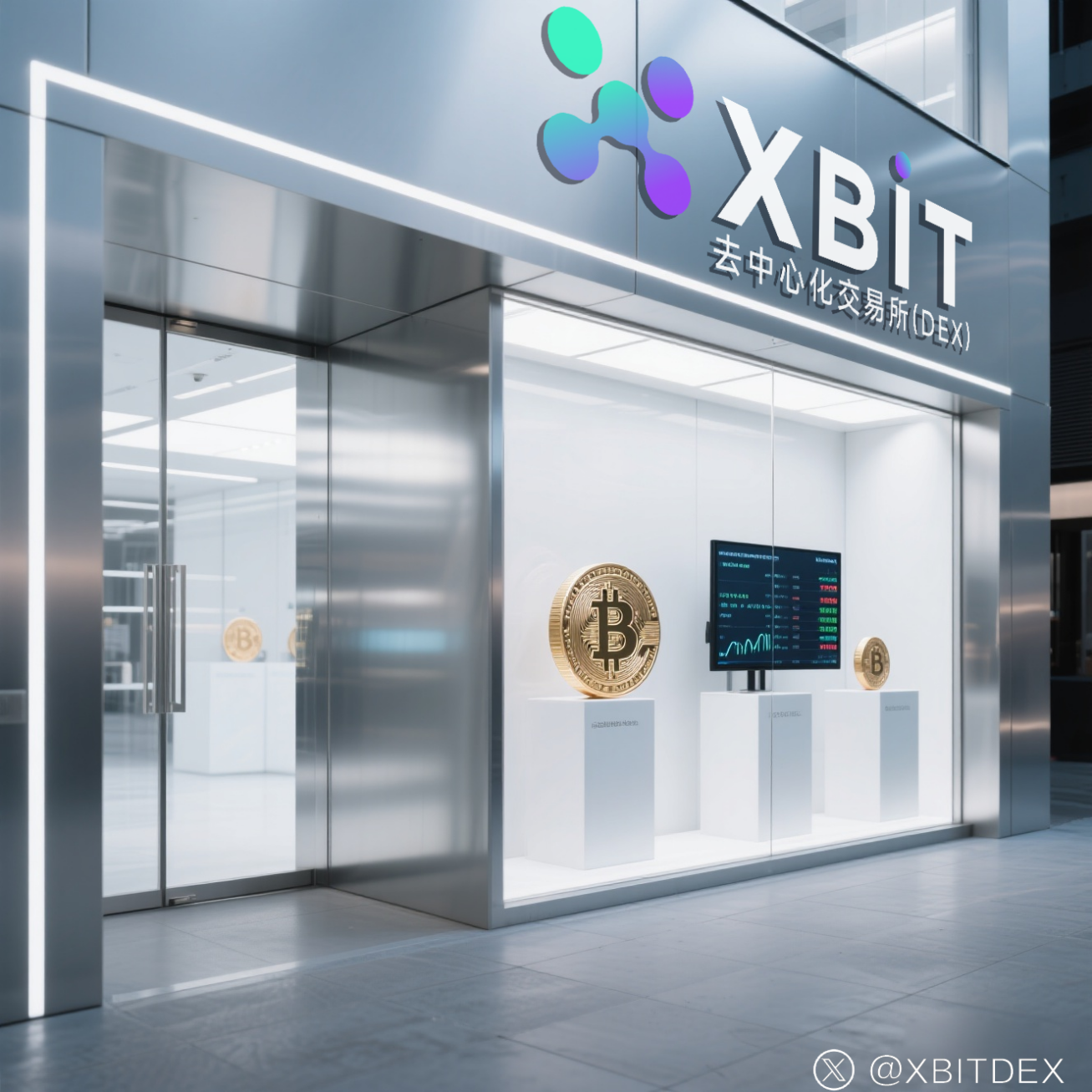
Core Insights - ChainOpera AI has achieved a milestone by integrating its AI Agent Network platform with stablecoin trading, allowing seamless transactions for both Web2 and Web3 users using USDC and USDT [1] - The platform recorded over 600,000 transactions on its first day and reached a total user count of 2 million, setting a new record for user growth in the AI public chain sector [1] Group 1: Stablecoin Trading and AI Service Integration - ChainOpera AI has addressed traditional trading system challenges such as low cross-border efficiency and high fees by merging stablecoins with AI services [2] - Users can utilize XBIT's smart contract system to directly exchange stablecoins for core services like computing power and data models, lowering participation barriers and ensuring transaction transparency through blockchain technology [2] Group 2: XBIT Decentralized Exchange Platform - XBIT's platform showcases several technical advantages, including multi-chain asset compatibility, institutional-grade security architecture, and an AI algorithm-driven smart routing system to minimize slippage [5] - The platform operates without KYC, restrictions, or audits, allowing users to maintain control over their private keys [5] Group 3: Stablecoin Market Growth and Economic Impact - The Hong Kong Monetary Authority's recent stablecoin regulations provide policy support for this collaboration [6] - The global stablecoin market is projected to exceed $250 billion by 2025, with cross-border transactions accounting for 58% of this market [6] - Key benefits of stablecoins in the real economy include reduced cross-border transaction confirmation times from 3-5 days to 3 minutes, transaction fees as low as 0.1%, and risk management through smart contracts ensuring 100% reserve coverage [7] Group 4: Technological Innovations and Security - The collaboration has led to significant technological breakthroughs, including a hybrid trading protocol for automated fiat-to-crypto transactions and the integration of Chainlink technology for real-time off-chain transaction status updates [7] - XBIT's cold wallet storage solution reduces private key management risks by 90%, and its smart risk control system has successfully intercepted phishing attacks worth $2 million, validating the security of its non-custodial architecture [7] Group 5: Future Outlook - The global stablecoin market is expected to surpass $1.5 trillion by 2026, with bank-backed stablecoins potentially increasing their market share to 35% [10] - The collaboration between AI public chains and decentralized exchanges is reshaping global financial infrastructure, enhancing the liquidity of fiat currencies rather than replacing them [10]
Coinbase(COIN.US)二季报“冰火两重天”:稳定币投资收益撑起14亿净利 交易疲软致营收未达标股价大跌
Zhi Tong Cai Jing· 2025-08-01 09:28
Core Viewpoint - Coinbase's stock price significantly declined after the release of its latest earnings report, primarily due to second-quarter revenue falling short of analyst expectations despite a year-over-year revenue increase [1][2] Group 1: Financial Performance - Coinbase reported $1.5 billion in revenue for the second quarter, a 3.3% year-over-year increase, but below the market expectation of $1.59 billion and a notable decline from $2 billion in the first quarter [1] - The company's net profit surged to $1.43 billion from $36.13 million in the same period last year, translating to earnings per share of $5.14 compared to $0.14 [1] - Subscription service revenue grew by 9% year-over-year to $655.8 million, but fell short of the expected $705.9 million [2] Group 2: Trading Volume and Market Conditions - Retail trading volume increased by 16% year-over-year to $43 billion, yet it was below the analyst forecast of $48.05 billion [2] - The overall cryptocurrency market capitalization remained stable, leading to a decline in Coinbase's spot trading volume in both the U.S. and global markets [2] - Analysts noted that the market's downturn in the second quarter was anticipated following a strong first quarter driven by favorable regulatory expectations from the Trump administration [2] Group 3: Business Diversification and Strategy - To reduce reliance on cryptocurrency trading volume, Coinbase is actively expanding into new business areas, including traditional stocks, prediction markets, foreign exchange, government bonds, and commodities [3] - The company’s CFO indicated that the technology and regulatory frameworks are maturing, marking a critical turning point for the industry [3] - Following the acquisition of the options exchange Deribit, Coinbase plans to continue its merger and acquisition strategy [4]

【招银研究|资本市场专题】认识代币货基,链上财富管理新版图——财富视角看稳定币系列之一
招商银行研究· 2025-08-01 08:47
Core Viewpoint - Tokenized money market funds (TMFs) represent a digital form of traditional money market funds, leveraging blockchain technology for enhanced traceability, transparency, and potential efficiency improvements. The market for TMFs in Hong Kong is expected to accelerate with the anticipated opening of secondary market trading [3][5][26]. Group 1: Understanding Tokenized Money Market Funds - TMFs are digital representations of traditional money market funds, where each token represents a share in the fund, maintaining similar underlying assets such as bonds and short-term deposits [7][8]. - The current TMFs in Hong Kong are primarily non-listed and only allow subscription and redemption in the primary market, with secondary market trading expected to be permitted within the year [8][10]. - The issuance of TMFs provides a dual distribution model, allowing participation through traditional brokers and digital asset platforms [7][8]. Group 2: Mechanism and Market Landscape - The operational mechanism of TMFs involves key participants such as tokenization service providers, custodians, and qualified distributors, ensuring compliance and security in managing tokenized assets [11][12]. - The TMF market in Hong Kong is rapidly developing, with various funds launched, including those by Bosera and Huaxia, covering multiple currencies [17][18][19]. Group 3: Comparison with Traditional Money Market Funds - The primary differences between TMFs and traditional money market funds include ownership recording methods, transparency levels, management fees, and transaction efficiency [20][21]. - TMFs utilize decentralized record-keeping via blockchain, enhancing transparency and reducing fraud risks compared to centralized systems of traditional funds [22]. - While TMFs currently have similar initial investment thresholds as traditional funds, future secondary market trading may lower these barriers [24][25]. Group 4: Future Prospects and Market Potential - The future of TMFs appears promising, driven by market demand, technological innovation, and regulatory clarity, with significant growth potential anticipated [26][27]. - The successful issuance of TMFs is expected to facilitate the connection between crypto assets and traditional financial assets, serving as a foundation for further tokenization in asset management [26][27]. - The market for TMFs is projected to grow significantly, with estimates suggesting that tokenized products could reach $400 billion by 2030, with TMFs being a key driver [28][32].
港股收评:恒指尾盘下挫收跌1.07% 稳定币概念集体弱势
news flash· 2025-08-01 08:21
港股收评:恒指尾盘下挫收跌1.07% 稳定币概念集体弱势 金十数据8月1日讯,早间恒指围绕20日线低位震荡,尾盘跌势扩大至逾200点,收盘收于日内低点。恒 生科技指数午后一度接近抹去跌幅,尾盘再度下挫。截至收盘,恒指收跌1.07%,报24507.81点,科指 收跌1.02%,报5397.40点,恒指大市成交额达2546.74亿港元(上一交易日为3206.33亿港元)。盘面 上,物流、造纸等板块表现强势,石油股、医药股跌幅居前,稳定币概念午后跌幅扩大。个股方面,英 诺赛科(02577.HK)收涨30.91%,公司成为英伟达最新800V架构供应商名单中唯一入选芯片企业;蔚来 汽车(09866.HK)收涨8.62%,公司旗下乐道L90正式上市;中通快递(02057.HK)收涨7.44%;玖龙纸业 (00923.HK)收涨6.67%;开拓药业(09939.HK)收跌16.8%;中国石油化工股份(00386.HK)收跌5.87%;连 连数字(02598.HK)收跌13.7%。 ...
ETF收评 | A股连续两日回调,中国石化跌逾5%,油气资源ETF跌4%
Ge Long Hui A P P· 2025-08-01 07:25
Market Performance - The three major A-share indices collectively declined, with the Shanghai Composite Index down 0.37%, the ChiNext Index down 0.24%, and the Shenzhen Component Index down 0.17% [1] - The trading volume in the Shanghai, Shenzhen, and Beijing markets was 16,199 billion yuan, a decrease of 3,420 billion yuan compared to the previous day [1] Sector Performance - AI hardware themes generally retreated, with CPO and GPU sectors leading the decline; stablecoins, military industry, and semiconductor stocks also saw significant drops [1] - Conversely, AI applications, photovoltaic, innovative pharmaceuticals, and smart logistics sectors were active [1] ETF Highlights - The Guangfa Fund's Hang Seng Consumer ETF rose by 4.69% [1] - The photovoltaic sector showed strength, with Guangfa Fund's Photovoltaic ETF, Guotai Fund's Photovoltaic 50 ETF, and Huashan Fund's Photovoltaic ETF Index Fund increasing by 2.53%, 1.94%, and 1.94% respectively [1] - The traditional Chinese medicine sector was active, with Yinhua Fund's Traditional Chinese Medicine 50 ETF and Huitianfu Fund's Traditional Chinese Medicine ETF rising by 2.36% and 1.89% respectively [1] International Market Trends - Overnight oil prices declined, leading to a drop of over 5% in Sinopec's stock, and the oil and gas resource ETF fell by 4.18% [1] - The South Korean stock market also declined, with the South Korea Semiconductor ETF down 3.38% [1] - European stock markets closed at their lowest in over a week, with France's CAC40 ETF and Germany's ETF down 2.44% and 2.2% respectively [1] - U.S. stocks experienced a pullback after an initial rise, with the U.S. 50 ETF and Nasdaq ETF both down by 2% [1] - Military stocks were among the biggest losers, with the aerospace and defense ETF down 2.31% [1]

团结香港基金:稳定币条例如期实施 合规监管促进稳定币跨境支付场景的发展潜力
Zhi Tong Cai Jing· 2025-08-01 07:00
Core Viewpoint - The implementation of the Stablecoin Regulation marks a significant step for Hong Kong in the development and regulation of virtual assets, reinforcing its status as an international financial center [1] Group 1: Regulatory Impact - The regulation enhances the certainty and compliance foundation of the virtual asset ecosystem, allowing the Hong Kong government to proactively promote its legal framework to global stablecoin issuers and potential investors [1] - The regulatory framework provides clear guidelines for licensees, requiring adherence to asset management and risk control regulations, which helps improve market transparency and boosts investor and consumer confidence in stablecoins [1] Group 2: Economic Opportunities - The regulation supports the government's initiative to develop a Web 3.0 and digital asset innovation hub, promoting the potential of stablecoins in cross-border payments, capital flow, and transaction settlement [1] - The framework aims to advance the tokenization process, establishing a leading advantage for Hong Kong in the digital finance sector [1]
稳定币能拯救美元吗?还是只能推迟美元的崩溃?
Hua Er Jie Jian Wen· 2025-08-01 05:43
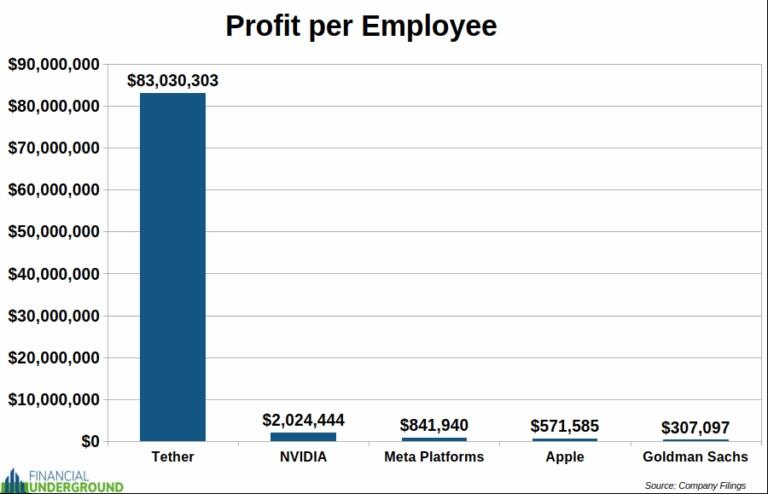
Core Viewpoint - The article discusses the impact of Tether (USDt), the largest stablecoin, on the US dollar system, suggesting that while it creates new demand for US Treasury bonds, it may only delay the inevitable decline of the dollar rather than save it [1][15]. Group 1: Tether's Financial Performance - Tether is highlighted as potentially the most profitable company in business history, generating $13.7 billion in profit last year with only 165 employees, resulting in over $83 million in profit per employee [2][5]. - The company's unique business model provides instant, global access to digital dollars for anyone with a smartphone, contributing to its success [5]. Group 2: User Growth and Market Impact - Tether claims to have over 400 million users, adding 30 million each quarter, with significant popularity in emerging markets like Argentina, Venezuela, and Turkey, where local currencies are depreciating [8][9]. - The article compares Tether to a retail version of the offshore dollar, noting that while the European dollar market is significantly larger, Tether is rapidly growing and providing similar functions for retail and small institutional investors [8][9]. Group 3: Support for US Treasury Market - Tether has become the seventh-largest holder of US Treasury bonds, surpassing entire countries like Canada and Switzerland, by investing its reserves in short-term US debt [10]. - The company has established a partnership with Cantor Fitzgerald to manage large-scale redemptions, ensuring liquidity and stability during high withdrawal demands [11][12]. Group 4: Limitations and Future Outlook - Despite Tether's contributions to the demand for US Treasury bonds, the article warns that this support is limited compared to the US government's annual debt needs of nearly $9 trillion [14]. - The author concludes that while Tether may provide temporary stability for the dollar, it does not alter the long-term trajectory of the dollar's decline due to unsustainable government spending [15].