
自动驾驶

Search documents
沪硅产业预计2025年净亏损12.8亿元-15.3亿元 联讯仪器科创板IPO获上市委会议通过
Xin Lang Cai Jing· 2026-01-14 13:21
Group 1: Company Announcements - Anheng Information's shareholder Alibaba Venture Capital plans to reduce its stake by no more than 1% [1] - Blue Special Optics intends to raise no more than 1.055 billion yuan through a private placement for various projects [3] - Ding Tong Technology plans to issue convertible bonds to raise no more than 930 million yuan for expansion projects [4] - Hu Silicon Industry expects a net loss of 1.28 billion to 1.53 billion yuan for 2025, with a decline in the price of 300mm semiconductor wafers impacting revenue [2] - Aerospace Hongtu anticipates a net loss for 2025 due to declining main business revenue and project gross margin [4] - Trina Solar expects a net loss for 2025 [4] - JinkoSolar also forecasts a net loss for 2025 [4] - Xiangyu Medical expects to launch 5-6 AI rehabilitation robot products by 2026 [4] Group 2: Industry Developments - Three departments held a meeting to regulate the electric vehicle industry, emphasizing the need to resist disorderly price wars and ensure fair competition [1] - Shanghai aims to achieve large-scale implementation of high-level autonomous driving applications by 2027, with a focus on innovation and industry competitiveness [2] Group 3: Financial Performance Forecasts - Daqing Energy expects a net loss for 2025, although the loss is projected to be narrower than the previous year [9] - Shengke Communication forecasts a net loss of 120 million to 160 million yuan for 2025, with revenue growth but increased R&D costs impacting profitability [10] - Qin Chuan Internet of Things anticipates a net loss of 100 million to 120 million yuan for 2025, driven by declining sales and high R&D expenses [11] - Jinbo Co. expects a net loss for 2025 [12] - Qi Anxin also forecasts a net loss for 2025 [13]

收到绿包 请配合监管查看
Datayes· 2026-01-14 12:50
Core Viewpoint - The article discusses recent regulatory measures in the A-share market aimed at cooling down excessive market activity, particularly by increasing the margin requirement for financing transactions from 80% to 100% to protect investors and manage leverage levels [2][3][5]. Regulatory Measures - The increase in financing margin requirements is intended to reduce leverage and protect investor rights, applicable only to new financing contracts [3]. - The market reacted with significant sell orders on major stocks, indicating a cautious sentiment among investors [5]. Market Reactions - Major stocks like China Merchants Bank saw sell orders exceeding 6.5 billion yuan, with several other stocks also experiencing large sell orders [5]. - Analysts suggest that while the measures may alter the pace of market growth, they do not fundamentally change the overall bullish trend of the market [5]. Industry Highlights - The article highlights the performance of various sectors, noting that the healthcare sector showed strength with stocks like Nuo Si Ge and Pu Rui Si rising over 10% [14]. - Alibaba's upcoming AI application launch is expected to stimulate the AI sector, with several related stocks experiencing significant price increases [10][14]. Financial Performance - Alibaba's cloud revenue is projected to grow by 35% year-on-year in the upcoming quarter, reinforcing its leading position in the market [14]. - The article mentions that the silver market has reached a historic high, with prices surpassing $90 per ounce, indicating strong demand in various industries [12]. Stock Market Overview - The total trading volume in the three markets reached 39,872.20 billion yuan, marking an increase of 2,881.10 billion yuan from the previous day, with over 2,700 stocks rising [14]. - The article notes that 111 stocks hit the daily limit up, reflecting a robust market sentiment despite regulatory interventions [14].


上海发布行动计划 到2027年高级别自动驾驶应用场景规模化落地
Zheng Quan Ri Bao Wang· 2026-01-14 12:48
上海市自动驾驶产业发展的前景,也得到行业人士的看好。"上海本身就是全国乃至全球新能源的桥头 堡,上海的新能源进程、新能源渗透率也是全球领先,上海地区消费者对于新能源、自动驾驶的接受度 也是行业领先。所以,发展自动驾驶产业,上海相当于具备了天时地利人和三方面的优势。"里斯战略 咨询汽车事业部总监、高级顾问赵春璋对《证券日报》记者表示。 安永大中华区战略与交易咨询合伙人、先进制造与移动出行(汽车)行业主管合伙人叶亮对《证券日 报》记者表示,上海具备推广自动驾驶的所有先决条件,有利于自动驾驶跑通部分应用场景,形成滚雪 球效应。 1月14日,上海市经济和信息化委员会、上海市交通委员会、上海市公安局发布《上海高级别自动驾驶 引领区"模速智行"行动计划》(以下简称"行动计划")。其中提到,到2027年,上海高级别自动驾驶应 用场景实现规模化落地,基本建成全球领先的高级别自动驾驶引领区。 行动计划提到,上海相关部门将按照"模型驱动引领、应用示范带动、产业协同发展、政策举措支撑"的 总体思路,推动自动驾驶技术创新向产业竞争力加速转化。到2027年,高级别自动驾驶应用场景实现规 模化落地,公共服务平台有力支撑行业创新,关键技术 ...
特斯拉FSD销售模式大变革 开启“订阅”新时代
Xi Niu Cai Jing· 2026-01-14 11:36
近日,特斯拉CEO埃隆·马斯克在社交媒体平台X宣布,2026年2月14日后,特斯拉将停止全自动驾驶(FSD)功能的销售,仅提供月度订阅服务。 监管方面,2025年10月美国国家公路交通安全管理局启动对特斯拉FSD的调查,涉及交通安全法规违规行为。 在中国市场,FSD于2025年2月上线后于3月暂停推送,马斯克2025年11月透露有望在2026年2月或3月左右获得全面批准。而此次销售模式的调整,能否助力 特斯拉突破挑战和困境,值得继续关注。 特斯拉FSD自2016年推出后便不断升级,2025年2月在中国市场开始分批推送,属L2级辅助驾驶,需驾驶员监督。此次销售模式的调整,对于特斯拉而言具 有一定的意义,它降低了用户的体验门槛,能够扩大市场的渗透率,也能为算法提供更多真实路测数据,加速技术迭代。 不过,FSD目前仍然面临着诸多挑战。技术上,极端天气和复杂路况下摄像头图像采集精度下降,算法训练依赖海量路测数据,全球长尾场景样本覆盖存在 缺口。 ...

有序扩大自动驾驶开放区域 上海印发“模速智行”行动计划
Zheng Quan Shi Bao Wang· 2026-01-14 11:21
Group 1 - The core idea of the plan is to accelerate the transformation of autonomous driving technology innovation into industrial competitiveness, aiming to establish a leading area for high-level autonomous driving by 2027 [1] - The plan targets the large-scale application of L4-level autonomous driving technology in smart public transport, smart taxis, and smart heavy trucks, with a goal of serving over 6 million passengers and transporting over 800,000 TEUs [1] - A public service platform will be established, including a digital twin training ground for autonomous driving, with an open area of 2,000 square kilometers and over 5,000 kilometers of roads for diverse scenarios [1] Group 2 - The plan aims for over 90% of new car production to feature L2 and L3 level autonomous driving capabilities, with L4 level vehicles entering mass production and key technologies being independently controllable [2] - It emphasizes the organization of smart taxi demonstration operations and the exploration of innovative applications for L3 level autonomous vehicles in personal and unit user travel scenarios [2] - The plan includes the development of key technologies such as onboard high-performance chips and intelligent computing platforms, fostering a complete industrial ecosystem [2] Group 3 - The focus areas for developing intelligent connected vehicles and key component industries include Pudong, Jiading, and Lingang, promoting collaboration and unique characteristics in these regions [3] - The plan supports the establishment of testing and verification platforms for intelligent connected vehicles and traffic safety, enhancing the capabilities for system validation and application services [3]
2.9亿吞下吉利系两资产,曹操出行回避了正面战场?
3 6 Ke· 2026-01-14 11:13
Core Viewpoint - Caocao Travel (02643.HK) has announced its first major acquisition post-IPO, acquiring Geely's Yao Travel and Zhejiang Geely Business Services for a total of 290 million RMB in cash [1][2]. Group 1: Acquisition Details - The acquisition includes 100% of Yao Travel for 225 million RMB and all shares of Geely Business Services for 65 million RMB [6]. - Yao Travel focuses on high-end business travel and is a luxury travel brand launched by Mercedes-Benz and Geely, while Geely Business Services provides corporate travel management solutions [2][6]. - Following the acquisition, Mercedes-Benz will completely exit its equity structure in Yao Travel [2]. Group 2: Financial Performance - Caocao Travel reported a revenue of 9.456 billion RMB for the first half of 2025, a year-on-year increase of 53.5%, but incurred a loss of 495 million RMB, although the loss is narrowing [4]. - Yao Travel is projected to incur a cumulative after-tax loss of over 115 million RMB for 2023 and 2024 [6]. - Geely Business Services is expected to see a significant profit decline of 47.87% in 2024 compared to 2023, with an estimated after-tax profit of 23.3 million RMB [8]. Group 3: Strategic Direction - The acquisition signals Caocao Travel's commitment to expanding its B2B business travel segment, aiming to create a comprehensive "one-stop technology travel platform" [4]. - The company aims to achieve threefold synergy through the integration of the two acquired entities, enhancing product offerings and client conversion [8]. - The business travel market in China is projected to exceed 3.5 trillion RMB in 2025, with a compound annual growth rate of over 11% [9]. Group 4: Market Position and Challenges - Despite being among the top three ride-hailing platforms in China, Caocao Travel holds only 5-6% of the market share, with over 50% controlled by Didi [11]. - The company faces significant reliance on external aggregation platforms for traffic, with commission payments to these platforms rising from 3.2 billion RMB in 2022 to 10.4 billion RMB in 2024 [12]. - The increasing commission fees paid to aggregation platforms have raised concerns about the company's bargaining power and profitability [13]. Group 5: Future Prospects in Autonomous Driving - Caocao Travel is positioning autonomous driving as a long-term strategic focus, with plans to establish five operational centers globally and achieve a transaction volume of 100 billion RMB over the next decade [15][16]. - The global autonomous vehicle market is expected to grow significantly, with a projected market size of 15.23 billion USD by 2026 [15]. - The company is leveraging Geely's comprehensive support across various dimensions, including vehicle costs and technology, to build a competitive edge in the autonomous driving sector [17].
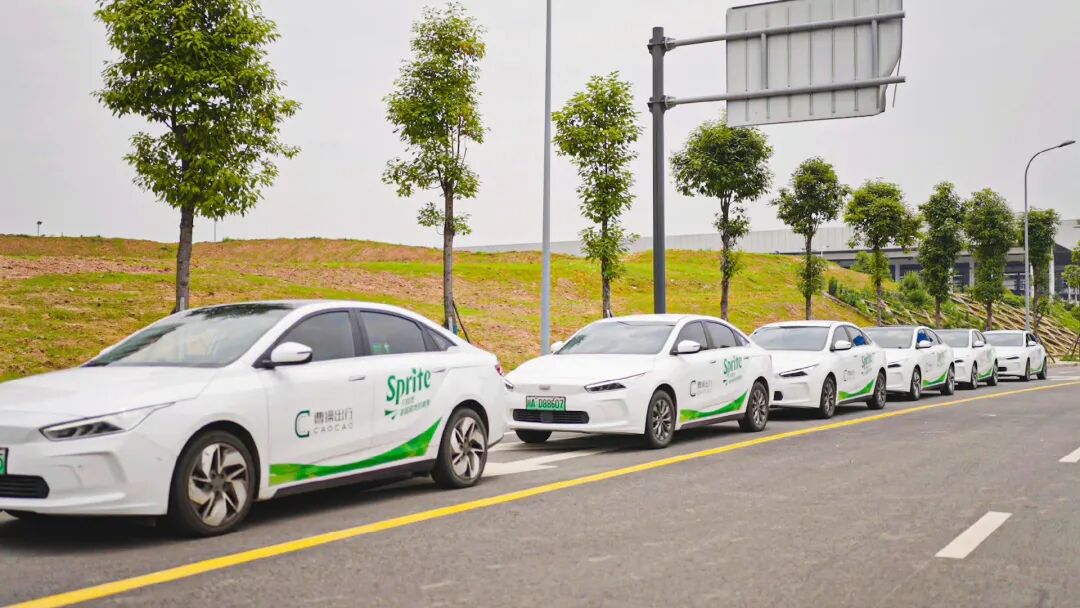
光环褪去,理性回归,自动驾驶驶入“务实”新阶段
3 6 Ke· 2026-01-14 10:43
Core Insights - The global autonomous driving industry is transitioning from technical feasibility to building a profitable, safe, and widely accepted ecosystem, as evidenced by recent developments in L3-level conditional autonomous vehicles in China, Tesla's plans for production of vehicles without steering wheels or pedals, and Waymo's expansion of its autonomous taxi service network [1] Group 1: Commercialization Timeline - The expectation for the commercialization timeline of autonomous driving has been significantly pushed back, with most applications now projected to be delayed by 1-2 years compared to previous forecasts [2] - Global large-scale commercialization is now expected to be delayed from 2029 to 2030, with L4-level pilot programs for private passenger cars pushed from 2030 to 2032 [2] Group 2: Regional Disparities - The development of autonomous driving is showing regional differences, with China and the U.S. leading due to faster development cycles, active capital and startup ecosystems, and favorable regulatory environments [3] - Experts predict that widespread commercialization of autonomous taxis globally will take an additional 3 to 7 years, with China and the U.S. expected to significantly lead in most application scenarios [3] Group 3: Market Focus Shift - The focus of the private passenger car market is shifting from L3 systems to L2+ (enhanced advanced driver-assistance systems), with 49% of experts believing L2+ will be the core of the market by 2035 [4] - This shift is attributed to slower-than-expected cost reductions for L3 systems and high development and validation costs [4] Group 4: Cost Expectations - Cost expectations for achieving L4 and above autonomous driving have been significantly raised, particularly in the area of autonomous trucks, with cost estimates increasing by 50%-60% [5] - The cost of software development for lower-level autonomous driving is estimated to be 4 to 7 times lower than for higher-level systems, with the investment for fully autonomous driving potentially exceeding $3 billion [5] Group 5: Industry Challenges - High costs have emerged as the primary challenge in the development process of advanced driver-assistance systems (ADAS), surpassing technical issues and liability concerns [6] - The need for a clear industry responsibility framework is becoming increasingly urgent, as product liability and regulatory uncertainties rank as medium-level pain points [6] Group 6: Technological Pathways - There is a consensus among experts that China is likely to develop an independent technology stack for ADAS, driven by local consumer interest and a complete domestic supply chain [8] - A mixed architecture approach, combining "end-to-end" AI models with traditional algorithms, is seen as the pragmatic choice for future development, with 78% of experts favoring this model [9] Group 7: Strategic Recommendations - Industry participants are advised to maintain agility in response to rapid changes in technology, regulations, and costs [10] - Focusing on core competencies and fostering open collaboration is essential during the industry consolidation phase [11] - Emphasizing customer value and addressing real user pain points is crucial for future success [12] - Collaboration with regulatory bodies to establish clear safety standards and responsibility frameworks is necessary for scaling [13]
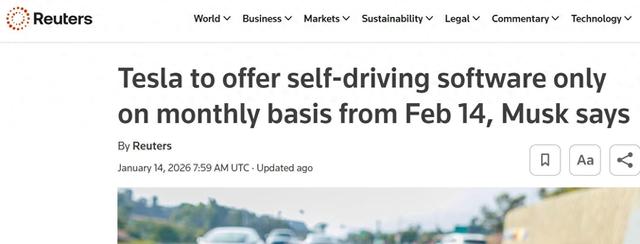
外媒:特斯拉将从2月14日起全面转向FSD软件月度订阅模式
Xin Lang Cai Jing· 2026-01-14 10:20
来源:环球网 【环球网科技综合报道】1月14日消息,据路透社报道称,特斯拉首席执行官埃隆·马斯克宣布,自2026 年2月14日起,公司旗下的"全自动驾驶"(Full Self-Driving,简称FSD)软件将仅以月度订阅形式向用 户提供,不再支持一次性买断选项。 目前,特斯拉在美国市场为车主提供两种FSD(监督驾驶版)获取方式:一次性支付8000美元,或按月 订阅99美元。该系统属于高级驾驶辅助功能,要求驾驶员始终保持注意力,并在必要时随时接管车辆控 制。 值得注意的是,美国国家公路交通安全管理局(NHTSA)已于2025年对约288万辆配备FSD系统的特斯 拉汽车展开正式调查,起因是收到50余起与该系统相关的交通违规报告及多起碰撞事故。作为回应,特 斯拉已在面向消费者的FSD产品描述中加入"监督驾驶"(Supervised)字样,以明确其技术定位。(青 云) ...
量产L4级自动驾驶汽车、有序扩大开放区域……上海发布“模速智行”计划
Xin Lang Cai Jing· 2026-01-14 10:20
Core Viewpoint - The "Mosu Zhixing" Action Plan aims to establish Shanghai as a leading area for high-level autonomous driving by 2027, focusing on technology innovation, application demonstration, and industry collaboration [2]. Group 1: Development Goals - The plan outlines a vision for large-scale implementation of Level 4 autonomous driving applications, targeting over 6 million passenger trips and 80,000 TEU in cargo transport by 2027 [2]. - It aims to create a comprehensive ecosystem for smart connected vehicles, achieving international competitiveness in key technologies and industry scale [2]. Group 2: Key Tasks - **Diverse Application Scenarios**: - Expand passenger vehicle applications through organized smart taxi operations and pilot projects for Level 3 autonomous vehicles [3]. - Enhance commercial vehicle applications in key locations like airports and train stations, transitioning to fully unmanned operations [3]. - Promote the deployment of autonomous equipment in urban inspection, logistics, and municipal services [3]. - **High-Energy Innovation Elements**: - Establish a digital twin training ground for autonomous driving, accumulating extensive data for model training [4]. - Develop a unified data monitoring platform for smart connected vehicles to ensure real-time operational oversight [4]. - Gradually expand open areas for autonomous driving, focusing on major urban zones and transport hubs [4]. - **Innovative Industry Ecosystem**: - Implement key technology research initiatives for advanced hardware and software solutions in autonomous driving [6]. - Build a world-class automotive industry cluster in regions like Pudong and Jiading, focusing on smart connected vehicles and key components [6]. - Strengthen testing and validation capabilities for autonomous systems through dedicated laboratories and simulation technologies [6]. Group 3: Support Measures - **Policy Support**: - Enhance data management mechanisms and establish a comprehensive safety assurance system for autonomous driving [7]. - **Financial Support**: - Encourage investment in startups focused on smart connected vehicles and support established companies in accessing diverse financing channels [7]. - **Talent Development**: - Promote talent acquisition in the smart connected vehicle sector and foster collaboration between enterprises and educational institutions [7]. Group 4: Regional Collaboration - Streamline testing and application management across the city, ensuring data sharing and coordinated operations [8]. - Foster collaboration within the Yangtze River Delta region to enhance testing capabilities and facilitate large-scale applications [8].
瑞银:2030年中国汽车品牌在西欧市场占有率有望达15%
Zhong Guo Xin Wen Wang· 2026-01-14 09:57
Core Viewpoint - UBS predicts that by 2030, the market share of Chinese automotive brands in Western Europe is expected to increase from the current 5% to 15% [1] Group 1: Market Growth - Five years ago, China's passenger car export volume was approximately 1 million units, projected to reach around 6 million units by 2025, indicating significant growth [1] - The average export price of Chinese passenger cars has risen from around 100,000 RMB to approximately 300,000 RMB, reflecting a shift from low-end to mid-to-high-end products [1] Group 2: Product Diversification - Chinese automotive companies are not only exporting passenger cars but also other categories such as motorcycles, heavy trucks, and buses [1] - The integration of electric vehicle advantages along with features like autonomous driving and driver assistance has made Chinese automotive products more competitive in terms of cost-performance compared to global counterparts [1] Group 3: Strategic Collaborations - Current efforts by Chinese automotive companies to strengthen partnerships with local European firms, along with the growth of direct export volumes and local production capacity, are expected to contribute to the steady increase in market share in Western Europe [1] - Globally, the market share of Chinese automotive brands is currently at 20%, with a forecasted increase to 25% by 2030 [1]