产业转移

Search documents
陕西商洛市前5月招商引资实际使用内资超40亿元
Zhong Guo Chan Ye Jing Ji Xin Xi Wang· 2025-08-04 22:30
Group 1 - The core viewpoint is that Shanzhou City has made significant progress in attracting investment and promoting industrial development, achieving a 27.44% year-on-year increase in actual domestic investment to 4.447 billion yuan from January to May [1] - The city has signed 179 new projects with a total investment of 27.994 billion yuan, focusing on five major industrial chains and six key industrial chains, particularly in the electronic information industry [1] - The city is actively enhancing its engagement with enterprises to understand their development directions and investment trends, assisting them in overcoming challenges related to labor, energy, and financing [1] Group 2 - Shanzhou City is leveraging opportunities from industrial transfer, particularly from developed eastern and southern regions, and is utilizing its external agencies for targeted investment attraction [2] - The city has successfully introduced several distinctive industrial projects, such as Zhongtian Yucheng and Guofei UAV, through collaboration with Nanjing and the Xi'an metropolitan area [2] - Innovative investment attraction models are being explored, including partnerships with government financing platforms and state-owned enterprise funds, to draw high-quality projects to Shanzhou [2]
德翔海运(02510):业绩略超预期,关注四季度旺季情况
Shenwan Hongyuan Securities· 2025-08-04 14:42
Investment Rating - The investment rating for the company is "Buy" (maintained) [1] Core Views - The company's performance slightly exceeded expectations, with a projected net profit of approximately $180-200 million for the first half of 2025, representing a year-on-year increase of 220%-225% compared to $56 million in the same period of 2024 [9] - The increase in performance is attributed to the rise in freight rates due to market conditions and the contribution of new capacity delivered in 2024 [9] - The report highlights strong freight performance in Southeast Asia, with significant year-on-year growth in freight rates and volumes [9] Financial Data and Profit Forecast - Revenue projections (in million USD): - 2023: 875 - 2024: 1,340 - 2025E: 1,351 - 2026E: 1,299 - 2027E: 1,539 - Year-on-year growth rates: - 2023: -64% - 2024: 53% - 2025E: 0.8% - 2026E: -4% - 2027E: 19% [8] - Net profit projections (in million USD): - 2023: 21 - 2024: 366 - 2025E: 378 - 2026E: 334 - 2027E: 449 - Year-on-year growth rates for net profit: - 2023: -98% - 2024: 1,667% - 2025E: 3% - 2026E: -12% - 2027E: 34% [8] - The company maintains a low PE ratio of 4.8, significantly below comparable companies, supporting the "Buy" rating [9][10]
广州南沙万顷沙镇“湾区智造”产业推介会深圳专场活动成功举办
Zheng Quan Shi Bao Wang· 2025-07-26 08:11
Core Viewpoint - The event focused on promoting the advanced manufacturing industry in Wanqingsha Town, aiming to establish a new high ground for intelligent manufacturing in the Guangdong-Hong Kong-Macao Greater Bay Area, with a specific emphasis on strategic emerging industries such as semiconductors, artificial intelligence, and new materials [1][2]. Group 1: Event Overview - The "Gravitational Pull, Heartfelt Collaboration" promotional event was held in Shenzhen, organized by the People's Government of Wanqingsha Town, with support from various institutions [1]. - The event highlighted the unique geographical advantages and extensive development space of Wanqingsha Town, promoting a three-in-one solution of "space + policy + service" to address the capacity expansion challenges faced by Shenzhen enterprises [1]. Group 2: Policy and Financial Support - Representatives from the Nansha Development Zone Investment Promotion Bureau provided a comprehensive introduction to the overall industrial layout, supporting facilities, and policy support in the Nansha District, showcasing a favorable business environment and development opportunities [2]. - The Guangzhou Nansha Greater Bay Area Climate Investment and Financing Center representatives explained the "Nansha Financial 30 Measures," clarifying the policy implementation paths to facilitate investment in Nansha [2]. Group 3: Investment Opportunities - Two high-growth, technology-leading manufacturing companies presented their project plans and financing needs, aligning with the key focus of Wanqingsha on developing new material industry clusters, providing potential investment targets for attending financing institutions [2]. - Wanqingsha Town is actively promoting the creation of a 22 square kilometer "Golden Inner Bay" benchmark intelligent manufacturing cluster, focusing on attracting third-generation semiconductor applications and advanced manufacturing enterprises [3].
滚动丨广东9市公布经济“半年报”,梅州、肇庆、湛江、惠州、潮州增速超5%
Nan Fang Nong Cun Bao· 2025-07-25 10:32
Economic Overview - Guangdong province has released economic performance reports for the first half of 2025, with nine cities reporting growth rates exceeding 5% [2][3] - The overall economic growth rate for Guangdong province is 4.2% [6] City Performance - Meizhou's GDP reached 72.059 billion yuan, with an actual growth rate of 5.7%, surpassing the initial target of 5% [4] - Zhaoqing, Huizhou, and Chaozhou also reported growth rates above 5%, with Zhaoqing at 5.2% and the other three cities at 5.1% [5] - Dongguan and Qingyuan both recorded growth rates of 4.8%, exceeding the provincial average [6] - Yangjiang and Jieyang had lower growth rates of 3.5% and 3.4%, respectively [7] Sector Contributions - In Meizhou, the primary industry added value was 10.124 billion yuan (3.0% growth), the secondary industry 22.612 billion yuan (7.5% growth), and the tertiary industry 39.323 billion yuan (5.6% growth), indicating strong contributions from the secondary and tertiary sectors [10][11] - Advanced manufacturing in Meizhou saw an 8.4% increase in industrial output, with high-tech manufacturing growing by 21.7% [13][14] - Zhaoqing's primary industry added value was 17.534 billion yuan (4.8% growth), secondary industry 53.638 billion yuan (4.9% growth), and tertiary industry 64.629 billion yuan (5.6% growth), showing robust performance across all sectors [20][21] Industrial Growth - Huizhou's GDP was 291.006 billion yuan with a growth rate of 5.1%, driven by a 7.7% increase in the secondary industry [32] - Dongguan's GDP reached 606.784 billion yuan with a growth rate of 4.8%, supported by a 5.3% increase in the secondary industry [36] - Qingyuan's GDP was 106.855 billion yuan with a growth rate of 4.8%, with the secondary industry growing by 5.4% [40] Investment and Projects - In Zhanjiang, the GDP was 181.126 billion yuan with a growth rate of 5.1%, and the city has successfully attracted high-quality projects, with industrial output increasing by 129.9% [44][48] - The new projects in Zhanjiang totaled 3.29 billion yuan in investment [48] Challenges - Jieyang's GDP growth was 3.4%, lower than the previous year's 3.9%, with the secondary industry growing by only 3.6% [50][52] - Yangjiang's GDP growth remained at 3.5%, with the secondary industry increasing by 2.3% [54][56]


产业转移应梯度有序
Jing Ji Ri Bao· 2025-07-24 22:04
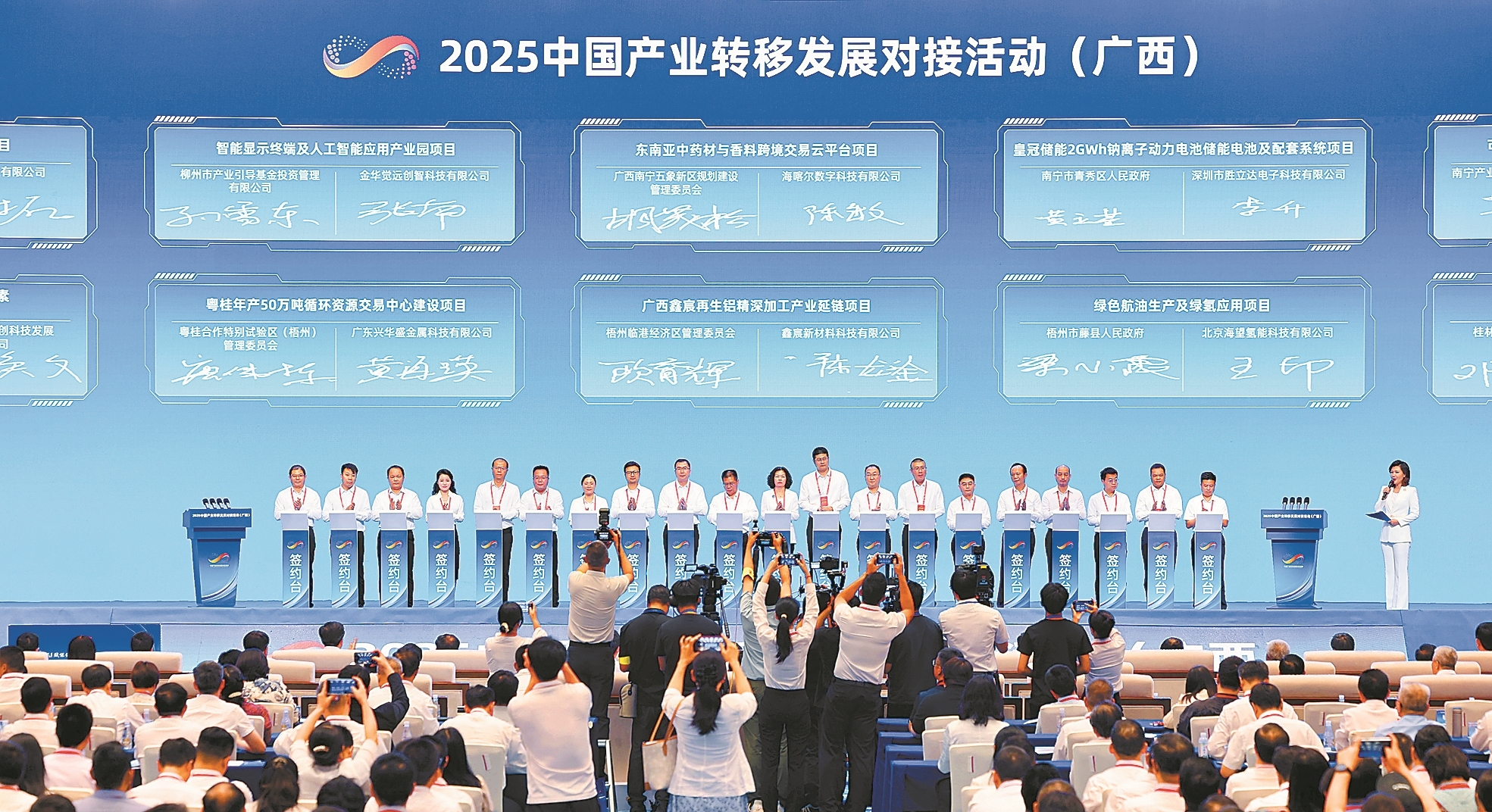
Core Viewpoint - The event in Guangxi facilitated 296 signed projects with a total investment of 217.3 billion yuan, emphasizing that industrial transfer is crucial for regional coordinated development and industrial structure optimization [1] Group 1: Industrial Transfer Dynamics - Industrial transfer is not merely relocation but involves respecting development laws and optimizing resource allocation, driven by significant regional differences in resource endowments, economic foundations, and labor costs [1][2] - The transfer process should follow a gradient approach, moving from labor-intensive and resource-dependent industries to capital-intensive and technology-intensive sectors, allowing for a phased and structured transition [1][2] Group 2: Efficiency and Sustainability - A structured gradient transfer enhances resource allocation efficiency by matching industries with regions that have complementary advantages, such as moving labor-intensive industries to areas with surplus labor [2] - It reduces risks associated with industrial transfer by ensuring that the receiving regions have the necessary infrastructure and skills to support advanced manufacturing and processing [2][3] Group 3: Avoiding Homogeneous Competition - Without gradient guidance, industrial transfer can lead to chaotic competition among regions, particularly in low-end manufacturing, resulting in overcapacity and resource wastage [2] - Homogeneous competition compresses profit margins and hinders technological upgrades, disrupting regional complementary dynamics and impeding coordinated development [2] Group 4: Ensuring Continuous Upgrading - Gradient transfer allows releasing resources from outdated industries in the sending regions to focus on high-end manufacturing and digital economy sectors, facilitating structural optimization [3] - Receiving regions can enhance their industrial capabilities by absorbing intermediate-level industries, gaining technical experience, and developing a skilled workforce [3] Group 5: Practical Outcomes - The practice of orderly and dynamic upgrading in industrial transfer leads to a win-win situation, enabling sending regions to concentrate on new breakthroughs while allowing receiving regions to cultivate new growth drivers [4]
2025中国产业转移发展对接活动(广西)在南宁开幕 李乐成陈刚致辞 韦韬主持
Guang Xi Ri Bao· 2025-07-21 01:13
Core Points - The event titled "AI Empowerment for New Chapters, Industrial Collaboration for Future" was held in Nanning, Guangxi, focusing on industrial transfer and collaboration [3][4] - The event aims to facilitate communication and cooperation among various stakeholders, leveraging Guangxi's unique advantages for industrial development [4][6] Government Initiatives - The Ministry of Industry and Information Technology emphasizes the importance of optimizing industrial layout and guiding the transfer of industries from eastern to central and western regions [4] - The government is committed to enhancing policy measures, promoting innovation, and expanding openness to drive industrial transfer and cooperation [4][5] Investment and Collaboration - The event resulted in the signing of 296 projects with a total investment of 217.3 billion yuan, including 30 projects signed during the opening ceremony worth 49.5 billion yuan [7] - Key sectors involved in the signed projects include artificial intelligence, high-end equipment manufacturing, new materials, and specialty light industry [7] Regional Development - Guangxi is positioned as a strategic area for industrial transfer, with significant resources and development potential, aiming to attract and undertake industrial transfers [5][6] - The collaboration between Guangxi and ASEAN is highlighted as a significant opportunity for both regional and international markets [6]
造船的战争:一个产业的艰险远航
远川研究所· 2025-07-17 13:22
Core Viewpoint - The article highlights the significant decline of the U.S. shipbuilding industry compared to China, which has become the dominant player in global shipbuilding, capturing 70% of new ship orders and delivering 53% of global orders in 2024 [1][2]. Group 1: U.S. Shipbuilding Industry - Trump noted that the U.S. shipbuilding capabilities have diminished, stating that it used to be possible to build a ship in a day, whereas now it is a major event [1]. - A report from the U.S. Navy indicated that China's shipbuilding capacity is over 200 times that of the U.S., with the U.S. holding only 0.1% of the global market share [1][2]. Group 2: Global Shipbuilding Landscape - In 2024, China accounted for 53% of global commercial shipbuilding deliveries, followed by South Korea at 29.1% and Japan at 13.1% [2]. - The U.S. is significantly lagging behind, with its shipbuilding numbers being so low that it is only five ships ahead of Mongolia [2]. Group 3: Historical Context - The article discusses the historical context of shipbuilding in East Asia, emphasizing the long-term strategic shifts and industry upgrades that have occurred in the region [2].

临沂(京津冀)招商引资推介会签约22个项目
Xin Jing Bao· 2025-07-16 14:45
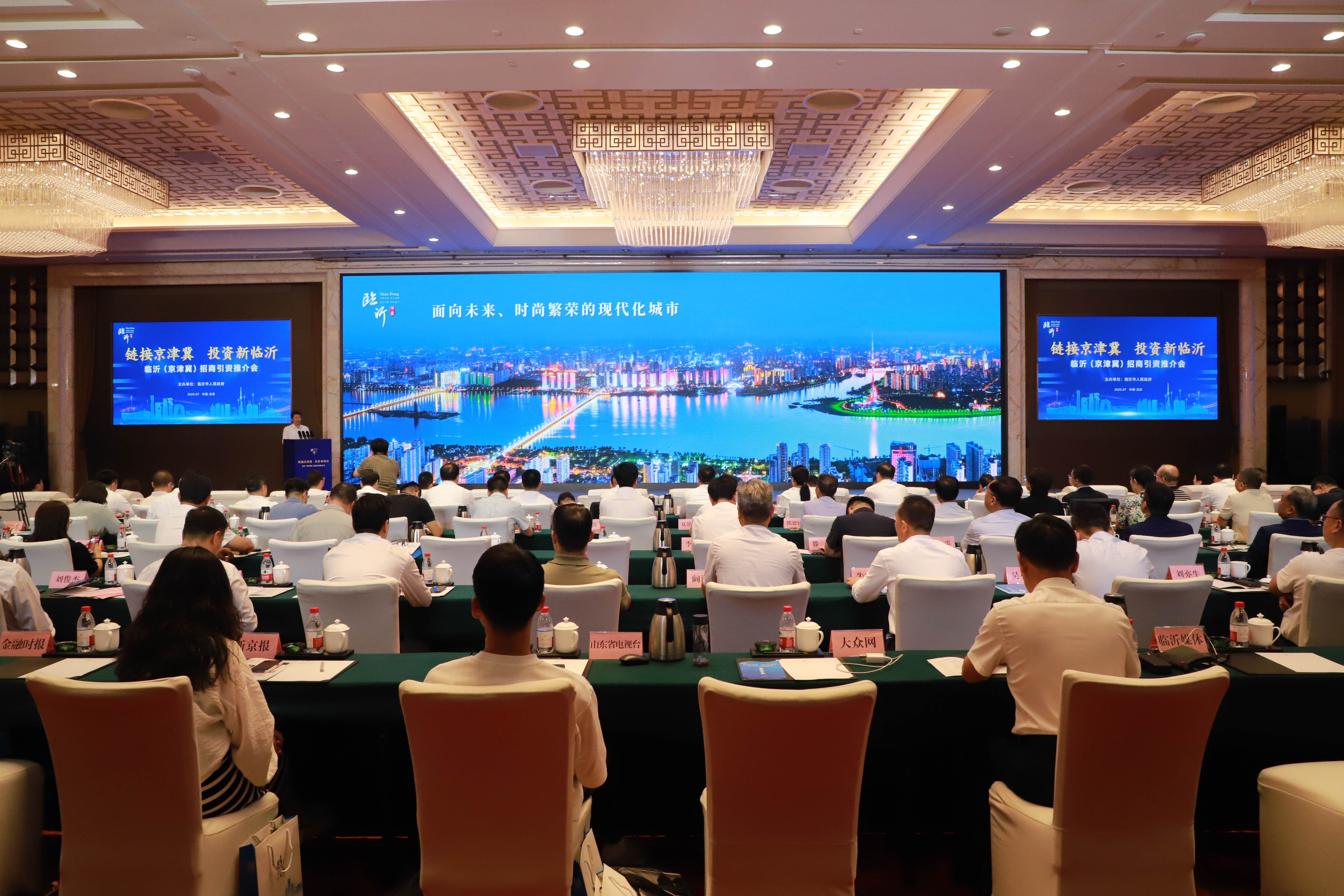
Core Insights - The Linyi Investment Promotion Conference was held in Beijing, resulting in the signing of 22 projects focused on emerging industries such as new energy, modern medicine, and high-end equipment [1] Group 1: Project Attraction - Linyi has successfully attracted 485 projects from the Beijing-Tianjin-Hebei region, establishing itself as a regional sub-center in Shandong Province with a GDP of 655.6 billion yuan, ranking 21st among Chinese prefecture-level cities [2] - The city has set up seven talent hubs in the Beijing-Tianjin-Hebei area, recognized as a national innovative city and among the top 100 cities for innovation capabilities [2] Group 2: Logistics and E-commerce - Linyi boasts the largest market cluster in the country with 136 wholesale markets and over 6 million types of goods, achieving the highest annual transaction volume among prefecture-level cities [3] - The logistics costs in Linyi are 30% lower than the national average, with a logistics network that allows for same-day delivery within 600 kilometers and next-day delivery within 1500 kilometers [3] - The city has developed 60 e-commerce parks and has 210,000 online businesses, with a total online retail sales of 82.5 billion yuan last year [3] Group 3: Industrial Development - Linyi is focusing on 13 key industrial chains, including traditional industries like high-end panels and green smart home products, as well as emerging sectors such as new energy commercial vehicles and biomanufacturing [4] - The city aims for a trillion-yuan industrial economy, with 4,907 large-scale industrial enterprises and an industrial output value of 868.8 billion yuan last year [4] Group 4: Business Environment - Linyi has 1.54 million market entities, with the private economy contributing over 90% of the city's revenue, tax, and employment [5] - The city has implemented a series of supportive policies to optimize the business environment, including 28 measures for business facilitation and 10 financial support initiatives [5] - Linyi has been recognized for its strong investment potential and ranked 3rd in the "Top 50 Potential Internet Celebrity Cities" [5]
临沂加快承接京津冀产业转移,22个项目在京签约
Di Yi Cai Jing· 2025-07-16 07:38
Group 1 - The core viewpoint of the news is that Linyi is accelerating the transfer of industries from the Beijing-Tianjin-Hebei region, promoting industrial upgrades and injecting strong momentum into regional economic development [1][5] - The Linyi (Beijing-Tianjin-Hebei) investment promotion conference signed 22 projects focusing on emerging industries such as new energy, modern medicine, and high-end equipment [1][5] - Linyi has attracted 485 projects with a total investment of 170 billion yuan from the Beijing-Tianjin-Hebei region, highlighting its status as a vibrant investment destination [5] Group 2 - Linyi is recognized as a major manufacturing city with 38 out of 41 industrial categories, housing 4,903 regulated industrial enterprises and achieving an industrial output value of 868.8 billion yuan [5] - The city is advancing towards a "trillion-level industry" by cultivating 13 key industrial chains, including high-end engineering equipment and new energy commercial vehicles [5] - Linyi's cultural tourism market is booming, with a target of reaching 100 million visitors and a 100 billion yuan industry, as evidenced by a recent concert attracting 120,000 attendees and generating 460 million yuan in consumption [6] Group 3 - A significant investment agreement was signed for a project to produce 100,000 tons of high-end biological organic fertilizer, aligning with Linyi's focus on upgrading its fine chemical industry chain [6] - The project is expected to create new economic growth points and facilitate the transformation of industries towards high-end, intelligent, and green production [6]
撤县并省,猛砸铁饭碗:越南为何这么急?
虎嗅APP· 2025-07-16 00:05
Core Viewpoint - Vietnam has initiated a significant administrative reform, reducing its provinces from 63 to 34 and eliminating nearly 628 county-level administrative units, which is seen as a major restructuring effort to streamline governance and reduce fiscal burdens [3][4][10]. Group 1: Administrative Reform Impact - The reform, termed "restructuring the landscape," aims to cut down nearly 100,000 government positions in the short term and potentially 250,000 in the long term, affecting 4% to 10% of the total civil service workforce [4][11]. - The Vietnamese government anticipates saving over 190 trillion VND (approximately 50 billion RMB) from 2026 to 2030 due to these cuts [11]. - The administrative structure will shift from a three-tier system (province-county-village) to a two-tier system (province-village), significantly reducing bureaucratic layers [6][10]. Group 2: Comparison with China's Administrative System - Vietnam's administrative system shares similarities with China's, particularly at the provincial level, but differs in the absence of city-level governance [15][16]. - Post-reform, Vietnam will have 34 provinces, mirroring China's 34 provincial-level administrative regions, which raises questions about the intent behind this structure [17]. - Major cities like Hanoi and Ho Chi Minh City are comparable to China's major cities, with Ho Chi Minh City projected to have a GDP of approximately 69.7 billion USD (around 500 billion RMB) in 2024, accounting for about 15% of Vietnam's total GDP [18]. Group 3: Reasons for Urgency in Reform - Vietnam's GDP growth rate reached 7.52% in the first half of the year, the highest in 15 years, highlighting the need for swift reforms amid global economic uncertainties [23]. - The country aims to become a middle-income nation by 2030 and a high-income nation by 2045, reflecting an ambitious economic vision [24][25]. - The urgency is driven by the diminishing global and demographic dividends, as well as the challenges posed by the fourth industrial revolution, which threatens traditional low-cost labor advantages [26][29].