
制造业数字化转型

Search documents
瑞达期货焦煤焦炭产业日报-20250714
Rui Da Qi Huo· 2025-07-14 11:18
Report Summary 1. Report Industry Investment Rating - Not provided in the given report 2. Core Viewpoints - On July 14, the JM2509 contract of coking coal closed at 920.0, up 1.15%. The market should be treated with a bias towards a bullish oscillation. For coke, the J2509 contract closed at 1525.0, up 1.09%, and it should also be treated with a bias towards a bullish oscillation [2]. 3. Summary by Relevant Catalogs 3.1 Futures Market - JM主力合约收盘价 was 920.00 yuan/ton, up 7.00 yuan; J主力合约收盘价 was 1525.00 yuan/ton, up 5.50 yuan [2]. - JM期货合约持仓量 was 807,762.00 hands, up 15,898.00 hands; J期货合约持仓量 was 55,759.00 hands, up 285.00 hands [2]. - The net position of the top 20 JM contracts was -61,570.00 hands, down 13,485.00 hands; that of J was -4,034.00 hands, down 351.00 hands [2]. - The JM1 - 9 monthly contract spread was 43.50 yuan/ton, up 10.50 yuan; the J1 - 9 monthly contract spread was 44.00 yuan/ton, up 15.50 yuan [2]. - The coking coal warehouse receipts were 1,400.00 sheets, up 1,200.00 sheets; the coke warehouse receipts were 90.00 sheets, unchanged [2]. 3.2 Spot Market - The price of Ganqimao Meng 5 raw coal was 757.00 yuan/ton, unchanged; the price of Tangshan quasi - first - grade metallurgical coke was 1390.00 yuan/ton, unchanged [2]. - The price of Russian main coking coal forward spot (CFR) was 118.00 US dollars/wet ton, unchanged; the price of Rizhao Port quasi - first - grade metallurgical coke was 1220.00 yuan/ton, unchanged [2]. - The price of Australian imported main coking coal at Jingtang Port was 1330.00 yuan/ton, up 60.00 yuan; the price of first - grade metallurgical coke at Tianjin Port was 1320.00 yuan/ton, unchanged [2]. - The price of Shanxi - produced main coking coal at Jingtang Port was 1350.00 yuan/ton, unchanged; the price of quasi - first - grade metallurgical coke at Tianjin Port was 1220.00 yuan/ton, unchanged [2]. - The price of medium - sulfur main coking coal in Lingshi, Jinzhong, Shanxi was 930.00 yuan/ton, unchanged; the J主力合约基差 was - 135.00 yuan/ton, down 5.50 yuan [2]. - The ex - factory price of coking coal produced in Wuhai, Inner Mongolia was 960.00 yuan/ton, unchanged; the JM主力合约基差 was 10.00 yuan/ton, down 7.00 yuan [2]. 3.3 Upstream Situation - The raw coal inventory of 110 coal washing plants was 300.77 million tons, down 11.40 million tons; the clean coal inventory was 197.07 million tons, down 17.91 million tons [2]. - The operating rate of 110 coal washing plants was 62.33%, up 2.61 percentage points; the raw coal output was 40,328.40 million tons, up 1,397.80 million tons [2]. - The import volume of coal and lignite was 3,303.70 million tons, down 300.30 million tons; the daily average output of raw coal from 523 coking coal mines was 191.80 thousand tons, up 3.80 thousand tons [2]. - The inventory of imported coking coal at 16 ports was 553.79 million tons, up 29.08 million tons; the total inventory of coking coal of independent coking enterprises was 892.35 million tons, up 44.17 million tons [2]. - The inventory of coking coal of 247 steel mills nationwide was 782.93 million tons, down 6.67 million tons; the inventory of coke of 247 sample steel mills was 637.80 million tons, up 0.31 million tons [2]. - The available days of coking coal of independent coking enterprises were 12.48 days, down 0.03 days; the available days of coke of 247 sample steel mills were 11.64 days, up 0.12 days [2]. 3.4 Industry Situation - The import volume of coking coal was 738.69 million tons, down 150.65 million tons; the export volume of coke and semi - coke was 68.00 million tons, up 13.00 million tons [2]. - The output of coking coal was 4,070.27 million tons, up 144.11 million tons; the capacity utilization rate of independent coking enterprises was 72.87%, down 0.30 percentage points [2]. - The profit per ton of coke of independent coking plants was - 63.00 yuan/ton, down 11.00 yuan/ton; the output of coke was 4,237.60 million tons, up 77.60 million tons [2]. 3.5 Downstream Situation - The blast furnace operating rate of 247 steel mills nationwide was 83.44%, down 0.40 percentage points; the blast furnace iron - making capacity utilization rate of 247 steel mills was 90.27%, down 0.58 percentage points [2]. - The crude steel output was 8,654.50 million tons, up 52.60 million tons [2]. 3.6 Industry News - The vice - president of the China Iron and Steel Association, Wang Yingsheng, said that the total steel output in China has reached its peak. The domestic consumption of crude steel is expected to remain at around 800 - 900 million tons, and the industry shows an obvious trend of减量 development, but the industrial concentration is increasing [2]. - Foreign Minister Wang Yi met with US Secretary of State Rubio in Kuala Lumpur. They agreed to strengthen communication and dialogue and explore expanding cooperation areas [2]. - Minister of Industry and Information Technology Li Lecheng chaired a party group meeting, stating that efforts should be made to implement large - scale equipment renewal and technological transformation projects in the manufacturing industry and promote digital transformation [2]. - In the next week, the heat will intensify in many places, and nearly 10 provinces such as Shaanxi, Hebei, and Henan will experience extremely hot weather above 40°C [2].

股指期货将偏强震荡,白银期货再创上市以来新高,白银、原油、烧碱期货将震荡偏强,黄金、焦煤、玻璃、PTA、豆油、棕榈油期货将偏强震荡,多晶硅期货将偏强宽幅震荡
Guo Tai Jun An Qi Huo· 2025-07-14 08:39
1. Report Industry Investment Rating No information provided in the content. 2. Core View of the Report Through macro - fundamental analysis and technical analysis, the report predicts the trends of various futures contracts on July 14, 2025, including股指期货,国债 futures, precious metal futures, base metal futures, energy futures, and agricultural product futures. It also analyzes the market conditions on July 11, 2025, and provides some macro - economic information and trading tips [2]. 3. Summary by Relevant Catalogs 3.1 Futures Market Outlook - **Stock Index Futures**: IF2509, IH2509, IC2509, IM2509 are expected to be strongly volatile. Resistance and support levels are provided for each contract [2][31]. - **Treasury Bond Futures**: The ten - year T2509 and thirty - year TL2509 are likely to have wide - range fluctuations, with corresponding support and resistance levels [2]. - **Precious Metal Futures**: Gold (AU2510) will be strongly volatile, and silver (AG2510) will be strongly volatile and may hit a new high. Resistance and support levels are given [2][3]. - **Base Metal Futures**: Copper (CU2508) will be range - bound, aluminum (AL2508) will be weakly volatile, zinc (ZN2508) and nickel (NI2508) will be weakly volatile, while tin (SN2508), alumina (AO2509) will be strongly volatile, with support and resistance levels for each [3][4]. - **Energy Futures**: Crude oil (SC2508) and fuel oil (FU2509) will be strongly volatile, and PTA (TA509) will be strongly volatile, with corresponding support and resistance levels [7]. - **Agricultural Product Futures**: Soybean oil (Y2509) and palm oil (P2509) will be strongly volatile, while corn (C2509) and natural rubber (RU2509) will be weakly volatile, with support and resistance levels [7][8]. 3.2 Macro - economic Information - The 2025 SCO Digital Economy Forum was held, and 12 digital economy cooperation projects were signed. The Ministry of Finance promotes long - term and stable investment of insurance funds. Diplomatic activities between China and the US, Russia, etc. were carried out [9][10]. - The second - quarter high - frequency data in China showed improvement in consumption, investment, etc. The US imposed tariffs on multiple countries, which affected the global trade and financial markets [12]. 3.3 Commodity Futures - related Information - The IEA adjusted the growth expectations of global oil supply and demand. International oil prices rose on July 11, 2025, and international precious metal futures generally closed higher. London base metals mostly closed lower [17][18][19]. 3.4 Futures Market Analysis and Outlook - **Stock Index Futures**: On July 11, 2025, IF2509, IH2509, IC2509, IM2509 showed different trends, with some hitting new highs. The market is expected to be strongly volatile in July 2025 [21][22][23]. - **Treasury Bond Futures**: On July 11, 2025, the ten - year T2509 had a slight decline, and the thirty - year TL2509 had a slight increase. They are expected to have wide - range fluctuations on July 14 [50][52]. - **Precious Metal Futures**: Gold (AU2510) had a slight increase on July 11, 2025, and is expected to be strongly volatile in July and on July 14. Silver (AG2510) hit a new high on July 12, 2025, and is expected to continue to rise [55][61]. - **Base Metal Futures**: Different base metal futures showed various trends on July 11, 2025, and their trends on July 14 and in July 2025 are predicted [74][78][83]. - **Energy Futures**: Crude oil (SC2508) and fuel oil (FU2509) had different trends on July 11, 2025, and their future trends are forecasted [128][132]. - **Other Futures**: Industrial silicon, polycrystalline silicon, lithium carbonate, rebar, hot - rolled coil, iron ore, coking coal, glass, soda ash, caustic soda futures all have their own trends on July 11, 2025, and future trends are predicted [100][102][105].
格林大华期货钢材早盘提示-20250714
Ge Lin Qi Huo· 2025-07-14 05:32
Group 1 - The black building materials sector of steel products is expected to fluctuate [1] Group 2 - Friday, rebar continued to rise, but closed lower at night [1] - The Minister of Industry and Information Technology, Li Lecheng, chaired a party group meeting, emphasizing high - end, intelligent, and green development in manufacturing [1] - This week, the output of five major steel products was 872,720 tons, a weekly decrease of 12,440 tons; the total inventory was 1,339,580 tons, a weekly decrease of 350 tons; consumption decreased by 1.4% [1] - Li Yongjun believes that the key to judging the industrial cycle is demand, and there is still room for per - capita consumption of crude steel in China [1] - Recently, steel mills in Shanxi are restricted in production by 10 - 20%. Last week, rebar production decreased, social inventory decreased, factory inventory increased, and total inventory decreased. Demand shows off - season characteristics [1] - The main pressure level of rebar is 3200, with an important support level at 3000; the support level of hot - rolled coil is 3130, and the pressure level is 3300; the support level of stainless steel is 12600, and the pressure level is 13000 [1] - The spread between spot and futures has widened rapidly. Pay attention to the opportunity of buying spot and selling futures. For single - sided trading, there is a high possibility of a short - term correction. Aggressive investors can try short - selling with a stop - loss set [1]
中国制造业数字化转型行业发展研究报告
艾瑞咨询· 2025-07-05 11:47
Core Insights - The core demand in the manufacturing industry remains unchanged, focusing on production management and supply chain-related needs, with a more rational and focused understanding of transformation expectations from the demand side [1] - The digital transformation market for China's manufacturing industry is projected to reach 1.55 trillion in 2024, with a steady growth rate of around 14% expected over the next five years [2][39] - Despite years of digitalization efforts, the competitive landscape in the manufacturing sector has not significantly changed, indicating substantial potential for future market opportunities [3] Demand Market Characteristics - The manufacturing industry exhibits strong regional characteristics, with Guangdong, Jiangsu, Zhejiang, and Shandong being the top provinces actively pursuing digital transformation [4][5] - The evaluation side of the market emphasizes practical implementation in production-related areas, with 57.8% of focus on core production needs in recent years [8][9] - The bidding side primarily involves government and state-owned enterprises, which account for 95.2% of digital transformation initiatives, focusing on diagnostic assessments and implementation [10] Transformation Status - Companies have recognized the necessity of digital transformation, with 86.7% acknowledging its importance, and 71.1% implementing various tools to optimize business processes [15][16] - The primary drivers for transformation are demand from the supply chain and the need for operational cost optimization, with 84.4% of companies aiming for cost reduction [19] Urgent Transformation Scenarios - The most pressing scenarios for digital transformation include data preparation, supply chain management, and production management, with 77.8% of companies prioritizing data infrastructure [21][22] Supplier Selection and Concerns - Companies prioritize practical solutions that align with their operational needs when selecting suppliers, with 82.2% focusing on solution applicability [25] - Historical burdens, such as complex system upgrades, are significant concerns for companies during the transformation process [25] Future Investment Trends - A significant 77.8% of companies plan to increase their digital transformation investments in the coming year, primarily focusing on software solutions [27][28] Exploration of Large Models - Companies are actively exploring the application of large models in marketing, supply chain management, and data services, with 40% focusing on customer insights and marketing management [30] - Concerns regarding the uncertainty of outcomes from large models pose a significant risk, with 80% of companies expressing apprehension about decision-making risks [33] Market Characteristics and Trends - The integration of solutions is becoming more evident, with a trend towards soft-hard integration and cross-module collaboration [44][47] - The application of large models is gradually deepening, with companies exploring various methods to leverage these technologies in industrial applications [48][49] Future Opportunities - High-tech industries within discrete manufacturing are identified as high-potential sectors, with opportunities for leading enterprises emerging in vertical industry strategies and domestic substitution markets [50]


(活力中国调研行)当内燃机遇上工业互联网:制造老兵交出创新答卷
Zhong Guo Xin Wen Wang· 2025-07-04 02:52
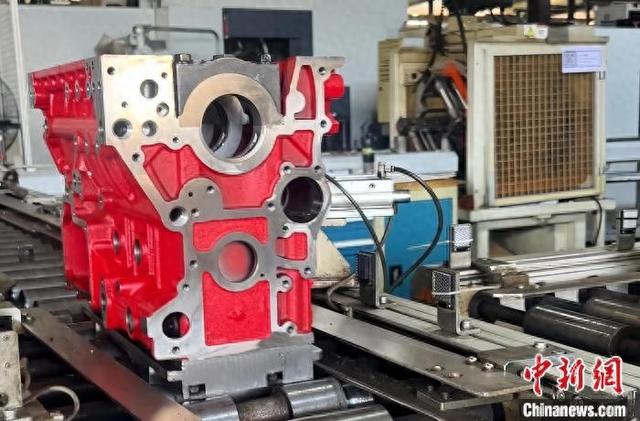
Core Insights - The article highlights the digital transformation of Anhui Quanchai Power Co., Ltd., showcasing its implementation of smart manufacturing through 5G and industrial internet technologies [1][3]. Group 1: Digital Transformation - Quanchai Power has integrated 11 5G indoor distribution systems to manage data flow across five production lines, allowing workers to interact with information without leaving their stations [1]. - The company has established a smart manufacturing platform that encompasses equipment, network, platform, and application layers, supported by digital twin technology for three-dimensional visualization of factory operations [3]. Group 2: Production Efficiency - The production line is designed with a cycle time of 75 seconds, with alerts triggered by millisecond-level discrepancies, ensuring product consistency and reliability [1]. - The use of RFID technology enables automatic switching of production parameters for different products, facilitating seamless production changes and comprehensive data collection for quality tracking and design optimization [1][3]. Group 3: Sales Performance - In the first quarter of this year, Quanchai's engine sales increased by 15% year-on-year, with overseas exports rising by 50% [3]. Group 4: Industry Context - Anhui province is leading in the digital transformation of manufacturing, with numerous successful cases, including Quanchai, contributing to a new industrialization path [3][4]. - In 2024, Anhui ranked first in the number of typical cases for manufacturing digital transformation and first in industrial internet platform innovation applications [4].

湖北开展数字化转型行业行活动
Zhong Guo Hua Gong Bao· 2025-07-02 01:34
Group 1 - The event in Yichang focused on the digital transformation challenges in the chemical industry, aiming to empower the sector through policy interpretation, experience sharing, case demonstrations, and on-site research [1] - Hubei Province has achieved significant progress in manufacturing digital transformation, being the first in the nation to cover provincial-level small and medium-sized enterprise digital transformation city pilots [1] - The province has established 170,000 5G base stations, with computing power exceeding 14,000 P (1 P equals 10 quadrillion floating-point operations per second), showing a year-on-year growth of over 200% [1] Group 2 - The theme of the conference was "Intelligent Empowerment and Contribution Points," featuring discussions on building an "Industrial Brain" and the importance of integrating factory equipment data to create an efficient chemical production system [2] - Experts from various institutions provided insights on the latest policies, concepts, trends, and technological support for digital transformation in the industry, covering transformation paths, provincial policy support, and application of identification and resolution [2] - Leading companies in Hubei, such as Hubei Sanning Chemical Co., Hubei Yihua Group Co., and Hualu Hengsheng, showcased their smart factory achievements, presenting replicable "Hubei experience" [2]

从“单点突破”到“链式改造” 广东推动超4.6万家规上企业数字化转型
Nan Fang Ri Bao Wang Luo Ban· 2025-06-30 08:06
Group 1 - The event in Guangzhou focused on the digital transformation of small and medium-sized enterprises (SMEs) in Guangdong, revealing that over 46,000 industrial enterprises have undergone digital transformation [1] - The theme of the event was "Linking SMEs, Leading the Future," featuring forums and exhibitions to share experiences among national pilot cities for SME digital transformation and showcase successful transformation models and case studies [1] - Guangdong has innovatively explored a "chain transformation" model, providing targeted support based on enterprise size, encouraging large enterprises to serve as transformation benchmarks, and enhancing the efficiency of industrial and supply chains [1] Group 2 - The event also launched the "Long-term Mechanism Achievement List for SME Digital Transformation Pilot Cities" and initiated the construction of the Guangdong Manufacturing Digital Transformation Promotion Center [2] - A digital transformation service platform for SMEs in Guangzhou was introduced, offering a one-stop public service that includes scenario cultivation, solution incubation, technology validation, application promotion, supply-demand matching, financial cooperation, talent training, and information security assurance [2]
华为支持的这个“村”,在做些啥
Jin Rong Shi Bao· 2025-06-27 02:51
Group 1 - The integration of digital technology and the real economy is crucial for building a modern industrial system, with talent being a fundamental driver of industrial innovation and development [1] - Dongguan, known as the "world's factory," is projected to see a 6.9% year-on-year growth in industrial added value in 2024, with advanced manufacturing and high-tech manufacturing growing by 11.1% and 12.7% respectively [1] - The Songshan Lake Developer Village aims to support the digital transformation of Dongguan's manufacturing industry through collaboration and innovation among developers [2][3] Group 2 - The Songshan Lake Developer Village, established in partnership with Huawei Cloud, serves as a hub for developers to create applications and solutions for local enterprises [2] - The Developer Village has attracted 29 companies, including CSDN and local enterprise Tailin, enhancing its collaborative ecosystem [3] - The village plans to provide comprehensive lifecycle services to at least 150 local enterprises over the next three years [4] Group 3 - Financial support is being provided to developers in the village through various subsidies, including credit loan interest subsidies and patent pledge loan subsidies, to foster a thriving developer ecosystem [5] - The establishment of the Dongguan Songshan Lake Technology Finance Gathering Area aims to enhance the financial ecosystem, offering policy financing products to support enterprise development [6] Group 4 - The Huawei Cloud Songshan Lake Developer Innovation Center is focused on helping developers expand globally by leveraging Huawei's global service capabilities [7] - The company "Today Talent," established in the Developer Village, has successfully implemented its AI digital assistants in Shenzhen, covering various government departments [7][8] - "Today Talent" is preparing to expand its services to overseas markets, focusing on customer service and digital product introductions [8]
第二十届中博会6月27日举行
Guang Zhou Ri Bao· 2025-06-27 02:19
Group 1 - The 20th China International Small and Medium Enterprises Expo (SME Expo) will be held from June 27 to 30 at the Guangzhou Import and Export Fair Complex, covering an area of approximately 80,000 square meters with over 3,400 exhibition booths [3][4] - The expo will feature nearly 60 high-participation supporting activities tailored to the theme of the exhibition and the needs of participating enterprises, including digital transformation initiatives and APEC SME industry cluster discussions [2][3] - The professional exhibition area exceeds 30,000 square meters, showcasing four specialized exhibitions: Industrial Design, Digital Transformation in Manufacturing, Smart Wearables and Modern Watches, and Time-honored Brands, with a total of 1,250 booths [3][4] Group 2 - The Industrial Design exhibition will focus on the theme "Bay Area Intelligent Manufacturing," featuring 150 award-winning international design works across 178 booths in a 2,500 square meter area [3] - The Digital Transformation in Manufacturing exhibition is highlighted by the presence of 55 companies, including the innovative "MR+AI Glasses Intelligent Body" from Zhongke Cloud Creation, which integrates AI and mixed reality technologies [3] - The exhibition will also include international brands from Switzerland and Japan in the Smart Wearables and Modern Watches section, while the Time-honored Brands exhibition will transform into an "International Cultural Market" showcasing products from various countries [4]
张国清在山西调研时强调 扎实推进制造业高质量发展 持续筑牢安全生产基层基础
news flash· 2025-06-24 10:50
Core Viewpoint - The emphasis is on advancing high-quality development in the manufacturing sector and strengthening the foundation of safety production in Shanxi province [1] Group 1: Manufacturing Development - The government aims to accelerate the construction of a modern industrial system with advanced manufacturing as its backbone [1] - There is a focus on guiding the manufacturing industry towards high-end transformation, utilizing technology upgrades and large-scale equipment renewal policies [1] - The importance of standardization is highlighted to promote the application of advanced equipment, process optimization, and high-end product supply [1] Group 2: Digital and Intelligent Transformation - The implementation of digital transformation actions and intelligent manufacturing projects in the manufacturing sector is prioritized [1] - There is an emphasis on strengthening the research and application of industry-specific vertical large models to enhance traditional industries through digital technologies [1] Group 3: Green Development - The initiative to promote green development in manufacturing is underscored, with a focus on cultivating and expanding the green low-carbon industry [1] - The government aims to enhance the clean and efficient utilization of coal and to advance high-quality development in industries such as coal-to-oil and gas, fine chemicals, and new materials [1] - The goal is to establish a green manufacturing and service system [1]