
港股投资

Search documents
资金结构发生质变 港股成配置“必选项”
Zhong Guo Zheng Quan Bao· 2025-11-09 20:15
□本报记者 王鹤静 国海富兰克林基金总经理、投资总监、基金经理徐荔蓉入行已有二十余年的时间,这位投资老将始终坚 守在市场一线,保持着对市场的紧密跟踪和敏锐嗅觉。此次在接受中国证券报记者采访时,徐荔蓉分享 了自己及投研团队近期对于港股市场的最新观察。 在徐荔蓉看来,当前无论是基于资金结构、资产质量,还是外资风向、市场预期等因素判断,港股市场 正在经历根本性的价值重估。当"跨过香江去,夺取定价权"不再是口号,近一年来内资充分释放的流动 性正汹涌奔向港股市场,迅速占领优质资产的权重高地,逐步以合围之势夺取港股定价权。 投资者结构生变 近年来,关于南向资金对港股市场定价权的讨论几度升温又沉寂。直到近来,徐荔蓉发现,这一趋势已 变得尤为显著。 徐荔蓉表示,港股市场过去是典型的离岸市场,十分容易受到海外因素的影响。离岸市场的典型特征是 资金只对核心资产定价,其余资产都被边缘化且缺乏流动性。主流资金覆盖的范围十分有限,也不愿意 接触非核心资产标的,外资在港股市场覆盖的只有一两百只个股。 "随着过去这一年A股市场流动性充分释放,南向资金开始涌向港股市场,并且逐步占据港股市场交易 量的半壁江山,定价权正在慢慢向内资投资者转移。 ...
国泰海通证券:美元走强对港股意味着什么
Zhi Tong Cai Jing· 2025-11-09 07:32
Core Viewpoint - The recent strengthening of the US dollar is primarily driven by the US government shutdown, hawkish statements from the Federal Reserve, and weakness in non-US currencies, which may lead to capital outflows from Hong Kong stocks and impact local liquidity under the currency peg system [1][2]. Impact of Strong US Dollar on Hong Kong Stocks - The US dollar index has strengthened since the end of September, surpassing the 100 mark on November 4, reaching its highest level since July [1]. - The strong dollar has historically correlated with capital outflows from Hong Kong stocks, as foreign capital remains sensitive to dollar movements [3]. - Recent data shows a net outflow of HKD 791.8 billion from foreign capital in Hong Kong stocks since the end of September, with flexible foreign capital being more sensitive to dollar strength [3]. Factors Contributing to Dollar Strength - The US government shutdown has led to a liquidity crunch, with the Treasury's total account balance rising to USD 1 trillion, effectively removing about USD 700 billion from the market [1]. - The Federal Reserve's hawkish stance has cooled expectations for interest rate cuts, with the probability of a December rate cut dropping from over 90% to 61.5% [2]. - Weakness in non-US currencies, particularly the Japanese yen and British pound, has further supported the dollar's strength [2]. Local Liquidity and Market Impact - The Hong Kong Monetary Authority's currency peg system may lead to short-term impacts on local liquidity and sectors sensitive to interest rates, such as consumption and real estate [4][5]. - Historical patterns indicate that a strong dollar often coincides with rising dollar interest rates, which can tighten local liquidity if the Hong Kong dollar depreciates significantly [5]. Market Outlook - Short-term focus should be on the potential reopening of the US government and upcoming economic data, which could influence market liquidity [6]. - Mid-term prospects for Hong Kong stocks appear positive, with low valuations and potential inflows of capital, particularly in the technology sector driven by AI [6][7]. - The Hong Kong stock market is expected to benefit from a combination of increased foreign and domestic capital inflows, alongside the scarcity of quality assets [7][8].

港股策略周报-20251107
Shanghai Securities· 2025-11-07 06:50
Market Overview - The Hong Kong stock market indices experienced a comprehensive decline during the week of October 27 to October 31, 2025, with the Hang Seng Index falling by 0.97%, the Hang Seng China Enterprises Index down by 2.09%, and the Hang Seng Technology Index decreasing by 2.51% [4][9] - The recent monetary policy meeting by the Federal Reserve resulted in a 25 basis point reduction in the federal funds rate target range to 3.75% to 4.00%, marking the fifth rate cut since September 2024 [4][5] Economic Indicators - China's manufacturing PMI for October stood at 49%, a decrease of 0.8 percentage points from September, while the non-manufacturing PMI rose slightly to 50.1%, an increase of 0.1 percentage points [4] - The composite PMI output index was at 50%, down by 0.6 percentage points from the previous month, indicating stable overall economic output [4] Investment Opportunities - The report suggests focusing on investment opportunities in sectors such as consumer electronics, semiconductors, and power equipment, as domestic demand is expected to strengthen in the fourth quarter [4] Market Data - As of October 31, the Hang Seng Index's current PE (TTM) is 11.55 times, positioned around the 68th percentile since January 1, 2007, while the PB ratio is 1.26, around the 55th percentile [6][10][13] - The southbound capital inflow for the week was 27.492 billion HKD, an increase of 10.204 billion HKD compared to the previous week [15][17] Capital Flow - The top five net purchases by southbound funds included the Tracker Fund of Hong Kong at 4.633 billion HKD, Meituan at 1.422 billion HKD, and Hua Hong Semiconductor at 1.346 billion HKD [17] - Conversely, the top five net sales were Alibaba at 3.751 billion HKD, Li Auto at 1.105 billion HKD, and Tencent Holdings at 0.713 billion HKD [17]
港股科技板块集体走强,恒生科技ETF易方达(513010)、港股通互联网ETF(513040)助力布局行业龙头
Mei Ri Jing Ji Xin Wen· 2025-11-06 05:33
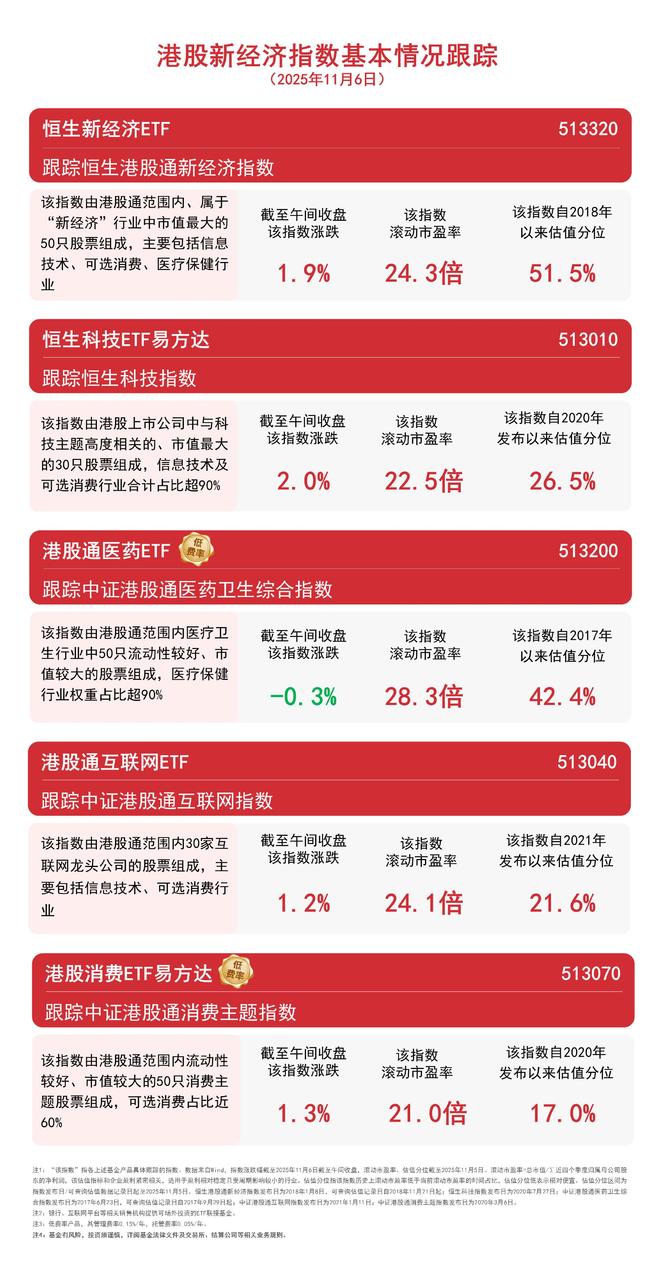
Core Viewpoint - The Hong Kong stock market showed a strong performance today, particularly in sectors such as semiconductors, new energy vehicles, internet, and new consumption, with the Hang Seng Technology Index rising by 2.0% and other related indices also experiencing gains [1]. Sector Performance - The Hang Seng Technology Index increased by 2.0% [1] - The Hang Seng Hong Kong Stock Connect New Economy Index rose by 1.9% [1] - The CSI Hong Kong Stock Connect Consumption Theme Index saw an increase of 1.3% [1] - The CSI Hong Kong Stock Connect Internet Index grew by 1.2% [1] - The CSI Hong Kong Stock Connect Pharmaceutical and Health Comprehensive Index declined by 0.3% [1] Index Composition - The CSI Hong Kong Stock Connect Consumption Theme Index consists of 50 major consumer stocks within the Hong Kong Stock Connect, with nearly 60% of the index composed of discretionary consumption [4] - The rolling price-to-earnings ratio of the index is 21.0 times, with a valuation percentile of 17.0% since its inception in 2020 [4]

资金动向!正在加仓港股
中国基金报· 2025-11-06 01:05
2025年以来,随着海外降息预期升温、南向资金持续涌入,以及港股市场优质资产不断扩容,港股 正迎来新一轮配置窗口。 首先,海外流动性环境持续宽松。2025年9月和10月,美联储连续两次降息,全球流动性环境持续 改善。市场普遍预期12月继续宽松的概率较高,美联储年内或将再降息一次。宽松的货币环境有望 提振全球权益资产表现,港股作为离岸市场,对流动性变化尤为敏感。 第二,南向资金持续流入,增配空间广阔。2025年前三季度,南向资金累计净流入达1.16万亿港 币,已超去年全年水平,月均流入创历史新高。从存量角度看,当前全市场可投资港股的主动偏股型 基金对港股的配置比例为28.7%,若提升至50%的上沿区间,预计仍有约3940亿港币的增配空间。 保险、私募及个人投资者的资金也在加速进场,预计全年非公募资金增量或达3924亿港币(数据来 源:WIND,截至2025年9月末,资料来源:华泰证券《香港资产重估进入新阶段》,2025年7月23 日)。 第三,优质资产持续上市,港股内生价值提升。今年以来,港股IPO融资规模已突破1889亿港币,远 超2024年全年。多家A股龙头企业选择赴港二次上市,涵盖新能源、消费、电子制造等 ...

机构研判港股2026年前景:基本面“接棒”驱动行情 看好四类资产配置价值
Zhong Guo Zheng Quan Bao· 2025-11-04 22:35
Core Viewpoint - The outlook for the Hong Kong stock market in 2026 is optimistic, driven by fundamental improvements and the potential for AI industry catalysis to enhance net asset returns in related sectors, particularly the Hang Seng Tech Index [1][3][6]. Market Performance - The Hong Kong stock market has shown strong performance in 2025, with major indices reaching new highs. As of November 4, 2025, the Hang Seng Index, Hang Seng Tech Index, and Hang Seng China Enterprises Index have increased by 29.37%, 30.22%, and 25.83% respectively [2][3]. - Despite recent adjustments, the market is expected to continue its upward trajectory into 2026, with investor focus on whether new highs can be achieved [2][3]. Fundamental Improvements - Predictions indicate that the revenue growth for non-financial Chinese companies listed overseas could reach 4% in 2026, with operating profit growth expected at 13%. This is attributed to cost reduction, efficiency improvements, and AI applications enhancing profitability [3][4]. - Current valuations of Hong Kong stocks are considered low, particularly in the tech sector, providing room for upward movement [3][4]. Capital Inflows - There is a high certainty of incremental capital entering the Hong Kong market in 2026, with net inflows from southbound funds exceeding 1.27 trillion HKD since 2025, marking a historical high [4][5]. - The inflow of foreign capital is expected to improve, driven by a low allocation to Chinese equity assets and potential easing of monetary policy by the Federal Reserve [4][5]. Sector Focus - The technology sector is anticipated to be the main driver of market performance in 2026, benefiting from industry development and policy support [6]. - Investment in innovative pharmaceuticals and brokerage firms is also recommended, as these sectors are expected to see significant growth and improved performance [6][7].
机构研判港股2026年前景: 基本面“接棒”驱动行情 看好四类资产配置价值
Zhong Guo Zheng Quan Bao· 2025-11-04 20:37
Core Viewpoint - The outlook for the Hong Kong stock market in 2026 is optimistic, driven by fundamental improvements and the potential for AI industry catalysis, which may enhance the net asset return (ROE) of related sectors, particularly the Hang Seng Technology Index [1][2][3]. Market Performance - The Hong Kong stock market rebounded significantly since early 2024, with major indices reaching new highs in 2025. As of November 4, 2023, the Hang Seng Index, Hang Seng Technology Index, and Hang Seng China Enterprises Index have increased by 29.37%, 30.22%, and 25.83% respectively this year [1][2]. Market Adjustments - The market experienced notable adjustments in April and October 2023, leading to a high-level consolidation phase. Investors are particularly focused on whether the market can maintain its upward momentum and set new highs in 2026 [2][3]. Earnings Growth - It is predicted that the revenue growth rate for non-financial overseas Chinese companies will reach 4% in 2026, with operating profit growth expected to be 13%. This profit growth is attributed to cost reduction, efficiency improvements, and advancements in AI applications [2][3]. Valuation Insights - Current valuations of the Hong Kong stock market are considered low, especially in the technology sector, providing ample room for further upward movement. Historical comparisons indicate that the market is undervalued, suggesting significant potential for valuation recovery [3][4]. Capital Inflows - There is a high certainty of incremental capital inflows into the Hong Kong market in 2026, with net inflows from southbound funds exceeding 1.27 trillion HKD since 2025, marking a historical high. The inflow structure is expected to become more balanced [4][5]. Domestic and Foreign Investment - Domestic institutional investors, including public funds and insurance companies, are increasingly influencing the pricing power in the Hong Kong market. It is anticipated that net inflows from southbound funds could exceed 1.5 trillion RMB in 2026 [5][6]. Sector Focus - The technology sector, particularly driven by AI advancements, is expected to be the main focus for the Hong Kong market in 2026. Additionally, there is a recommendation to pay attention to innovative pharmaceuticals and brokerage firms, which are anticipated to perform well due to favorable market conditions [6].
11月4日【中銀做客】恆指、小米集團、比亞迪、泡泡瑪特、建設銀行、
Ge Long Hui· 2025-11-04 20:03
Market Overview - The Hong Kong stock market has shown volatility recently, with the Hang Seng Index fluctuating around 25,900 to 26,000 points [2][6] - Trading volume has decreased from approximately 300 billion to around 200 billion in recent weeks, indicating a more cautious market sentiment [1][2] - Investors are shifting focus from individual stocks to index-related products, such as ETFs and warrants, due to uncertainty in stock performance [2][3] Investment Strategies - Many investors are adopting a more conservative approach as the year-end approaches, preferring to observe market trends before making further investments [1][2] - The pharmaceutical, retail, and technology sectors have performed well throughout the year, with significant interest in chip stocks [1][2] - Investors are increasingly using index tools to capture market fluctuations, with high leverage options available for index warrants [2][3] Product Offerings - The company has increased the issuance of index-related products to meet market demand, providing a variety of options for investors [3][4] - The issuance of warrants is based on three reference prices, allowing for timely product offerings that align with market conditions [3][4] - Investors can communicate their product needs directly to the company, facilitating a responsive product development process [5][6] Individual Stock Analysis - Xiaomi has seen a significant decline in stock price, dropping from around 60 to 42-43, with investors showing interest in call warrants as a lower-cost entry point [6][7] - BYD's stock has also weakened, with prices falling below 100, leading to cautious interest in call warrants as investors await signs of stabilization [9][10] - Pop Mart, once a market favorite, has experienced a downturn, with mixed investor sentiment reflected in both call and put warrant activity [11][12] Banking Sector Performance - Traditional financial stocks, such as China Construction Bank, have gained attention, with stock prices rising from around 7 to over 8, indicating a shift in investor focus towards more stable sectors [14][15] - The company offers high-leverage warrants for banking stocks, allowing investors to capitalize on the recent upward trend in this sector [16][17]



国泰海通 · 晨报1103|宏观、海外策略、非银、策略
国泰海通证券研究· 2025-11-02 14:43
Macro Overview - The long-term growth potential of China's economy is significant, with a stable macroeconomic total expected by 2025, but structural differentiation is evident, necessitating policy solutions for weak domestic demand in 2026 [4] - Asset restructuring is crucial, with inflation expectations playing a vital role in wealth management for residents [5] - Global economic and monetary system restructuring is leading to changes in the pricing framework for assets like gold, the US dollar, and US Treasuries [6] Hong Kong Stock Market Strategy - Hong Kong stocks have substantial upward valuation potential, with the overall valuation still considered low despite a rapid recovery in 2025 [11] - The market is expected to attract a significant amount of incremental capital, with over 1.5 trillion yuan anticipated from domestic investors in 2026 [12] - The scarcity of quality assets in the Hong Kong market is a strong supporting factor for upward movement, particularly in sectors like internet, new consumption, and innovative pharmaceuticals [12] - The technology sector is projected to be the main focus for 2026, driven by the AI wave and supportive policies [13] Non-Banking Sector Regulations - The China Securities Regulatory Commission is seeking opinions on new guidelines for performance benchmarks for publicly offered securities investment funds, aiming to address systemic issues in performance comparison and management mechanisms [19][20] - The new regulations will enhance the selection, change, disclosure, and constraint of benchmarks, improving investment transparency and potentially increasing the proportion of index products in the market [21] Asset Overview - Equity markets are outperforming bonds and commodities, with significant gains in Asian markets, particularly Japan and South Korea [25][26] - The bond market shows a "bull steep" characteristic in China, while US Treasuries exhibit a "bear flat" trend due to hawkish signals from the Federal Reserve [27] - Commodity indices have seen declines, with gold and oil leading the downturn, while the US dollar index has risen [28]

兴业证券:ETF已成为资金流入港股市场的重要载体
Zhi Tong Cai Jing· 2025-10-30 23:55
Core Insights - The report highlights that since September 2024, the Hong Kong Stock Connect has been continuously injecting incremental funds into the Hong Kong stock market, with ETFs becoming a significant vehicle for this capital inflow [1][2]. Group 1: ETF as a Key Investment Vehicle - ETFs have emerged as a crucial channel for capital inflow into the Hong Kong market, with a cumulative net inflow of 11,438.8 billion yuan since the beginning of 2025, of which 2,763.7 billion yuan flowed through ETFs, accounting for over 20% of the total [2]. - By the end of Q3 2025, the market value of public funds investing in Hong Kong stocks reached 13,117 billion yuan, with passive public funds holding 6,862 billion yuan, representing 52.3% of the total [2]. Group 2: Fund Flow Trends in ETFs - In 2025, there is a noticeable preference for industry and thematic ETFs, while broad-based ETFs are experiencing outflows. The technology sector has become the focal point for capital allocation, with significant interest in innovative pharmaceuticals, large financials, and dividend sectors [3]. - Since the beginning of 2025, nearly 65% of the cumulative net inflow into Hong Kong stock ETFs has been concentrated in the technology sector [3]. - From June 2025 onwards, there has been an accelerated net inflow into Hong Kong stock ETFs, with a widening gap between the total net inflow into all ETFs and that of technology sector ETFs, as innovative pharmaceuticals and large financials have diverted some of the incremental funds [3]. Group 3: Recent Fund Flow Dynamics - In recent months, there has been a significant inflow into technology ETFs, with a net inflow of 20.1 billion yuan since early October 2025, despite adjustments in the Hang Seng Technology Index [5]. - The dividend sector has also seen a marked increase in inflow, with 4.6 billion yuan net inflow since early October, reaching a high level since September 2024 [5]. - Conversely, the inflow into innovative pharmaceutical ETFs has slowed, with a net inflow of 3.5 billion yuan since early October [6].
