AI泡沫

Search documents
宏观研究:假期国内消费平稳增长,海外风险事件频出
China Post Securities· 2025-10-10 07:42
Group 1: Domestic Travel Trends - During the National Day holiday, the total cross-regional passenger flow is expected to reach 2.432 billion, with an average of 304 million daily, reflecting a 6.2% increase compared to 2024 and a 331.03% increase compared to 2019[1] - Road travel remains the primary mode of transportation, accounting for 92.56% of total trips, with 198 million road trips recorded, a year-on-year increase of 7.34%[11] - Waterway travel has seen a significant increase, with 10.05% growth year-on-year, totaling 10.7846 million trips during the holiday[12] Group 2: Tourism and Consumption - Cross-province travel orders increased by 45% year-on-year, with orders for inter-provincial border cities rising by 58%[14] - Tourists are staying longer in the same city, with a 50% increase in visitors staying 7-8 days compared to 2024[15] - National retail and catering sales during the holiday increased by 3.3% year-on-year, indicating a steady recovery in consumer spending[23] Group 3: International Risks - The U.S. government shutdown has led to significant economic impacts, with estimated losses of $15 billion per week and a potential GDP growth reduction of 0.2 percentage points[32] - Political uncertainty in France following the resignation of Prime Minister Le Cornu may hinder fiscal reforms and impact the EU's economic recovery[36] - Japan's new Prime Minister, Kishi, may boost market sentiment in the short term, but long-term fiscal risks remain a concern due to high debt levels[40]
人工智能吸引过半数风投资金流入,华尔街却开始警惕“AI泡沫”
Huan Qiu Wang· 2025-10-10 00:53
Group 1 - The World Trade Organization (WTO) has raised its global goods trade growth forecast for the first half of 2025 to 2.4%, up from 0.9% in August, driven by increased demand for AI-related products, a surge in imports in North America before tariff hikes, and active trade among emerging economies [1] - In 2025, venture capital is expected to see over half of its funding flow into the AI sector for the first time, with AI startups attracting a record $192.7 billion in investments since 2025 [3] - The proportion of venture capital directed towards AI companies reached 62.7% in the recent quarter in the U.S., while globally it was 53.2% [3] Group 2 - Concerns have been raised about a potential "industrial bubble" in the AI sector, with notable figures like Jeff Bezos and Goldman Sachs CEO David Solomon warning that the current excitement may overlook significant risks [3][4] - To sustain current data center expenditures, large tech companies need to generate $480 billion in revenue, and for next year's spending, this figure could rise to $1 trillion [3] - Market analysts express a cautious perspective, likening the current AI trading environment to one of the greatest speculative frenzies in market history [4]


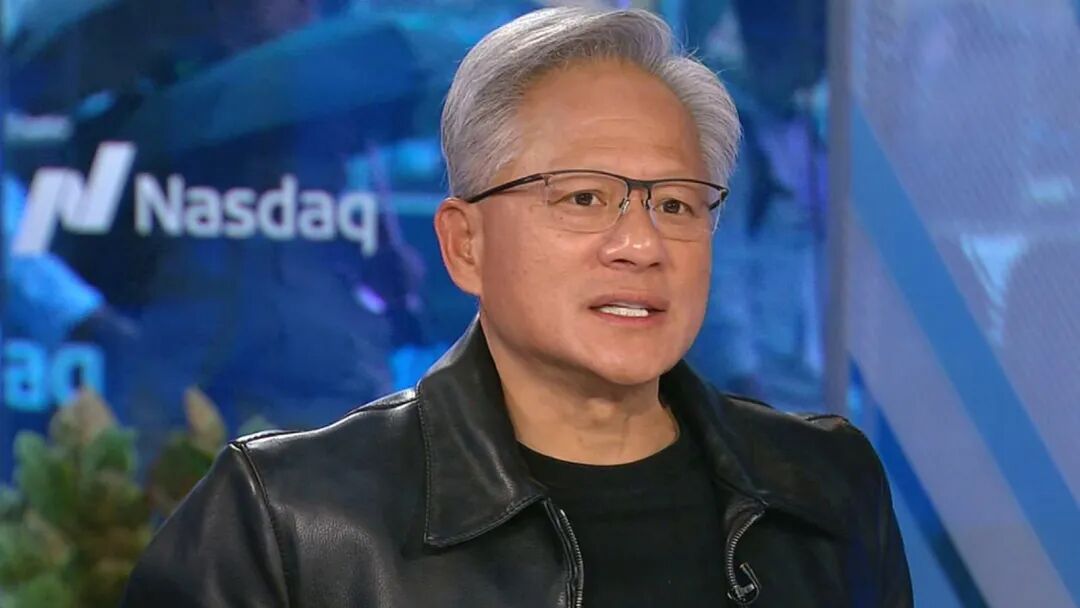
黄仁勋回应AMD“送股”OpenAI:很高明的交易,OpenAI现在还没钱给我付账
3 6 Ke· 2025-10-09 11:27
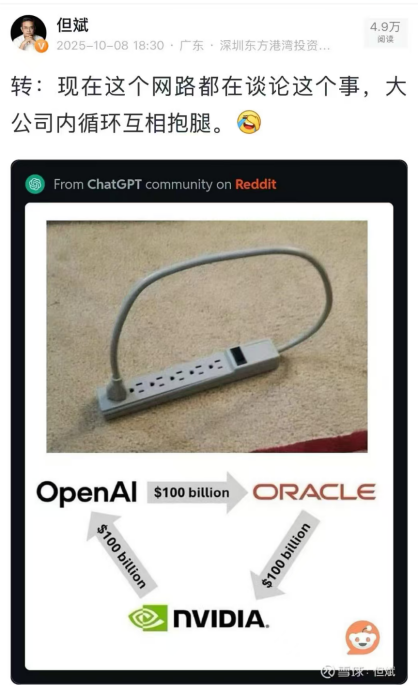
Core Insights - Huang Renxun expressed surprise at AMD's strategy of exchanging 10% of its shares for OpenAI orders, calling it clever and imaginative [1][3] - He emphasized that Nvidia's relationship with OpenAI is fundamentally different, as Nvidia sells products directly to OpenAI rather than exchanging equity [1] - OpenAI currently lacks the funds to pay for its large orders, and will need to raise capital through future revenue growth, equity, or debt financing [3] Nvidia and OpenAI Transactions - Nvidia announced a potential investment of up to $100 billion in OpenAI, which will require 10 gigawatts of power, equivalent to 4 to 5 million GPUs [6] - OpenAI has agreed to purchase AMD chips, including the upcoming MI450 series, and will receive warrants for up to 160 million shares of AMD, representing about 10% of the company [6] - The warrants have a nominal exercise price of $0.01 per share, with conditions tied to chip deployment and AMD's stock performance [6] Circular Financing Dynamics - The transactions create a closed-loop funding mechanism where Nvidia's investment flows to Oracle through OpenAI, which then purchases Nvidia hardware [7] - The total value of AI computing transactions between OpenAI, Nvidia, AMD, and Oracle has surpassed $1 trillion, while OpenAI is projected to not achieve positive cash flow until 2029 [7] Nvidia's Broader Investment Strategy - Nvidia plans to invest $2 billion in Musk's xAI, which is part of a larger $20 billion funding round [8] - The investment will utilize a special purpose vehicle (SPV) structure, with funds allocated for purchasing Nvidia processors [8] - Nvidia has also invested in AI data center operator CoreWeave, holding a 7% stake, and has participated in numerous AI venture capital transactions [8] Market Concerns - The complex web of transactions has raised concerns about a potential AI bubble, with analysts warning that these deals could signal early warning signs if the bubble bursts [8] - Nvidia's spokesperson clarified that the company does not require its invested companies to use Nvidia technology [9]


1万亿美元的大单,OpenAI的钱从哪来?
华尔街见闻· 2025-10-09 11:14
Core Viewpoint - OpenAI has signed nearly $1 trillion in computing power procurement agreements, significantly exceeding its revenue and financing capabilities, raising questions about how the company can support such a massive gamble [3][5][7]. Group 1: Financial Agreements - OpenAI's agreements include $500 billion with Nvidia, $300 billion with AMD, and $300 billion with Oracle, along with over $22 billion with CoreWeave, aiming to provide over 20 GW of computing power over the next decade [7]. - The company is utilizing a "circular financing" model and an innovative "equity-for-purchase" approach to secure funding from suppliers, effectively rewriting capital rules in the AI era [5][8]. Group 2: Financial Models - The AMD model involves a groundbreaking agreement where OpenAI plans to purchase up to $90 billion worth of AMD GPUs while receiving warrants to buy up to 160 million shares at $0.01 each, potentially allowing OpenAI to acquire significant equity at minimal cost [10]. - The Nvidia model involves a direct investment of up to $100 billion, which provides OpenAI with cash to purchase Nvidia chips, creating a "circular revenue" flow where funds are reinvested back into purchasing [11][12]. Group 3: Financial Analysis - Goldman Sachs estimates that OpenAI's operational infrastructure costs will reach approximately $35 billion by 2026, with self-generated revenue contributing about 48% [15]. - However, when considering future capital commitments, total funding needs could soar to around $114 billion, with external equity and debt financing needs rising to 75% of the total funding structure [17][19]. Group 4: Market Impact and Risks - The partnerships have significantly boosted the market valuations of companies like Oracle and AMD, with market caps increasing by $244 billion and $63 billion, respectively, following the announcements [22]. - Despite the innovative financial structures, OpenAI's reliance on external capital raises concerns about sustainability, especially if user growth or willingness to pay slows down [25][21].


但斌“新身份”!中国香港居民!
证券时报· 2025-10-09 09:08
Core Viewpoint - The recent change in identity of Dan Bin, chairman of Dongfang Port Bay, from "China" to "Hong Kong" has attracted market attention, indicating a strategic shift towards greater international flexibility and potential tax advantages for the private equity firm [2][6]. Group 1: Identity Change and Company Operations - On August 26, 2023, Dongfang Port Bay underwent an "investor change," with Dan Bin's identity updated to "Hong Kong" [2][5]. - Dongfang Port Bay confirmed that the change in Dan Bin's identity is being processed according to regulatory procedures and will not affect the company's stable operations or investment strategies [2][6]. - Dan Bin has stepped down as the general manager but remains in the role of manager, while still being the actual controller of the firm [5][6]. Group 2: Strategic Implications of Hong Kong Residency - The shift to a Hong Kong residency is significant as it offers advantages in capital markets, tax arrangements, and cross-border investment facilitation, enhancing the firm's international operational flexibility [6]. - Dongfang Port Bay has established multiple QDII products, focusing on investments in U.S. stocks, Hong Kong stocks, and overseas ETFs, with notable performance due to heavy investments in tech stocks like NVIDIA [6]. Group 3: AI Investment Trends and Market Sentiment - The AI investment boom has led to record highs in U.S. tech stocks, with major companies like NVIDIA and Oracle making substantial investments in AI capabilities [8][9][10]. - The International Monetary Fund (IMF) and the Bank of England have issued warnings about the rapid rise in tech stock valuations driven by AI, indicating a buildup of vulnerabilities and risks in the market [12]. - Dan Bin expressed that the risk of missing out on the AI era outweighs the concerns about a potential bubble, suggesting a long-term positive outlook for AI investments [13].



但斌“新身份”!中国香港居民!
Zheng Quan Shi Bao Wang· 2025-10-09 07:03
Core Viewpoint - The recent change in identity of Dan Bin, chairman of Dongfang Hongwan, from "China" to "Hong Kong, China" has attracted market attention, indicating a strategic shift towards greater international flexibility and potential tax advantages for the private equity firm [1][2][3]. Group 1: Identity Change and Company Structure - Dan Bin's identity change was officially recorded on August 26, 2023, and he has stepped down as the general manager while retaining the title of manager [2]. - Dongfang Hongwan has submitted an application to the Asset Management Association of China regarding the change in the identity of its actual controller, which is currently under regulatory review [2][3]. - The company reassured that this change will not affect its operational stability or investment strategy execution [1][2]. Group 2: Strategic Implications of Hong Kong Identity - The shift to a Hong Kong identity provides Dongfang Hongwan with advantages in capital markets, tax arrangements, and cross-border investment opportunities, enhancing its international operational flexibility [3]. - This identity change may facilitate easier participation in the Hong Kong and U.S. stock markets, as well as attract overseas capital and partnerships [3]. Group 3: AI Market Dynamics - The AI investment surge has led to significant increases in U.S. tech stock valuations, with major companies like Nvidia and Oracle making substantial investments in AI capabilities [4][7]. - The debate over potential "AI bubbles" has intensified, with warnings from the IMF and the Bank of England about the rapid rise in tech stock valuations and the associated risks [7]. - Dan Bin expressed that the risk of missing out on the AI era outweighs the concerns about a bubble, suggesting a long-term view on the potential of AI investments [7].
黄仁勋回应AMD“送股”OpenAI:很高明的交易,OpenAI现在还没钱给我付账
量子位· 2025-10-09 04:52
Core Insights - Huang Renxun expressed surprise at AMD's strategy of exchanging 10% of its shares for OpenAI orders, calling it clever [1][3] - He emphasized that NVIDIA's relationship with OpenAI is fundamentally different, as NVIDIA sells products directly to OpenAI rather than through equity exchange [4] - OpenAI currently lacks the funds to pay for its large orders, needing to raise capital through future revenue growth, equity, or debt financing [5][7] NVIDIA and OpenAI Transactions - NVIDIA has the opportunity to co-invest in OpenAI's future financing rounds, with Huang expressing regret for not investing more when OpenAI was founded [8] - NVIDIA announced plans to invest up to $100 billion in OpenAI, which will build systems requiring 10 gigawatts of power, equivalent to 4 to 5 million GPUs [12][13] - OpenAI has also agreed to purchase AMD chips, committing to a significant procurement of AMD's upcoming MI450 series [14] Circular Trading Dynamics - The transactions create a closed-loop funding mechanism where NVIDIA's investment flows to Oracle through OpenAI, which then purchases NVIDIA hardware [16] - The total value of AI computing transactions between OpenAI, NVIDIA, AMD, and Oracle has surpassed $1 trillion, while OpenAI is projected to struggle with positive cash flow until 2029 [16] Expansion of NVIDIA's AI Investments - NVIDIA confirmed its participation in a $20 billion funding round for Musk's xAI, with plans to invest $2 billion [17] - The investment will utilize a special purpose vehicle (SPV) structure, with funds allocated for purchasing NVIDIA processors [18] - NVIDIA has also invested in CoreWeave, holding a 7% stake, and is actively involved in numerous AI venture capital transactions [19][20] Market Concerns - The intricate web of transactions has raised concerns about a potential AI bubble, with analysts warning that these deals could signal early warning signs if a bubble were to burst [20] - NVIDIA representatives clarified that the company does not require its invested companies to use NVIDIA technology [21][22]
加入“AI泡沫”大论战,高盛:还没有泡沫!
美股IPO· 2025-10-09 04:48
Core Viewpoint - Goldman Sachs believes that despite the current market showing some characteristics of historical bubbles, the recent rise in technology stocks is primarily driven by strong fundamentals and real earnings growth rather than pure speculation, indicating that the market has not yet reached bubble levels [1][3]. Valuation Analysis - Technology stocks are currently at high valuations, with the median expected price-to-earnings (P/E) ratio for the "seven giants" of the U.S. tech sector at approximately 27 times, significantly lower than the 52 times seen at the peak of the 2000 tech bubble [4]. - The PEG ratio for U.S. tech stocks is currently at 1.7 times, below the 3.7 times peak during the late 1990s bubble, indicating more rational valuations [4]. - The market pricing for the TMT (Telecom, Media, and Technology) sector suggests a required annual dividend growth rate of 25% over the next decade, which, while high, is still below the 35% growth expectation during the tech bubble [4]. Earnings Growth vs. Speculation - The recent performance of technology stocks is a direct reflection of their strong earnings capabilities rather than unrealistic speculation about the future [5]. - Since 2009, the earnings per share (EPS) growth in the global tech sector has significantly outpaced that of non-tech sectors, with the current earnings growth being a key pillar supporting stock price performance [5]. Systemic Risks and Market Concentration - Despite an overall optimistic tone, Goldman Sachs acknowledges potential risks, particularly the surge in capital expenditures and record market concentration [6][8]. - The capital expenditures of "super-scale computing companies" are expected to reach $239 billion in 2024, more than double the amount in 2018, raising concerns about potential overinvestment and declining returns [7]. - The current market concentration is historically high, with the top five U.S. tech companies' combined market value exceeding that of the European Stoxx 50 index and other major markets, accounting for about 16% of the global public equity market [8]. Diversification Recommendations - Goldman Sachs advises investors to diversify their portfolios to mitigate risks associated with high valuations and concentration [10]. - Suggested areas for diversification include: - **Geographical Diversification**: European, Japanese, and Chinese markets have shown returns comparable to the S&P 500 [10]. - **Style Diversification**: Opportunities exist for cross-style investments as the lines between "value" and "growth" styles blur [10]. - **Industry Diversification**: The growth of AI will drive demand in sectors like power, energy, and capital goods, presenting growth opportunities [11]. - **Internal Diversification within Tech**: Investors should also look for emerging tech "superstars" that can capitalize on the current capital expenditure trends [11].


纳指、标普500再创新高;哈马斯证实达成加沙停火协议
Di Yi Cai Jing Zi Xun· 2025-10-09 01:03
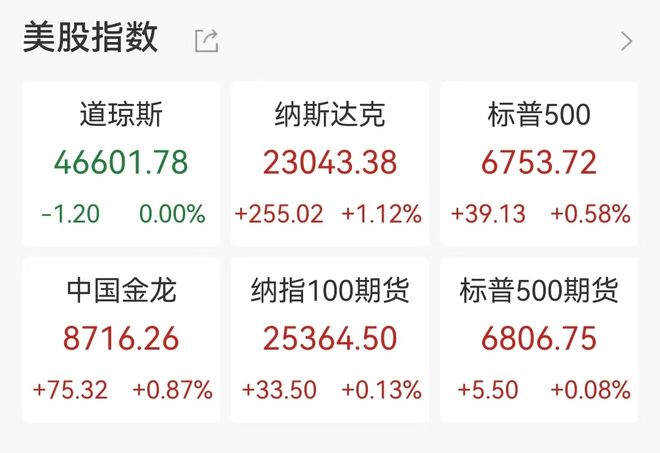
Market Performance - The three major U.S. stock indices showed mixed results, with the Nasdaq and S&P 500 reaching all-time highs, while the Dow Jones fell slightly by 1.20 points to 46,601.78 [1] - Nasdaq rose by 255.02 points, a 1.12% increase, closing at 23,043.38, and the S&P 500 increased by 39.13 points, or 0.58%, to 6,753.72 [1] Semiconductor Sector - Nvidia's stock rose by 2.20%, driven by increased demand for computing power, as stated by CEO Jensen Huang, who noted a significant rise in demand over the past six months [2] - The Philadelphia Semiconductor Index surged by 3.40%, with AMD up 11.37%, Arm Holdings up 4.66%, and TSMC up 3.57% [2] - Concerns about an AI bubble were raised, drawing parallels to the late 1990s internet bubble, with analysts suggesting potential adjustments in tech stock investments [3] Gold and Oil Prices - Gold prices continued to rise, with spot gold increasing by 1.44% to $4,042.14 per ounce, and COMEX gold futures up 1.43% to $4,061.70 per ounce [5] - International oil prices also saw an increase, with WTI crude oil futures rising by $0.82, or 1.33%, to $62.55 per barrel, and Brent crude oil futures up $0.80, or 1.22%, to $66.25 per barrel [5] Economic Indicators - The U.S. federal government has been in a shutdown for eight days, with the Senate failing to pass temporary funding bills [5] - The National Development Bank reported significant financial support for housing and infrastructure projects, with 48 billion yuan in housing loans and 978.1 billion yuan for urban village renovations [7] International Developments - A peace agreement between Israel and Hamas was announced, with plans for a prisoner exchange and a ceasefire in Gaza [6] - The European Parliament passed a resolution allowing for the temporary or permanent suspension of visa exemptions for certain third-country citizens [10]

中国资产走强,文远知行涨12%,蔚来涨4%,半导体全线大涨
2 1 Shi Ji Jing Ji Bao Dao· 2025-10-09 00:09
记者丨江佩佩 张嘉钰 编辑丨谭婷 当地时间10月8日,美国三大股指多数收涨,道指持平,标普500指数涨0.58%报6753.72,纳指涨1.12% 报23043.38。纳斯达克指数和标普500指数均创历史新高。 消息面上,10月9日凌晨,美联储公布9月联邦公开市场委员会(FOMC)会议纪要。美联储官员们在9 月政策会议上表现出今年进一步降息的意愿,但同时也因通胀风险而保持谨慎。 万得美国科技七巨头指数涨0.84%,英伟达涨超2%,收盘创历史新高。亚马逊、特斯拉涨超1%。 热门中概股全线走高,文远知行涨近12%,小马智行涨超8%,蔚来涨逾4%。 | MILLEWHIHU | 2.330 | 10.43% | | --- | --- | --- | | ECX.O | | | | EPSIUM ENTERP ... | 33.190 | 9.72% | | EPSM.O | | | | 小马智行 | 23.460 | 8.61% | | PONY.O | | | | 有道 | 10.960 | 7.87% | | DAO.N | | | | 声网 | 4.060 | 5.18% | | API.O | | | | ...