
避险资产

Search documents
刚刚,黄金、原油拉升!
Zheng Quan Shi Bao· 2025-10-06 00:21
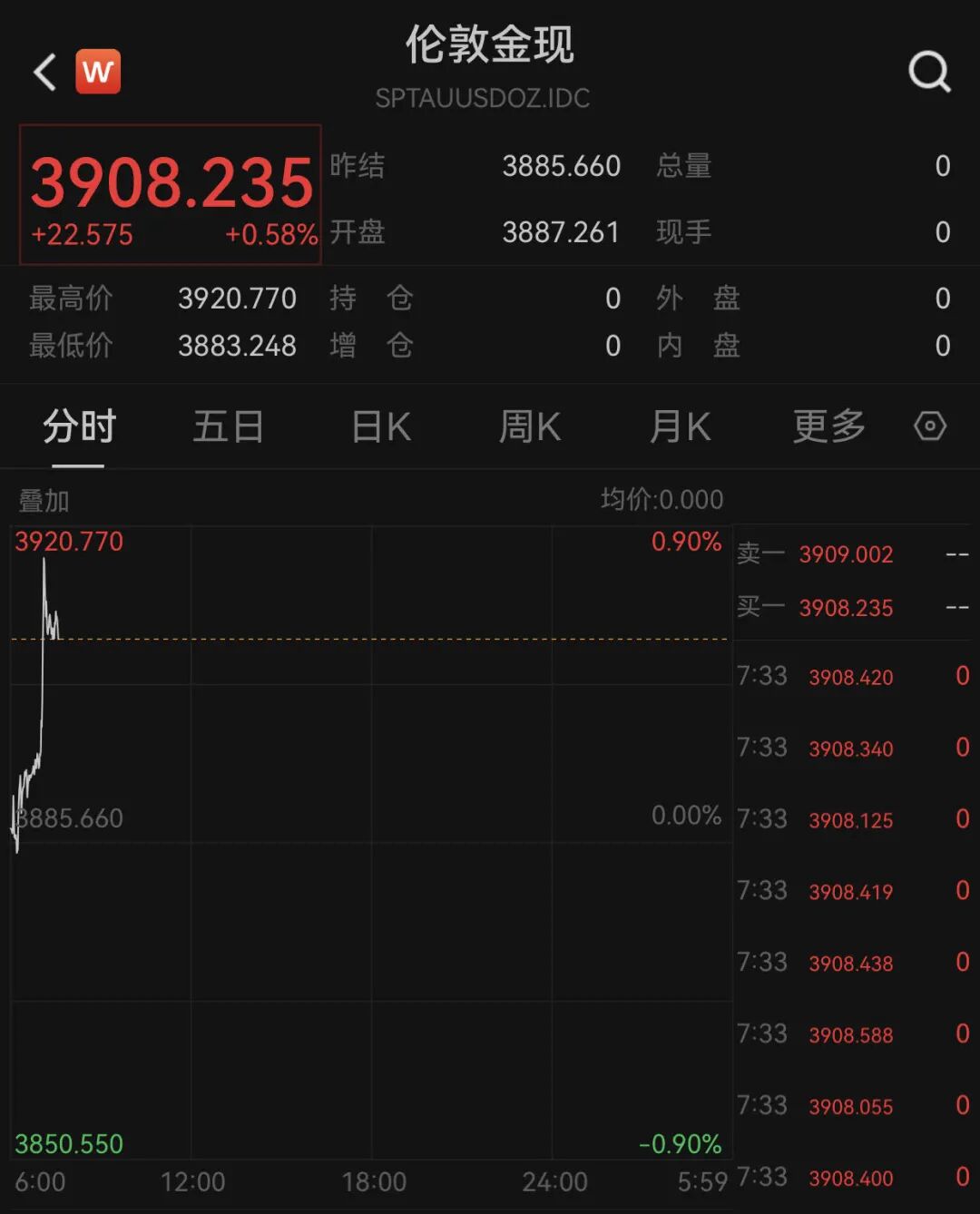
Group 1: Gold Market Dynamics - Gold prices surged on October 6, reaching a record high of $3920.77 per ounce, marking a 49% increase year-to-date [1] - COMEX gold also hit a new high of $3945.2 per ounce, reflecting strong market demand [2][3] - The recent government shutdown in the U.S. has intensified uncertainty, driving investors towards gold as a safe haven [4] Group 2: ETF Inflows and Predictions - Gold ETFs saw a net inflow of $13.6 billion over the past four weeks, with total inflows exceeding $60 billion for the year, setting a record [4] - Analysts predict that gold prices may continue to rise, with major banks forecasting potential prices of $4000 to $5000 per ounce [5] Group 3: Federal Reserve's Monetary Policy - The Federal Reserve is expected to lower interest rates, with a 95% probability of a rate cut in October and a 99% probability in December [6] - The current economic environment is seen as restrictive, prompting calls for a more aggressive easing of monetary policy [6] Group 4: Oil Market Overview - International oil prices have risen over 1%, with WTI crude reaching $61.85 per barrel and Brent crude at $65.52 per barrel [7][8] - OPEC+ is expected to confirm an increase in oil production by at least 137,000 barrels per day in November, following the abandonment of previous production cuts [10] Group 5: Supply and Price Forecasts - The International Energy Agency (IEA) warns of a potential oversupply in the oil market, predicting that supply could exceed demand significantly by 2026 [10] - Macquarie Group forecasts that Brent crude prices could drop to the $50 per barrel range if oversupply conditions persist [11]

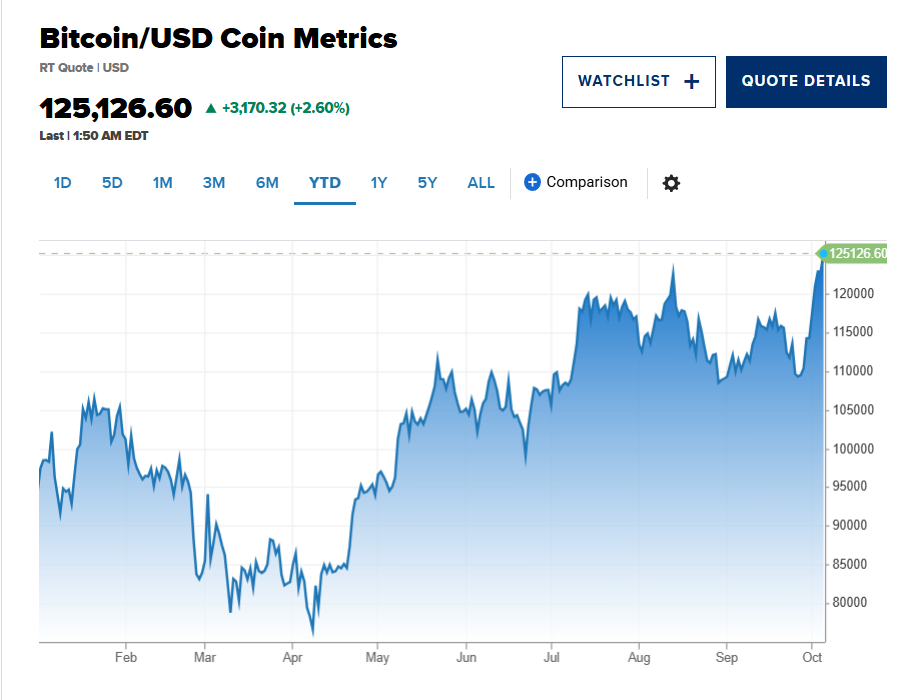
12.5万美元,“贬值”交易刺激风险资产反弹,比特币价格再创历史新高
Hua Er Jie Jian Wen· 2025-10-05 22:50
Core Viewpoint - The U.S. government shutdown has triggered a "devaluation trade," leading to a rebound in global risk assets, with Bitcoin reaching a new all-time high of $125,689, surpassing its previous record of $124,514 set on August 14 [1][3]. Group 1: Bitcoin Performance - Bitcoin surged by 12% this week and has increased over 30% year-to-date, driven by the expectation that the government shutdown will push funds toward "safe-haven" assets [3]. - The recent performance of Bitcoin is significantly different from the previous government shutdown in late 2018, as it is now more closely correlated with U.S. government risk [5][6]. - Institutional demand, technical factors, and seasonal trends have all contributed to Bitcoin's price increase [3][4]. Group 2: Broader Market Impact - The "devaluation trade" has led to a broad rise in risk assets, with the S&P 500 and Nasdaq Composite indices reaching record highs, and gold prices increasing by over 2% this week [3]. - Various assets, including stocks and collectibles, have also hit historical highs, indicating a widespread market response to the devaluation narrative [4]. Group 3: Institutional Influence - Increased institutional demand for Bitcoin has been supported by companies like MicroStrategy adopting cryptocurrency accumulation strategies, which have boosted market demand [6]. - The inflow of funds into Bitcoin-related ETFs has provided additional momentum for price increases, making it easier for traditional investors to participate in Bitcoin investments [6]. Group 4: Market Sentiment - October has historically been a strong month for Bitcoin, with nine out of the last ten Octobers showing price increases, reinforcing bullish sentiment among investors [6].
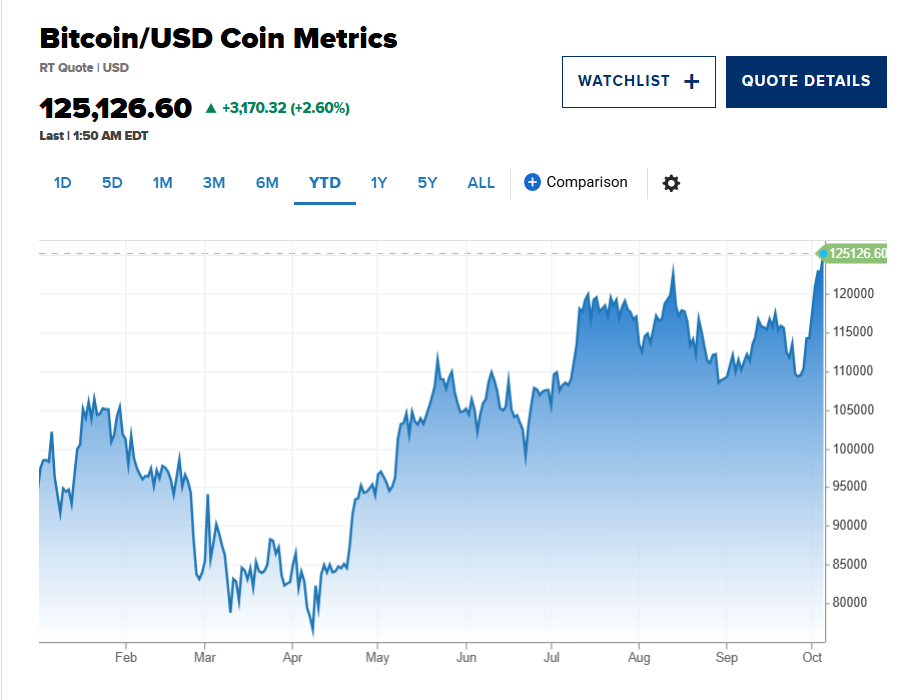
12.5万美元:“贬值”交易刺激风险资产反弹 比特币价格再创历史新高
Hua Er Jie Jian Wen· 2025-10-05 07:38
Core Viewpoint - The U.S. government shutdown has triggered a "devaluation trade," leading investors to shift funds into assets like Bitcoin and gold to hedge against the risk of dollar depreciation, with Bitcoin reaching a new all-time high of $125,689 on October 5 [1][3]. Group 1: Market Reactions - Bitcoin surged 12% this week and has risen over 30% year-to-date, with the government shutdown being identified as a catalyst for the flow of funds into "safe-haven" assets [3]. - The shutdown has led to a broad rally in risk assets, with the S&P 500 and Nasdaq indices also reaching record highs, and gold prices increasing by over 2% this week [4][5]. Group 2: Institutional Demand and Strategies - Institutional demand and technical factors, along with seasonal trends, have contributed to Bitcoin's price increase, with market participants closely monitoring negotiations in Congress regarding federal funding and the Federal Reserve's monetary policy [3][5]. - Companies like MicroStrategy, under a favorable legislative environment, have adopted a strategy of accumulating cryptocurrencies, which has boosted market demand and extended to smaller competitors like Ethereum [5]. Group 3: Historical Context and Technical Support - Bitcoin's performance during the current government shutdown contrasts sharply with its performance during the previous shutdown in late 2018, indicating a stronger correlation with U.S. government risk this time [5]. - October has historically been a strong month for Bitcoin, with nine out of the last ten Octobers showing price increases, reinforcing bullish sentiment among investors [6].
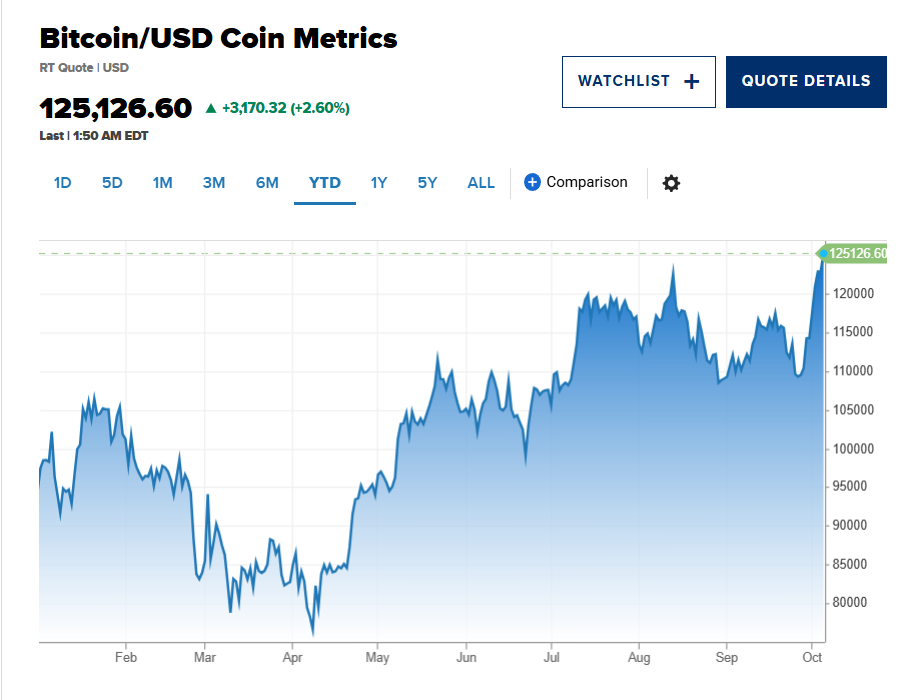
12.5万美元!“贬值”交易刺激风险资产反弹,比特币价格再创历史新高
智通财经网· 2025-10-05 07:27
Core Insights - The U.S. government shutdown has triggered a "devaluation trade," leading to a rebound in global risk assets, with Bitcoin reaching a new all-time high [1][3] - Investors are shifting funds towards Bitcoin and gold as a hedge against the risk of dollar devaluation [1][3] Group 1: Bitcoin Performance - Bitcoin surged to a peak of $125,689 on October 5, surpassing its previous record of $124,514 set on August 14 [1] - The cryptocurrency has increased by 12% this week and over 30% year-to-date, driven by the government shutdown and expectations of funds flowing into safe-haven assets [3] - Institutional demand, technical factors, and seasonal trends are contributing to Bitcoin's price increase [3][6] Group 2: Market Reactions - The shutdown has led to a broad rise in risk assets, with the S&P 500 and Nasdaq Composite indices reaching record highs [4] - Gold prices have also increased by over 2% this week, marking the seventh consecutive week of gains [4] Group 3: Institutional Influence - The demand for Bitcoin is bolstered by institutional interest, particularly from companies like MicroStrategy that have adopted a strategy of accumulating cryptocurrencies [6] - The influx of funds into Bitcoin-related ETFs has made it easier for traditional investors to participate in Bitcoin investments, expanding the market participant base [6] Group 4: Historical Context - The current performance of Bitcoin during the government shutdown contrasts sharply with its performance during the previous shutdown in late 2018, indicating a stronger correlation with U.S. government risk this time [6] - October has historically been a strong month for Bitcoin, with nine out of the last ten Octobers showing price increases, reinforcing bullish sentiment among investors [7]
“贬值”交易刺激风险资产反弹,比特币价格再创历史新高
Hua Er Jie Jian Wen· 2025-10-05 06:09
Core Viewpoint - The U.S. government shutdown has triggered a "devaluation trade," leading to a rebound in global risk assets, with Bitcoin reaching a new all-time high of $125,689, surpassing its previous record of $124,514 set on August 14 [1][3]. Group 1: Bitcoin Performance - Bitcoin has surged by 12% this week and has increased over 30% year-to-date, driven by the expectation that the government shutdown will push funds toward "safe-haven" assets [3]. - The recent performance of Bitcoin is significantly different from the government shutdown in late 2018, as it is now more closely associated with U.S. government risk [6]. - October has historically been a strong month for Bitcoin, with 9 out of the last 10 Octobers showing price increases, contributing to bullish sentiment among investors [7]. Group 2: Market Dynamics - The shutdown has led to a broad increase in risk assets, with the S&P 500 and Nasdaq Composite reaching record highs, and gold prices rising over 2% this week [4]. - The influx of funds into Bitcoin-related ETFs has provided additional momentum for price increases, making it easier for traditional investors to participate in Bitcoin investments [6]. - Institutional demand and favorable technical factors, along with seasonal trends, are driving Bitcoin's price upward [3][6]. Group 3: Broader Asset Trends - Various assets, including stocks, gold, and collectibles, have reached historical highs, indicating a widespread trend of investors seeking refuge in alternative assets amid dollar devaluation concerns [5]. - The current environment has seen a shift in investment strategies, with companies like MicroStrategy adopting cryptocurrency accumulation strategies, further boosting market demand [6].
假期首日金价狂飙 国内首饰金涨至1129元/克
Zhong Guo Xin Wen Wang· 2025-10-04 01:12
Group 1 - Gold prices reached a new historical high, with COMEX gold prices surpassing $3900 per ounce, marking an increase of over 1% [1] - London gold prices also rose, reaching $3895 per ounce, approaching the $3900 mark [1] - Domestic gold jewelry prices increased, with brands like Chow Tai Fook and Luk Fook raising their gold jewelry prices to 1129 RMB per gram, up 21 RMB from two days prior [2] Group 2 - The U.S. government shutdown, due to Congress's failure to reach an agreement on funding, coincided with the surge in gold prices, marking the first shutdown in nearly seven years [2] - The timing of the government shutdown is critical as it delays the release of key employment data, potentially impacting the Federal Reserve's interest rate outlook [3] - As risk assets face pressure amid uncertainty, gold continues its strong upward trend, achieving its 39th historical high of the year [3]
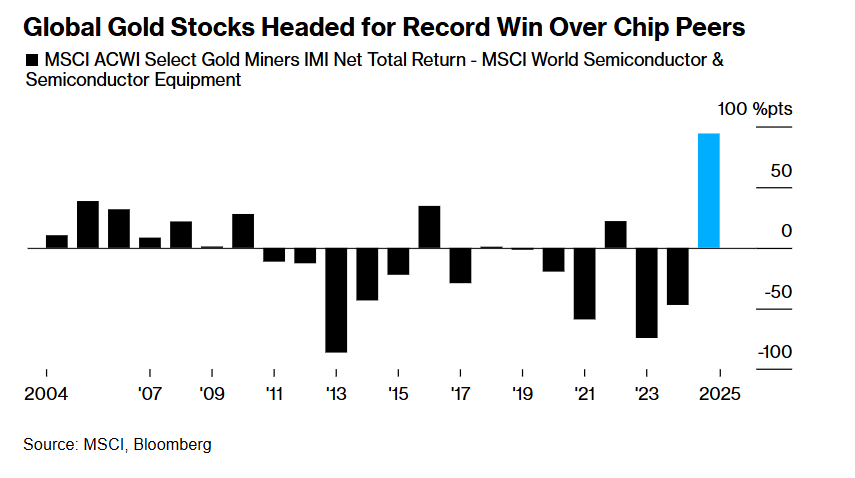
黄金股竟然击败芯片牛市神话! 135%涨幅碾压AI大浪潮驱动的芯片股涨势
Zhi Tong Cai Jing· 2025-10-03 10:08
Core Insights - The performance of gold stocks has significantly outpaced chip stocks, with gold stocks rising approximately 135% year-to-date, compared to a 40% increase in the MSCI semiconductor index [1][4][5] - The strong demand for gold as a traditional safe-haven asset is driven by central bank purchases and ongoing geopolitical tensions, leading to a bullish outlook for gold prices [6][7][8] Group 1: Gold Stock Performance - The MSCI Global Gold Miners Index has surged about 135% this year, outperforming the MSCI Semiconductor Index, which has risen 40% [1][4] - Major gold mining companies like Newmont Corp. and Agnico Eagle Mines have seen their stock prices double, while Zijin Mining from China has increased over 130% [4][5] Group 2: Valuation Comparisons - The forward P/E ratio for the MSCI Gold Miners Index is only 13 times, slightly below its five-year average, while the MSCI Semiconductor Index has a much higher forward P/E of 29 times [5] - Despite the significant rise in gold prices, gold mining companies' valuations appear reasonable as profit growth is outpacing stock price increases [5] Group 3: Future Gold Price Predictions - Goldman Sachs predicts a baseline gold price of $4,000 per ounce by mid-2026, with potential scenarios suggesting prices could reach $4,500 or even $5,000 depending on economic conditions [7][8] - JPMorgan forecasts an average gold price of $3,800 per ounce in Q4 of this year, with expectations to surpass $4,000 in Q1 of next year [8]
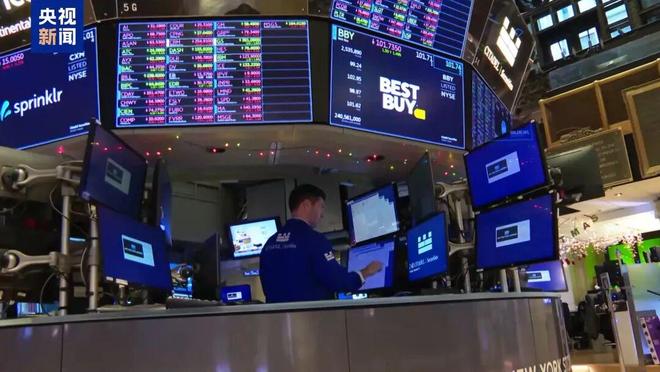
美联邦政府时隔7年再次“停摆”,引发金融市场动荡
Xin Jing Bao· 2025-10-03 04:02
Group 1 - The U.S. federal government shutdown, occurring for the first time in seven years, is expected to negatively impact the economy, including U.S. import and export trade, and investment, shaking corporate confidence in the U.S. market [1][6] - Key financial regulatory agencies, including the SEC and CFTC, have placed most of their staff on unpaid leave, leading to a suspension of IPO applications and delays in the listing process for many companies, which could harm investor sentiment [3][5] - The shutdown is likely to exacerbate existing concerns in global asset markets, with investors shifting capital towards safe-haven assets like gold, potentially leading to price increases in these commodities [3][5] Group 2 - During the shutdown, customs operations will continue, but many technical staff will be on unpaid leave, causing delays in new certifications, approvals, and background checks, which will complicate import and export licensing for traders [5][6] - The absence of timely economic data releases, including employment and price data, will create uncertainty for foreign companies operating in the U.S. market, further amplifying global economic insecurity [6] - Historical data indicates that during the last shutdown in 2018, delays in food and beverage import/export procedures led to significant losses for traders, with cargo dwell times at major ports increasing by 15% to 20% [5][6]
多重因素共振推动现货黄金创纪录高位
Sou Hu Cai Jing· 2025-10-03 03:11
Core Viewpoint - The recent rise in gold prices is primarily driven by the U.S. government shutdown, soft employment data, and expectations of interest rate cuts by the Federal Reserve, making gold an attractive safe-haven asset [1][3][4] Group 1: Government Shutdown Impact - The U.S. government shutdown has become a key driver for the increase in gold prices, with a failure to reach a funding agreement leading to significant operational closures and risks to thousands of federal jobs [3] - The shutdown is expected to delay economic indicators and could reduce economic growth by 0.1-0.2 percentage points for each week it continues, amplifying uncertainty around the Federal Reserve's monetary policy [3] - Historical context shows that while government shutdowns have varied effects on market performance, the current situation is exacerbated by President Trump's plans to cut approximately 300,000 jobs by December, heightening the economic consequences of the shutdown [3] Group 2: Employment Data and Rate Cut Expectations - The ADP National Employment Report indicated a decrease of 32,000 private sector jobs in September, significantly below economists' expectations of a 50,000 increase, with August's data also revised down [4] - This trend of weakening labor market signals negatively impacts the dollar and strengthens market bets on a Federal Reserve rate cut, with the probability of a cut rising to 99% from 96% [4] - The delay of the non-farm payroll report and initial jobless claims due to the shutdown positions the ADP report as a critical indicator for assessing economic health [4] Group 3: Dollar Weakness and Gold's Appeal - The U.S. dollar index experienced a slight decline of 0.1%, closing at 97.73, and even dipped to a near one-week low of 97.44, enhancing gold's attractiveness to foreign buyers [4] - A weaker dollar means that gold, priced in dollars, becomes more competitively priced for international investors, as currency depreciation allows them to acquire more gold for less of their local currency [4]

美股季线收官,道指英伟达黄金齐创新高
Sou Hu Cai Jing· 2025-10-01 19:45
Group 1: Stock Market Performance - The US stock market closed strongly on September 30, marking the end of the third quarter, with the Dow Jones and Nvidia both reaching historical highs [1][3] - The Dow Jones Industrial Average closed at 46,397.89 points, up 0.18%, while Nvidia's stock rose 2.6% to $186.58, making it the first company to surpass a market capitalization of $4.5 trillion [1][4] - The S&P 500 index increased by 0.41% to 6,688.46 points, and the Nasdaq Composite rose by 0.3% to 22,660.01 points, with all three major indices closing higher [3] Group 2: Nvidia's Market Impact - Nvidia's stock has surged nearly 40% year-to-date, outperforming all large-cap companies [5] - The strong performance of Nvidia has also driven the Philadelphia Semiconductor Index to a new high, increasing by 0.87% [6] - Nvidia's CEO stated that the company's products account for approximately 70% of new AI data center spending [9] Group 3: Gold Market Dynamics - Gold prices reached a record high of $3,871 per ounce on September 30, before settling around $3,793, with a monthly increase of approximately 10.5% and a quarterly increase of over 15% [2][10] - The price of gold has risen by 45% year-to-date, with significant increases in domestic gold jewelry prices as well [12][13] - Factors driving gold prices include concerns over the US economy, potential interest rate cuts by the Federal Reserve, and geopolitical tensions [14][16] Group 4: Future Predictions for Gold - Analysts are optimistic about gold prices, with Citibank raising its three-month target for gold prices after reaching $3,800 per ounce [18] - UBS predicts that gold prices could reach $3,900 per ounce by mid-2026 [19] - Barclays strategists believe that gold prices are not overvalued compared to the dollar and US Treasury bonds, suggesting a continued interest in gold as a hedge against risks [20]
