大语言模型

Search documents
让AI融入游戏剧情和玩法,怎样才能少走弯路?
3 6 Ke· 2026-01-14 12:26
Core Viewpoint - The integration of generative AI in gaming has led to mixed reactions, with many players finding AI-generated dialogues to be dull and lacking creativity, while some industry experts see potential for innovation if used correctly [1][2][4]. Group 1: Current State of AI in Gaming - Generative AI has permeated mainstream gaming, but its implementation has often resulted in poor quality experiences, such as incorrect dialogues and low-quality graphics [1]. - Players have expressed skepticism towards AI-driven NPCs, with some arguing that interacting with a chatbot instead of a well-crafted story is foolish [1][2]. - Experts like Meg Jayanth criticize AI-generated dialogues as "boring" and lacking the depth that human writers provide, emphasizing the importance of human creativity in storytelling [4][5]. Group 2: Potential and Future of AI in Gaming - There is a belief that with careful guidance, generative AI could enhance game narratives and create more immersive experiences [2]. - Some experts suggest that AI could be effectively utilized in new game genres, as seen in games like "1001 Nights" and "Infinite Craft," where AI is central to gameplay rather than just an add-on [8][9]. - Dan Griliopoulos highlights the need for narrative designers to adapt to the evolving landscape of AI, suggesting that AI could be used to enhance storytelling if integrated thoughtfully [11][12]. Group 3: Ethical and Practical Considerations - Concerns about ethical implications, such as privacy risks and the potential for job loss in the industry, are prevalent among experts [5][11]. - Younès Rabii points out that while AI has the potential to generate content, it requires significant investment in training and resources to be effective, which may not be feasible for all developers [15][16]. - Chris Gardiner warns against the over-reliance on AI, arguing that it could lead to a loss of originality and depth in games, which players value [18].


AAAI 2026|AP2O-Coder 让大模型拥有「错题本」,像人类一样按题型高效刷题
机器之心· 2026-01-14 05:37
Core Insights - The article discusses the development of the Adaptive Progressive Preference Optimization (AP2O) method and its framework, AP2O-Coder, aimed at improving code generation and error correction in large language models (LLMs) [3][5][6]. Group 1: Existing Challenges and AP2O-Coder Design - Current offline preference optimization methods face three main challenges: lack of error type awareness, insufficient training focus, and weak dynamic adaptation capabilities [5][12]. - AP2O-Coder is designed to address these challenges by utilizing a systematic learning process similar to human error correction strategies, which includes error analysis and targeted optimization [6][8]. Group 2: AP2O-Coder Framework and Mechanism - The AP2O-Coder framework consists of four key steps: code generation evaluation, error diagnosis analysis, progressive preference optimization, and adaptive error replay [10][11][14]. - The code generation evaluation step establishes an initial training dataset by generating candidate answers for programming tasks and labeling them as pass or fail [10]. - The error diagnosis analysis step uses programming language-specific tools to identify and categorize errors, creating a structured "error book" for targeted optimization [11]. - The progressive preference optimization step focuses on correcting errors in a structured manner, prioritizing error types based on model size [13]. - The adaptive error replay step regularly evaluates model performance and adjusts training data distribution to focus on current weaknesses [14]. Group 3: Experimental Validation and Results - The research team conducted systematic validation on six mainstream LLMs, achieving performance improvements of 2.8% to 3.4% on the EvalPlus benchmark, even for large models [16][18]. - AP2O-Coder demonstrated a significant reduction in error occurrence rates and improved generalization capabilities across various models [22][29]. - The method also showed enhanced sample efficiency, requiring only 4% to 60% of the preference data compared to traditional methods to achieve optimal performance [25]. Group 4: Adaptability of General LLMs - AP2O-Coder is effective not only for code-specific LLMs but also for adapting general LLMs to coding tasks, as evidenced by significant performance improvements in models like Qwen3 and Llama3 [28].

DeepSeek论文披露全新模型机制,SSD等存储需求有望再进一步,龙头还发布炸裂业绩
Xuan Gu Bao· 2026-01-13 23:24
Group 1 - DeepSeek introduced a new paper proposing "conditional memory" as a new dimension of sparsity to optimize large language models through the Engram module [1] - The existing Transformer architecture lacks a native knowledge retrieval mechanism, leading to inefficient simulation of retrieval behavior [1] - Conditional memory complements the MoE (Mixture of Experts) approach and significantly enhances model performance in knowledge retrieval, reasoning, coding, and mathematical tasks under equal parameters and computational conditions [1] Group 2 - The Engram module is a large, scalable embedding table that acts as an external memory for Transformers, allowing for efficient retrieval of nearby content [2] - Engram caches frequently accessed embeddings in faster storage mediums while storing less frequently accessed data in larger, slower storage, maintaining low access latency [2] - The NAND industry is expected to have limited capital expenditure over the next two years, with leading manufacturers likely to focus on HBM rather than NAND, while AI applications are anticipated to drive SSD demand [2] Group 3 - Baiwei Storage forecasts a net profit of 850 million to 1 billion yuan for the year, representing a year-on-year growth of 427.19% to 520.22% [2] - Jiangbolong has launched several high-speed enterprise-level eSSD products, covering mainstream capacities from 480GB to 7.68TB [3]

桥水 中国市场新动作
Zhong Guo Zheng Quan Bao· 2026-01-13 23:23
Core Insights - Bridgewater Associates is hiring for a "China Policy AI Research Assistant" position, indicating a strategic focus on China and AI integration in macroeconomic research [1][3] - The role aims to enhance understanding of China's policy environment and its impact on assets and the economy, utilizing AI tools for data processing and trend identification [3][4] Group 1: Bridgewater's Strategic Focus - The recruitment signals Bridgewater's preparation to increase its focus on the Chinese market by 2026, amidst growing global macroeconomic uncertainties [3][6] - The Asia Strategy Team at Bridgewater aims to develop leading investment research and strategies to navigate evolving geopolitical and macroeconomic landscapes [3][4] Group 2: AI Integration in Investment Research - The trend of combining subjective research with AI is gaining traction, with Bridgewater exemplifying this shift by establishing an AI lab to leverage machine learning for excess returns [4][5] - The hiring strategy reflects a transformation towards incorporating more data scientists, as stated by Greg Jensen, Co-CIO of Bridgewater [4][5] Group 3: Market Diversification Insights - Bridgewater's analysis highlights the risk of high concentration in U.S. assets, suggesting a shift towards Asian and emerging markets for better diversification [6] - The firm recommends that global equity allocations outside the U.S. should at least match those in U.S. markets, emphasizing the timing for tactical investments in non-U.S. markets [6] Group 4: Positive Outlook on Chinese Assets - Several foreign investment giants express optimism for the performance of Chinese assets in 2026, particularly in the technology sector [7] - There has been a notable inflow of funds into various U.S.-listed Chinese stock ETFs, indicating growing interest from foreign investors [7]
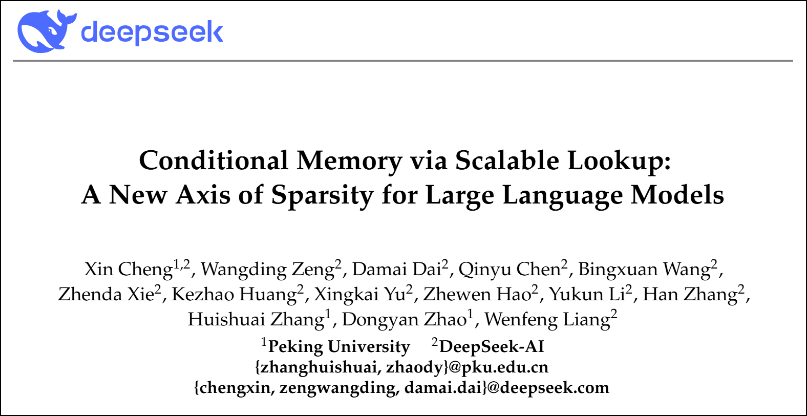
梁文锋署名DeepSeek最新论文,提出新方法突破GPU内存限制
Xin Lang Cai Jing· 2026-01-13 12:33
Core Viewpoint - DeepSeek, a Chinese AI startup, has developed a new model training technique that bypasses GPU memory limitations, enhancing cost efficiency and performance in AI model training [1][3]. Group 1: Technology and Innovation - DeepSeek and researchers from Peking University introduced a "conditional memory" technique called "Engram" to address the limitations of high bandwidth memory (HBM) in scaling AI models [3][4]. - The Engram technology allows for more efficient retrieval of foundational information by decoupling computation from storage, improving the model's performance in handling long contexts [4][6]. - In a model with 27 billion parameters, the new technique improved performance on key industry benchmarks by several percentage points, preserving capacity for complex reasoning tasks [4][6]. Group 2: Competitive Landscape - The HBM gap between China and the US is significant, with Chinese storage chip manufacturers lagging behind their US and South Korean counterparts [4]. - DeepSeek's previous model, DeepSeek-R1, was trained in two months at a cost of $5.5 million, significantly lower than the expenses incurred by US companies like OpenAI, while achieving comparable performance [6][7]. - Microsoft President Brad Smith highlighted that Chinese companies like DeepSeek are rapidly gaining ground in the global AI market, particularly in emerging markets, due to their low-cost open-source models [7]. Group 3: Future Developments - Anticipation is building for DeepSeek's upcoming V4 model, expected to launch in mid-February, which is said to possess strong programming capabilities [7].
王小川,计划再造一个IPO
Di Yi Cai Jing· 2026-01-13 12:31
Core Insights - Baichuan Intelligent aims for an IPO around 2027 and currently has nearly 3 billion yuan in funds available [4] Industry Trends - The AI healthcare sector is experiencing rapid growth, with major players entering the market, including OpenAI and Anthropic [2] - The competition in AI healthcare is intensifying, with significant investments and talent acquisition from companies like Ant Group [2] Company Strategy - Baichuan Intelligent is focusing on the medical sector, particularly pediatrics and oncology, and has established partnerships with Beijing Children's Hospital and the Cancer Hospital of the Chinese Academy of Medical Sciences [3] - The company plans to release two consumer-oriented medical products in the first half of the year, initially offering them for free to build trust and reputation before introducing paid features [3] Product Development - Baichuan Intelligent has launched a new open-source medical language model, Baichuan-M3, which has shown promising results in medical AI evaluations and possesses advanced questioning capabilities [2] - The model aims to enhance medical decision-making by providing patients with comprehensive information and risk assessments, thereby improving healthcare efficiency [3]
梁文锋署名DeepSeek新论文,“突破GPU内存限制”
Guan Cha Zhe Wang· 2026-01-13 12:28
Core Insights - DeepSeek, a Chinese AI startup, has published a technical paper introducing a new model training technique that bypasses GPU memory limitations, highlighting its focus on cost efficiency despite existing gaps with leading US firms [1][2] - The new technique, termed "Engram," addresses the bottleneck of limited high-bandwidth memory (HBM) in scaling AI models, which is a significant gap between China and the US in AI hardware [3][4] - The paper has garnered attention from industry professionals in both China and the US, indicating DeepSeek's role as a leader in AI innovation over the past year [1][2] Technical Developments - The paper titled "Conditional Memory via Scalable Lookup: A New Axis of Sparsity for Large Language Models" presents the "conditional memory" technology aimed at improving the efficiency of AI models when processing long contexts, a major challenge for AI chatbots [2][3] - The Engram technique allows for the decoupling of computation and storage, enhancing the model's ability to retrieve foundational information more efficiently [3][4] - Validation of this technology was conducted on a model with 27 billion parameters, showing performance improvements in key industry benchmarks [3] Market Position and Competition - DeepSeek's previous model, DeepSeek-R1, was trained in two months at a cost of $5.5 million, significantly lower than competitors like OpenAI, while achieving comparable performance [6][7] - Microsoft President Brad Smith has noted that US AI companies are being surpassed by Chinese competitors like DeepSeek, particularly in emerging markets due to the low-cost and user-friendly nature of Chinese open-source models [7] - Anticipation is building for DeepSeek's upcoming V4 model, expected to launch in mid-February, which is said to possess strong programming capabilities [8]

复盘特斯拉FSD进化史:把端到端推向无人驾驶终局
3 6 Ke· 2026-01-13 12:14
Core Insights - Tesla's FSD V14 has demonstrated significant advancements in autonomous driving capabilities, completing a cross-country journey of 2732 miles (approximately 4400 kilometers) with zero human intervention [2][7][35] - The evolution of Tesla's FSD system from V12 to V14 showcases a shift from rule-based to data-driven approaches, enhancing the system's ability to learn and adapt to complex driving scenarios [19][45][86] Group 1: Tesla's FSD Development - Tesla's FSD V14 completed a cross-country trip, showcasing its advanced autonomous driving capabilities with zero human intervention [2][7] - The previous similar test by Delphi in 2015 took 9 days with significant human intervention, highlighting Tesla's technological advancements [5][6] - FSD V14 is seen as a potential benchmark in the industry, with Nvidia's Jim Fan suggesting it may have passed a "physical Turing test" [8][9] Group 2: Technical Evolution of FSD - The transition from FSD V12 to V14 represents a significant leap in capabilities, with V12 focusing on end-to-end learning and V13 enhancing contextual understanding [18][24][35] - FSD V13 introduced a new hardware platform (HW4) with a fivefold increase in AI computing power, enabling more complex decision-making [31][32] - FSD V14 further enhances the system's capabilities, allowing it to operate in L4 conditions and paving the way for the commercial rollout of Robotaxi services [35][40] Group 3: Competitive Landscape - Domestic competitors are narrowing the gap with Tesla, with some claiming the distance has reduced from three years to one year in terms of technology [12][13] - The competitive focus is shifting from generational differences to engineering efficiency, as companies seek to optimize their models and data within limited resources [86] - Tesla's unique approach, integrating autonomous driving with robotics and leveraging extensive data and computing resources, sets it apart from domestic players [67][70][76]


龙虎榜复盘丨AI医疗集体大涨,顶级游资锁仓“地天板”航天龙头股
Xuan Gu Bao· 2026-01-13 10:49
Group 1 - The core point of the news is that institutional investors are actively trading stocks, with a total of 67 stocks listed on the institutional leaderboard, where 47 stocks saw net buying and 20 stocks experienced net selling [1] - The top three stocks with the highest net buying by institutions are China Satellite (¥679 million), Yonyou Network (¥655 million), and Hengwei Technology (¥404 million) [1] - Yonyou Network's stock increased by 7.87%, and the company has invested over ¥10 billion in product upgrades over the past two years [2][3] Group 2 - AI for Science (AI4S) is identified as one of the three core directions of artificial intelligence, alongside large language models and embodied intelligence, focusing on accelerating scientific research through AI [3] - The AI4S sector is expected to see significant growth, particularly in pharmaceutical research, materials science, and energy chemistry, with 2026 projected as a potential breakthrough year for AI4S technology [3] - The demand for AI applications in healthcare is highlighted, with recent developments indicating a real need for AI in medical applications, as evidenced by the launch of "Ant Financial's AI" and the progress of companies like Zhizhu and miniMax [3]



对话千寻智能韩峰涛:真正的机器人是生产力,不是展品和玩具
雷峰网· 2026-01-13 10:20
Core Viewpoint - The article discusses the launch of Spirit v1.5, which has become the world's strongest open-source embodied model, surpassing the previous benchmark Pi0.5, indicating a significant advancement in embodied intelligence technology [3][6]. Group 1: Development of Embodied Intelligence - The launch of Spirit v1.5 marks a pivotal moment in embodied intelligence, showcasing a task success rate of over 50% in real-world scenarios, compared to Pi0.5's 42.67% [6]. - The founder of the company believes that 2026 will be a competitive year for embodied intelligence, similar to the rapid advancements seen in large language models in 2023 [6][9]. - The company plans to expand its data collection team to nearly 1,000 people to enhance data quality and quantity, which are crucial for model performance [6][36]. Group 2: Historical Context and Market Position - The Chinese industrial robot market has seen a significant rise, with domestic robots' market share increasing from 3% in 2015 to over 50% by 2024 [8][12]. - The founder emphasizes that the current era of embodied intelligence is driven by revolutionary changes in AI technology, which allows robots to perform meaningful tasks [9][20]. - The company aims to differentiate itself by focusing on AI as the core of its operations, rather than merely hardware production [18][24]. Group 3: Data Collection and Model Training - The company is developing its own data collection systems to gather sufficient data for training models, aiming for a target of 1 million hours of data to achieve better model performance [36][40]. - The founder highlights the importance of collecting real-world data through their robots, as opposed to relying on third-party data, which may not be effective for training [37][38]. - The company believes that achieving a model capable of L2 tasks, such as folding clothes, is essential for commercial viability and will enable the data flywheel to turn effectively [32][40]. Group 4: Future Outlook and Market Potential - The company anticipates that the market for capable robots will grow significantly, with potential sales volumes reaching levels comparable to automobiles and smartphones [28][29]. - The founder predicts that 2026 will be a critical year for embodied intelligence, akin to the pivotal moments seen in the development of large language models, leading to increased investment and interest in the sector [44].